
Lecture
Forensic toxicology is an interdisciplinary field that combines the principles of toxicology with expertise in disciplines such as analytical chemistry, pharmacology, and clinical chemistry, to assist in the medical or legal investigation of death, poisoning, and drug use. [ 1 ] The primary concern of forensic toxicology is not the legal justification of the toxicological investigation or the methodologies used, but the acquisition and accurate interpretation of the results. Toxicological analysis can cover a wide range of specimens. In the course of an investigation, a forensic toxicologist must take into account the context of the investigation, in particular any recorded physical symptoms and any evidence collected at the crime scene that could narrow the search, such as pill bottles, powders, traces of substances, and any available chemicals. Armed with this contextual information and specimens for testing, the forensic toxicologist must identify the specific toxic substances present [ 2 ], quantify their concentration, and assess their probable effect on the victim. [ 3 ]
In the United States, forensic toxicology comprises three distinct disciplines: postmortem toxicology, human performance toxicology, and forensic drug testing (FDT). [ 4 ] Postmortem toxicology involves the analysis of biological specimens obtained during autopsy to detect exposure to drugs, alcohol, and poisons. A wide range of biological specimens may be analyzed, including blood, urine, gastric contents, oral fluid, hair, and tissue. Forensic toxicologists collaborate with pathologists, medical examiners, and coroners to establish the cause and circumstances of death. Human performance toxicology studies the dose-effect relationship between drugs present in the body and their effects. This field plays a key role in shaping and enforcing laws concerning acts such as driving while intoxicated or under the influence of drugs. Finally, forensic drug testing (FDT) refers to the detection of drug use in contexts such as the workplace, sports doping, drug-related probation, and screening of new job candidates. [ 3 ]
Identifying an ingested substance is often a complex task because of the body's natural processes (as described under ADME). Rarely does a chemical substance persist in its original form after entering the body. For example, heroin is rapidly metabolized, ultimately being converted into morphine. Consequently, careful examination of factors such as injection marks and chemical purity becomes necessary for an accurate diagnosis. [ 5 ] In addition, a substance may become diluted as it spreads through the body. Unlike a regulated drug dose, which may contain grams or milligrams of the active component, the specimen under investigation may consist of only micrograms or nanograms.
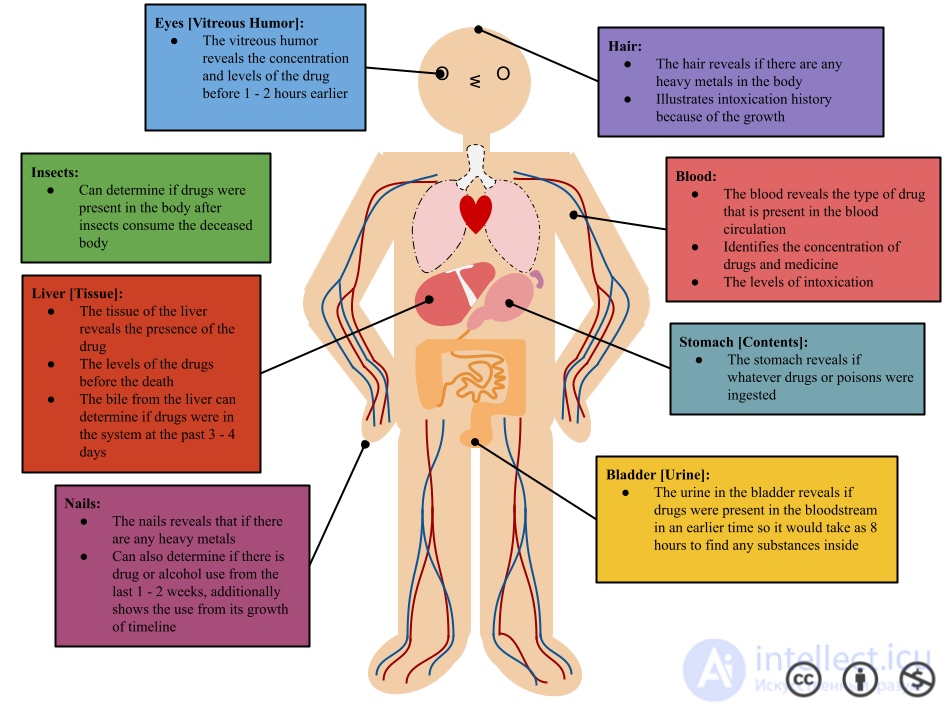
Location of the drug in the body
Alcohol enters the central nervous system after being absorbed into the bloodstream through the mucous membrane of the stomach and small intestine. It then crosses the blood–brain barrier via the circulatory system. Absorbed alcohol can weaken reflexes, disrupt nerve impulses, prolong muscular reactions and affect various other physiological functions throughout the body. [ 6 ]
Like alcohol, marijuana is absorbed into the bloodstream and crosses the blood–brain barrier. Notably, THC released from marijuana binds to CB-1 cannabinoid receptors, producing a range of effects. These effects include mood changes, altered perception of time and heightened sensitivity, among others. [ 7 ]
Cocaine, unlike marijuana or alcohol, is a powerful stimulant. Once in the bloodstream, it reaches the brain within minutes, causing a substantial spike in dopamine levels. The effects of cocaine are intense but short-lived, usually lasting about 30 minutes. The main route of use is nasal insufflation (snorting), although it can also be smoked in crystal form. The rapid rise in dopamine during use leads to a pronounced and hard-to-manage crash, often prompting people to seek higher doses on subsequent use to achieve the same effect as before. Such a pattern of behaviour can contribute to the development of dependence. The effects of cocaine use include increased energy and euphoria, accompanied by potential negative consequences such as paranoia, rapid heartbeat and anxiety, among others. [ 8 ]
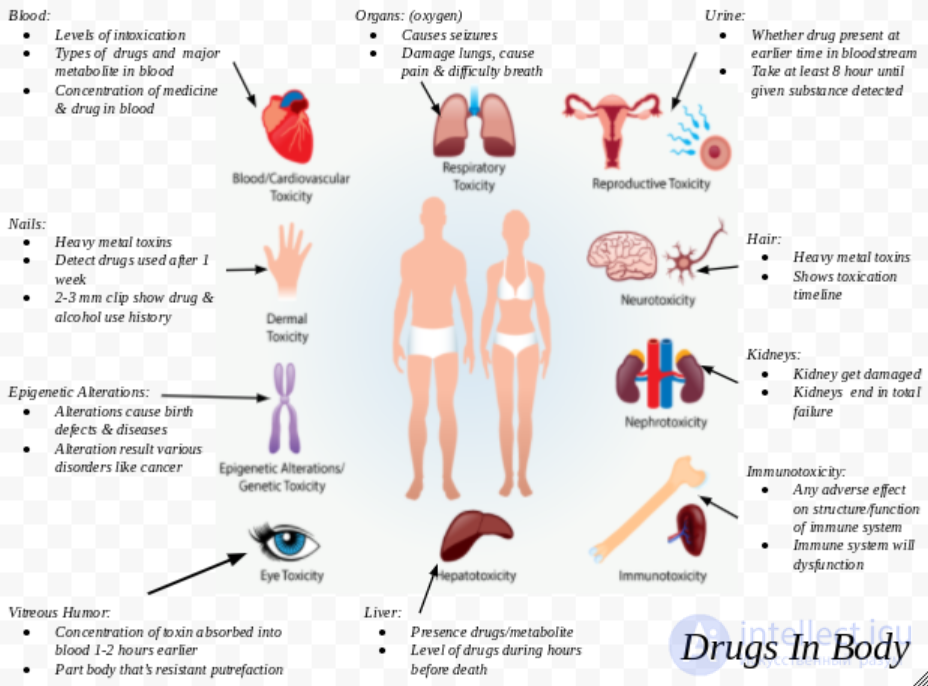
Drugs in the body
A urine sample , obtained from the bladder , can be collected either voluntarily or post-mortem. Notably, urine is less susceptible to viral infections such as HIV or hepatitis B compared with blood samples. [ 9 ] Many drugs show higher concentrations and longer detection windows in urine compared with blood. Urine collection is a non-invasive process that does not require professional assistance. Although urine is generally used for qualitative analysis, it does not provide an indication of impairment, since the presence of drugs in urine only indicates prior use. [ 10 ] The duration of drug detection in urine varies; for example, alcohol is detectable for 7–12 hours, cocaine metabolites for 2–4 days, and morphine for 48–74 hours. Marijuana, a substance with a variable detection window depending on the pattern of use, can be detected for 3 days after a single use, 5–7 days with moderate use (four times a week), 10–15 days with daily use, and up to 30 days with prolonged heavy use, depending on the frequency and intensity of consumption. [ 11 ]
A blood sample of approximately 10 mL (0.35 imperial fluid ounces; 0.34 US fluid ounces) is generally sufficient for screening and confirming most common toxic substances. A blood sample provides the toxicologist with a profile of the substance the subject was exposed to at the time the sample was taken; for this reason it is the preferred sample for measuring blood alcohol content in drunk-driving cases . [ 12 ]
Hair is able to record the use of psychoactive substances over a medium- to long-term or high-dose period. Chemicals from the bloodstream can be transferred into growing hair and accumulate in the follicle , providing an approximate timeline of drug intake events. Head hair grows at a rate of approximately 1–1.5 cm per month, so cross-sections of different segments of the follicle can give an estimate of when a substance was taken. Hair drug testing is not a standard procedure for the general population. The darker and coarser the hair, the more drug will be detected in it. If two people have used the same amount of a drug, the person with darker, coarser hair will show more drug in the hair than the person with lighter hair when tested. This raises questions about possible racial bias in substance testing using hair samples. [ 13 ] Hair samples are analysed using enzyme-linked immunosorbent assay (ELISA). In ELISA, the antigen must be immobilized on a solid surface and then bound to an antibody that is linked to an enzyme. [ 7 ]
Bone marrow can be used for analysis, but this depends on the quality and availability of bones. There is as yet no evidence that some bones are better than others for analysis. Extracting bone marrow from large bones is easier than from small ones. [ 14 ] Forensic toxicologists often use bone marrow to determine the type of poisons used, including cocaine or ethanol. [ 15 ] Ethanol, in particular, is one of the most widely abused drugs in the world, and its use and abuse of alcohol is one of the leading causes of death. Suicides, car accidents and various crimes are often committed under the strong influence of alcohol. The process of determining ethanol allows forensic toxicologists to use bone marrow after death and determine the level of ethanol the person had, as well as the metabolic rate, which can be used to trace the time of death. [ 16 ]
Other biological fluids and organs can serve as samples, especially samples collected during an autopsy . A common sample at autopsy is the stomach contents of the deceased, which can be useful for detecting undigested pills or liquids taken before death. In heavily decomposed bodies, traditional samples may be unavailable. The vitreous humor of the eye can be used, since the fibrous layer of the eyeball and the orbit of the skull protect the sample from injury and tampering. Other common organs used for toxicological studies are the brain, liver and spleen. [ 12 ]
Detection of drugs and pharmaceuticals in biological samples is usually carried out by initial screening followed by confirmation of the compound(s), which may include quantitation of the compound(s). Screening and confirmation are usually, but not necessarily, performed using different analytical methods. Every analytical method used in forensic toxicology must be thoroughly tested through method validation to ensure correct and undisputable results in all cases. The choice of testing method largely depends on which substance is expected to be detected and on what material the testing is being performed. [ 17 ] A classification scheme is commonly used that places poisons into categories such as: corrosive substances, gases and volatile substances, metallic poisons, non-volatile organic substances and others. [ 3 ]
Immunoassays require drawing blood and using antibodies to detect a reaction with substances such as drugs. The substances must be specific. This is the most common method of drug screening. Using a target drug, the test will show a positive or negative result for that drug. When the test is performed, 4 outcomes are possible: true positive, false negative, false positive and true negative. [ 14 ]
Gas chromatography–mass spectrometry ( GC-MS ) is a widely used analytical method for detecting volatile compounds. The ionization methods most commonly used in forensic toxicology include electron ionization (EI) or chemical ionization (CI), with EI preferred in forensic analysis because of its detailed mass spectra and extensive spectral library. However, chemical ionization can provide greater sensitivity for certain compounds with functional groups that have a high affinity for electrons. [ 18 ]
Liquid chromatography–mass spectrometry ( LC-MS ) allows the analysis of polar and less volatile compounds. These analytes do not require derivatization, as would be needed for GC-MS, which simplifies sample preparation. As an alternative to immunoassay, which usually requires confirmation by another method, LC-MS provides greater selectivity and sensitivity. This, in turn, reduces the likelihood of a false negative result, which has been recorded with immunoassay testing of synthetic cathinones and cannabinoids. [ 19 ] A drawback of LC-MS compared with other analytical methods such as GC-MS is the high cost of the equipment. However, recent advances in LC-MS have led to improved resolution and sensitivity, which helps in evaluating spectra for the identification of forensic analytes. [ 20 ]
Compounds suspected of containing a metal are traditionally analysed by destroying the organic matrix through chemical or thermal oxidation. This makes it possible to identify and quantify the metal in the inorganic residue, and it can be detected using methods such as the Reinsch test , emission spectroscopy or X-ray diffraction . Unfortunately, although this identifies the metals present, it destroys the original compound and therefore makes it difficult to determine what may have been ingested. The toxic effect of different metal compounds can vary considerably. [ 12 ]

Comments