
Lecture
Toxicology (from Greek toxicon – poison, logos – study) is the science of the potential danger of the harmful effects of substances on living organisms and ecosystems, and of the reaction of living beings to contact with chemical agents.
Toxicology is a fundamental science that addresses a wide range of tasks, drawing on the research methods of related and natural sciences such as biochemistry, physiology, immunology, genetics, general chemistry, organic chemistry, and so on.
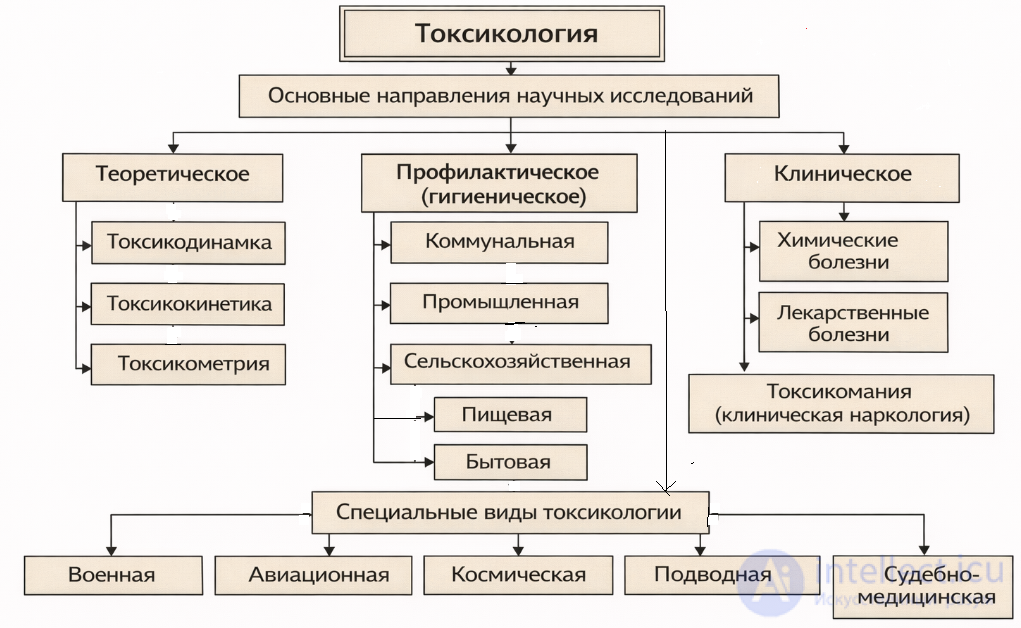
At present, toxicology has three main branches: experimental-theoretical, preventive and clinical.
The first branch studies the fundamental laws governing the interaction of a substance with biological objects. This includes such areas of research as toxicodynamics, toxicokinetics and toxicometry. These areas study the basic laws of the interaction between the organism and poisons, the routes of entry and the stages of transformation of poisons in the organism, and the routes of their excretion.
The second is concerned with preventing the potential danger of the harmful effects of substances on living organisms. It includes communal, food, industrial, agricultural and household branches. They address the problems of determining the degree of danger and ways of preventing and protecting against the toxic effects of chemicals in the human environment.
The third branch of toxicology investigates diseases arising from the effects of environmental chemicals on humans. Within this branch the following areas are distinguished: toxicology of acute chemical poisoning, toxicology of chronic chemical poisoning, addiction toxicology, drug toxicology, and the study of the effects of synthetic materials (implants). These areas study diseases of chemical etiology, that is, chemical diseases in humans arising as a result of the toxic influence of chemical compounds in their surrounding environment.
In addition to the three branches mentioned above, there is a special branch that includes the following areas: military toxicology, aerospace toxicology and forensic medical toxicology. These areas study poisonings of humans and animals under special conditions.
Recently, a new branch has emerged – ecological toxicology, which studies the effects of poisons on living objects, populations and ecosystems, as well as their interconnections.
The structure of modern toxicology is shown in Diagram 1.
Diagram 1.
Modern toxicology.
The concept of «poisoning» is inseparably linked with the notion of poison. Poisons are substances of plant, animal or mineral origin, or products of chemical synthesis, capable of causing acute or chronic poisoning when they affect a living organism.
In accordance with accepted terminology, poisoning refers to intoxications caused by “exogenous” poisons that have entered the body from outside; the classification of poisoning by cause of occurrence is divided into accidental and intentional.
More often, the toxic effect is produced by xenobiotic substances foreign to the living organism. Some substances, when present in a certain amount and state in the habitat or in the internal environment of the human or animal body, constitute an essential condition for their existence, for example trace elements (cadmium, mercury, cobalt, lithium, etc.)
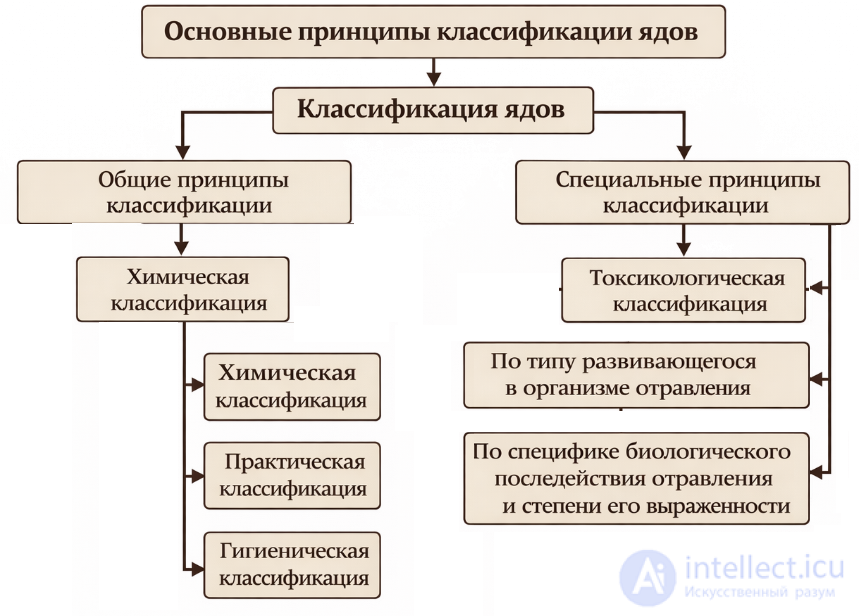
The basic principles of the classification of poisons are shown in Diagram 2.
Diagram 2.
The interaction of a poison with the organism is studied from two aspects: how the poison affects the organism, and what happens to the substance within the organism. The first question can be answered by studying the toxicodynamics of the substance, and the second by studying its toxicokinetics. This is precisely why the foundation of general toxicology is the study of the movement of toxic substances in the organism — the routes of entry, distribution, and metabolic transformation (biotransformation). The second task of toxicology is to determine the zone of toxic action of a chemical substance (toxicometry). The third task of general toxicology – is the study of the clinical and pathomorphological signs of poisoning via different routes of entry of the poison into the organism.
Poisons enter the organism by various routes (through the respiratory organs, the skin, or the digestive tract). Poison is a fairly relative concept. Paracelsus – a physician of the era
of the Renaissance (1493–1541) expressed the idea: Everything is poison, and nothing is devoid of toxicity. In other words, one and the same substance can be a poison, a medicine, and a substance necessary for life. This depends on its quality, quantity, and the conditions of its interaction with the organism.
The effect of substances on the organism depends on many conditions: the dose that has entered the organism, the time of exposure (duration), the content in the environment, the state of the organism itself, and environmental conditions.
The effect of the harmful influence of substances is determined not only by the properties of the substance itself, but also by the state of the biological objects. By the level of complexity of the organization of environmental elements, they are arranged in the following order:
Macromolecules organelles cells organs organisms populations ecosystems. Every biological object is in constant interaction with the environment and is characterized by relative constancy and stability of its basic physiological functions. The ability of a biological object to self-regulate when the environment changes is called homeostasis. A biological object is an open system, and homeostasis is in dynamic equilibrium with the environment. Therefore self-regulation represents a dynamic state
of an open system subject to a biological rhythm.
When harmful substances act on an object, a disruption of homeostasis occurs, the depth of which depends on the degree of exposure; however, with small exposures no disruption occurs. The nature of the response to environmental factors differs between humans and various animal species. There are substantial differences in metabolic processes, metabolism, and the detoxification of substances in the organism.
Two approaches are distinguished for determining the comparative sensitivity of humans and animals to chemical agents: choosing an adequate model for studying the action of a new chemical substance, and determining the quantitative relationships in the sensitivity of humans and animals to a given poison. Because there are no animals identical to humans in all physiological and biochemical parameters, in each case animals are selected taking into account the specific biological activity of the poison and the similarity of the biochemical reactions of animals and humans.
P. Ehrlich's idea about the existence of a high specificity of the primary reaction of interaction between a poison and a cell proved fruitful: the poison interferes with metabolic processes owing to its structural similarity to one or another metabolite, mediator, hormone, etc. It is precisely in these cases that one can speak of the interaction between the poison and the receptor as a relationship resembling «a key to a lock», according to Ehrlich. This idea gave impetus to the development of chemotherapy, based on the selection of drugs according to their «selective toxicity» for particular structures of the organism that differ in specific cytological and biochemical features.
For clinical toxicology, the reversibility of the bond between the poison and the receptor is of great importance. Most toxic substances bind to receptors weakly and can be «washed off».
It is believed that the covalent bonds of poisons (preparations of arsenic, mercury and antimony) with receptors are strong and poorly reversible.
Most toxic substances and medicinal agents currently known interact with the receptor through more labile, easily broken bonds – ionic, hydrogen, van der Waals – which makes it possible to successfully «wash them off» and remove them from the body. Table 1 reflects the characteristics of the various types of bonds between a poison and a receptor.
Table 1. Characteristics of the bond between a poison and a receptor
| Types of bonds | Properties of bonds | Examples | Note |
|---|---|---|---|
| Covalent | Strong and poorly reversible bonds | Preparations of arsenic, mercury and antimony; nitrogen mustards; organophosphate anticholinesterase agents | A decrease in the bond energy of the «poison – receptor» complex is directly proportional to the decrease in specific manifestations of the organism's response and makes it more reversible. |
| Ionic | More labile, easily broken bonds | Medicinal agents | Modern detoxification methods are based on the possibility of weakening the «poison – receptor» complex. For this purpose, substances are used that are able to displace the poison from weak bonds, mainly hydrogen and van der Waals bonds, with the active centers of individual organs of the body. |
| Hydrogen | More labile, easily broken bonds | Medicinal agents | Modern detoxification methods are based on the possibility of weakening the «poison – receptor» complex. For this purpose, substances are used that are able to displace the poison from weak bonds, mainly hydrogen and van der Waals bonds, with the active centers of individual organs of the body. |
| Van der Waals | More labile, easily broken bonds | Medicinal agents | Modern detoxification methods are based on the possibility of weakening the «poison – receptor» complex. For this purpose, substances are used that are able to displace the poison from weak bonds, mainly hydrogen and van der Waals bonds, with the active centers of individual organs of the body. |

Comments