
Lecture
Excessive consumption of sugar and sugar-containing products causes, besides obesity, systematic overexcitation of the insular apparatus of the pancreas
gland, may be a cause of its disorder, considerably increases the risk of developing diabetes, as well as of dental caries, hypertension, and atherosclerosis. Therefore, many countries around the world have organised the production and search for new sweeteners and sugar substitutes [2, 5].
Food products containing a sweetener must carry the corresponding information
on the label, and for aspartame – a special warning
notice. Baby food products must not contain sweeteners.
Synthetic sweeteners are represented by saccharin, aspartame, its analogues, cyclamates, acesulfame potassium, etc.
Saccharin (3.6) and its sodium, potassium or calcium salts (E954)
– benzoic acid sulfamide C7H5NSO3, is 300-500 times sweeter than sucrose.
Saccharin passes through the digestive tract relatively quickly, and 98% of it
is excreted in the urine. A large amount of saccharin in the diet has caused
the development of urinary bladder tumours in 60% of rats. It has now been established that daily consumption of saccharin over a long period is dangerous. According to the World Health Organization, no more than 5 mg/kg of saccharin may be used, and in dietary products – up to 25 mg/kg. In
Ukraine, the use of saccharin (E954) is authorised.
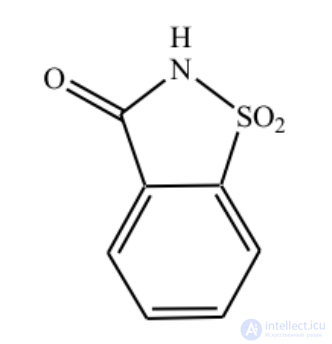
Saccharin (3.6)
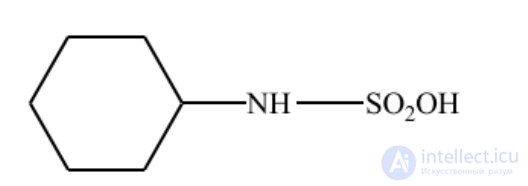
cyclamate (3.7)
The use of the artificial sweetener cyclamate (3.7) and its
sodium, potassium or calcium salts (E952) is restricted in Ukraine – they
are permitted only as sweeteners in combination with saccharin. In the countries
of the European Community it is used to a limited extent in flavoured low-calorie soft drinks.
drinks, desserts. In the USA, cyclamate and its derivatives are not permitted for consumption.
No harmful effect of cyclamates on the liver, kidneys.
or other human organs has been found. The metabolic products of cyclamates are removed from the body fairly
quickly. At the same time, from 0.1 to 0.9% of cyclamate is metabolised to cyclohexylamine, which has high toxicity, and to the carcinogenic dicyclohexylamine. It has been shown that cyclamates in large doses cause bladder cancer in test animals. The widespread use of cyclamates in food products requires further study of their biological activity.
The sweetener aspartame (E951) (3.8) is suitable for use in
food products whose preparation does not require heat treatment, for example ice cream and creams. It loses its sweet taste when held at
150°C for 45 minutes. For this reason aspartame is poorly suited for use in food products that are manufactured at high temperatures and then stored for a long time (sterilised compotes, beer).
In the body aspartame breaks down into the L-amino acid (phenylalanine) and methanol, which are fully metabolised. As a side reaction, diketopiperazine may be formed, with its own ADI. The content
of phenylalanine may be harmful to patients with phenylketonuria (phenylketonuria – a very rare (1:15000) genetic defect requiring a special diet). Subject to these conditions, all clinical studies conducted in
France and the USA on children and adults have shown no undesirable
side effects.
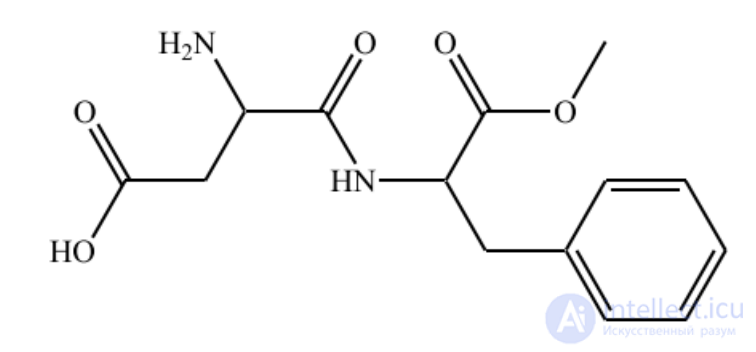
aspartame (E951) (3.8)
In Ukraine the ADI of aspartame is up to 40 mg/kg, and its MPL in food products (desserts based on fermented milk with added fruit fillers, yoghurts with added fruit fillers, kefir with
added fruit fillers, curd cheeses with added fruit fillers) – 1000 mg/kg. The labelling of food products manufactured with
the use of aspartame (E951), or the joint use of aspartame
(E951) and acesulfame-K (E950), must necessarily contain the following warning: "Aspartame is a source of phenylalanine. The product is not recommended for patients with phenylketonuria and children under seven years of age" (Resolution of the Ministry of Health
of Ukraine and the Chief Sanitary Physician of Ukraine No. 42 of 28.12.2002).
Acesulfame potassium (acesulfame-K (E950)) (3.9) is a stable sweetener both in dry form and in aqueous solutions over the pH range
3-7. Its flavour profile is similar to the flavour profile of sugar.
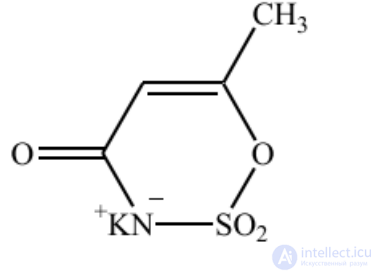
Acesulfame potassium (acesulfame-K (E950)) (3.9)
It is predominantly used for the preparation of beverages, dairy products, and confectionery.
Since acesulfame potassium dissolves quickly in water, it is well
suited for instant beverages and table sweeteners. It is usually used as part of blended sweeteners together with aspartame. In this case not only quantitative but also qualitative synergism is manifested. Each substance separately is about 200 times
sweeter than sugar, while in the mixture – 300 times. The sweetness of acesulfame potassium is felt
instantly but does not last very long, whereas the sweetness of aspartame, by contrast, is not felt
right away but persists for a long period of time.
Pharmacokinetic studies conducted on humans have shown that
orally administered doses of acesulfame potassium were fully absorbed and
rapidly excreted unchanged in the urine.
The ADI of acesulfame potassium is up to 15 mg/kg, and its MPL in food products (desserts based on fermented milk
with added fruit fillers, yoghurts with added fruit fillers, kefir with
added fruit fillers, curd cheeses with added fruit fillers) is 350 mg/kg. When sweeteners are used together, the MPL of aspartame (E951) will be 500 mg/kg, and of acesulfame-K
(E950) – 175 mg/kg (Resolution of the Ministry of Health of Ukraine and the Chief Sanitary
Physician of Ukraine No. 42 of 28.12.2002).
The following have not received absolute authorisation status: sucralose (E955),
thaumatin (E957), glycyrrhizin (E958), neohesperidin dihydrochalcone (E959)
and some other sweeteners.
Among monosaccharides, an important place is occupied by fructose, which is absorbed
slowly in the body (2.3 times more slowly than glucose) and has little effect on the blood sugar level. Its metabolism takes place without the participation of insulin,
which opens up possibilities for using fructose in the diet of patients with
diabetes mellitus. Fructose has a limited cariogenic effect compared with sucrose and glucose. It can enhance the taste and aroma of products.
and forms aromatic and coloured compounds.
Xylitol (E967) – a five-carbon alcohol C5H12O5 – is found in some
fruits and vegetables. Xylitol has a pleasant sweet taste and in sweetness
is close to sucrose. The utilisation of xylitol does not depend on insulin. Xylitol
has an anti-ketogenic action, caused by its conversion into glycogen, and
is able to reduce the accumulation of acetyl coenzyme A in the liver, which is a source of formation of ketone bodies. Xylitol has been shown to have an anti-caries action.
Its consumption in large doses can cause diarrhoea. Ukraine authorises the use of xylitol (E967).
In addition, Ukraine authorises the use of sorbitol and sorbitol
syrup (E420), mannitol (E421), isomaltitol (E953), maltitol and maltitol syrup (E965), otizon and sakharol.

Comments