
Lecture
Detoxification – is the process of neutralizing poisons and accelerating their elimination from the body. Various methods of detoxification promote the release of the stomach and intestines from poison that has not yet been absorbed into the blood, as well as the release of
blood and body tissues from toxic substances and their metabolites
Release of the body from poisons occurs as a result of enhancing certain natural physiological processes (inducing vomiting, gastric lavage, bowel cleansing, forced diuresis, hyperventilation), artificial detoxification (hemodialysis, peritoneal dialysis, hemosorption, exchange
blood transfusion, etc.) or by the method of antidote therapy.
Release of the body from poisons by these methods is carried out
by medical specialists. However, toxicological chemists must know the principles of the measures and procedures aimed at eliminating poisons and their
metabolites from the body, since they conduct the examination of vomit, urine,
dialysates, and other fluids obtained during the process of detoxification.
Detoxification of the body with the help of antidotes.
Detoxification of the body with the help of antidotes was originally carried out mainly to neutralize toxic substances located in the
stomach.
Later, antidotes came to be used also for inactivating toxic substances in the blood, parenchymal organs, and so on.
The use of antidotes – is an effective method of detoxification only at
the early stage of acute poisoning. The duration of this stage depends on the properties of the toxic substance. In poisoning with heavy metal compounds, antidotes can also be used at later stages of intoxication. They gradually bind the cations of heavy metals that have previously entered the body
and formed complexes with the sulfhydryl groups of enzymes and other
protein substances.
Some antidotes are specific with respect to a particular poison. Therefore, for their
rational use it is necessary to know which substance caused the
poisoning. With an incorrect choice of antidote and its introduction into the body
in a large dose, poisoning by the antidote itself may occur. Therefore, data
from clinical-laboratory (including chemical-toxicological) investigation of the poisons contained in the body are of great importance for the correct
choice and use of the corresponding antidote
Activated charcoal is often used as an antidote, its action being based on the adsorption of poisons in the stomach. Owing to the large specific surface area of activated charcoal particles, it adsorbs poisonous substances located in the stomach, thereby preventing their absorption into the blood.
A large group of antidotes is made up of chemical substances
that interact with poisons. As a result, the poisons are inactivated,
converted into harmless substances, and eliminated from the body via
the urine and feces. Antidotes can also be mixtures of several substances, which
are introduced into the body in a certain sequence or simultaneously.
Antidotes belonging to the group of mercaptan compounds (unithiol, dimercaptosuccinic acid, penicillamine, and others) deserve attention.
One of the frequently used mercaptan compounds
as an antidote is unithiol (sodium 2,3-dimercaptopropanesulfonate). Its molecule
 (1.1)
(1.1)
contains two sulfhydryl groups capable of interacting with metal ions.
In the compounds formed, the bonds of metal ions with unithiol are very strong.
Penicillamine (dimethylcysteine) also belongs to the group of antidotes
containing a sulfhydryl group. In addition, the penicillamine molecule
contains a nitrogen atom and a carboxyl group. Owing to this, it readily
forms strong compounds with the atoms of many metals of toxicological significance. Penicillamine is used as an antidote for poisoning
with compounds of lead and mercury.
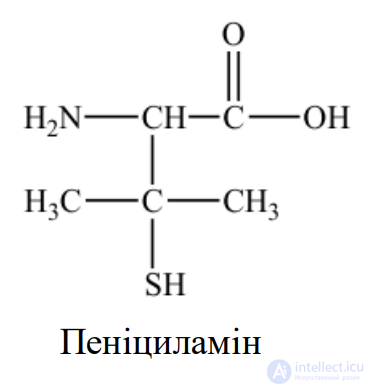 (1.2)
(1.2)
Penicillamine
Cysteine – is a sulfur-containing amino acid that is an effective antidote
for poisoning with monosubstituted halogen derivatives of aliphatic hydrocarbons (methyl bromide, methyl iodide, ethyl chloride, and the like).
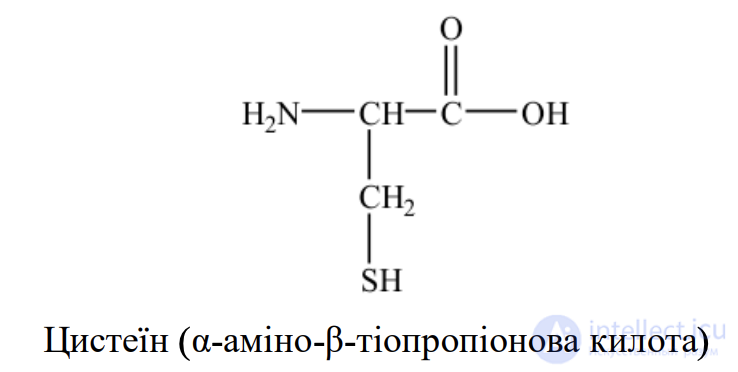 (1.3)
(1.3)
Cysteine (α-amino-β-thiopropionic acid)
These halogen derivatives form conjugates with cysteine, as part of which
they are eliminated from the body in the urine. As the number of halogen
atoms in the molecules of halogen-derivative hydrocarbons increases, the effectiveness of cysteine's action as an antidote decreases.
An effective antidote for poisoning with dihalogen derivatives of aliphatic hydrocarbons is acetylcysteine.
Antidotes can also be certain substances that form
inner-complex compounds (chelates). For such antidotes to be able to penetrate into cells and rapidly remove poisonous metals from the body, they must contain in their composition a certain number of hydrogen atoms capable
of being replaced by ions of poisonous metals or of forming hydrogen bonds.
Such hydrogen atoms must be contained in certain functional groups.
(–OH, –COOH, –SH, – NH2) of chelate-forming antidotes. In this case, after
the binding of toxic ions, the molecules of such antidotes must retain
at least one hydrogen atom.

Comments