
Lecture
In the second phase of metabolism, conjugation of metabolites with certain substances present in the body occurs. Conjugation reactions are biosynthesis reactions. As a result of conjugation reactions, the body forms
conjugates that are more polar, better soluble in water, and less toxic than the foreign compounds. Therefore, as a result of conjugation processes, the toxicity of foreign compounds (drugs and poisons) decreases and the rate of their elimination from the body increases. Consequently, conjugation reactions are detoxication reactions.
The activity of some enzymes depends not only on their composition and
structure. There are enzymes whose activity depends on the presence of certain
groups (or molecules) of a non-protein nature, called cofactors. In
As cofactors, complex organic substances called coenzymes, or metal ions, can act.
Coenzymes are low-molecular-weight organic compounds (predominantly
derivatives of vitamins) that determine the activity of enzymes.
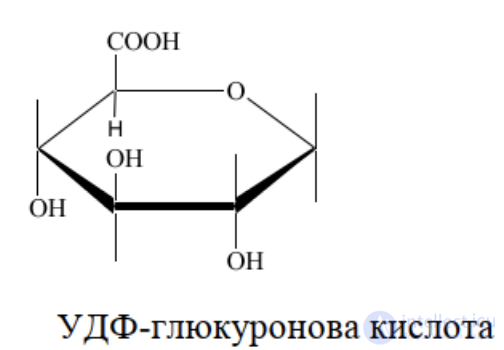
During conjugation, the coenzymes (carriers of groups of atoms) can
be UDP-glucuronic acid (uridine diphosphate glucuronic acid),
S-adenosylmethionine, acetyl-CoA (CoA-pantothenate adenine nucleotide diphosphate), and others.
 1 13
1 13
Glucuronic acid
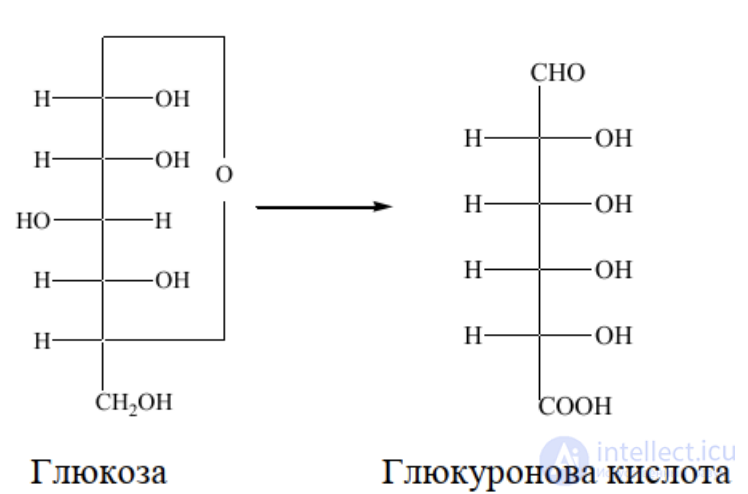
C6H10O7 belongs to the uronic acids (oxidation products of aldoses). During
the formation of uronic acids, the primary alcohol group of aldoses is oxidized
to a carboxyl group, while the aldehyde group remains unchanged.
The formation of glucuronic acid from glucose proceeds according to the scheme:
 1 14
1 14
Uronic acids (glucuronic, mannuronic, galacturonic) are components of many polysaccharides, oligosaccharides, etc. In the body, free
glucuronic acid is formed during the enzymatic hydrolysis
of UDP-glucuronic acid, certain glucoproteins, and other substances.
Glucuronic acid forms conjugates with alcohols, phenols, carboxylic
acids, thiols, and amines. The products of the interaction of glucuronic
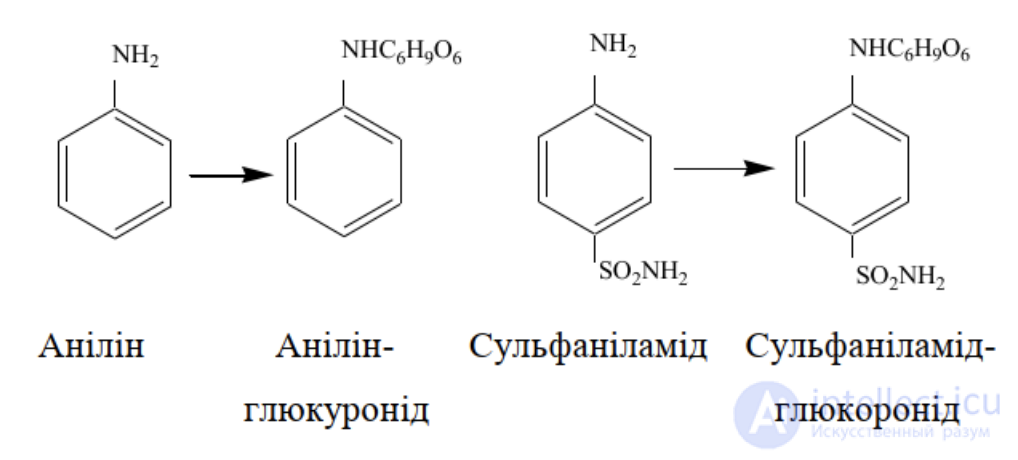
acid with the named substances are called glucuronides. Glucuronides are formed mainly in the liver, as well as in the kidneys, skin, esophagus, etc. Glucuronic acid, with certain nitrogen-containing compounds
(amines, amides, carbamic acid derivatives, nitrogen-containing heterocycles, etc.), forms N-glucuronides. The formation of glucuronides
can be represented by the following scheme:
 1 15
1 15
Thiophenols and other organic compounds whose molecules contain a sulfur
atom form 3-glucuronides with glucuronic acid.
Glucuronides, under the influence of the enzyme β-glucuronidase, can be hydrolyzed to form glucuronic acid and the corresponding substance that had
previously entered into the conjugation reaction with this acid.
In the body, amines,
phenols, and thiols can undergo methylation. As a result of methylation, the corresponding N-, O-, and
S-methyl conjugates are formed. During the methylation of foreign compounds and certain
metabolites, the carrier of methyl groups is the coenzyme S-adenosylmethionine. With the participation of the methyl groups of this coenzyme, methylation of the above-listed compounds occurs. Methylation reactions occur
under the influence of enzyme systems (methyltransferases).
During N-methylation, the methyl group of S-
adenosylmethionine, under the influence of N-methyltransferase, is attached to
the nitrogen atoms of metabolites or foreign compounds.
This type of conjugation is undergone by compounds that
contain phenolic groups. Under the influence of enzymes (O-methyltransferases), the methyl group of the coenzyme S-adenosylmethionine is attached to the oxygen atoms of phenolic hydroxyls. For the methylation reaction of phenols, besides the coenzyme, the presence of magnesium ions or other divalent metals is required.
Compounds containing a single phenolic group are not methylated under the influence of the
enzymes indicated.
Some foreign compounds containing thiol groups (–
SH) can be methylated in the body. In this case, the methyl group of the coenzyme S-adenosylmethionine, in the presence of enzymes (methyltransferases), is transferred to the sulfur atoms of metabolites or foreign compounds to form
the corresponding S-methyl derivatives of these compounds.
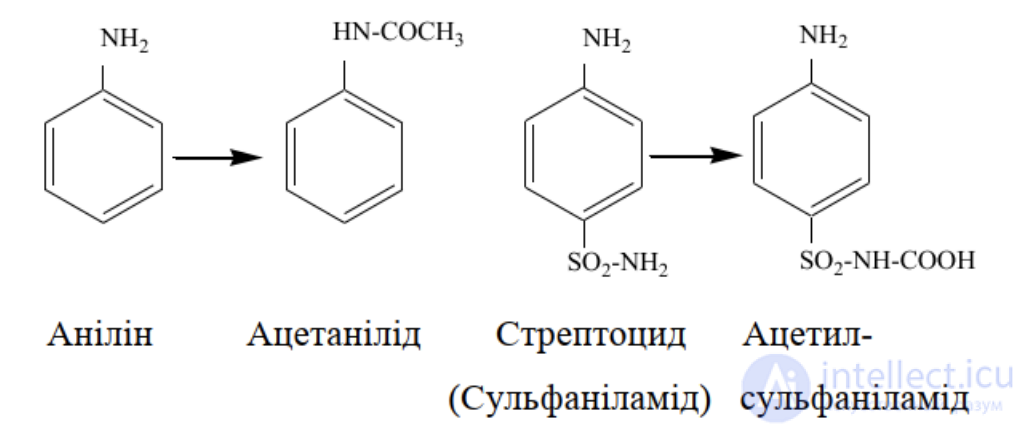
The process of acetylation is the main method of metabolism of aromatic amines, sulfonamides, and certain foreign amino acids. During acetylation, an acetyl group is attached to
the molecules of foreign compounds or metabolites.
The products of acetylation of aniline and streptocide are shown in schemes
(1.16):
 1 16
1 16
Aromatic carboxylic acids, benzoic acid derivatives, and heterocyclic carboxylic acids form conjugates with glycine
(glycol) H2N-CH2-COOH and other amino acids.
Glycine conjugates of benzoic, salicylic, nicotinic, and other acids
are called hippuric acids. Below is the product of conjugation of benzoic acid with glycine:
Aliphatic carboxylic acids do not form conjugates with glycine.
The conjugating agent is sometimes cysteine, which is an α-amino acid.
Glutathione – a complex natural tripeptide (glutaminyl-cysteinyl-glycine) – forms conjugates with benzene, naphthalene, and
anthracene (mercapturic acids). The formation of conjugates with
glutathione is catalyzed by the enzyme glutathione S-aryltransferase.
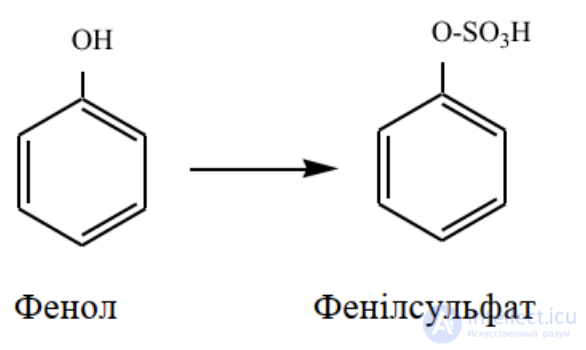
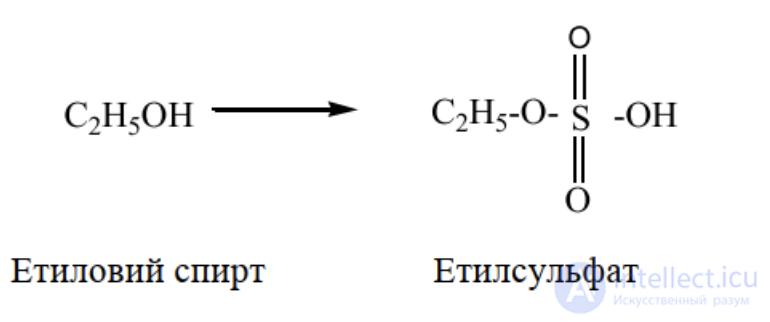
Phenols and alcohols are conjugated in the body with sulfates. In this process, conjugates that are esters are formed.
of these substances. In the body, the source of sulfates entering into conjugation
reactions is 3-phosphoadenosine-5-phosphosulfate. The reaction forming
conjugates of alcohols and phenols is catalyzed by the enzyme sulfotransferase.
Conjugates of phenols with sulfates are esters – aryl sulfates:
 1 18
1 18
During the conjugation of primary aliphatic alcohols with sulfates, esters – alkyl sulfates are formed:
 1 18
1 18
Some foreign compounds and metabolites have two or more functional groups by means of which they can enter into conjugation reactions. Most such compounds enter into
conjugation reactions through one functional group. However, some foreign compounds and metabolites form double conjugates through the attachment to their molecules of two different compounds or groups of atoms. Indeed, foreign compounds are known that simultaneously form conjugates with glucuronic acid and glutathione, or with glucuronic acid and sulfates.

Comments