
Lecture
Preservatives are substances that increase the shelf life of food products by protecting them from microbiological spoilage [2, 5].
It is not permitted to introduce chemical preservatives into products of mass
consumption: flour, bread, milk, fresh meat, specialised dietary
products and baby food products, as well as items labelled as «natural». For preserving products, combinations of no more than two chemical preservatives may be used. In this case, the total concentration in the product must not exceed the maximum permissible concentration of the preservative for which it is lower [2, 5].
Preservatives that damage the cells of microorganisms reversibly
are called bacteriostatic, and those that do so irreversibly are called bactericidal. The rate of bactericidal action increases with increasing concentration of the preservative and temperature.
The action of chemical compounds, in turn, affects the metabolism in
the microorganism cell, regulated by the action of enzymes. Chemical substances, depending on their reactivity, can damage cellular
enzymes through interaction with their functional groups. In this case, the destruction or blocking of the corresponding group interacting with the substrate or
coenzyme stops or slows the catalytic reaction.
Most preservatives have a specific action against different
types of microorganisms. At the same time, spoilage of food products is caused by many types of microorganisms. Therefore, the creation and use of
a combined mixture of preservatives has certain advantages. The additive action of two
substances is possible because one of them, acting on the cell membrane, facilitates the penetration into the cell of the other. In another variant, one of the
preservatives lowers the pH, and then the effectiveness of the action of the second is increased.
Formaldehyde (formic aldehyde, E240) is a highly soluble gas with a sharp odour, strongly irritating the mucous membranes of the respiratory
tract. The content of formaldehyde in formalin (aqueous solution) is 35-40%. Formaldehyde is known as a slow-acting disinfectant. It is capable of
reacting with the amino groups of proteins. In Ukraine the use of formaldehyde (E240) is prohibited, although in the countries of Europe it is permitted.
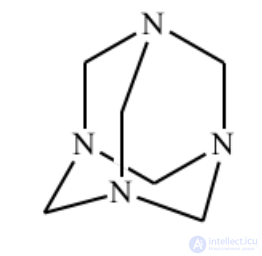
Urotropin (hexamethylenetetramine, E239) (3.10)
Urotropin (hexamethylenetetramine, E239) (3.10) – white crystals without odour. It has been permitted in Ukraine since 04.01.1999. Hexamethylenetetramine
is formed by the action of formalin on ammonia. This preparation is used
for preserving caviar, fish and crustacean preserves, and sometimes in the
production of cheeses to regulate fermentation processes.
Subcutaneous administration of a 35-40% solution of hexamethylenetetramine causes neoplasms in rats. In experiments on insects a
mutagenic effect was found. According to WHO data, the acceptable daily intake of hexamethylenetetramine should not exceed 0.15 mg/kg of body weight when used
for preserving sausage casings and cold marinades for fish
products. Hexamethylenetetramine is used in a number of countries for a limited list of food products. In Ukraine the use of urotropin (E239) is permitted.
The following preservatives have not received approval status in Ukraine: dimethyl dicarbonate (E242), derivatives of para-hydroxybenzoic acid (E214-219),
ammonium acetate (E264), dehydroacetic acid (E265), sodium dehydroacetate
(E266), propionic acid (E280), propionates (E281-283).
Dimethyl dicarbonate (E242) – an antimicrobial preparation used for fruit juices, soft drinks and wines. In aqueous
solutions it is not stable and immediately decomposes into methanol and carbon dioxide. A small amount of methyl carbonate is also formed. The use of dimethyl dicarbonate is permitted in Russia and Germany.
Ammonium acetate (E264), or acetic ammonium, is not permitted
for use in all countries of Europe and Russia. Dehydroacetic acid (E265)
and sodium dehydroacetate (E266) are permitted as a preservative only in Russia.
Propionic acid (E280) is an intermediate link of the Krebs cycle and
is metabolised to pyruvic acid. Sodium, potassium and calcium propionates
(E281-E283) occur in fermentation products and are considered to be of low toxicity. When 6 g of sodium propionate is consumed per day, an
alkaline reaction in the urine is observed in men. In rats, sodium propionate increased blood sugar content. In Ukraine these preservatives have not received absolute approval status.
A significant number of preservatives may be used in Ukraine for certain types of food products. A wide range of application is characteristic of sorbic acid (E200) (Table 3.2).
Sorbic acid suppresses the growth and development of mould fungi,
yeasts and, to a lesser extent, it is active against bacteria. Sorbic acid has the greatest activity at pH 4.5. The combined use of the acid and
sodium chloride enhances the fungistatic action of sorbic acid. It
does not change the organoleptic properties of food products.
The antimicrobial action of sorbic acid is multifaceted:
1) it suppresses various enzymes in the cells of microorganisms. Among these,
particularly important are the enzymes of carbohydrate metabolism – enolase and lactate dehydrogenase;
2) sorbic acid, comparatively deeply, though not very specifically,
interferes with the citric acid cycle and suppresses, among others, the enzymes
malate dehydrogenase, isocitrate dehydrogenase, α-ketoglutarate dehydrogenase,
succinate dehydrogenase, fumarase and aspartase;
3) sorbic acid, having two double bonds, inactivates enzymes by covalently binding sulfhydryl groups;
4) in connection with the known action of sorbic acid on catalase-positive
microorganisms, it may possibly affect catalase and peroxidase. The inhibitory action of sorbic acid on microorganisms cannot be explained by inhibition of any single enzyme.
Table 3.2 – MRL of sorbic acid in various food product groups
| Food product group | MRL, mg/kg; mg/L |
| Fruit and berry juices | 600 |
| Fruit and berry juices for processing | 1000 |
| Canned fruit and vegetables | 800 |
| Jam, preserves, marmalade | 500 |
| Baked goods | 1000 |
| Cream for cake decoration | 2000 |
| Soft drinks | 500 |
| Sauces, mustard | 1000 |
| Wines | 200 |
| Margarine | 800 |
| Mayonnaise | 1000 |
| Condensed milk | 200 |
| Ripened and processed cheeses | 1000 |
| Dry-cured sausages | 500 |
| Salmon and sturgeon caviar | 1000 |
| Packaging materials for food products | 1000-3000 mg/m2 |
At the same time, sorbic acid has a beneficial biological effect on the body. It is able to increase the immunological reactivity and detoxification capacity of the body. In the human body, sorbic acid is metabolised to form acetic and β-hydroxybutyric acid.
Sorbic acid, potassium and calcium sorbates are permitted in all
countries of the world for the preservation of many food products. The permitted maximum amounts (with some exceptions) range from 0.1 to 0.2%. Owing to its unconditional hygienic safety, there is a worldwide
trend towards using sorbic acid instead of other less-tested preservatives.
The Joint FAO/WHO Expert Committee on Food Additives
has established an unconditionally acceptable dose of sorbic acid for humans of up to
12.5 mg/kg of weight, and a conditionally acceptable dose of 12.5 – 25 mg/kg of body weight.
Benzoic acid (E210) – a colourless crystalline substance, poorly soluble in water (1 g in 350 mL) and readily soluble in ethyl alcohol (1 g in
3 mL).
The antimicrobial action of benzoic acid is due to its ability to inhibit the activity of oxidation-reduction enzymes in microbial cells. For example, when catalase and peroxidase are inhibited, hydrogen peroxide accumulates, which suppresses the activity of the microbial cell. Benzoic acid
is able to block lipase and succinate dehydrogenase – enzymes that
break down fats and starch. It inhibits the growth of yeasts and butyric acid bacteria, acts weakly on acetic acid fermentation bacteria and, to a lesser extent, on lactic acid microflora and mould fungi. As a preservative,
benzoic acid is used for many products.
Benzoic acid practically does not accumulate in the human body.
It forms benzoylglycine, or hippuric acid, in the form of which it is almost
completely excreted from the body. At the same time, children have a weak ability
to inactivate benzoic acid in the body. In this regard, the younger their
age, the more defenceless the body is with regard to the harmful effects of benzoic acid. The unconditionally acceptable dose of benzoic acid for humans is
up to 5 mg/kg of body weight, and the conditionally acceptable dose is 5-10 mg/kg of weight.
The salt of benzoic acid – sodium benzoate (E211) – may be used instead of benzoic acid with a conversion factor of 1.18. In
Ukraine, the use of benzoic acid (E210) and sodium benzoate (E211) is permitted.
Potassium benzoate (E212) and calcium benzoate were permitted in Ukraine
until 04.01.2000. According to new data, it was found that sodium benzoate
E211 is capable of disrupting the structure of human DNA. There are concerns that
the recently discovered problem may soon acquire the same scale as premature ageing and alcoholism, since the consumption of products containing
sodium benzoate may lead to the development of liver cirrhosis and
Parkinson's disease. It has been established that this ingredient in many cases caused
cancer, since, upon reacting with vitamin C, it was transformed into the carcinogen benzene.
Sulphur dioxide (sulphurous anhydride, E220) can serve as a preservative and consistency stabiliser for the product. It suppresses the growth of
mould fungi, yeasts and aerobic bacteria. In an acidic medium,
the antimicrobial effect of sulphur dioxide is increased.
Sulphites can cause in people both true allergies and pseudoallergic reactions. Intolerance reactions to sulphites mainly take the form
of urticaria or asthma attacks. Depending on the susceptibility
of the body, a reaction can be caused by 2 to 250 mg of sulphur dioxide.
Therefore, the law requires that the presence of
sulphites be indicated on food product labels.
The presence of 0.5-2% sodium bisulphites in the feed of rats over the course of a year
leads to damage to their nervous system, reproductive organs, bone tissue,
kidneys and other internal organs. A concentration of less than 0.25% does not lead to pathological effects (at a concentration above 0.1%,
diarrhoea is observed).
Experiments on four generations of rats given wine
containing from 100 to 450 mg of SO2 per litre showed no deviations from normal with regard to
protein assimilation from feed, reproductive ability, or macroscopic and
histological condition, biochemical behaviour and the mass of various
internal organs. In rats given wine with the highest SO2 content,
a delay in development was observed.
Sulphurous anhydride destroys thiamine and biotin, and as a result of intensified
oxidative processes, a deficiency of tocopherol in the body may occur. For humans, an unconditionally acceptable daily dose (calculated as SO2) of up to 0.35 mg and a conditionally acceptable dose of 0.35-1.5 mg per 1 kg of body
weight have been established. In Ukraine, the use of sulphur dioxide (E220) is permitted [2, 5].
Hydrogen peroxide is permitted for use in Ukraine in the production of semi-finished preparations for the canning industry from carrots,
onions and white roots. In the finished semi-finished products, residues of hydrogen peroxide are not permitted. Hydrogen peroxide and its concentrated solutions
disrupt the structure of tissues. However, this does not create toxicological problems, since in the presence of organic material it rapidly decomposes into water and oxygen.
Today, in most countries hydrogen peroxide is prohibited as a food
additive, since, being an oxidiser, it can interact with components of food products (for example, vitamins) or produce an undesirable
bleaching effect. In Germany, hydrogen peroxide is permitted only for
bleaching starch, gelatin and fish marinades (rollmops).
Formic acid (E236) is characterised by a strong antimicrobial action, especially against yeasts and mould fungi. In its free state it
occurs in bee honey, and traces – in raspberries. At high
concentrations it has a toxic effect. In food products it is capable of
precipitating pectic substances, which somewhat limits its use. It is stated in the literature that formic acid is slowly
oxidised in the human body and is therefore poorly excreted. It is able to
inhibit certain tissue enzymes, owing to which impairment of
liver and kidney function is possible.
Formic acid, the sodium and calcium forms, are still permitted in some European countries for preserving certain types of food products. The draft future legislation of the European Community
does not envisage their use. The acceptable daily intake of formic
acid should not exceed 0.5 mg/kg of body weight. In Ukraine, formic
acid and its derivatives have not received absolute approval status.
Boric acid (E284) – a white crystalline substance without odour, with a slightly sour taste. Boric acid (H3BO3) and its salt, borax
(Na2B4O7.10H2O) (E284), were for a long time widely used in Europe for preserving margarine and butter. Today they are almost never
used as food preservatives. Their toxicity is insignificant, but the rate of excretion from the body is very low, so even small
amounts of these compounds have a cumulative effect when taken. Boric acid
is able to accumulate in the body, mainly in the brain and central nervous system. In large concentrations it reduces tissue consumption of oxygen and the oxidation of adrenaline. In the materials of the Joint Committee
of FAO/WHO experts on food additives, the pathological action of boric
acid is described, manifesting itself as irritation of the intestines, skin and damage to the kidneys. In some countries boric acid is permitted only for preserving caviar at a concentration not exceeding 4 g/kg. In Ukraine, boric acid
as a food additive has not received absolute approval status, while the use of borax is permitted.
When technologically necessary, in Ukraine it is possible to use
acetic acid (E260), sodium acetate (E262) and calcium acetate (E263).

Comments