
Lecture
Among other additives, food colorants play a significant role in
shaping the consumer properties of food products and increasing
consumer demand for the corresponding products
Colorants restore the natural color lost during the
processing and storage of products, enhance the intensity of natural
color, and color colorless products, for example, soft
drinks. Colorants are divided into [2, 5]:
1) organic and inorganic;
2) fat-soluble and water-soluble;
3) pigments.
At the same time, colorants are divided into natural and synthetic ones. Natural colorants are obtained by various methods from plant and
animal sources. Sometimes colorants are subjected to chemical modification.
to improve their technological and consumer properties. A number of colorants are obtained not only by extraction from natural raw material, but also by synthetic
means. For example, alongside the natural colorant β-carotene, extracted from
carrots, there is the synthetic colorant β-carotene, obtained by
microbiological or chemical means. At the same time, natural β-carotene
is significantly more expensive.
By chemical structure, colorants of natural origin predominantly belong to flavonoids (anthocyanins, flavones, flavonols) and carotenoids. In addition, chlorophyll, riboflavin, carmine, etc. are widespread in nature.
Synthetic food colorants are organic compounds that do not
occur in nature. From a chemical standpoint they are divided into azo dyes,
triphenylmethane, xanthene, quinoline and indigoid dyes. All of them are usually
used in the form of sodium salts.
The toxicological evaluation of synthetic food colorants requires studies [2, 5]:
1) of metabolism (in various animal species), and during the study it is necessary to study data on absorption, distribution, biotransformation,
and excretion of the colorants and their metabolites. In addition, an attempt
must be made to identify the metabolic products at each of these stages;
2) short-term studies on mammals (non-rodents);
3) teratogenicity;
4) long-term studies, carcinogenicity and toxicity
mandatorily on two animal species.
Among synthetic colorants there are practically no harmless substances. Many of them are not soluble in water. Some synthetic
colorants dissolve in fats or alcohol. Synthetic colorants do not
differ in acute toxicity, but are often carcinogens, mutagens or allergens. When analyzing the relationship between the chemical properties
of colorants and their possible carcinogenic activity, no clear
dependency has been found. However, it is noted that there are more carcinogens among fat-soluble colorants of synthetic origin.
Since 2004 in Ukraine, for use in the food industry,
only a limited part of natural, synthetic or artificial colorants is permitted – E100, E101, E102, E104, E110, E120, E122, E124, E129,
E131, E132, E133, E140, E141, E142, E150a, E150b, E150c, E150d, E152,
E153, E160a, E160b, E160c, E160e, E162, E163, E164, E170-175. The established maximum permissible levels for synthetic colorants in
food products are mandatory.
In Ukraine it is not permitted to use two synthetic colorants:
citrus red 2 (E121) and amaranth (E123). In some countries citrus red 2 is used to color the peel of citrus fruits, but
this colorant is banned for use in most countries.
Amaranth (E123) (3.1) is used for coloring confectionery products, fruit preserves, juices, etc. Amaranth undergoes azo-reduction in the organism, 10-20% is resorbed in the intestine, 75-85%.
is excreted from the organism.
The main metabolite is naphthionic acid. In experiments on rats
it was shown that amaranth causes biochemical and morphological changes in the
liver, and also affects reproductive function and offspring development. In
the European Union the use of amaranth is permitted.
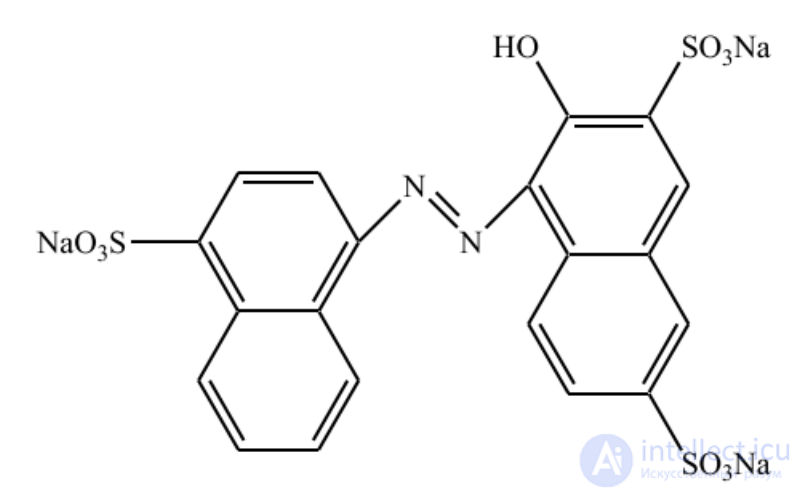 . (3 1)
Tartrazine (E102) (2.2) is by its nature a constituent
of coal tar.
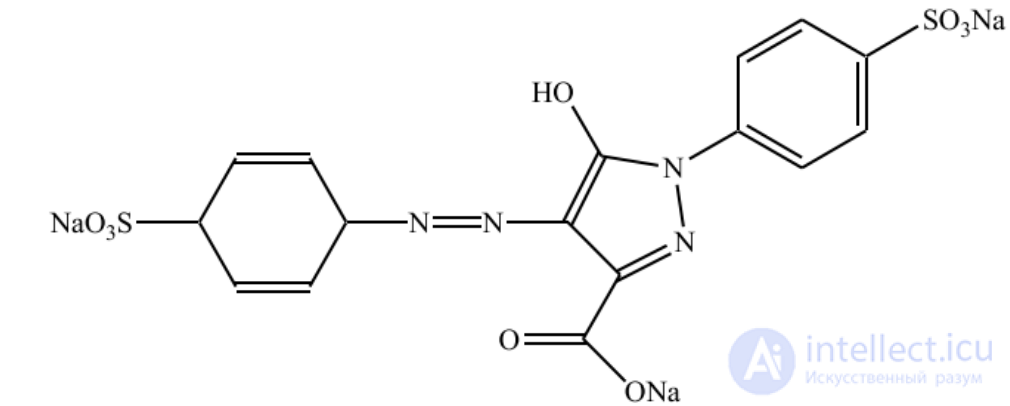 (3 2)
(3 2)
In 1986, a specialized council under the American Food and
Drug Administration concluded that
tartrazine can cause undesirable reactions through the appearance of a rash.
As a result of this, tartrazine was permitted for use in strictly
limited amounts. As a result of special studies conducted
by the department of allergy and clinical immunology of the University of Bari (Italy), it was determined that in 1% of patients who had a rash, it was caused by consumption
of products containing tartrazine. Studies by Indian physicians indicate that
allergic reactions after consuming beverages with tartrazine
affect 3.8-4.2% of patients. In some studies a figure as high as 20%
is even reported (manifestation of urticarial rash). Increased sensitivity to tartrazine causes irritability, hyperactivity, and restless sleep in children.
After the publication of this data, many countries (USA, United Kingdom) are considering banning the use of tartrazine in
food products.
Erythrosine (E127) (3.3) belongs to the xanthene colorants and can
be used in preparing cherries in syrup (MPL 150 mg/kg),
cocktail cherries and sugar (MPL 200 mg/kg). The FAO/WHO Committee
on Food Additives established the
acceptable daily intake of erythrosine at up to
0.1 mg/kg body weight.
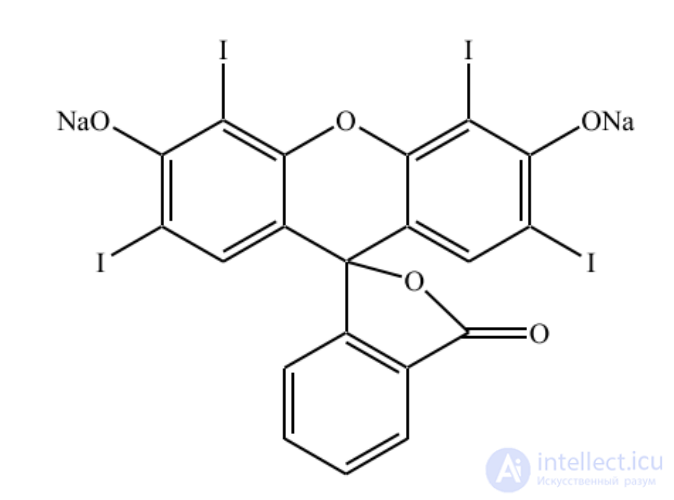 (3 3)
(3 3)
It is known that erythrosine does not undergo metabolism and is excreted with urine and feces. Partial cleavage of iodine may cause disease
of the thyroid gland, in particular oncological disease.
Red 2G (E128) (3.4) is used in the manufacture of sausage products with a starch content above 6% (MPL 20 mg/kg) and sausage products without starch (MPL 100 mg/kg). Some scientists believe that
this colorant, upon metabolism, is converted into naphthalenedisulfonic acid
and aniline. It is known that the formation of aniline leads to the appearance of methemoglobin in the organism.
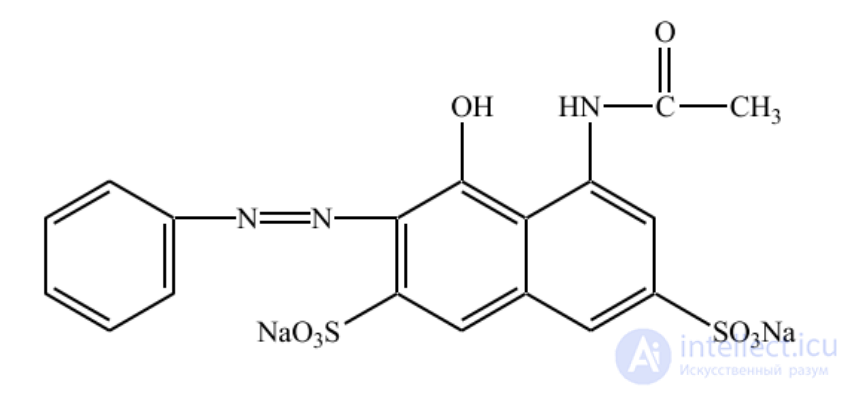 . (3 4 )
Today considerable attention is being paid to the biological polyfunctionality
of the colorant β-carotene and natural carotene extracts, which is related to
their antioxidant properties. They are able to neutralize free
radicals formed in the organism under the action of ionizing radiation,
enzymes, etc. It is known that free radicals cause noticeable changes in the
organism and provoke radiation-induced, cardiovascular diseases, cancer, and cataracts. It has been established that one molecule of β-carotene can bind 5-6
reactive free radicals. According to scientific research, β-carotene has radioprotective, antitumor, anticarcinogenic, antimutagenic and antistress properties. Carotene colors products yellow,
red and brownish-red depending on the product and concentration.
In the human organism, β-carotene can accumulate in the liver, be converted into vitamin A, or be excreted from the organism. But vitamin A is also one of the sufficiently toxic vitamins. The known phenomenon of hypervitaminosis
(overdose with a vitamin) occurred in people who consumed polar bear liver.
Even after eating a small portion of such liver, a severe head
ache, vomiting, visual disturbance and even fatal cases may occur. All this is
related to the high content of vitamin A in polar bear liver. It has been established that a few grams of such liver can satisfy the annual requirement
of a person for this vitamin. However, in volunteers who consumed β-carotene in
large amounts, no hypervitaminosis was observed. Based on the established facts, the FAO/WHO committee of experts on food additives assigned
carotene to the group of colorants for which additional studies are required.
Annatto seed coat extracts (E160b) contain bixin and norbixin (C25H30O4). Such seeds are permitted for limited use for
coloring margarine, butter, flour confectionery
products, etc. The use of annatto is limited not only by its low
resistance to the action of acids and light, but also by the danger of adverse
toxic reactions occurring. Thus, it has been shown that an aqueous extract of annatto suppresses
the motor activity of mice. Also, this substance inhibits gastric secretion, but does not affect its acidity. Hypotensive properties of annatto have also been identified [2, 5].
Color fixatives are potassium nitrite (E249) and sodium nitrite (E250).
They are permitted in some countries in the production of meat products
without heat treatment, cured, dried products made of pork and beef,
boiled, semi-smoked, boiled-smoked, raw-smoked sausages, brawn, and canned meat. The MPL of the added dose of NaNO2 and KNO2 – 150 mg/kg,
and the residual level – 50 mg/kg. In Ukraine, limited use of
E250 is permitted.
Consumption of food products containing nitrites leads to the formation of methemoglobin and carcinogenic transformations

Comments