
Lecture
The basis of toxicological research is formed by methods of exposing the organism of animals to chemical compounds, with the animal experiment serving as the main methodological technique. For this purpose, methods have been developed for introducing harmful substances into the body: oral (via the gastrointestinal tract), inhalation (via the respiratory tract), and dermal (via the skin). A sanitary-toxicological experiment is carried out under conditions close to natural ones — for example, animals are kept in rooms of experimental houses finished with plastics. Toxicology is the science that studies the harmful effects of chemical, biological and physical factors on living organisms, as well as the mechanisms of the occurrence, development and prevention of intoxications. The main task of toxicology is to identify hazardous substances, determine the degree of their toxicity, study the mechanisms of action, and develop methods for the prevention and treatment of poisoning. To achieve these goals, a variety of research methods are used, which are constantly being improved through the development of modern technologies.
Integral tests are widely used in toxicological research, making it possible to detect nonspecific reactions of the organism to exposure to low-intensity chemical factors. In this, considerable attention is paid to assessing the state of the central nervous and cardiovascular systems.
Changes in the functional state of various parts of the central nervous system (CNS) very often are the earliest manifestations of the effect of toxic substances on the organism. When assessing the state of the nervous system, changes in motor-alimentary, local-alimentary and defensive conditioned reflexes are studied in small laboratory animals (mice and rats). In addition, the motor activity of the animals is determined, and the method of functional encephalography is used, by means of which a number of physiological parameters of the brain are established.
To detect changes arising under the action of environmental factors, methods of biochemical research are used that make it possible to judge the mechanisms of intoxication (the immunobiological reactivity of the organism and its sensitizing properties).
Reducing the timeframe of toxicological research is possible in two directions: by the method of calculated forecasting or through experimental accelerated biological justification of standards.
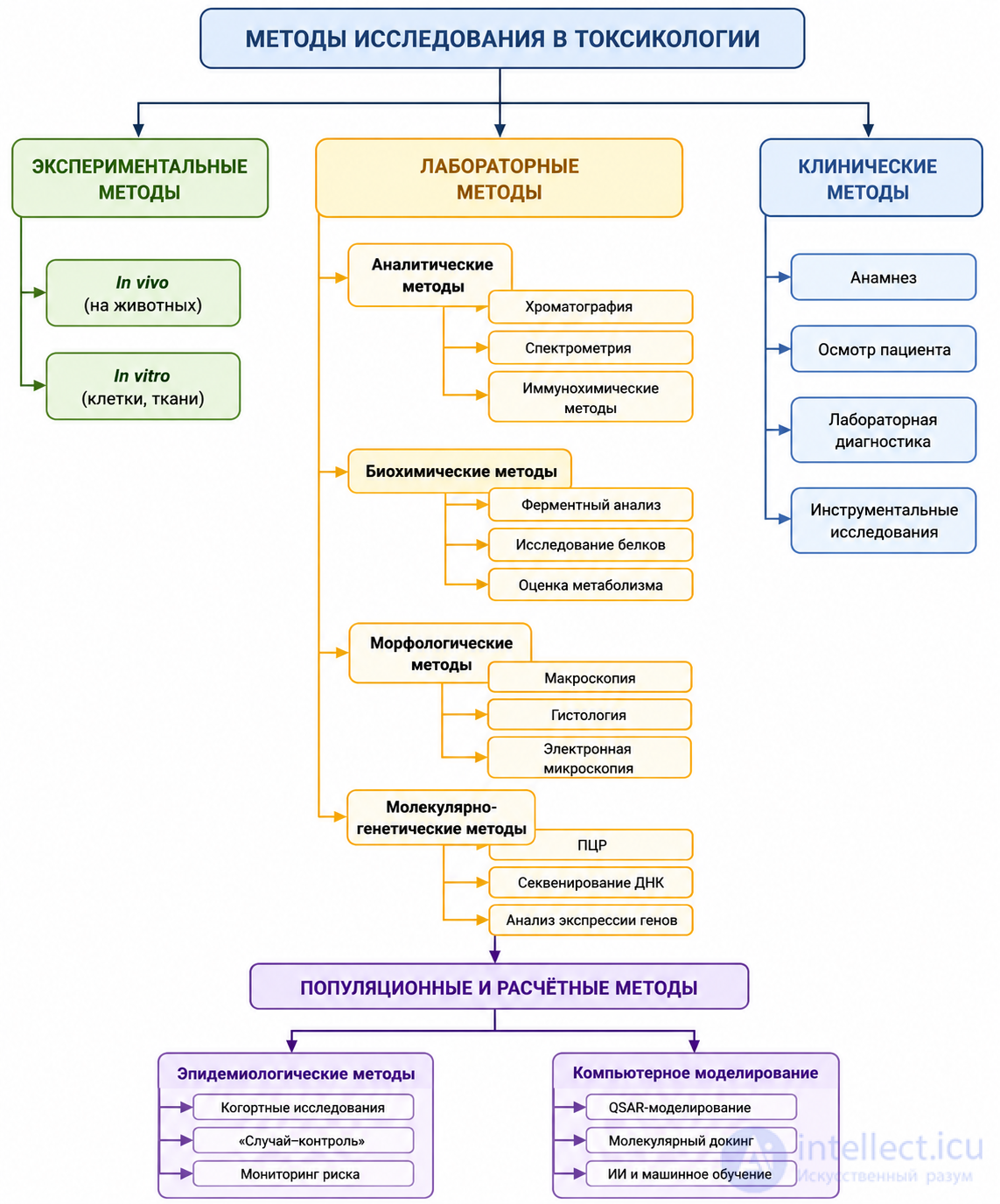
Research methods in toxicology are divided into experimental, laboratory, analytical, clinical and mathematical.
Experimental methods are the basis of toxicological research. They make it possible to assess the effect of toxic substances on the organism under controlled conditions.
These include:
Experimental studies help to determine:
Analytical toxicology is concerned with the detection and quantitative determination of toxic substances in biological objects (blood, urine, tissues, hair) and environmental objects.
The most common methods:
Used to separate complex mixtures of substances.
Variants:
Chromatography makes it possible to detect even very small amounts of toxins.
Used to determine the chemical composition of a substance.
Main methods:
These methods are distinguished by high sensitivity and accuracy.
Based on the interaction of antigens and antibodies.
The best known:
Used for the rapid detection of drugs, medicinal preparations and various toxins.
Biochemical studies make it possible to determine changes in metabolism under the influence of toxic compounds.
The following are studied:
The data obtained help to assess the degree of damage to the liver, kidneys, heart and other organs.
These methods are aimed at studying structural changes in organs and tissues.
Main methods:
They make it possible to detect inflammation, necrosis, dystrophy, tumor changes and other pathological processes.
Modern toxicology widely uses the achievements of molecular biology.
Main methods:
These studies make it possible to detect a hereditary predisposition to toxic effects and to study the molecular mechanisms of intoxications.
Clinical toxicology deals with the diagnosis and treatment of poisoning in humans.
The following are used:
A comprehensive examination makes it possible to establish the diagnosis in a timely manner and prescribe effective treatment.
Used to study the prevalence of toxic effects among the population.
They include:
These methods help to identify the effect of environmental pollution on human health.
Modern information technologies make it possible to predict the toxicity of new chemical compounds without carrying out a large number of experiments on animals.
The following are used:
Computer methods significantly reduce the cost of research and speed up the development of new medicinal preparations.
At present, considerable attention is paid to the development of alternative methods that make it possible to reduce the use of laboratory animals. Technologies of organoids, organs-on-a-chip (organ-on-a-chip), three-dimensional cell cultures and high-throughput screening are being developed. These approaches provide a more accurate modeling of the processes occurring in the human body and make it possible to increase the reliability of research results.
In addition, methods of toxicogenomics, proteomics and metabolomics are being actively introduced, which make it possible to comprehensively study changes at the molecular level and predict the development of toxic effects.
Research methods in toxicology cover a wide range of experimental, analytical, biochemical, morphological, molecular genetic, clinical and computational approaches. Their comprehensive application makes it possible to identify toxic substances, study the mechanisms of their action, assess the risks to human health and the environment, and also develop effective measures for the prevention and treatment of poisoning. The current development of technologies contributes to increasing the accuracy of diagnosis, reducing the number of experiments on animals, and creating new safe methods for assessing toxicity.

Comments