
Lecture
An examination of the phenomenology of temperament and character will interest us primarily from the standpoint of how much a given type of temperament or character contributes to the psyche's resilience to emotiogenic, psychotraumatic situations, which
is one of the main criteria used in professional selection
in aviation (this applies especially to flight crews). Strange as it may seem at first glance,
selection for aviation institutions is in part already carried out before enrollment
in them: people characterized by a combination of emotional-volitional instability and low
sociability (melancholics) are, as a rule, not inclined even to attempt to master extreme occupations. Individuals of this temperament type are not often encountered among pilot cadets, but among air-traffic-control cadets they are encountered more often, and this should not
be alarming in any way, since the main problem with this temperament type in extreme occupations is not that such people cannot master the profession (on the contrary,
they are very often characterized by persistence in achieving a goal), but rather the energetic, emotional cost of the activity performed – given the same outwardly flawless result (for example, the correctness of the actions carried out), the expenditure differs between a melancholic and a sanguine person: for the former this will be a tense situation requiring effort, while
for the latter it will be routine.
Fortunately, any properties of temperament can be compensated for by another, already conditioned-reflex, formation – character – and, given the cadet's willingness combined with
competent guidance from the instructional staff, many negative manifestations of one temperament type or another can be successfully counterbalanced by new formations of character. This is precisely why, as far back as 1948, K. Platonov and L. Schwartz warned:
the study of temperament in cadets should be only one component of a large-scale research program, and it is therefore impermissible to draw
any reliable conclusion about a cadet's fitness for professional activity based on determining the type of temperament. The same authors report that not only very pronounced melancholics but also very pronounced cholerics are rarely encountered among pilots.
Air-traffic controllers and pilots have to work at a pace dictated from outside, which does not always correspond to the pace of mental activity expressed in
the type of temperament.
Temperament (Lat. temperamentum – proper proportion of parts) is a dynamic characteristic of mental processes and behavior, manifested in their strength, balance, mobility, and other characteristics (including introversion and extraversion).
Temperament is a property that remains stable over the course of life, though within certain
limits it can be compensated for by experience. Temperament represents the physiological framework (an unconditioned-reflex formation) on which character is built –
a conditioned-reflex formation.
The typology of temperaments has a long history of development, and despite the exceptional variety of types and the ways of distinguishing and interpreting them, most researchers have measured two indicators. The first is «extraversion – introversion», and the second –
«emotional-volitional instability – stability». Extraversion (Lat. extra – outside +
verto – I turn) is the orientation of a person's consciousness predominantly toward what is happening around them, while introversion (Lat. intro – inward) is the opposite quality, the orientation of consciousness toward oneself, absorption in one's own experiences. According to H.J. Eysenck, these two variables are independent, and each represents a continuum between two poles of an extremely pronounced personality trait.
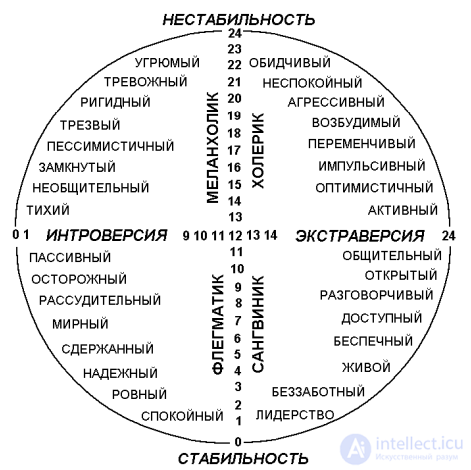
Fig. 7.1. Characteristics of temperament types according to H.J. Eysenck
In his typology, H.J. Eysenck uses Hippocrates' terminology: melancholic (Gr.
melanos – black + chole – bile), sanguine (Lat. sanguis – blood), phlegmatic (Gr. phlegma –
mucus, phlegm), choleric (Gr. chole – bile). A brief characterization of the types according to H.J. Eysenck
is given in Fig. 7.1. It should be noted that I.P.
Pavlov used similar terminology when distinguishing types of higher nervous activity (temperaments).
In the course of studying the characteristics of dogs' nervous activity, I.P. Pavlov (1928, 1951)
established the existence of four types of nervous system, which he correlated with four types
of temperament in people. The excitable type of nervous system corresponded to the choleric
temperament, the inhibited type – to the melancholic, the balanced mobile (lively)
type – to the sanguine, and the balanced inert (calm) type – to the phlegmatic.
I.P. Pavlov (1928, 1951) attempted to link the choleric temperament in people with neurasthenia, and the melancholic – with hysteria, which certainly does not correspond to reality. But
I.P. Pavlov's thesis that melancholics and cholerics are the main suppliers of neuroses (1932, 1933, 1936) is indeed reflected in reality. It is correct
to say that these two temperament types serve as fertile ground for a psychotrauma befalling a person, owing to the emotional instability of these types, to have
less chance of being worked through, but the final outcome (whether or not the psychotrauma
is worked through) depends not only on the unconditioned-reflex ground (the type of temperament), but
also on character and intelligence, which are conditioned-reflex formations capable, within wide limits, of compensating for the properties of the nervous system.
In a 1933 work, I.P. Pavlov gave the following characterization of representatives of the types he distinguished. In representatives of the excitable, unbalanced type (cholerics), the inhibitory process constantly lags relatively behind the excitatory process. In
difficult tasks (requiring significant inhibition), animals of this type almost completely
lose their inhibitory function (a neurosis arises): they become extremely restless to the point of anguish, and this restless, agonizing state is sometimes periodically replaced by a state of depression and drowsiness.
In representatives of the weak (inhibited) type, the excitatory and inhibitory processes
are insufficient, but often especially the inhibitory one. Animals of this type are timid, anxious,
excessively fussy, impatient, and easily develop neuroses. They cannot tolerate
any sufficiently complex system of conditioned reflexes or a change in the stereotype of conditioned-reflex activity. At the same time they display weakened conditioned-reflex activity and for the most part fall into various phases of a hypnotic state. In the weak type, with weakness of internal inhibition (the inhibition responsible for correcting conditioned reflexes), external inhibition (negative induction), on the contrary, extremely predominates and largely determines the animal's entire
external behavior. Hence the name of this type – weak, inhibited.
In representatives of the balanced types (sanguine and phlegmatic), the excitatory and inhibitory processes are equal in strength; these animals are difficult, or often impossible, to make neurotic by means of difficult tasks (Pavlov I.P., 1933, 1951).
The division of dogs into four types of nervous system was based on differences in the properties
of the nervous system. The difference runs along three basic properties. The first property is the strength
of the basic nervous processes (excitatory and inhibitory); the second property is the balance of these processes; the third property is their mobility (Pavlov I.P., 1935, 1951).
The significance of the strength of nervous processes is clear from the fact that the surrounding environment presents unusual, extraordinary events and stimuli of great intensity, and it not infrequently becomes
necessary to suppress or restrain the effects of these stimuli at the demand of other,
equally or even more powerful, external conditions. And the nerve cells must withstand these
extraordinary strains. From this also follows the importance of balance, of equality in the strength
of both nervous processes. And since the environment surrounding the organism is constantly (and often sharply and unexpectedly) fluctuating, both processes must, so to speak, keep pace with these fluctuations, that is, they must possess high mobility – the ability, quickly and at the demand of external conditions, to yield ground, to give preference to one stimulus over
another, to excitation over inhibition and vice versa (Pavlov I.P., 1935, 1951).
Animals of the weak type are characterized by an evident weakness of both the excitatory and
the inhibitory processes; they can never fully adapt to life and break down easily,
becoming ill (neurotic) quickly and often, whether under the influence of difficult life circumstances or difficult nervous tasks (Pavlov I.P., 1935, 1951).
Opposite to this type are the types of strong animals. The first of them is the strong but unbalanced type, having a strong excitatory process but with an inhibitory process that lags behind in strength, sometimes very significantly, and which as a result is also easily susceptible to disorder precisely when inhibition is required. In the words of I.P. Pavlov (1935,
1951), this type is exceptionally suited for combat, but not for the type of everyday life with all its contingencies and demands. But being strong, it is nevertheless capable of disciplining itself to a very
large degree, improving its initially insufficient inhibition. From this strong type
the strong and balanced animals must be set apart: the calm as well as the lively.
These are the main types, corresponding precisely to the ancient classification of the so-called human temperaments: melancholic, choleric, phlegmatic, and sanguine
(Pavlov I.P., 1935, 1951).
As I.P. Pavlov points out in his 1936 work, the study of conditioned reflexes in dogs raised the question of the different nervous systems of individual animals, and, ultimately, grounds were obtained for systematizing nervous systems according to certain of their basic traits.
There are three such traits: the strength of the basic nervous processes (excitatory and inhibitory), their balance relative to one another, and the mobility of these processes. By strength, animals were divided into strong and weak; the strong ones, by the balance of their processes, into balanced and
unbalanced, and the balanced strong ones into mobile and inert. This corresponds roughly with the classical Hippocratic systematization of temperaments. Thus we get strong but unbalanced animals with both processes strong, but with the excitatory process predominating over the inhibitory – the excitable, unrestrained type – cholerics according to Hippocrates. Next – strong, fully balanced, and moreover
inert animals – the calm, slow-moving type – phlegmatics according to Hippocrates. Then
strong, fully balanced, and moreover labile animals – a very lively, mobile type – sanguines according to Hippocrates. Finally, the weak type of animal, which most closely corresponds to melancholics according to Hippocrates: their predominant and general trait is easy inhibitability, due both to
internal inhibition, constantly weak and readily irradiating (spreading,
propagating), and, especially, external inhibition under the influence of any, even minor, extraneous external stimuli. In other respects this is a less uniform type
than all the others; these are animals that are sometimes equally weak in both processes, sometimes predominantly extremely weak in the inhibitory one, sometimes fussy and constantly looking around, and sometimes,
conversely, constantly stopping, as though frozen animals. The basis of this
non-uniformity is, of course, that animals of the weak type, just like animals of the strong
types, differ among themselves in traits other than the strength of the nervous processes. But the predominant and extreme weakness of either one inhibitory process or both destroys
the vital significance of variations in the remaining traits (Pavlov I.P., 1936, 1951).
In the words of I.P. Pavlov (1936, 1951), a type is an innate constitutional kind
of an animal's nervous activity – a genotype. But since from the day of its birth an animal is subject to the most varied influences of its surrounding environment, to which it inevitably
must respond with certain forms of activity that often become fixed, in the end, for
its whole life, the animal's ultimate, actual nervous activity is an alloy of the traits
of the type and of changes brought about by the external environment – the phenotype, the character.
It should be kept in mind that the properties of temperament manifest themselves especially in stressful situations and change little over the course of ontogeny, which naturally affects a person's professional suitability, particularly in aviation, where production algorithms change rapidly, the volume of incoming information fluctuates within wide limits, and various kinds of interference arise, all of which demand rapid reaction and timely decision-making. In this connection, people with certain types of temperament
prove unable, in one or another specific (especially non-standard) situation,
to carry out this or that action or task. Excessive impressionability and emotionality
in melancholics can cause them a state of emotional tension and give rise to inadequate actions of either an inhibited or an impulsive character. The inertness of phlegmatics, under conditions of rapidly changing flight circumstances, can put them into a state of confusion, with a sharp inhibition of mental processes. In turn, the excessive optimism and self-confidence of cholerics can lead to an overestimation of their own capabilities and create the conditions for an emergency situation. The carelessness, and sometimes
the extreme superficiality, of the sanguine person can likewise create conditions for an inadequate
perception of reality and the emergence of a non-standard situation. This is far from a complete
list of the possible negative manifestations of the characteristics of individual temperaments, and this circumstance determines the exceptional necessity of establishing
the type of temperament and of subsequently working to compensate for particular traits
of temperament. And compensating for the negative manifestations of temperament with traits of character –
this is, first and foremost, the task of the person possessing these qualities!
In determining the type of temperament, attention should be paid not so much to which type you belong to, as to how many points you scored on the first (extraversion – introversion) and second (emotional-volitional stability – instability)
scales, since the zone of each of the four temperaments (see Fig. 7.1) defines not merely those
particular characteristics, but the degree of their expression. If, having taken the test, you fell, say,
into the choleric temperament zone, you might find yourself at various points within
this zone, and the whole spectrum of these points defines all the variants of choleric temperament: if you scored 14 points on the «extraversion – introversion» scale and 22 points on the «emotional-volitional stability – instability» scale, you would be a choleric in whom
moderate sociability would be combined with excessive impulsivity; if you scored 22 points and 14 points on the first and second scales respectively, such a choleric would
be characterized by excessive sociability and moderate impulsivity. In other words, the whole set of variants that can be obtained while remaining within the choleric
temperament zone (and there are 121 such variants, not counting the borderline variants corresponding to points on the axes: for example, 20 points on the first scale and 12 points on the second) will characterize different variants of choleric temperament (one choleric
is not like another). This is precisely why it is important to know not simply one's membership in a particular temperament type, but the exact values obtained on the two scales.
Character (Gr. charakter – trait, feature) is a conditioned-reflex formation
representing a set of stable, closely interrelated, and distinctly
manifested features, expressed in a person's attitude toward themselves, others, and activity, which together determine the distinctive character of a person's behavior.
Characterological features of the personality (character traits) manifest themselves in various
kinds of human activity. Character traits are complex individual features that are sufficiently indicative of a person and make it possible to predict, with a certain probability,
their behavior in particular situations. Character traits, on the basis of their connection with cognitive, emotional, and volitional mental processes, are divided
accordingly into cognitive, emotional, and volitional ones. Different character traits
are grouped depending on whether they reflect a person's attitude toward themselves, toward other
people, or toward activity.
Character may be distinguished by the presence of especially vividly manifested traits, which
have been called character accentuations. This problem was worked on by K. Leonhard and A.E. Lichko. Knowledge of character accentuations makes it possible to predict the actions of an aviation specialist in this or that situation. Furthermore, recognizing accentuated
personalities makes it possible to prevent their turning into the corresponding type of psychopathy, that is, it prevents pathocharacterological personality formation.
It is important to know that character accentuations, having finally taken shape in adolescence, subsequently tend to smooth out, and, for example, in the character of cadets, and later of aviation specialists, they are seen in a less pronounced form,
which nevertheless in no way diminishes their importance in diagnosing the behavior of flight and
air-traffic-control personnel. Character accentuations, having peak values in adolescence,
are subsequently erased to a greater or lesser degree, but do not disappear and remain in
the structure of character in the form of one type of character or another.
Accentuations (Lat. accentus – stress) of character are extreme variants of its norm,
in which particular character traits are excessively intensified, whereby a selective vulnerability is revealed with regard to a certain kind of psychogenic influence, alongside good
or even heightened resistance to others (Lichko A.E., 1983). A.E. Lichko (1977) notes
that character accentuations cannot constitute a psychiatric diagnosis: «the type of accentuation is
the premorbid [pre-disease] background against which reactive states, acute affective reactions, neuroses, and pathological behavioral disturbances may develop,
even reactive psychoses – only these may serve as a diagnosis». A.E. Lichko
(1977) distinguished two degrees of character accentuation. An overt accentuation belongs to the extreme variants, while a covert one belongs to the ordinary variants of the norm.
A.E. Lichko (1977) notes that character accentuations presuppose so-called «places of least resistance» (locus minoris resistentiae). The place of least
resistance is the place where psychotraumas most easily arise. As is known, a psychotrauma represents the blocking of some significant need. The needs of particular significance for a person with a given character accentuation will be those that are already satisfied with difficulty in any case (needs connected with the accentuated
traits): for example, establishing informal contacts is difficult for a schizoid
(owing to a lack of understanding of what is happening in the sphere of interpersonal relations), but
if a schizoid is placed in a situation where they constantly need to establish informal contacts with someone, this will utterly break them, becoming not a moderate but a severe
psychotrauma, followed by a breakdown of adaptation. If, however, a psychic trauma, even a severe one, is not addressed to the place of least resistance, the matter is usually limited to
an adequate personal reaction, and in this, in the author's opinion, lies one of the important
differences between accentuations and psychopathies: in psychopathies, disturbances of adaptation can result
from any trauma, whereas in accentuations adaptation is disturbed only by blows to
the place of least resistance. If a psychic trauma strikes the place of least resistance of an accentuated character, its traits can become sharpened to the
level of psychopathy.
A.E. Lichko (1977) identified the following character accentuations.
1. Hypertimic type (Gr. hyper – over + thymos – soul). Characterized by a good mood and a striving for leadership, often informal. Good mood is harmoniously combined with good well-being, high vital tone, and often a flourishing appearance. A good feel for novelty is combined with unstable interests, and great
sociability with indiscriminate choice of acquaintances. They adapt easily to unfamiliar
surroundings, tolerate solitude, strictly regimented discipline, and monotonous work requiring precision poorly. Owing to their consistently good mood and high vital tone, they tend to overestimate their own capabilities and build excessively optimistic plans for the future. Excessive confidence in their own strength prompts them to «show off», to present themselves
to those around them in a favorable light, to boast a little, which sometimes lends a hysteroid tinge to the behavior of hypertimic individuals. But sincerity in behavior is still more characteristic of them
than the strained striving «to appear greater than one actually is», as with genuine
hysteroids. They become irritated when an attempt is made to suppress their activity and leadership claims. Hypertimic adolescents are prone to group forms of delinquent (Lat. delinquens, delinquentis –
committing an offense) behavior, and often themselves become the instigators of offenses, driven not only by a thirst for entertainment or a desire to obtain means for
pleasures – the element of risk is itself also attractive to them. Sexual feeling awakens early
and pushes them toward early sexual relationships: romantic infatuations are rare, and there is
a tendency to enter into a sexual relationship with the object of their affection as quickly as possible.
2. Cycloid type (Gr. kyklos – circle + eidos – form). Characterized by cyclicity
of development: a phase of subdepression alternates with a hypertimic phase. In the subdepressive phase, working capacity declines, interest is lost, and there is avoidance of company. Reproaches that wound self-esteem may prompt thoughts of inferiority and worthlessness and push
toward suicide. Sharp breaking of routines is poorly tolerated. In the hypertimic phase they behave as
hypertimics do.
3. Labile type (Lat. labilis – unstable). Characterized by extreme changeability (lability) of mood, on which everything depends: well-being, appetite, working capacity,
sociability, sleep. Mood swings poorly motivated (from an outside observer's viewpoint) can create an impression of superficiality and frivolity. They are characterized by deep feelings,
a sincere attachment to those from whom love, care, and attention come. They prefer
to be friends with those who can support them and satisfy their need for empathy. Labile adolescents are sensitive to any kind of attention, gratitude, or praise – all
of this brings them sincere joy and does not lead to arrogance or excessive self-conceit.
They do not lay claim to the role of leader. Selective intuition allows them to quickly determine how
those around them feel about them. Their self-assessment is marked by sincerity and the ability to correctly
identify the features of their own character. Their weak point is emotional rejection on the
part of significant others. Sexual activity in labile adolescents is usually limited to flirting and courtship, with the drive itself remaining poorly differentiated.
4. Psychasthenic type (Gr. phyche – soul + astheneia – weakness, powerlessness). The main traits are indecisiveness, a tendency toward endless deliberation, anxious apprehensiveness in the form of fears about the future, a love of introspection, and an ease of developing obsessive fears. The anxious apprehensiveness of the psychasthenic adolescent differs from the similar traits of the astheno-neurotic and sensitive types. Whereas the astheno-neurotic type is characterized by fear for one's own health (a hypochondriac orientation of
apprehensiveness and anxiety), and the sensitive type is characterized by anxiety about others' attitudes, possible ridicule, gossip, and unfavorable opinions of oneself
(a relative orientation of apprehensiveness and anxiety), the psychasthenic's fears are entirely
addressed to what may happen in the future. Psychological defense against constant anxiety about the
future takes the form of invented omens, rituals, as well as pedantry and formalism (if
everything is foreseen in advance and one does not deviate from the planned course, nothing bad will happen). The psychasthenic's pedantry differs from that of the epileptoid: behind the epileptoid's pedantry there always lies self-love and concern for their own interests and well-being, whereas the psychasthenic's
pedantry is more contrived and formalistic. A reaction of hyper-compensation with respect to their own indecisiveness and tendency to doubt manifests itself in self-assured, categorical judgments and in exaggerated decisiveness and hastiness of action at moments when unhurried circumspection and caution are required. The failures that consequently befall them further intensify their indecisiveness and doubts. All
manual skills and sports are given to them poorly. Their self-assessment, despite a tendency toward introspection, is not always accurate. Delinquency, running away from home, and alcohol or drug use are, as a rule, not observed in psychasthenics. Sexual development usually outpaces general physical development. In difficult situations that place heightened demands on the sense of responsibility, an obsessive-compulsive neurosis may develop.
5. Epileptoid type (Gr. epilepsia + eidos – form). The main trait is a tendency
toward states of a sullenly gloomy mood, with a gradual build-up of irritation and a search for an object on which to vent anger. Affects in epileptoids are intense and
prolonged – «they take a long time to cool down». This epileptoid explosiveness, or
combustibility, differs from the capricious changeability of affects in the labile type and from the affectivity of hypertimics, who flare up instantly but cool down just as easily. The affective discharges of epileptoids seem sudden only at first impression – they can
be compared to the bursting of a steam boiler that has long and gradually been building up pressure beforehand. Leadership manifests itself in a striving to dominate over peers. Epileptoids are unyielding and
cruel. Inertness and viscosity leave their mark on the whole psyche – from motor function and emotions to thinking and personality traits. Petty precision, scrupulousness, meticulous
observance of all rules, even to the detriment of the matter at hand, and a pedantry that wears down those around them are usually
regarded as compensation for their own inertness. Sexual drive is often bound up with sadistic and masochistic tendencies. Self-assessment is usually one-sided; a tendency toward a gloomy state of mind, sound sleep, difficulty waking up, and
the strength and intensity of sexual drive are also noted.
6. Hysteroid type (Gr. hystera – womb + eidos). The main traits are boundless egocentrism and an insatiable thirst for attention to their own person, for admiration, astonishment, and sympathy. Deceitfulness and fantasizing serve entirely to embellish themselves. Outward displays of emotionality in fact turn out to conceal an absence of deep feelings amid great
theatricality of experience and a tendency toward posturing and posing. An inability for sustained
labor is combined with high aspirations regarding their future profession. By inventing things,
they easily get into a role and, through skillful acting, mislead trusting people. They try
to elevate themselves among their peers with tales of their successes and adventures. Those around them
recognize their fabrications and unreliability, which is why they frequently change their circle of company. Among the behavioral manifestations of hysteroid traits in adolescents, a tendency toward demonstrative suicide attempts (aimed at manipulating those around them) is very common. Hysteroids lack
persistence and perseverance. The reaction of grouping with peers is always bound up
with claims to leadership or an exceptional position within the group. Lacking either sufficient forcefulness or the fearless readiness to assert, by force at any moment, their own
leading role and subordinate others, hysteroids strive for leadership by every means
available. Possessing a good intuitive feel for the group's mood, when unconscious desires within it are only just ripening, hysteroids can become their first mouthpieces, acting
as instigators and agitators. In a burst of enthusiasm, inspired by the eyes turned toward them,
they can lead others along, even displaying reckless bravery. But they always turn out to be leaders for an hour only – they falter before unexpected difficulties, easily betray their friends,
and, deprived of admiring glances, immediately lose all their enthusiasm. The group soon recognizes, behind the outward effects, their inner emptiness. The sexual drive of hysteroid adolescents is
notable for neither strength nor intensity; their sexual behavior involves much theatrical play.
Their self-assessment is not objective: they usually present themselves as whatever is easiest to make an impression with at a given moment.
7. Unstable type. The main traits are an unwillingness to work or study, and a constant urge for
entertainment and idleness. Under strict and continuous supervision they submit reluctantly, but
always look for an opportunity to avoid effort. Complete lack of will is revealed when it comes to
the performance of obligations. Their desire for entertainment is associated with delinquency (criminal behavior) and early drinking, and a pull toward street company. Because of cowardice and insufficient initiative, they end up in a subordinate position within groups. They are indifferent to their own future and make no plans. They try to run away from any difficulties and troubles and not think about them. Their sexual drive is not particularly strong, but being in antisocial company leads to early sexual experience. Self-assessment is usually inaccurate –
they readily attribute hypertimic or conformist traits to themselves.
8. Schizoid type (Gr. schizo – I divide, split + eidos). Schizoid traits are revealed earlier than the character features of other types: such children like to play alone, are not drawn to peers, and prefer to keep company with adults. The main traits are aloofness and a lack of intuition in the process of communication. Informal, emotional contacts are difficult to establish. Rapid exhaustion within a contact leads to an even greater withdrawal into oneself. A lack of intuition manifests itself in an inability to understand others' experiences, to guess what is left unsaid
aloud. A lack of empathy is characteristic. The inner world is almost always closed to others, and their pursuits are notable for their intensity, often for their unusual character. The inaccessibility of the inner world
and the restraint in expressing feelings make many of the schizoid's actions incomprehensible and unexpected for those around
them, because everything that preceded them – the whole course of experiences
and motives – remained hidden. Some of their antics have the character of eccentricity, but unlike
those of hysteroids, they do not serve the purpose of attracting attention to themselves. Reactions connected with a developing sexual drive may, at first glance, seem not to manifest themselves at all. An outward «asexuality» and contempt for questions of sexual life are usually combined with
rich erotic fantasies. Drinking is rare among schizoids, though some of them find that small doses of alcohol, without causing euphoria, can ease the establishment of contacts and remove the feeling of shyness and unnaturalness during communication.
They like to emphasize their independence and self-sufficiency. Their self-assessment is incomplete: aloofness, difficulty with contacts, and misunderstanding by others are well noted, while other
features are noticed less well.
9. Sensitive type (Lat. sensitivus – sensitive). The main traits are great impressionability and a feeling of one's own inferiority. They see many shortcomings in themselves. Aloofness and shyness manifest themselves in the presence of strangers and in unfamiliar surroundings. Even the most superficial contacts with strangers are difficult, but with those to whom they are accustomed they can be quite sociable and open. A sense of duty, of responsibility, and of high moral demands on others and themselves develops early. Owing to a reaction of hyper-compensation, sensitive adolescents end up in public positions: they are put forward by educators, attracted by their obedience and diligence. Reactions connected with the developing
sexual drive are strongly colored by feelings of their own inferiority. Timidity and shyness stand out with particular force when first love flares up; often
the object of their affection remains entirely unaware of the feeling they aroused. Rejected
love plunges them into despair and sharply intensifies the feeling of their own inferiority, which not infrequently gives rise to thoughts of suicide. They are not prone to drinking, drug use, or delinquent
behavior. Their self-assessment is marked by a high degree of objectivity. Situations in which they find themselves the object of ill-disposed attention or subjected to unjust accusations are unbearable for them.
10. Astheno-neurotic type (Gr. astheneia – weakness, powerlessness + neuron – sinew,
nerve). In adolescents of the astheno-neurotic type, the following signs are often found from childhood on:
restless sleep, poor appetite, capriciousness, timidity, tearfulness, night
terrors, nocturnal enuresis, and stuttering. The main traits of this accentuation are heightened
fatigability, irritability, and a tendency toward hypochondria. Fatigability manifests itself especially during intellectual activities. Delinquency, running away from home, and drinking are not characteristic
of adolescents of this type. Their self-assessment usually reflects their hypochondriac attitudes. They
note a dependence of their bad mood on poor well-being, poor sleep at night, and drowsiness during the day, and a sense of exhaustion in the mornings. They are aware that fatigability and irritability dampen
their interest in anything new and make criticism and objections that constrain their rules unbearable.
11. Conformist type (Lat. conformis – similar). Inclined to imitate their immediate environment in everything – to be conformist (to submit to others' opinions). In good
surroundings they are decent people and decent workers, but having ended up in bad surroundings, they eventually
adopt everything characteristic of them. Conformity is combined with a striking lack of critical judgment. They are conservative and dislike anything new, because they cannot adapt to it quickly. Conformist adolescents value their place within the familiar group, the stability of this
group, and the constancy of their surroundings. A conformist adolescent's self-assessment can be quite good.
A.E. Lichko (1977) examined the relationships between types of improper upbringing and psychic traumatization on the one hand, and, on the other, the types of character accentuation most sensitive to them. Character accentuations, being extreme variants of the norm, provide fertile ground for the formation of acquired psychopathies
(pathocharacterological development, or pathocharacterological formation). However,
for psychopathic development to occur against the background of an accentuation, it is not simply any unfavorable environmental influence that matters – this influence must be especially significant for the given type of character
(it must be addressed to the place of least resistance). In adolescence,
the most frequent influence of this kind is improper upbringing. Thus, if a child with a hysteroid character accentuation is raised in the «family idol» style (constant
overpraising, admiration for imagined talents, exaggeration of actual abilities, constant showing them off to acquaintances and strangers alike), this leads to a strengthening of egocentrism and a striving to obtain everything without particular effort – psychopathic development of the hysteroid type arises. Upbringing in the «Cinderella» style (the child is mistreated within the family,
humiliated, kept in fear, severely punished for the slightest misdeeds, and preferred less than other children, as a result of which the child feels unloved and unwanted) leaves an indelible mark against the background of a sensitive, astheno-neurotic, or labile accentuation – psychopathic development of the corresponding type is formed (Lichko A.E., 1977).
Exceptionally important information regarding how to deal with adolescents in the course of
psychotherapy is given by A.E. Lichko in a 1985 work. Although the work itself is titled «Psychotherapy in Psychopathies in Adolescents», it goes beyond the problem of
psychotherapy for adolescents with psychopathies – it thoroughly addresses the question of the delicacy required in dealing with adolescents in general, as well as the kinds of improper upbringing that turn out to be a blow to the «place of least resistance» for a particular type of character accentuation, triggering the transition of a character accentuation into psychopathy.
As A.E. Lichko (1985) notes, the constitutional factor in the genesis of psychopathies cannot
serve as a justification for refusing psychotherapy, since the role of psychogenies (pathogenic
information) in their formation remains undeniable. In most types of psychopathy, unlike in neuroses, adolescents present no complaints whatsoever to the doctor, do not consider themselves
ill, do not want treatment, and are unable to critically assess their own behavior. An adolescent's uncritical attitude toward their psychopathic manifestations, and their unwillingness to be treated, cannot be regarded as grounds for refusing psychotherapy. Changing this attitude is one of the first tasks of psychotherapeutic intervention. Sometimes with adolescents
it even becomes necessary to resort to the device of «psychotherapeutic iatrogeny»: deliberately drawing attention to some existing but insignificant disorder or possible impairment that the adolescent might come to fear, in order to prompt a desire for treatment in them.
One of the main tasks of psychotherapy in psychopathy is to raise the level of critical assessment of the pathological features of character and to increase compensatory capacities: to teach the person to spare their vulnerable points, to avoid the most psychotraumatic situations, and to actively seek out the paths of greatest adaptation.
In contact with an adolescent, a psychotherapist must possess great flexibility – the ability
to move quickly, at the right moment, from free conversation to directive guidance,
from advice to admonition, from patient listening to active disputation, and from that
to empathy. This skill is required both in individual rational psychotherapy and (especially) during family and group psychotherapy sessions.
Another requirement placed on the adolescent psychotherapist is the capacity for
empathy. One cannot behave toward an adolescent as a formally neutral figure, deliberately
putting one's objectivity on display. A lack of empathy can easily be interpreted as indifference, coldness, or even emotional rejection. In communication, the adolescent
is above all seeking empathy. However, the psychotherapist's emotional reactions, remarks, and encouragements in the process of empathizing must not be accompanied by a loss of distance. Familiarity and overfamiliarity must not be allowed – otherwise the value of the empathy will diminish (Lichko A.E., 1985).
From the very beginning of the interaction one must be prepared for the fact that an adolescent's protest against
parents, educators, and adults in general can easily extend to the psychotherapist as well.
All the more so because, in cases of psychopathy, it is only rarely that the adolescent appears before the doctor
of their own free will – more often they have been «referred» or «brought in», and moreover against their will, by precisely those who are supposed to be raising them and against whom the protest may be directed with particular force
! The adolescent must therefore immediately sense that the doctor treats them as
an autonomous individual. The adolescent must see that they are being listened to and that no decisions are made behind their
back without them. As A.E. Lichko points out, at the first meeting (before
contact is established) he never used a conversation alone with the parents or educators in the adolescent's absence. Questioning of the person who brought the adolescent in is conducted in the presence
of the latter. The adolescent is invited only to listen to the conversation without intervening in it, and then,
alone with the doctor, to refute, clarify, correct, and add to everything that was said about them.
During the questioning of the parents one should show restraint, while in a conversation with the adolescent alone one should
behave more freely and emotionally (Lichko A.E., 1985).
One must also be prepared for the fact that the adolescent, consciously or unconsciously, may
try to provoke the psychotherapist into statements, remarks, actions, or emotional reactions that would confirm, in the adolescent's eyes, their own preconceived judgment that the doctor is «in league» with the parents or educators. To this end, rudeness, mockery, ostentatious disdain, and even taunts that sometimes shrewdly strike at the doctor's own weak points may all be brought into play. But until contact has been established, one must be very circumspect so as not to let
oneself be provoked. «Testing» behavior on the adolescent's part during a conversation with the psychotherapist must not
go unnoticed. A display of complete equanimity and indifference on the
doctor's part toward such behavior can only push the adolescent toward even greater displays of protest,
up to and including some kind of excess. Such behavior should be met not only with calm and
restrained disapproval; the doctor must show the adolescent that their primary aim is to find out why the adolescent behaves this way. Wishing for the adolescent to change their behavior,
one must help them – open up a path for them so that they are able to do so (Lichko A.E., 1985).
Once good contact with the adolescent has been established, one must prepare for another difficulty. Empathy and involvement on the psychotherapist's part, sometimes «for the first time», from the
adolescent's point of view, the «understanding» that has been found may lead the adolescent, especially one who has found themselves in a situation of emotional rejection by those close to them, to begin perceiving the psychotherapist as a kind of emotional substitute for their parents.
In doing so, the adolescent may display jealousy and demand special attention for themselves. Here the
psychotherapist is required to show particular flexibility in observing reasonable boundaries. One must not push the adolescent away, cool the sympathy that has flared up in them, or leave unsatisfied
their need for empathy, or allow them to easily become «disillusioned» – this can nullify
all the results achieved in the course of psychotherapy. The situation becomes even more complicated
when one has to deal with the jealousy of parents, especially those inclined toward dominant
hyper-protection (excessive care, petty control, a system of prohibitions) in their upbringing.
It is necessary to gradually and tactfully broaden the circle of the adolescent's attachments – including in it
their peers, and then also those close to them, teaching them to see in these people not only negative but also positive traits (Lichko A.E., 1985).
As A.E. Lichko (1985) points out, it is necessary to establish which kind of improper upbringing was used by the parents. This is especially important in cases of psychopathic development (pathocharacterological formation), when the pathological anomaly of character
is formed as a result of this particular kind of improper upbringing turning out to be a blow
to the «place of least resistance» for the given type of character accentuation. In the author's opinion, the following kinds of improper upbringing are of the greatest significance.
1. Hypoprotection (Gr. hypo – under + Lat. protectio – cover). In this case the adolescent
grows up without sufficient supervision and care, amid the family's complete indifference to their interests,
pursuits, and plans. Even if the material side of the adolescent's life is provided for adequately, in their spiritual life they find themselves entirely left to their own devices.
There is also a covert form of hypoprotection – when control over the adolescent seems to be exercised but in fact turns out to be quite formal. The adolescent senses that their family has no time for them, that they are entirely absorbed in their own interests, and that their parental duties weigh on them. Usually the adolescent learns to get around the elders' formal control and begins to live their own life secretly from them (Lichko A.E., 1983, 1985). Covert hypoprotection is often combined with covert emotional rejection. Hypoprotection is especially unfavorable in accentuations of the unstable and conformist types. A striking resistance to the harmful effects of hypoprotection is observed in
the case of sensitive and psychasthenic accentuations (Lichko A.E., 1983).
2. Dominant hyper-protection (Gr. hyper – over + Lat. protectio – cover) is described by A.E. Lichko (1983, 1985) as follows. It involves excessive, continuous supervision, petty control over the adolescent's every step (down to surveillance – secretly following the adolescent from home to every institution they visit), a whole system of constant prohibitions, and, above all, the complete impossibility for the adolescent ever to make
independent decisions. All of this suppresses their sense of responsibility, deprives them of independence, and fails to accustom them to using freedom sensibly. Constant prohibitions and the impossibility of making their own decisions confuse the adolescent, creating in them the impression
that everything is «forbidden» to them while their peers are «allowed everything». Hyper-protection does not give them the opportunity
to learn from an early age, through their own experience, to use freedom sensibly, and does not accustom them to
independence. It suppresses their sense of responsibility and duty, for if everything is decided for the adolescent
and they are constantly told what to do, they come to the conviction that they themselves can be held accountable for
nothing. In hypertimic adolescents, already in early (12–13 years) or middle (14–15
year old) adolescence, hyper-protection leads to a sharp intensification of the emancipation reaction (a thirst for independence, a striving to break free of control). The parents
respond to this in a way that, from their point of view, is adequate – demanding obedience even more strictly,
punishing more severely, tightening control even further, and trying to isolate the adolescent from peers.
But this has only the opposite effect – it intensifies the emancipation reaction. At some point
such adolescents rise up in revolt against «oppression», ignoring all prohibitions and rushing toward wherever, from their point of view, «everything is allowed» – most often into an antisocial milieu. On adolescents with
psychasthenic, sensitive, and astheno-neurotic character accentuations, dominant hyper-protection has an entirely different effect – it intensifies dependency, self-doubt, indecisiveness, and an inability to stand up for themselves and their own affairs.
3. Indulgent hyper-protection. This consists not so much in intensified control (here
adolescents are able to learn to get around it) as in excessive indulgence, in freeing the adolescent from all tedious everyday obligations and from the necessity of overcoming ordinary life's difficulties on their own. As A.E. Lichko (1983) points out, in
its extreme variant indulgent hyper-protection has received the name of the «family idol» style of upbringing
. What was described above is supplemented by constant admiration for the child's imagined talents and exaggeration of their actual abilities. From childhood the child grows up in an atmosphere of raptures, praise, and adoration. This cultivates the egocentric desire always
to be the center of others' attention, to catch the interest-filled glances directed at oneself, and to obtain
everything desired with ease, without particular effort. Indulgent hyper-protection sooner
or later creates a crisis situation for the adolescent. On the one hand, from childhood the desire to always be in the spotlight and to lead among their peers is instilled, from which inevitably follow
an inordinately high level of aspirations and a thirst for a prestigious position. On the other hand, indulgent hyper-protection hinders the development of skills of systematic
work, of persistence in achieving a goal, of the ability to stand up for oneself and one's own interests, and of the ability to carry out
leadership functions, to subordinate others, and to lead them. In hysteroid accentuation,
indulgent hyper-protection pushes toward psychopathic development along this type. It also
promotes the development of hysteroid traits on the basis of labile and hypertimic, and, more rarely,
epileptoid and schizoid, character accentuations (Lichko A.E., 1983).
4. Indulgent hypoprotection. In this case a lack of parental supervision
is combined with permissiveness for the adolescent outside the home – they become accustomed to the fact
that they will not be punished for their misdeeds, since the parents will shield
them from this by any means available, blaming others instead. Such an upbringing makes it easier to embark on a path of crime.
5. Upbringing in a cult of illness. This type of improper upbringing, as A.E.
Lichko (1983, 1985) points out, was described by E.S. Ivanov (1980) for children and adolescents with cerebral palsy. A.E. Lichko himself observed something similar in adolescents suffering from various chronic illnesses (for example, bronchial asthma). On the adolescent's
illness the whole attention of the family is continually fixed. Imperceptibly, the adolescent is instilled with
the idea that illness gives them «special rights»: everyone must accommodate them in everything, fulfill
their wishes, and shield them from unpleasantness. As a result, not only egocentrism but also
extreme selfishness and rent-seeking (profit-oriented) attitudes are cultivated. In the face of any difficulty, the leading response becomes
a hysterical mode of reacting with hypochondriac manifestations. As A.E.
Lichko (1983) points out, upbringing in a cult of illness is one of the forms of dominant hyper-protection.
6. Emotional rejection by parents. This can be overt and open,
but more often turns out to be covert. In the first case, the adolescent is shown directly the parents' cold
or hostile attitude, with no concealment of the fact that they are unwanted and a hindrance to life. Covert emotional rejection is observed when the parents themselves will not admit that the child is a burden to them, drive such thoughts from themselves, and even become indignant if it is pointed out to
them. By force of reason and will, the parents suppress within themselves emotional rejection toward their children
as unworthy, and usually even display hyper-compensation in the form of exaggerated care and overstated attention. But the adolescent understands the artificiality of this care and senses the lack of genuine emotional warmth. In hypertimic and epileptoid accentuations, the emancipation reaction stands out sharply. Hysteroids, in these cases, continue in adolescence
to display a pronounced childish reaction of opposition. All of their acts (unexplained thefts, ostentatious interest in alcohol, suicidal demonstrations, self-accusations of debauchery) are used as signals to their family, as a demand for attention, love, and care. Other hysteroids, having despaired of attracting love to themselves, immerse themselves in a world of
fantasy or begin seeking attention elsewhere. Schizoids react to such a situation, as to
other difficulties in life, by withdrawing into themselves. Unstable types are not inclined to take
emotional rejection by those close to them hard. This type of upbringing strikes
hardest at adolescents with labile, sensitive, and astheno-neurotic accentuations. Here
the accentuation can turn into psychopathic development of the corresponding type, and
for the labile accentuation – also into the unstable type (Lichko A.E., 1983).
7. Conditions of cruel relationships within the family. These are usually combined with emotional rejection of the adolescent. Cruel relations can manifest themselves openly – through severe punishments for even minor misdeeds, with the adolescent constantly used as an outlet for venting anger. But these same
relations can be hidden from outside eyes – when the family is dominated by an atmosphere of callous relations toward one another, concern only for oneself at the expense of others' interests and needs, and an absence of any mutual help or support (Lichko A.E., 1983, 1985). In cases of character accentuation, upbringing under such conditions is especially harmful for the epileptoid and
conformist types – it is precisely in such adolescents that psychopathic development along
the epileptoid type begins most easily (Lichko A.E., 1983).
8. Conditions of heightened moral responsibility. These arise more often when parents cherish great hopes regarding their children's future. The adolescent senses that
much is expected of them, often something entirely beyond their capacity. Most adolescents, however, respond quite coolly to their parents' inflated expectations, and only
in the presence of pronounced psychasthenic traits does such an upbringing prove hard to bear (Lichko A.E., 1983, 1985). For psychasthenic and, possibly, sensitive accentuation, excessively high demands on the sense of responsibility constitute a blow to the place
of least resistance, leading to a protracted obsessive-phobic neurosis or to
psychopathic development of the psychasthenic type (Lichko A.E., 1983).
9. Contradictory upbringing. This occurs when, within a family, each of the parents, or,
worse still, other family members as well, adhere to different, sometimes
opposite, approaches to raising the adolescent. In doing so, such caregivers compete with, or even openly conflict with, one another. For example, dominant hyper-protection on the father's part may combine with indulgence on the mother's part, or emotional rejection on the parents' part with indulgent hyper-protection on the grandmother's part. The adolescent turns out to be most sensitive to whichever kind of improper upbringing is addressed
to the place of least resistance of their particular type of accentuation (Lichko A.E., 1983).
The characteristics of character accentuations listed above serve as an example of a relatively stable combination of several character traits, knowledge of which allows one to fairly accurately
predict people's behavior – in our case, that of aviation specialists. Taking character accentuations into account is above all necessary
in shaping a cadet's personality. As an
illustration of how a character accentuation manifests itself in a specific case, and what changes occur in the conditioned-reflex (modifiable) part of a cadet's psyche, let us examine the personality of a cadet with a psychasthenic accentuation. In describing this type of character accentuation, it was noted that, when exposed to psychotrauma, individuals of this type
readily develop an obsessive-compulsive neurosis. In what follows we will be able to see both the character accentuation (the soil) and the neurotic symptoms (the illness) that formed on its basis under the influence of
psychotrauma.
As flight instructor G.G. Golubev (1958) reports, Yerofeyev, a cadet at a school
продолжение следует...
Часть 1 7 TYPES OF TEMPERAMENT AND CHARACTER: THEIR INFLUENCE ON THE PERFORMANCE OF AVIATION SPECIALISTS
Часть 2 - 7 TYPES OF TEMPERAMENT AND CHARACTER: THEIR INFLUENCE ON

Comments