
Lecture
Flight illusions (from Lat. illusio – error) are false images of reality
that occur in crew members during flight. Illusory sensations are not something pathological and occur in perfectly healthy pilots owing to the unusual conditions of flight (the analyzer systems evolved under conditions on the ground, and being in the air is
already functioning in an unfamiliar environment – an environment whose conditions are at the limit
or beyond the resolving capacity of the analyzers). Anything that degrades the state of the analyzer systems will increase the probability of flight illusions occurring
– a change in the sensitivity threshold is followed by a change in perception. Knowledge of the mechanism
by which various types of flight illusions and the aviation events arising from them
occur is an essential condition for flight safety.
Flight illusions are characteristic of practically all pilots, but their manifestations
vary considerably from one individual to another. Depending on the specific flight conditions and the individual characteristics of the pilot, the same illusion in terms of its mechanism can have different manifestations, which considerably complicates the classification of flight illusions.
Flight illusions are most often divided into groups on two grounds.
The first is the stage of flight at which the illusory sensations arise. The second
is the leading analyzer involved in producing the illusory
sensations. As a rule, several analyzers take part in the creation of flight illusions, so the degree of participation of one or
another analyzer in their occurrence was chosen as the basis for classifying illusions. According to this classification, visual,
visual-vestibular, and vestibular illusions are distinguished.
Quite recently P.A. Kovalenko, V.A. Ponomarenko, and A.V. Chuntul (2006) presented a new classification of flight illusions. The authors examined 154 flight illusions. At
present this is the most comprehensive publication concerning the problem of flight illusions.
In this classification, flight illusions are divided into groups on several grounds at once:
1) the stage of flight (while the aircraft is taxiing on the aerodrome; during the takeoff roll; at takeoff; during climb; en route; during descent to circuit height; while flying
the rectangular traffic pattern; on approach; during the flare; at landing; on
the landing roll);
2) flight parameters (bank; pitch (nose-up, nose-down); speed; altitude; vertical rate of climb (descent); slip; heading; range; turn);
3) time of day and time of year;
4) flight regime (visual or instrument);
5) profession (pilot, navigator, flight engineer);
6) modality of the illusion – that is, identification of the leading analyzer taking
part in creating the illusion, on the basis of which visual, visual-vestibular, and vestibular illusions are distinguished;
7) type of illusion (individual or group);
8) level of information processing (errors of judgment in perception or errors
of representation);
9) meteorological conditions (simple or complex).
The 154 illusions examined in the work of P.A. Kovalenko, V.A. Ponomarenko, and A.V. Chuntul (2006)
were grouped into 11 groups.
1. Bank illusions.
2. Pitch illusions.
3. Altitude illusions.
4. Airspeed illusions.
5. Vertical speed illusions.
6. Slip illusions.
7. Heading illusions.
8. Range illusions.
9. Aircraft turn illusions.
10. Illusions arising from the use of landing lights.
11. Illusions of spatial object perception.
The most widespread division of flight illusions is into visual, visual-vestibular, and vestibular.
Visual illusions substantially complicate the process of controlling an aircraft, and many of them
lead to one aviation event or another. The main cause of visual illusions is
errors in the processing of information arriving from the visual analyzer.
The first visual illusion we shall consider is the illusion of object swelling. It occurs
during the convergence of aircraft. At a certain closing speed it begins to seem that the oncoming aircraft is significantly increasing in size. Everyone
is prone to this type of illusion, but it occurs at different closing speeds for different people. In some cases, the object being approached
may disappear and reappear. There are grounds to believe that the illusion of object swelling arises because the speed of convergence (of the visual axes) and accommodation
lag behind the speed of movement of the observed object. According to V.A. Martynov (1967), the illusion
appears in all subjects, but at varying speeds (a speed of 120
km/h is sufficient). Periodic flying in a closing regime makes the swelling illusion less pronounced. It should be noted that the ability to estimate distance to other aircraft varies at different altitudes. According to V. Koblyansky (1974), pilots at high altitudes sometimes identify an oncoming aircraft at a distance three times shorter than that at which it could
be distinguished at low and medium altitudes.
The illusion of overestimating the height of obstacles in line with the runway
arises if there are any vertically positioned objects at the end of the runway or in its immediate vicinity. Due to fear of colliding with these obstacles, the pilot forms a false impression of their height (the height is overestimated), which prompts the pilot to put the aircraft into a steeper climb angle while forward speed is still insufficient (Platonov K.K., Goldstein B.M., 1972). The authors note that this illusion most often affects cadets at the start of solo flights, which
is why it is advisable to familiarize them with the actual dimensions of objects located along
the takeoff and landing course.
The illusion of a disturbed flight altitude can arise with changes in the illumination conditions of the ground. On a clear moonlit night, improved illumination seems to «bring the ground closer», whereas the moon being obscured by clouds creates an impression of a «deep abyss» beneath
the aircraft (Platonov K.K., Goldstein B.M., 1972). During flights under conditions of gradually
decreasing illumination (at dusk), altitude is overestimated and the true flight altitude is actually reduced. The disappearance of cloud cover, a rapid transition from overcast to clear weather, leads to a sharp improvement in visibility of the ground, which can cause an underestimation of true altitude and, as a result, a high flare and overshoot. On a foggy day a low flare is most likely (Platonov K.K., Goldstein B.M., 1972).
With the illusion of the horizon turning during a turn, which is characteristic mainly of cadets, it seems to them
that their body is in a vertical position while the horizon is turning (Korchemny P.A., 1986). The frequency of occurrence of this illusion
is highest during the first flights (Table 4.1).
With the «false horizon» illusion, a pilot flying between two layers of clouds
may get the impression that the lower cloud layer is positioned horizontally (whereas in
fact it is tilted relative to the horizon), as a result of which the pilot begins to orient the aircraft
relative to the lower layer. This leads to the development of a bank.
Table 4.1
Frequency of individual types of illusions among cadets during training, expressed
as a percentage of their total number
(after: Korchemny P.A., 1986)
I have recognized a table from the image. Here is its data in text form:
| Type (nature) of illusion | Simple meteorological conditions — In the first two demonstration flights | Simple meteorological conditions — After completing 30% of the introductory program | Simple meteorological conditions — At the end of the introductory program | Flight at high altitude and in the stratosphere | Flight in clouds and under the hood | Long-duration flights |
|---|---|---|---|---|---|---|
| False bank | 9 | 15 | 18 | 23 | 34 | 32 |
| Nose-up (pitching up) | 22 | 29 | 32 | 5 | 8 | 4 |
| Gliding (descending) | 6 | 8 | 29 | — | 6 | 3 |
| Immobility | — | — | — | 18 | 10 | 8 |
| Optical illusions | — | 10 | 15 | 24 | — | 3 |
| Complete loss of spatial orientation | — | — | — | 10 | 18 | 19 |
| Inverted flight | — | — | — | 20 | 16 | 14 |
| False perception of heading | — | 23 | — | — | — | 17 |
| Combination of bank with pitch-up, descent (spiral) | — | 10 | — | — | 8 | — |
| Turning of the horizon | 63 | 5 | — | — | — | — |
As a result of a reduction in visual information and its uniformity, an
illusion of the aircraft hovering, or stopping, may arise. The appearance of this type of visual
illusion is promoted by a state of fatigue and night flights.
In the area of approach to the runway, an illusion of excessive or
insufficient altitude often arises. The illusion of excessive altitude is promoted by a lowering of the terrain relief ahead of the runway. The danger of this illusion lies in an unwarranted descent of the aircraft (Platonov K.K., Goldstein B.M., 1972). When the terrain relief rises, the opposite tendency is observed – an underestimation of the distance to the ground.
In this situation, a landing calculation with an overshoot of the landing markers is possible.
The illusion of «stars all around», or «stars surrounding», consists in the pilot
getting the impression that stars surround the aircraft on all sides. First-class military pilot A. Ena (1977) describes the occurrence of this illusion as follows. The fighter was climbing, and when the altimeter needle showed an altitude of 1,000 m, the pilot glanced over the other instruments, which naturally distracted him from observing the space outside the cockpit. When the pilot again glanced at the space outside the cockpit, there were no clearly defined light landmarks – the aircraft was in clouds. The pilot had
the following thoughts: «Where did they come from? Just five seconds ago the stars were clearly shining above, and below there was a populated area. And the flight is being conducted in simple meteorological
conditions.» A little later his thoughts changed: «Evidently there is just one cloud here. Since nothing
has been reported about it over the radio to the flight controller, it must be small. The aircraft will pierce it like an arrow. And beyond it, up above, there's a clear horizon.» The fighter continued
climbing: the climb angle remained unchanged, and the existing bank was removed. The speed slowly began to fall, but the cloud still did not end. The pilot decided to bring the control stick slightly
toward himself: «The fighter emerged from the murky haze. Overhead the long-awaited stars lit up. I sighed with relief.» However, almost immediately after this the pilot saw stars not only above, but also to the left, to the right, and below. He got the impression that the aircraft was flying straight up. The pilot thought: «If the stars are below, that means I'm flying upside down. Probably,
while recovering the aircraft from a bank in the clouds, I unknowingly rolled the fighter onto
its back. If so, I need to roll it around the longitudinal axis by one hundred eighty degrees, and then establish level flight.» The pilot deflected the control stick to the right, expecting everything to fall into place, but the stars disappeared and the aircraft again found itself in clouds. He realized that he had completely lost spatial orientation. The pilot remembered the words of his instructors, who said that if illusions arise it is necessary to switch to instrument flying. After this he turned his
attention to the attitude indicator and realized that the aircraft was flying with a bank, which was immediately corrected. Next his gaze fell on the airspeed indicator – the needle was moving to the right along the scale. Following
this the engine power was reduced and the «air brakes» were deployed. The rate of speed increase
dropped significantly. The flight altitude began to decrease rapidly. The aircraft emerged from
the clouds. The dive angle was around 50° with a slight left bank: «I instinctively pulled the stick more sharply than usual. The aircraft shuddered, then rocked slightly, and immediately leveled into horizontal flight.» The flight altitude turned out to be 100 m! As A. Ena (1977) notes, only the fourth minute of the flight was passing, whereas it seemed that he had been getting out of the difficult situation for an eternity.
A careful analysis of what happened to the squadron commander enabled the pilot to understand the situation:
1) the aircraft emerged above the clouds at a large climb angle;
2) from the cockpit the pilot sees the entire space above the horizon, which is why
it seems that stars are everywhere.
The «noon mirage» illusion arises when the sun is at its zenith and
the air masses are still. Under these conditions, a pilot coming in to land may get the impression that there are two runways (Fig. 4.1). The distance between the true and the apparent runways may be estimated by pilots at anywhere from 5 to 50 meters. Landing on the upper (illusory) runway has repeatedly led to emergency situations and the death of the crew.
A specific group of illusions consists of illusions on a runway
that has a slope (Fig. 4.2). If the runway slopes upward from the threshold (with a positive angle of inclination of the runway relative to the horizon), then to observe safe landing conditions
the aircraft should be brought down along a glide path with a smaller angle of inclination relative to the horizon (or the glide path should be corrected during the final segment of the flight). Otherwise a hard landing of the aircraft will follow, with subsequent structural damage. If the runway slopes downward from the threshold
(with a negative angle of inclination of the runway), a glide-path correction is also needed: the descent
should be carried out above the standard glide path. In that case the pilot will observe
the runway at the standard angle.
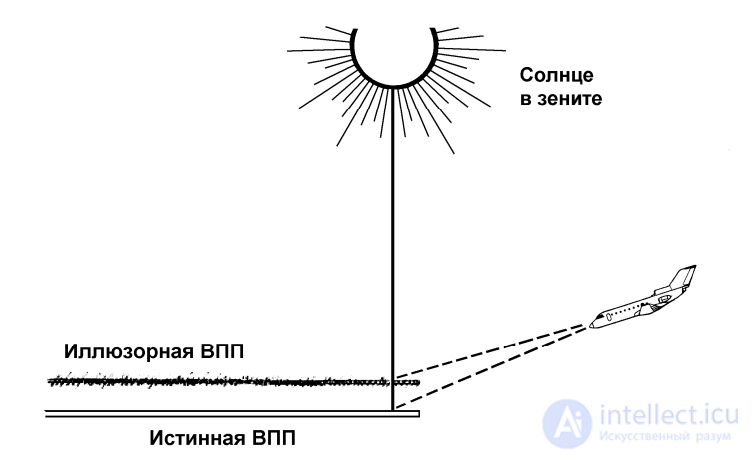
Fig. 4.1. The «noon mirage» illusion (after: Bibliothek des Flugzeugführers, 1980)
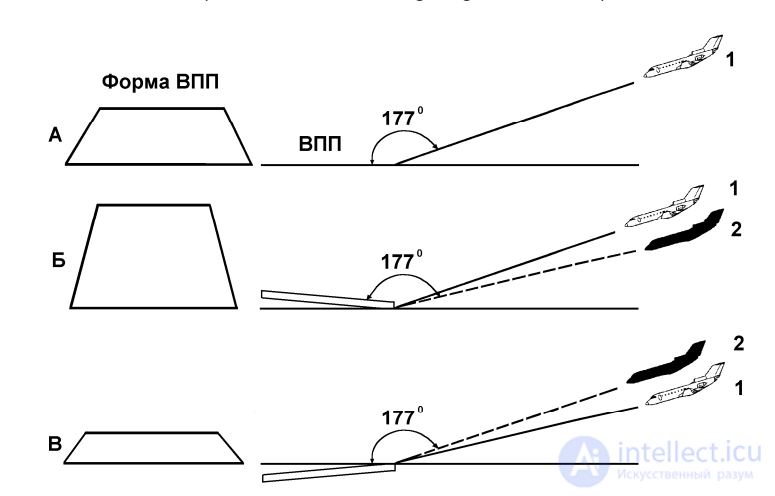
Fig. 4.2. Features of an aircraft's descent onto a runway with a positive (B) and a negative (V) slope (after: Pogrebnyak V.I., 1982)
One of the recent aviation events associated with an incorrect estimation of distance to the runway due to an existing positive slope (gradient of 1.14%) is
the hard landing (2.36 units according to the MSRP-64 flight data recorder) of a Tu-134 aircraft, which occurred on March 14, 2008
at Kharkiv airport (Kharkiv, Ukraine). Since the landing was carried out under conditions of limited visibility due to heavy snowfall, at night, on an artificial runway
with a positive slope and a black asphalt surface reflecting the light of the edge lights, the commander formed an erroneous impression of
the flare initiation altitude – toward its overestimation (Informatsionny…, 2008, No. 5).
The aircraft touched down on the runway with a vertical speed of 3.1 m/s, a pitch angle of 4.1°, and a forward speed of 276 km/h. According to the conclusion of the investigation commission, the causes of the hard landing were:
– descent along the glide path at a speed exceeding the recommended one, which led to the aircraft becoming unbalanced;
– landing of the aircraft on a runway with a positive
slope gradient of 1.14%;
– insufficient crew preparation: the individual training program for the commander after a break in flying duties (1 year 2 months) was insufficient.
Due to the varying degree of runway illumination, the runway may seem to be either farther away (in rain, runway lights appear
dimmer, creating a sense of greater altitude), or closer (water droplets on the surface
of the cockpit canopy can act as lenses, increasing the brightness of the runway lights, which is associated with lower altitudes), than it actually is.
If a runway has an elevation in its middle section, then after landing it may seem that the runway is shorter than it actually is, since
the far end of the runway is not always visible, which leads to attempts at abrupt braking
(Tepnadze S.A., Ioanidi M.B., 2002). As the authors indicate, this is the reason that on a Tu-104
in Vladivostok all the tires were damaged, even though the aircraft
had not covered even half the runway.
Runways elevated in the middle section (also referred to as «humped») cause discomfort for the pilot not only during the landing phase, but also during takeoff. Illustrative in this respect is the behavior of a pilot before preparing for takeoff, described by first-class military pilot A. Ena (1979). What is interesting in the pilot's behavior is not only
the oppressive feeling about the upcoming takeoff from a «humped» runway, but also the fear of appearing unprofessional in the eyes of others if he were to ask what particular features
are involved in taking off from this kind of runway.
So, the young pilot, having arrived at his new duty station, began studying the flying area. In a relatively short time he passed the required tests, after which the time came
for familiarization flights. The instructors' remarks concerned mainly the execution of the landing approach calculation and
the landing itself. The young pilot, however, was more concerned about a feature of the runway – it was humped.
At the point where the nose gear had to be raised, the runway seemed to break and then
dip to such a depth that by the moment of liftoff the aircraft was completely hidden from the view of an observer standing
at the start of the runway. The pilot was troubled by the question of how to raise the nose gear if the runway
disappears «below the horizon» during the takeoff roll. The pilot reasoned as follows: «If, as per
the instructions, I create a takeoff angle greater than required in advance, I might strike the concrete with the tail section of the aircraft.
Even with a normal liftoff, the fighter-bomber reaching impermissible angles of attack is not entirely excluded, which is unsafe. And
raising the nose wheel too little means deliberately lengthening the takeoff roll.» These thoughts did not frighten the pilot, but they caused doubt.
He did not dare approach the flight commander with such a question. He tried to ask a colleague who had arrived at the unit earlier, but
the latter was hurrying to a training session and answered the question with a joke: «Just take off more carefully.» On the eve
of the solo flight, taking into account remarks he had previously heard from experienced pilots that on this runway it was better to slightly «under-raise the nose» of the aircraft than to raise it above
what was required, the young pilot answered for himself the question that had been tormenting him. However, the next day his doubts returned. Immediately before the flight he saw the deputy squadron commander, who was overseeing the preflight preparation of pilots from a neighboring flight, and decided to clarify the question about the takeoff features, but then thought better of it, thinking: «What if he asks what I was doing during preliminary preparation? No, better to stay silent, I'll manage on my own. I'm just being overcautious.»
At the exact scheduled time, the young pilot received permission to start the engine and
taxied onto the runway. Having lined the fighter-bomber up along the centerline
of the runway, he thought: «And the far end of the runway isn't visible.» This thought was dismissed
by the decision he had already formed – to «under-raise the nose gear.» Before the aircraft lifted off the runway, the pilot thought: «The main thing is not to pull the stick too far, or the tail section of the aircraft will touch the concrete.» He pulled the control stick toward himself about ⅔ of the travel
that would be needed to create a normal takeoff angle. Having fixed this position,
the pilot waited for liftoff from the runway. At almost the same moment the aircraft, as if pushing off from
the runway, shot upward rapidly, but just before liftoff the pilot noticed that the aircraft jerked slightly to the left, which, in his opinion, occurred due to an increased crosswind. At
the established altitude the pilot was about to retract the landing gear, but heard a command from the flight controller: «110, do not retract the gear! Reduce speed!» This command caused
confusion in the pilot. A new instruction followed – to fly over the runway at
low altitude. After executing the command he heard: «110, your left
wheel has been destroyed. Burn off fuel in the circuit, prepare for landing.» The pilot thought the wheel had been destroyed due to a tire puncture. Only after landing did it become clear to him that, as a result of his unconventional actions at the moment of the aircraft's liftoff from the runway, he had exceeded the speed limitation set for the tires of the main landing gear, which led to the destruction of the left wheel (Ena A., 1979).
The perception of distance to the runway is also affected by the ratio
of the runway's length to its width: narrower runways are perceived as longer and more
distant (Fig. 4.3).
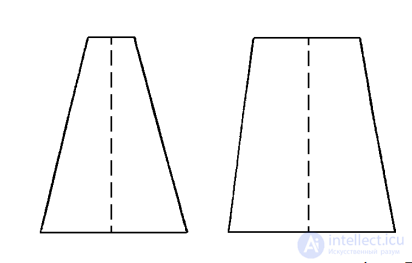
Fig. 4.3. Geometric illusions in estimating length (after: Pogrebnyak V.I., 1982)
A significant number of aviation accidents have occurred because the crew mistakenly took lights from ground sources (highway lights, lights of populated areas,
lights of the light horizon) for runway lights, or because of an incorrect correlation of the distance between the runway lights and other ground landmarks. Thus, if
a pilot observes aerodrome lights from a high altitude and the horizon line is not visible, on the landing approach an illusion of climbing may arise (due to the fact that the brighter
lights near the outer marker beacon appear to be located at a lower
altitude than the more distant runway lights).
Another example of this group of illusions is an incident that occurred
on January 6, 2000 with an An-24 aircraft of the airline «Yamal» at Krasnoselkup airport (Yamalo-Nenets Autonomous Okrug) – the aircraft landed 144 meters
short of the runway. The incident was linked to an unintentional descent of the aircraft
below the glide path due to the crew's erroneous perception of light-horizon lights as the runway's threshold lights.
The events preceding the incident unfolded as follows. The crew began descending using the ILS-type landing system. Descent from cruising
altitude to circuit height was carried out on the controller's instruction according to the approach pattern with a magnetic heading of 170°. The third turn was performed at a speed of 310 km/h with
a bank of 25°. After the speed was reduced, the landing gear was lowered and the flaps set to 15°. It should be noted that, according to clause 4.6.1 of the An-24 Flight Operations Manual, the landing gear
is lowered before the start of the third turn, and the «Before the third turn» section of the checklist is completed. After performing the fourth turn at a speed of 250
km/h with a bank of 25° at a distance of 10 km, the crew set the flaps to 30°, completed the checklist, and began the descent. In violation of the requirements of the «Instructions on
crew interaction and work procedures», after extending the flaps in
steady level flight the crew did not determine the engine operating mode for the landing configuration at the glide-path speed. Given that the descent along the
glide path was carried out at engine settings close to flight idle
(at an outside air temperature of –43°C, with the anti-icing system on),
the descent was begun somewhat later than the calculated glide-path entry point.
After the flight engineer's report «230, assessment,» the aircraft commander began to establish visual contact with ground landmarks and the lighting system. Due to the presence of smoke
drifting from the settlement toward the end of the unpaved runway and the approach lights,
the commander mistakenly took the light-horizon and approach lights for the runway lights. Having assessed the aircraft's position on the glide path solely by the position
of the runway lights he had mistakenly identified, the commander decided to
land. According to the flight data recorder (MSRP), the outer marker beacon crossing was performed below the crossing altitude with temperature correction (~
210 m instead of 252 m). The copilot did not intervene in the commander's actions and did not correct the error. After the flight engineer's report «200 m, decision height,» the commander
decided to land. The descent proceeded without a change in vertical speed, as
a result of which the aircraft was allowed to drift further below the glide path. An altitude of 60 m
according to the aircraft's radio altimeter was reached before the inner marker beacon crossing. The crossing altitude at the inner marker was ~ 50 m instead of the required 84 m (with temperature correction).
At an altitude of 30 m and a speed of 220 km/h, the commander gave the command to turn on the landing
lights, but due to the formation of a light screen they were turned off. After the lights were turned off, at
an altitude of 20 m, due to a reduction in the vertical rate of descent, the flight
speed decreased to 210 km/h. At an altitude of 10 m, after the engine operating mode was set
to 24° on the throttle position indicator, the speed and altitude continued to decrease further. After the flight engineer's report «190 km/h, 2 m,» the commander gave the command to increase engine power to 40° to avoid a hard landing. The aircraft's touchdown coincided with the beginning of the increase in engine power and occurred at a speed of
180 km/h with a load factor of 1.0 g, 144 m short of the runway threshold, 43.2 m to the right of the centerline
. During the landing roll on loose snow the load factor increased to 1.8 g. The aircraft struck
the approach light housing with the fourth blade of the right engine's propeller and damaged the blade (Informatsionny…, 2001, No. 4).
The investigation commission noted the extreme passivity of the copilot, his
failure to participate in correcting the aircraft commander's errors. It must be said that the passivity of copilots with regard to preventing and correcting the incorrect, inadequate actions of the commander – if not the rule, then an extremely widespread phenomenon.
Such behavior of copilots has been noted repeatedly. Several
types of copilot behavior can be identified. Thus, one type of copilot behavior consists
in the unquestioning execution of any command from the commander, however absurd. Such pilots
often say: «The more I stay silent, the more I agree and go along with the commander, the sooner I'll be brought up to command status.» Another type of copilot is expressed in an even more passive position: «The copilot's job is to sign paperwork, not to stick his neck out, no responsibility, but decent pay.»
An incident similar to the one described above occurred on January 12, 2001 at Bugulma airport with a Yak-40 aircraft, which landed 112 m short of the artificial runway. The approach was carried out under icing conditions with the anti-icing system and the air conditioning system switched on, with flaps extended
to 35°. The landing was performed 112 m short of the runway with a subsequent entry onto the runway with a deviation during the landing roll of 4 m to the left of the centerline. The cause of the incident
was erroneous actions by the aircraft commander, related to the fact that he mistook the light-horizon lights of the OMI M-2 system for the runway's threshold lights.
The investigation commission recommended that, during preliminary and prelanding preparation, the aerodrome's lighting equipment be studied more thoroughly, that the calculated crossing altitudes at the outer and inner marker beacons and the vertical rates of descent using the ILS-type system be strictly maintained, and that, in the event of losing contact with the runway lights, a go-around be initiated immediately (Informatsionny…, 2001, No. 3).
The two incidents described above show how a psychophysiological factor known as the «phenomenon of the target-location illusion», examined in the work
of V.V. Kozlov et al. (2000), manifests itself.
It turns out that even the lights of a television tower can be mistaken for runway lights (Gander
D.V., Kurzenkov G.K., Lysakov N.D., 2004). Scheduled training flights into an area at night were being carried out under
conditions of a cloudless, starry sky. The area was located 70–80 km east of the aerodrome.
Having completed the task in the area, the crew reported this to the flight controller and received
permission to approach the aerodrome toward the third turn with a descent to circuit height (400 m). The aircraft's blip on the radar was clear the entire time, until, on approaching the «box» pattern at about 10 km, it suddenly disappeared, which the plotter immediately reported. The flight controller queried the crew, but there was no response. At this time another
crew requested permission to approach the aerodrome toward the third turn with a descent to circuit height. The flight controller told this crew that another crew was already heading toward the third turn, and therefore ordered increased vigilance and instructed them to call the crew that was not responding in order to determine its location and the reason for its silence
(the flight controller's instruction is explained by the greater range of
the airborne crew's radio relative to the ground station). After the request made by the crew on the controller's instruction, the commander of the «missing» crew came on the radio: «Completed the third turn, reached circuit height, and am in
the area of the fourth turn.» However, this was hard to believe, since the aircraft's blip
was absent from the radar screen, which is impossible while flying in the area of the fourth turn. Through the crew acting as a relay, the flight controller instructed
the «missing» crew to climb to 1,200 m, request «Priboi» (heading to the aerodrome), and
proceed on that heading.
Some time later the aircraft's blip appeared on the radar screen north of the aerodrome
at a distance of ~ 50 km, after which the crew carried out the approach pattern, descended, came in for a landing, and landed safely. As it turned out, the crew had temporarily lost spatial orientation. After receiving permission to approach the third turn, the crew, on the
navigator's command, set a course for their aerodrome. The heading taken was correct, as confirmed by the movement of the blip on the radar screen, but this lasted only for a certain time.
The navigator saw red lights of a television tower ahead to the right and mistook them for the aerodrome's approach lights. He reported to the commander that he saw the aerodrome and gave a command to turn right, believing
that the aircraft had overshot the runway alignment, and that in order to move away from the aerodrome to the width of the circuit it was necessary to perform a maneuver to the right. Both pilots confirmed that they saw the runway. The crew
began to perform a maneuver to approach the illusory runway – the television tower. A vertical object can be approached from any direction and will appear correct, because
relative to the aircraft's track the television tower has no length along the ground
(Gander D.V., Kurzenkov G.K., Lysakov N.D., 2004). At this moment the crew received an instruction
relayed by another crew, conveying the flight controller's order to climb.
A new danger arose – once the illusion had ceased, all crew members began
to analyze the causes of the deviation, whereas they needed to concentrate on continuing the flight in order to complete it safely.
D.V. Gander, G.K. Kurzenkov, and N.D. Lysakov (2004) indicated the flying experience of this
crew. The aircraft commander (captain) had been flying this type of aircraft
for about ten years, in the position of commander – for about three years – and all in the aerodrome area.
The navigator (senior lieutenant) had flown in the position of second navigator for about ten years, in
the position of navigator – for about two years. The copilot and the second navigator had a combined flying experience of less than one year.
Landing lights are also confused with the lights of industrial-facility antenna masts. This is why an accident occurred to an An-24 aircraft of the Romanian airline
«Tarom» on November 15, 1971 near Otopeni airport near Bucharest (Antonov O.K.,
2009, a). The aircraft commander, while making an approach for landing, saw red lights on the antenna masts of an industrial facility located along the landing course. Mistaking these lights for landing lights, the crew began the landing over a forest. The aircraft first struck the trees and then landed on the territory of the industrial facility at a distance of 1,100 m before the start of the runway. The 24 passengers were practically unhurt (they sustained minor bruises). The crew, consisting of the commander, copilot, and flight engineer, sustained significant bodily injuries.
Up to this point we have examined illusions related to mistaking lights from ground objects for runway lights, but illusions related to ground light sources are not limited to these. An aviation accident involving an An-26
occurred at Saransk airport at night during takeoff on February 6, 1986. The crew was flying
a route «Nizhnevartovsk – Sverdlovsk – Saransk – Gomel.» 48
seconds after the start of the takeoff roll (at an altitude of 120 m and a speed of 280 km/h), the copilot, who was actively flying the aircraft, gave a command to retract the flaps, which was
carried out by the flight engineer in accordance with the Flight Operations Manual. At the 53rd second of flight (at an altitude of 150 m)
the aircraft commander saw a moving object in the form of two red lights and took
it for an oncoming aircraft. The aircraft commander warned the crew of this: «aircraft,» to which the copilot replied: «I see it,» after which, to avoid a collision (at an altitude of 156 m), he leveled the aircraft into horizontal flight with a turn away from the takeoff heading to the left, followed by a smooth descent. At the 68th second the navigator, noticing a decrease in altitude
of 60 m, reported very emotionally: «Climb, altitude, alti… What are you doing? Climb!»
The aircraft commander did not heed the navigator's warnings and continued to move away from the «oncoming aircraft» with a descent, an increase in bank up to 21.5°, and a slip to the right. At the 72nd second (at an altitude of 93 m), the commander, having confirmed that they had separated from the
«oncoming aircraft,» began removing the bank, which turned out to be insufficient, and at an altitude of
87 m, with a bank of 17°, the aircraft struck a tree line and sustained some damage.
The aircraft then touched the ground and, while moving across a flat snow-covered field, was completely destroyed. Crew members sustained various injuries.
Let us consider one more unusual group of visual illusions, arising in whiteout – an atmospheric phenomenon encountered in winter in the regions of the Arctic and Antarctic.
It occurs under conditions of low cloud cover and a snow-covered ground surface, not
only during precipitation, thick fog, or haze, but also in clear weather with diffuse
lighting. During whiteout, the visual perception of the surroundings is formed not from actually
observed visual sources, but from mental assumptions, since the eyes cannot
determine color contrasts and surface structure (Lazarev R.A., 1984). The danger
lies in the fact that when the pilot's mental representation that everything is proceeding
correctly is sufficiently strong, it can override insufficient visual sources that would otherwise raise concern.
The occurrence of this illusion under low cloud cover and a white underlying surface is explained as follows: low, sufficiently dense clouds
eliminate all shadows and differences in surface structure, so that lows and highs on
the ground merge into a single flat surface (Lazarev R.A., 1984). In addition, the clouds and the surface of the earth have almost the same color, so the horizon disappears. All this does not
allow a visual assessment of flight altitude, speed, and aircraft attitude. Thus, if visibility is good, flying should be conducted only by instruments.
Visual-vestibular illusions arise with equal participation of the visual and vestibular analyzers, which are interconnected by numerous unconditioned-reflex links. Stimulation of the vestibular apparatus naturally leads to visual illusions, a narrowing of the scope of attention, and errors in determining the spatial
position of objects. Visual illusions arising from stimulation of the vestibular
apparatus can be produced experimentally by rotation in a Barany chair.
The triggering mechanism for visual-vestibular illusions can turn out to be the perception of certain
kinds of glow. An example is the illusion arising as a result of the appearance on the windshield of the aircraft's cockpit of static electricity discharges with a subsequent
sensation of bank while breaking through cloud cover (Gander D.V. et al., 2003). When breaking through storm
clouds, the static electricity discharge appearing on the cockpit windshield may take the form of lines, rectangular figures, or spots and may move across
the glass from left to right and in the opposite direction. At this moment the pilot develops
a sensation of a left or right bank and a shift in posture toward the apparent bank. The duration of the illusion ranges from a few seconds to minutes. Pilots who encounter this illusion note that if the causes of the illusory sensation are not analyzed after the flight, it may
appear again. When this
type of illusion appears, a switch to instrument flying is necessary, along with checking
the synchronization of the readings of the primary and backup groups of flight-navigation instruments.
The negative effect of this illusion is manifested as follows:
- the occurrence of stress;
- concentration of attention on suppressing the illusion, distracting the pilot from the flying process;
- performance of inadequate control actions (counteracting the bank, correcting it).
In the situation described above, the pilot fought against the illusory sensations that arose in him (Gander D.V. et al., 2003): «I feel my body, together with the aircraft, banking to the right. Such a sensory perception can arise only with a visual reference to
the natural horizon or ground landmarks, but there are none and cannot be – there is impenetrable darkness all around. A glance at the attitude indicator – there is no bank at all, but I feel this bank,
it weighs on me. I overcome it, overcome it in my mind. It's very difficult,
almost painful. The unpleasant sensations intensified when an instruction came from the command post
to perform a turn. I create a left bank of 30° to roll out onto the landing heading.
The instruments show that everything is correct, I am performing a left turn, the heading is gradually
decreasing, approaching the landing value. But what is this? I still feel
that I am in a right bank. The impression is that I am performing a right turn with a bank of 30°.
I provoke my own sensations with a brief increase in the left bank and immediately establish a bank of 30°. And what happens? I increase the bank toward the approach direction and painfully feel
an increase in the bank in the opposite direction. I reduce the actual left bank, and the sensation
of a right bank decreases. There is a clear mismatch between the analyzer systems. The position of the body
is perceived as exactly the opposite of the visual perception of the instrument readings. Nevertheless, I rolled out exactly onto the landing heading, lowered the landing gear and flaps, and established the descent regime. Somehow the sensation of a right bank imperceptibly disappeared, and the unusual glow on the canopy glazing also vanished somewhere.»
A similar description of the struggle against flight illusions is given by first-class military pilot
I.B. Kachorovsky (1977). «I completed the turn… I can clearly see that the aircraft silhouette on the attitude indicator has settled at the needed mark, but I feel something completely different. I clearly sense
that the aircraft is flying inverted, and not in level flight, but with its nose pitched up. I look
at the instruments… Everything is in order on the instrument panel, but not in order within me. I tried in vain to convince
myself that the truth is in the instruments, that ultimately, in inverted flight, I would be hanging on my
straps and dust from the floor would be flying into my eyes – nothing helped. The sensation is so distinct
that I hold firmly onto the stick, afraid of coming off the seat. My consciousness split in two. Within me
there sat two people, who related to the situation that had arisen in completely different ways.
One was governed by feelings, sensations, and demanded that I act in accordance with them. The other was governed by reason, and demanded that I trust the instruments, their readings. But these two shared one
pair of hands – receiving contradictory instructions, they didn't know what to do. For some time I could not
move the control stick, even though I clearly saw that the flight regime was being disrupted. When
I finally, with an enormous effort of will, forced myself to deflect it in the needed direction, I did it
so miscalculated that the vertical speed indicator needle, instead of coming to zero, shot straight past it and went off in the opposite direction… Why can't I get rid of the false sensations, where is their source? And suddenly I catch myself, although I am
looking at the instruments, wanting all the time to look over the side. And it's impossible to convince myself
not to do this. And with peripheral vision I keep seeing it all the time, this space. In the reflections of the red cockpit lighting, through the glinting, glare-covered canopy glass, I see a pink haze – that space in which I wanted to orient myself and determine visually what position the aircraft is actually
in. But apart from
this pink haze, nothing else is visible there… With my teeth clenched and gripping the control stick tightly, I stubbornly «drove» the instrument needles to the needed marks. And they danced around them, not
wanting to settle. Relax the muscles! But I couldn't do this either. It seemed
that only extreme tension was keeping the aircraft under control. And the moment I relaxed,
it would stop obeying. It seemed to me that this furious struggle with the aircraft was going on for a very long time and that I hadn't given up. Yet there was no sense of victory. Terrible fatigue, the feeling of a need to give myself a break, took over. And I emerged from the clouds.»
I.B. Kachorovsky (1977) points out that the situation described above was preceded by emotional tension before the flight: strenuous work in the preceding days, an unpleasant
conversation with a superior. As a result there was no proper mindset for the flight. During the flight a feeling
of apathy and distraction never left him, and extraneous, «earthly» thoughts kept intruding. The causes of what happened became clear to the author. In another flight, described by the author in the same work, the illusion of inverted flight arose for a different reason. During a night flight, when
he turned his gaze to the space outside the cockpit, I.B. Kachorovsky saw a distinct horizon line to the left (before this, flying had been carried out strictly by instruments, without looking outside the cockpit). But this horizon line turned out not to be horizontal, as expected.
It «reared up on the side to my right, and dropped away somewhere below on the left, under the aircraft's wing.» He immediately got the sensation that the aircraft was in a steep bank and about to roll onto its back. The thought arose: «Have the instruments failed?» The instruments, however, were functioning properly and
indicated that the aircraft was in level flight. It became clear to I.B. Kachorovsky
that he was dealing with an illusion, but the urge to bring the aircraft out of its seemingly abnormal state nevertheless arose. By an effort of will he had to concentrate his attention
on the instrument readings, as well as to turn his head. The illusory sensations gradually receded. Only after the flight did the pilot realize that what he had taken for the horizon
line turned out to be cloud cover that he had seen from a distance: «It cut into the starry sky like a sharp wedge, and I mistook its edge for the horizon.»
As can be seen from this description, the illusion of inverted flight represents a visual-vestibular illusion: the triggering mechanism was a visual stimulus (cloud cover)
that produced an illusory sensation of banking.
Vestibular illusions include the illusions of: bank, nose-up (nose-down),
counter-rotation, and altered perception of airspeed.
The illusion of bank can be produced in several ways. An illustration of the first
method is a situation in which the aircraft enters a bank with an acceleration that is
subliminal for the receptors, such that the pilot does not sense the aircraft banking
. Under such conditions, a rapid return of the aircraft to a level attitude is perceived as a bank in the opposite direction, which pilots
try to correct, thereby creating a bank in the original direction (Illusions in
flight…, 1962; Alyakrinsky B.S., 1985). The second method is incorrect execution of a turn: if it is too shallow, the pilot's body will lean strongly in the direction opposite to the turn, so that an impression of a bank in the opposite direction arises. The occurrence of the bank illusion can be promoted by incorrect posture of the pilot in the
seat and functional asymmetry (Gr. a – negation + symmetria – proportion) of the vestibular apparatus.
Nose-up and nose-down illusions. In level flight these illusions most
often arise during changes in the aircraft's speed. Under such conditions the forces
of inertia add to the force of gravity and, as a result, produce a sensation of displacement either forward or backward. The vector of the transformed force of gravity, as the aircraft's speed increases, tilts forward, creating conditions for a false sensation of climbing (nosing up). The vector of the transformed force of gravity, as speed decreases, tilts backward, creating a false sensation of nosing down and losing altitude. Nose-up and nose-down illusions also arise when performing a turn, during a climb, and
during descent. If, when performing a turn, the magnitude of the transformed force of gravity significantly exceeds the pilot's weight, he may experience an illusion of nosing up. Conversely, when coming out of a turn, due to a subjective reduction in
the pilot's perceived body weight, it may seem to him that the aircraft is losing altitude (the nose-down illusion).
The illusion of counter-rotation arises immediately after the pilot exits a
rotation regime of the aircraft, and is expressed as a sensation of movement in the direction opposite to the aircraft's rotation. The counter-rotation illusion manifests itself when performing
such aircraft maneuvers in which the rotational movements are carried out at a high
rate and with a small radius. These are steep turns, spins, and spirals. The mechanism
by which the counter-rotation illusion arises consists in the endolymph (the fluid
filling the semicircular canals of the vestibular apparatus) lagging behind the walls of the canals when the human body rotates with accelerations (Illusions in flight…, 1962; Alyakrinsky B.S., 1985).
The illusions of altered perception of airspeed include the illusion of exaggerated
loss of speed and the illusion of contrast. The first arises when the landing gear is extended: the loss of speed
actually taking place is overestimated, and the pilot, believing that the aircraft
is beginning to «hang,» struggles to refrain from increasing speed. The second is observed
when transitioning from a faster to a slower aircraft: in particular, when transitioning from
military types of aircraft to civilian ones (Platonov K.K., Goldstein B.M., 1972).
The problem of preventing flight illusions lies not only in preventing illusions on the basis of explaining the mechanisms of their occurrence and listing the psychophysiological factors that contribute to their appearance, but also involves including, in the flight-crew
training system, sessions in which skills for counteracting
illusions are practiced.
At present the following factors can be listed as reducing the risk of flight illusions occurring.
1. Analysis of the causes of aviation events associated with distorted perception of reality.
2. Somatic health, which presupposes the use not only of standard medical examination data, but also the involvement of functional diagnostic data, which provides information about latent forms of disease or preclinical states of a person. Both represent no less a danger than acute forms of disease; even a mild indisposition significantly increases the probability of illusions occurring.
3. Emotional stability and the absence of such phenomena as neuroses, fatigue,
and overwork. Neuroses are often difficult to diagnose and represent a serious danger to flight safety not only because they can contribute to illusions,
but also because of inadequate perception of instrument readings and the statements of crew members.
4. The absence of serious autonomic deviations upon stimulation of the vestibular
apparatus. Studies of this kind are usually conducted using a Barany chair and make it possible to periodically screen out individuals with clear vestibular apparatus disorders.
5. Training of the vestibular apparatus both in the course of physical training and
in specialized sessions. For this purpose, pilots are recommended to engage in
sports that involve sharp and frequent movements of the head and body. Conducting
special training of the vestibular apparatus is more problematic, since the reaction to
stimulation of the vestibular apparatus differs greatly between people: in some the sensitivity of the apparatus increases, in others it decreases, and in still others it does not change at all.
6. Flying skill, regular training on simulators and in real complex weather conditions, and rational distribution of duties among crew members.
7. Trust in the readings of aviation instruments (Komendantov G.L., 1963; Alyakrinsky B.S., 1985).
Despite the importance of this last point, cases of aviation accidents due to distrust of instrument readings are quite common.
1. On what basis can the classification of flight illusions be considered the most acceptable?
2. What aerodromes do you know that have a positive or negative angle of runway slope?
3. Name the most effective ways of preventing illusory sensations in flight.
4. Recall which specific illusory sensations you have experienced in flight, and how you overcame them.
5. Name the factors that will increase the probability of illusions occurring.
продолжение следует...
Часть 1 4 Flight Illusions: False Perceptions of Reality Experienced by Crew Members in Flight

Comments