
Lecture
Memory and thinking are mental processes of paramount, defining
importance in the professional activity of air traffic controllers and pilots.
Memory is the retention of information about a signal after the signal's action has already
ceased (the so-called trace reflection of experience). Memory is based on associations, which from a physiological point of view represent nothing other than a temporary
neural connection (that is, a conditioned reflex). Memory is a mental process
consisting, in turn, of the processes of memorization, retention, recognition, and reproduction (General…, 1973).
1. Memorization (imprinting) – a process aimed at retaining received impressions in memory, is a prerequisite for retention. Memorization can be involuntary or voluntary. Involuntary memorization is unintentional memorization,
memorization without a purpose or effort. Special experiments have established that
what is involuntarily memorized is that which is connected with the purpose of the activity, its main content. Unlike involuntary memorization, voluntary memorization presupposes the presence of a conscious goal. The success of memorization is influenced by: the meaningfulness of the material, the amount
of knowledge a person already has, the purpose of memorization, memorization techniques (identifying the main ideas, semantic grouping, semantic outline, semantic correlation), personality
traits.
2. Retention – the process of actively processing, systematizing, generalizing the material, and
mastering it. The process of retention depends on the depth of understanding, the extent of application of acquired knowledge, and personal attitudes.
3. Recognition – the process of restoring what was previously perceived upon a repeated direct encounter with the object.
4. Reproduction – the process of restoring what was previously perceived in the absence of the object. Reproduction can be involuntary or voluntary. Involuntary reproduction presupposes spontaneously arising reproduction, triggered, as a rule, by
one association or another. Voluntary reproduction is a purposeful process of restoring particular material in consciousness. Reproduction is
not a mechanical process; it implies mental processing of the material, which can
manifest itself in a change of the presentation plan, or the introduction of additional material.
The classification of memory is carried out on many grounds. Depending on whether
information belongs to the species or is acquired in the course of individual development,
species memory and individual memory are distinguished. The information of species memory has been accumulated in the course of the evolution of the species and fixed in the form of innate reflexes, while the information of individual memory is acquired in the course of ontogenesis in the form of conditioned reflexes.
Depending on what is memorized, a distinction is made between motor memory (a person's memorization and reproduction of movements), emotional memory (memory for emotions and feelings), figurative memory
(memory for representations), and verbal-logical memory (the memorization, retention, and reproduction of thoughts in verbal form). They arise in this sequence in ontogenesis. Depending on the length of time for which information is retained, memory is divided
into short-term and long-term memory.
Memory is the process of forming a network of associations (conditioned reflexes), which
we «weave» throughout our lives and on the completeness of which the fullness of our psyche depends, since the psyche is represented by unconditioned and conditioned reflexes, the former of which are given to us
at birth, while the latter are formed during the course of life. This is precisely why the methods of memorization, which
will be discussed below, are nothing other than methods of forming conditioned reflexes.
Let us name the methods and conditions of memorization.
1. The presence of certain emotional states that are especially conducive to the formation of new conditioned connections. These include either a state of experiencing strong positive emotions (the emotions of interest and joy), or a calm state involving the absence of any negative emotions associated with the processing of psychotraumatic situations (otherwise all mental energy will be spent exclusively on processing psychotraumatic information rather than on memorizing information!). The aforementioned emotion of interest is fundamental to the formation of both memory and intelligence!
2. The information being learned should be structured: cognitive goals should be formulated clearly and precisely, essential information should be selected while excluding secondary information, and the information should be broken into parts of varying volume, forming one's own plan.
3. It is necessary to comprehensively and intensively use all analyzers. When working with
text, one should not only aim to understand the meaning but also represent its content in figurative form; the main ideas of the text can be jotted down on paper or spoken aloud.
4. It is necessary to relate what is being learned to what is already known, to identify the criteria by which
the information presented now will be evaluated and compared with what
is already in memory (it is easier to remember what one has worked out oneself than what is given ready-made by someone else).
5. Learned information should be periodically reproduced, each time enriching
it with new elements.
6. It is important to recognize the necessity of memorizing information for one's own work
and for raising one's own intellectual level, since memory is part of the structure of intelligence and is one of its components (the more information a person possesses, the easier it is to memorize subsequent information; in other words, the more branched the network of
conditioned reflexes, the easier it is to find an association with one reflex or another – information that is in some way similar to what is being learned at the moment).
It is necessary not only to possess a large body of knowledge but also to be able to correctly
operate with the imprinted information. A high level of intellectual ability is a necessary condition for mastering any aviation specialty.
The most important intellectual abilities for air traffic controllers include flexibility of thinking, its criticality, well-developed spatial representations, the capacity for systemic analysis, and the capacity for forecasting. Air traffic controllers, just like
pilots, often have to solve non-standard intellectual tasks in the absence of a rigid system of algorithms. As for the intellectual abilities
of pilots, the requirements placed on them are even greater. Thus, K.K. Platonov (1960) attributes to the positive
qualities of pilots' thinking such traits as activity, criticality, speed, flexibility, depth, and concreteness. Subsequently (Platonov K.K., Goldstein B.M., 1972), the qualities of mind necessary for pilots were described in more detail. By criticality of mind the authors mean the ability to evaluate one's own mental activity; by depth of mind – the ability to penetrate the essence of phenomena; by flexibility of mind – the ability to find new solutions
when the situation and conditions of activity change; by breadth of mind – the ability to grasp the whole issue while not losing sight of the parts necessary for the matter; by speed of mind – the speed of solving mental tasks. The authors note that excellent piloting technique should not, for example, be the sole criterion for evaluating whether a first officer is ready to move up to the position of captain, since a captain will only
successfully cope with his duties when he is able to make quick and
correct decisions in unexpectedly changing conditions. The cause of most aviation events related to the «human factor» is not errors due to poor piloting
technique, but the inability to correctly and promptly assess an emerging complication, or the inability to make the correct decision to get out of a complicated situation (Platonov K.K.,
Goldstein B.M., 1972).
Among the extremely important intellectual abilities of pilots, V.A. Ponomarenko
and V.V. Lapa (1985) include pronounced operational thinking and the capacity
for anticipating events. These abilities allow a pilot to make sound decisions in special
flight situations. By operational thinking, V.A. Ponomarenko and V.V. Lapa (1985) mean the ability to actively select the characteristic features of a situation and, through inference and analysis, to quickly work out a new scheme of action (in other words, this is a specific way of processing incomplete information that ensures successful action under uncertain conditions, allowing the single necessary feature to be singled out from a mass of features, one by which the situation can be recognized and a decision made). The degree of readiness of
pilots to act successfully in special situations is determined by the ability to process
uncertain and contradictory information, and this ability is evidently based on knowledge gained through analysis of one's own flight experience, the experience of one's colleagues, and the experience of flight crews who were involved in one aviation event or another.
If a pilot wishes to fly safely, he needs, at a minimum, to know all the aviation events associated with the type of aircraft on which he is preparing to fly (or already
flies). And this is truly «at a minimum», because one may encounter, in flight, a situation that has not yet occurred in the operational history of that particular type of aircraft
but has occurred on other types, with the knowledge of how to counter this
situation already available.
Thanks to training experiments in which an emergency situation was simulated involving
the unexpected failure of the only engine, it was possible to reduce the time needed
to recognize the failure by a factor of 3–4 (Ponomarenko V.A., Lapa V.V., 1985). The training experiments conducted
allowed the authors to conclude that the development of operational thinking can be achieved through the following measures:
1) demonstrating in flight the non-instrument signals that arise upon a failure;
2) the unexpected introduction of an engine failure, not envisaged by the flight assignment,
with subsequent analysis of the flight and identification of the signs of the failure.
In addition, the authors also studied the structure of a pilot's activity in the event of autopilot and flight-navigation instrument failures. It is emphasized that any failure should
be introduced unexpectedly, since when a pilot is set on the possibility of a failure occurring
in flight, the structure of attention allocation changes and instrument monitoring becomes more intensive. In experiments in which the pilot was warned about the type of
failure, the relevant instruments were monitored 3–5 times more often compared to the frequency and duration of their monitoring in an ordinary flight. After two to three training sessions in which
the same failure was introduced without warning, the time required for identification and the number of erroneous
actions decreased by 30–40%.
Speaking of abilities in general, it should be remembered that even a cadet's excellent abilities only give the possibility of rapid learning, while how the learning actually proceeds will depend on the activity of the cadet himself and his instructors, just as the absence of one ability or another does not indicate «complete flight unsuitability» or the impossibility of training the cadet (Platonov K.K., Schwartz L.M., 1948). The authors rightly point out that this merely means that more effort must be expended on this particular cadet
in order to develop his abilities in one way or another. Moreover, when answering
the question of abilities, one must not lose sight of compensatory mechanisms – mechanisms
that make up for certain physical and mental deficiencies through the development of other qualities and, at times, through their rather complex restructuring (Platonov K.K., Schwartz L.M., 1948).
The authors described examples of how compensatory mechanisms work and the
results they lead to. A pilot flying a training aircraft constantly looked around and turned his head – «like a fighter pilot during air combat». It turned out that as a
result of an illness a restriction of the visual field had arisen. This deficiency, which limited his perception, was compensated for by excellently developed attention, quick reactions,
persistence, and determination. Pilots whose attention span is insufficiently developed
often compensate for this by the ability to switch attention quickly, and by circumspection and caution.
Intellect (from Latin intellectus – mind) is a conditioned-reflex formation, woven
from a gigantic number of conditioned reflexes and performing the function of algorithms for processing information. All the objects and phenomena of the world around us are connected
by cause-and-effect relationships, and our task is to recognize, comprehend, and assimilate these cause-and-effect relationships and to be able to use them to solve whatever tasks
are at hand at a given moment. The magnitude of intelligence is determined by the number of assimilated
cause-and-effect relationships.
The most widely recognized model of the structure of intelligence is the cubic model of J.
Guilford (Guilford J., 1967). According to this model, there are 120 factors of intelligence,
which can be classified according to three independent variables
characterizing the process of information processing. The first variable is the content
of the information presented (the nature of the stimulus material), the second is the operations of information processing (mental actions), and the third is the results of information processing.
Each intellectual ability is described in terms of specific content,
operations, and results (Fig. 5.1).
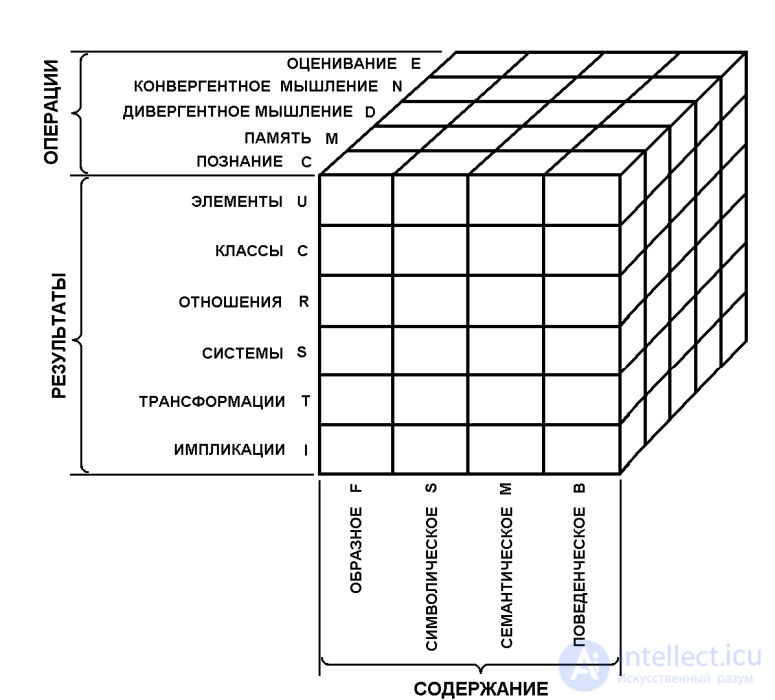
Fig. 5.1. J. Guilford's model of the structure of intelligence
The content of the information presented.
1. Figural (F) – visual, auditory, and other images reflecting the physical characteristics of an object.
2. Symbolic (Gr. symbolon – conventional sign) (S) – formal signs: letters, digits, notes,
code designations.
3. Semantic (Gr. semantikos – denoting) (M) – conceptual information, most often
verbal; verbal ideas and concepts; meaning conveyed through words or images.
4. Behavioral (B) – information reflecting the process of interpersonal communication: motives, moods, thoughts, and attitudes that determine people's behavior.
Operations of information processing.
1. Cognition (C) – discovery, recognition, awareness, and understanding of information.
2. Memory (M) – memorization and storage of information.
3. Divergent (Lat. divergere – to diverge) thinking (D) – the generation of a multitude
of diverse alternatives logically connected to the information presented, a multivariate search for a solution to a problem.
4. Convergent (Lat. convergere – to converge) thinking (N) – deriving a single
logical consequence from the information presented, the search for one correct solution
to a problem.
5. Evaluation (E) – comparison and assessment of information according to a particular criterion.
Results of information processing.
1. Units (Lat. elementum – primary substance) (U) – separate units of information, individual pieces of data.
2. Classes (Lat. classis – category) (C) – grounds for assigning objects to a single class,
grouping data according to their common elements or properties.
3. Relations (R) – established relations between units of information, connections between objects.
4. Systems (Lat. systema – a whole made up of parts) (S) – structured systems of information units, complexes of interrelated parts, information blocks, integral networks composed of elements.
5. Transformations (Lat. transformatio – conversion) (T) – conversions, modifications, reformulations of information.
6. Implications (Lat. implico – to closely connect) (I) – results and conclusions logically connected with the given information but extending beyond it.
Thus, J. Guilford's model describes 120 (5∙4∙6) intellectual abilities, each of which corresponds to a small cube formed by three coordinate axes: content, operations, and results (see Fig. 5.1).
Thinking is a mental process connected with the activity of the whole brain and expressed in the reflection of objects and phenomena of reality in their essential features.
Thinking is a process aimed at cognizing objective reality by
uncovering and establishing the connections and relations that exist between objects and phenomena. If perception is the reflection of a single object in its external features, then
thinking is the reflection of the general in the particular, of the essential in the incidental.
Thinking is characterized by the following properties (General…, 1973).
1. Sociality – consists in the fact that in posing and solving any problem, a person uses the laws, rules, and concepts accumulated by society.
2. Problem-orientedness – expressed in the direction of thinking toward solving a specific
task.
3. Generality – expressed in the fact that, when solving some specific task, a person does not
approach it as something entirely unfamiliar. He finds the category, the group of phenomena, to
which he can assign this new task, and selects accordingly the concepts, dependencies, as
well as the techniques, rules, and methods that should be used in this case.
4. Mediacy – expressed in the fact that thinking is expressed in (mediated by) language.
The process of thinking (the thought process) passes through a number of stages. For a
thought process to arise, two conditions are necessary: the ability to separate the new, unfamiliar from the known, and the desire to find out, understand, and uncover this new thing. The first stage
of mental activity is the awareness and formulation of the task, and the second is the solution of the task set.
Any process of solving problems consists of decomposing (analyzing) the perceived phenomenon into parts and establishing (synthesizing) connections and relations that were previously unknown to the person, both within a single object or phenomenon and between different objects and phenomena. Analysis is the breaking down of the whole into parts, differentiation, isolation, abstraction from individual features. Synthesis is the joining of parts and features, generalization, grouping, and the creation of a whole.
The processes of analysis-synthesis, being the basis of the thought process, manifest themselves in
various mental operations of a more particular character (General…, 1973).
1. Comparison – establishing the similarities and differences of the objects being compared.
2. Classification – combining objects into groups (classes, genera, species) on the basis of establishing similarities of major and minor features; classification is derivative of
comparison.
3. Systematization – also a grouping of objects, but not merely by the similarity of the basic features common to all objects of a given kind. Systematization involves identifying smaller subgroups within this group.
4. Generalization – combining similar objects by incidental features common to them. It can be observed in the form of generalization (Lat. generalis – general) and abstraction
(Lat. abstractio – withdrawal). Generalization is a level of generalization that involves combining objects by the similarity of individual, most often non-essential, features. Abstraction is a level of generalization that involves disregarding secondary features
that have no essential significance for a given task. Any rule or law derived from observation of homogeneous facts, phenomena, or dependencies under different conditions is a generalization. Any concept we use is likewise a generalization.
5. Concretization – the application of generalized knowledge to a specific, individual case.
The main forms of the thought process are judgment and inference.
Inference can be a movement from the particular to the general, in which case it is called inductive; when moving in the opposite direction, it is called deductive.
In the course of their professional activity, processes of probabilistic forecasting take place in the brains of pilots and controllers, and
these processes occur more acutely in them compared to other operators. The capacity for anticipation, for probabilistic forecasting, is one of the most decisive and critical abilities of an air traffic controller and pilot, without which it is impossible to carry out professional activity adequately and competently.
Probabilistic forecasting is the ability to compare information about the current situation, arriving through the analyzers, with information stored in memory about past experience, and on the basis of all this data to construct assumptions about upcoming events, assigning to each of these assumptions a certain degree of probability
(Feigenberg I.M., 1986). In accordance with such a forecast, presetting is carried out –
preparation for actions in the upcoming situation that will most probably lead to
the achievement of a certain goal. If the world were absolutely random, completely disorganized, probabilistic forecasting would not help one live in it. If the world were
rigidly deterministic (that is, if everything in it were unambiguously predetermined), probabilistic forecasting would prove unnecessary. Probabilistic forecasting is
the modeling of a probabilistically organized world by an organism living in that world
(Feigenberg I.M., 1986).
Forecasting processes allow an organism to better prepare for future events and therefore have great biological significance. It has been noted that the greater the discrepancy (mismatch) between a signal that has actually occurred and what was predicted, the
more information that signal carries and the more pathogenic it may prove to be
(Feigenberg I.M., 1963). In light of the role of probabilistic forecasting in adaptation to the environment, the author examined the nature of the orienting reaction. The orienting reaction (reflex) is
not a reaction to the amount of energy of a physical stimulus that has struck the organism, but a reaction to novelty, unexpectedness, and significance, that is, a reaction to the amount and importance of the information carried by a given signal for a given organism. The extinction of the orienting reaction upon
repetition of the signal is the result of the fact that the signal, while remaining physically (energetically)
the same, carries the organism ever less information. The orienting reaction and its
extinction are a biologically highly expedient phenomenon that promotes the adaptation of the organism
to a changing environment with the least energy expenditure. If a conditioned reaction is anticipation of a specific situation and preparation for it, then an orienting reaction is anticipation of an uncertain situation and preparation to act within it.
Probabilistic forecasting is the anticipation of the future, based on the probabilistic structure of past experience and information about the current situation (Feigenberg I.M.,
Zhuravlev G.E., 1977). Past experience and the current situation provide grounds for creating hypotheses
about the coming future, with each of them being assigned a certain probability. In
accordance with such a forecast, presetting is carried out – preparation for actions in
the upcoming situation that will most probably lead to the achievement of a certain goal. The authors emphasize that there are practically no situations in human activity in which
probabilistic forecasting does not play a significant role.
The capacity for probabilistic forecasting is the result of biological evolution
in a probabilistically organized environment. An organism's forecasts are designed to optimize the results of its actions. That is why they are adequate specifically to those variable characteristics of the environment on
which the success of the action depends. The totality of these characteristics has been called the organism's actual environment (Feigenberg I.M., Zhuravlev G.E., 1977). A subject's actual environment
includes those aspects of the real environment that are capable of affecting the satisfaction (or non-satisfaction) of the subject's needs. A subject's actual environment includes primarily those aspects of
the real environment on which the subject can act or which he can use,
increasing or decreasing the probability of satisfying his needs.
I.M. Feigenberg and G.E. Zhuravlev (1977) indicate that probabilistic forecasting can concern various aspects of the future and accordingly have a different character.
1. Probabilistic forecasting of the further course of external events not subject to the subject's control
(so-called «nature»).
2. Probabilistic forecasting of the further development of external events whose course the
subject can influence. Such forecasting encompasses not only the course of external events but also
includes forecasting the results of one's own actions.
3. A subject's actions are always purposeful, and the correspondence of planned actions to a certain goal (need) necessarily includes an assessment of the probability that a given
action by the subject, under conditions of the most probable development of external events, will make it possible to achieve
that goal or to get closer to it. The development of external events and the consequences of one's own actions is assessed not only in accordance with their frequency in past experience, but also in accordance with
their significance for the subject. As the authors indicate, this significance should be understood as the relation of the most probable future to what is, for the subject, the required (or desired) future. The subject assesses the significance for himself of the predicted events and compares the significance of possible variants of the future. In choosing his own actions, he takes into account both the probability of achieving the goal as a result of these actions and the significance for him of
the anticipated outcome.
4. The environment surrounding the subject is represented not only by elements of «nature», but also by «partners» – active elements of the environment carrying out purposeful behavior, whose goals may not coincide with the goals of the subject (in particular, they may be opposite).
In this case the forecast must include hypotheses about the most probable actions
of this active partner. But since this partner is active, the probability of one or another of his
actions depends on the actions of the subject – and not only on those already carried out, but also on those that
appear most probable to the partner. Thus, the «modeling of the probable
future» by a subject interacting with an active partner includes reflexive processes of various orders – hypotheses about «what he thinks I
think about him».
5. Constructing a plan of one's own actions must take into account not only the probability and significance of the predicted results of these actions, but also the magnitude of one's own costs (time, energy) required to carry out the said actions. Optimal are actions capable of bringing one closer to achieving the goal at an acceptable cost. Thus, costs must be assessed on the same scale by which the significance of goals is assessed.
Air traffic controllers and pilots are characterized by activity in which the occurrence of
one event or another may differ substantially from the forecast. A controller's or pilot's constant presence
in such an environment can, over time, cause overexertion or neurosis. The occurrence of the latter, in particular, is favored by situations in which a person experiences
a lack of information about how to act further (situations of uncertainty).
According to data from Yu.F. Tseplyaev et al. (1990), the effectiveness of an air traffic controller's forecast is significantly increased if:
– there is redundancy of information during direct air traffic
control;
– the controller is sufficiently familiar with the target's trajectory of movement and its characteristic
features have been determined;
– the controller is prepared to carry out air traffic control in the given
zone.
A characteristic of the quality of a forecast made is its accuracy, which depends on
the length of the forecast (the lead interval), the curvature of the predicted trajectory, and the components of the controller's workload (Tseplyaev Yu.F. et al., 1990).
So, forecasting processes allow the organism to better prepare for future
events, and in this connection the following should be noted: the more familiar a pilot is with the number of possible deviations in the operation of aircraft systems (based on his own experience of overcoming special situations and on the experience of aviation event investigations), the more
likely he is to cope with a given flight situation. Situations in which, given the same external manifestation (for example, a slowed rate of aircraft acceleration during takeoff run), the causes may be quite
varied significantly complicate probabilistic forecasting
(tire failure, a parking brake left engaged, insufficient engine thrust, aircraft overload, a non-standard flap setting for takeoff), and to identify the causes the pilot will need to use a
diagnostic table (of the «thesis – antithesis» type), which must already be present
in the mind by the time a special situation develops, since there is often
no time to solve the given problem (that is, the determination of the causes must be carried out by the method of gradual elimination
of variants). For the diagnostic table to work, the pilot obviously needs to know all the external signs (manifestations) of each of the known causes.
To illustrate what happens when crew members find themselves in a situation where
the cause cannot be established, let us cite an aviation event analyzed by N.F.
Mikhailik (1989). After the Tu-134A aircraft reached the speed V1 (the captain had already made
the decision to continue the takeoff), the increase in speed stopped at approximately 265 km/h. The flaps
were extended to 10°. At this moment, 500–600 m remained to the end of a runway 2,600 m long, and
this despite the fact that at this high-altitude aerodrome there were neither end nor side
safety strips. The runway was located on a mountain plateau (relative elevation = 2,000
m) and immediately beyond the runway a deep gorge began. When about 200 m
remained to the end of the runway, the aircraft's speed was 270 km/h. Each crew member, in a tense rhythm,
mentally searched for a way to save the aircraft (Mikhailik N.F., 1989). There were no deviations in the operation of the power plants, high-lift devices, landing gear, or other systems according to the monitoring instruments,
nor were there any extraneous noises or sounds in the operation of the engines or other systems.
The flight engineer was the first to react, saying: «Flaps!», and his hand automatically reached for the flap control handle. The captain and the first officer understood him instantly and gave the command: «Twenty!». The aircraft was pulled off the ground with almost the last meter of runway remaining.
The speed increased slowly, and the aircraft climbed with difficulty. Thanks to an updraft, a safe altitude was reached. Then an attempt was made to accelerate the aircraft in level flight: at an altitude of 3,600 m, after 10 minutes of flight, a speed of 500 km/h was reached, which
increased no further. The flight engineer inspected the wing high-lift devices, landing gear, and surfaces from the cabin – everything
was in order, but the aircraft was «short» by about 120–130 km/h. The crew had never before encountered such significant deviations.
The landing at the destination airport was made safely, after which the investigation commission began work: a control run of the aircraft's high-lift devices was performed, the operation of the warning systems was checked, and an inspection of the engines was carried out (blades, turbine discs, combustion
chambers). No deviations were found anywhere. After a repeat conversation with the crew members,
the commission chairman drew attention to the fact that the captain recalled that during the takeoff run
he had felt the aircraft being pulled slightly to the right, whereas, given the wind direction, the aircraft should
have had a tendency to drift left. Upon repeated inspection of the engines, the engineering-technical staff noticed excessive play in the doors of the right engine's thrust reverser.
When a control activation and deactivation of the reverser was performed from ground equipment, incomplete closure of the reverser doors on the right engine was discovered. In this case the warning signal for the doors not being closed had not activated. During five test runs of the reverser doors, the warning signal for the lock not being closed activated only once. It turned out that the cause of the failure of the warning signal was the destruction of the reverser door lock and, as a result, the incomplete closure of the reverser doors, which led to a significant loss of thrust during takeoff under limiting conditions. The crew's
actions were recognized as the only correct and possible ones under the circumstances (Mikhailik N.F., 1989).
Speaking of probabilistic forecasting in the activity of flight crews and the ability to anticipate the occurrence of one situation or another in flight, pilots need not only
to be able to forecast the very fact of an event occurring, but also to have a clear forecast of whether they
will be able, within a given period of time, to carry out one action or another to change the given event. For this it will be necessary to distinguish between the concepts of a time reserve and a time
deficit. A time reserve must be taken into account not only when a dangerous situation arises,
but also when performing every flight assignment as a whole or its individual elements. For example, after joining the final approach and before passing the outer marker, the pilot has a specific reserve of time within which he must manage to carry out a number of actions and operations. In addition to this, an allowance for time should be made in case it becomes necessary to make turns onto the landing course or to correct a deviation from the set altitude
or airspeed. Thus, the time reserve consists of the time needed to assess the flight situation, the time for an adequate action on the flight controls
to maintain the set or desired flight regime, and also the time needed
for the required maneuvering of the aircraft or for recovering it from a difficult situation (Pikovsky A.,
1972). A time deficit, on the other hand, characterizes a situation in which the time required for
the performance of a certain set of actions (or individual elements) exceeds the objectively available reserve of time. The author emphasizes that a time deficit
is related to the subjective capabilities of a person, and given the same reserve of time,
one pilot may find himself in a condition of deficit while another may not. The very fact of a time deficit determines the impossibility of performing all the necessary actions, that is, some
operation will not be performed. If there is a time deficit, one should speak of an emergency situation or a precursor to one. The author insists that a limited reserve of
time and its deficit should not be confused: with a limited reserve of time it is necessary to find ways to increase the effectiveness of activity and reduce tension,
whereas with a time deficit, urgent measures are already required to prevent an aviation event. So that a pilot does not find himself in a situation of time deficit, A. Pikovsky
(1972) proposed training based on the principle of practicing actions with a phased increase
in the tempo of work. To this end, on a simulator or during a training flight, after some exercise has been practiced, complications are introduced that require an acceleration of the tempo of work. If the pilot does not
skip operations and does not make mistakes, they move on to the next stage, at which the tempo
of work is accelerated even further – and so on until the training provides the pilot with the ability to get out of a time deficit. In the case of a time deficit, the task should not be made more complex
until, at that stage of training, the pilot begins to act without error
(that is, until he can manage within the given reserve of time). The author also recommends practicing
flights with a curtain remotely controlled by the instructor: if the instructor suddenly closes the cockpit canopy cover during the visual performance of some maneuver, the trainee
will be forced to switch to flying by instruments alone, and given the same reserve of time he will need to accelerate the tempo of work.
In addition to the above, it should be remembered that a time deficit for performing
some activity in flight is a psychological trauma (needs that must be met within a certain period of time are blocked).
How, then, can one raise one's own intellectual level? The most interesting thing is that the tenets of a program for developing and improving
already existing mental abilities are simple; what often proves difficult is deciding to implement this program and following it day after day. So, the ways of increasing the productivity of mental activity include (Vorobyov A.N., 1989).
1. Rational and adequate nutrition
(above all, a sufficient amount of animal protein).
2. A rational regimen of work, rest, and sleep. Switching to occupations and work of a different
kind.
3. Moderate physical work.
4. Mandatory intensive mental work, alternated with work of lower intensity.
5. Mandatory periodic extreme efforts in mental work, up to
the point of deep fatigue.
It should be noted that a break from this training regimen should not last more than
7–10 days. Regular training must not be discontinued for the rest of one's life.
Discontinuation leads to
a sharp decline in mental performance.
Types of training include (Vorobyov A.N., 1989):
- memory training – memorizing texts and numbers, retelling what has been read;
- writing down one's thoughts, which represents the best way to develop and
maintain one's intellectual level;
- solving various kinds of problems;
- creative activity.
In considering the problem of training the intellect, one cannot ignore P.Ya. Galperin's system of the step-by-step formation of mental actions and concepts (1985, 1998).
Before discussing this system, which includes four components, it is necessary to understand the premises from which the author proceeded in formulating his concept. It is entirely natural that the author would not have arrived at correct conclusions had he incorrectly understood what thinking is, what a thought is.
As P.Ya. Galperin (1998) writes, an individual thought is nothing other than an object-related action, transferred into the internal plane and then having passed into inner speech. The author continues: thinking is an activity «in order to find out», and nothing can be found out about things without
tracing (under clearly defined conditions) what they do and what is done to them. The difference
between certain object-related content, taken by itself, and that same object-related content as part of thinking lies above all in the fact that in thinking, the object-related process is not simply repeated, but appears as an image, and moreover in a specific function – to serve as a reflection of the original process and to provide orientation within it. Thinking is
a form of orientation to which we resort when other forms of it are insufficient. The author emphasizes that this function must not be forgotten even in cases where the task of such orientation becomes so complex that the construction of an image, an ideal duplicate of things, becomes, as it were, an independent task, and the image begins to appear as if
by itself, without direct connection to orienting activity. In thinking, what is
at issue is orientation in things on the basis of an image of those things, not the things themselves or their image as such.
P.Ya. Galperin (1998) writes that when the need arises to orient oneself in a situation with the help of an image, a special signal has developed in the phylogeny of active animals for this purpose – a signal of the «mismatch» of the situation unfolding with the standard conditions for
standard reactions, a requirement to check the situation and adapt possible
actions to it. This signal causes inhibition of immediate, automatic reactions (to
certain, previously operative stimuli) and the appearance of an orienting reflex. On this signal, orienting-investigative activity unfolds,
the actual position and purpose of the individual components of the field are established, and
correction of actions is carried out in the course of execution, allowing them to be adapted to the individual features of the situation. In this connection, P.Ya. Galperin (1998) relies on two
fundamental propositions formulated by I.P. Pavlov:
1) the orienting reflex necessarily precedes the formation of a conditioned reflex;
2) the more artificial and alien to the conditions of life (and hence to the animal's orienting activity) the combinations of stimuli are, the more difficult it is to establish
a conditioned connection.
The performance of an object-related action for the purpose of finding out what will result if such an action is
actually carried out – its orienting performance – constitutes a separate
act of thinking. But in order to use an object-related action for the purposes of thinking,
one must be able to perform it and, hence, must first learn to do so. And not merely learn in general, but
learn to perform it with certain specified indicators. These are dictated by the conditions of life, and therefore we are entitled to set such indicators as
today meet the fullest system of requirements for the action. The system of such highest indicators
is dictated by each field of knowledge and practical activity. Naturally, the formation of an object-related action with such predetermined properties is possible only
under certain conditions.
In the study of object-related actions, the starting question becomes: «What is needed in order to form such-and-such an action with such-and-such properties?». One should proceed not from the conditions to the action (whatever results), but from the given action to the conditions ensuring
its formation: not to observe and record the formation of the action, but to construct it!
In the course of formation, an action inevitably undergoes stereotyping to one degree or another – owing to the constancy of conditions or to their generalization, the isolation of their constant, principal part for the action. The stereotyping of an action leads to its mastery, which most directly expresses the formation of conditioned connections. The latter means
the physiological consolidation (in the form of a dynamic stereotype) of that reflection of environmental objects
which is obtained thanks to orienting-investigative activity. Since a dynamic stereotype is formed only in the presence of an external stereotype, that is,
under constant conditions, one can rely on such a picture. And if an action has an orienting purpose («to find out what will result»), then the outstripping of the actual performance of the
action by its picture makes the performance itself unnecessary; what we wish to find out, we find out (from past experience) without performing the action. Then its curtailment sets in, which under generalized, constant conditions goes as far as action «by formula». In action
«by formula», the original action is no longer performed, and the subject directly
moves from «the left half of the formula to the right» – from the initial data and instructions to the final result (Galperin P.Ya., 1998).
Curtailed operations are not simply eliminated but are transferred to the status of something that is, as it
were, already done and now «implied». Thanks to this, the action acquires a distinctive
appearance. Thus, for example, in the field of perception, the gaze no longer follows the path along which
the physical action proceeded and which it previously carefully retraced. Now, in spite of
obstacles, the gaze goes directly to the final point of that path. True, with «peripheral vision» the individual still monitors the state of the «actual path» and stops if he notices a change in it. However, this actual path is now not carried out but only «implied» – as
a substitute content for the ideal action that is actually being carried out, but which
no longer resembles it at all. Anyone who takes into account only this movement of the gaze point and does not know what
lies behind it cannot understand what action is being carried out.
When, on the mental plane, an action is curtailed to a formula, the successive transformations of the initial data are likewise no longer carried out but are only «implied». The presence of the
latter distinguishes full-fledged knowledge from «something learned by rote without understanding», but the movement itself
«by formula» also does not resemble curtailed object-related operations at all. And anyone who detects and takes into account only this ideal movement naturally concludes that the individual is no longer doing anything but merely answering from memory, and that the thought of the action
is something completely different from the action itself.
Thus, both in the plane of perception and in the mental plane, the object-related content
of the action is no longer carried out but is only «implied» beyond what is actually
being done. And this actual action is everywhere represented by the movement of the «point of attention» (in
the external or internal plane), a movement that goes straight from the starting point to the
final one contrary to the objective relations of the task, as if thereby demonstrating its
distinction from the object-related action and its disregard for the latter's objective logic, for its
difficulties. Attention appears as a «pure» directedness toward its objects – as mental activity in all its difference from object-related activity (Galperin P.Ya., 1998).
But studying the process in its genesis, the step-by-step formation of mental actions, opens up new possibilities for research and the true structure of the process. From the very beginning, cognitive, planning, and
control functions can be distinguished within the orienting part of an object-related action. Each of them is realized by a specific action, which in general follows the same path of formation, becomes ideal, and is curtailed. But among
the functions mentioned, control occupies a special position. First, its result is only an assessment of what is being done or has been done by other, productive kinds of activity; therefore it does not leave a separate product (by whose presence we usually
infer a separate mental activity). Second, it therefore never appears as a
fully independent activity, but always only together with some other activity, toward whose process and result it is directed.
On the mental plane, the object-related content of an action is represented not by sensory
images, but by the lexical meanings of speech, which is likewise curtailed to a formula. Therefore
mental content appears in self-observation not in the form of a sensory picture (of objects, or of the sounds of speech), but in the form of speech meanings without their acoustic value and articulateness.
The scale of step-by-step formation lays out successive levels that allow an action to be built, beginning with the orienting basis, through a material or materialized form, then in loud speech without objects, in «external speech to oneself», and, finally, in
«inner speech» proper. A separate object-related action, performed and traced «in order to find out», constitutes the natural unit of thinking (Galperin P.Ya., 1998).
According to P.Ya. Galperin (1985, 1998), the system of step-by-step formation of mental actions and concepts presupposes the fulfillment of four conditions.
1. Formation of sufficient motivation.
2. Ensuring the correct performance of the new action (= the condition for forming
the correct structure of actions and concepts).
3. Cultivating the desired properties of actions (= the condition of cultivating («honing») the desired properties of actions).
4. Converting actions into a mental action (= the condition of transferring actions to the mental plane while preserving the already cultivated and newly acquired, psychologically especially important, properties).
The implementation of this program of actions must obviously be present
in any type of instruction, including in the process of flight training. The question of the importance of
motivation in mastering material will be addressed by us in Chapter 8, where the essence of the emotion of interest is described in detail. As for the second and third conditions for the formation of mental
actions according to P.Ya. Galperin, their realization will depend on how well the instructor
(for example, a flight instructor) knows his subject and its methodology (in particular, the methodology of flight training), and whether he can single out, down to the smallest detail, all the operations and actions (and their sequence!) that the cadet needs to perform to form each
action being trained. The cause-and-effect relationships between the units of information being assimilated must be understood by the trainee down to the smallest detail, since only thoroughly understood
(rather than unconsciously accepted on faith) information is successfully assimilated! As an action is performed (provided it is correct), it passes into the
internal plane – it becomes interiorized. And from this moment on, the algorithm for performing the action is not
only understood and realized in the external plane in the form of actions set by this algorithm, but is also a mental action – a new, higher-order, more complex, conditioned reflex. One should invariably proceed precisely from this four-stage
understanding of the formation of mental actions in the learning process. This same logic (of thoroughly understanding the cause-and-effect relationships between units of information) should also be followed in analyzing errors made by cadets.
1. What place does figurative memory occupy in the activity of pilots and air traffic controllers?
2. How are intelligence and thinking related to each other?
3. Name the factors that influence the success of the thought process.
4. What errors have you made in forecasting the development of a particular situation, and what was needed to eliminate these errors?
5. Owing to the organism being in what kind of environment did the emergence of processes of probabilistic forecasting become possible?
продолжение следует...
Часть 1 5 THE ROLE OF MEMORY AND THINKING PROCESSES IN THE WORK OF PILOTS AND AIR

Comments