
Lecture
The professional activity of an air traffic controller is structured according to the structure and functions of the air traffic control system. The air traffic control system is designed to ensure a safe, orderly, and expeditious flow of air traffic and represents a complex ergatic (Gr. ergates – acting person)
system in which the central role is assigned to the air traffic controller.
In the air traffic controller's activity of managing air traffic, the following stages can be distinguished:
1) continuous monitoring of changes in the air situation, in the course of which incoming information is perceived and analyzed;
2) formation, on the basis of information about the air situation, of an integral model of the airspace with the aircraft located in it;
3) planning of one's own actions in accordance with the formed model of the air situation;
4) practical execution of the planned actions;
5) evaluation and monitoring of the results achieved in the course of executing the actions; analysis and generalization of information.
In turn, the implementation of the identified stages and the success of their execution depend on:
– the task, representing pre-formulated goals of the activity;
– the information (its completeness, accuracy, timeliness, reliability) available to the air traffic controller;
– the state of the automated control systems and their maximum capabilities;
– the working methods, that is, a certain set of sequential operations oriented toward
achieving a particular result;
– the conditions of the air traffic controller's activity;
– the nature of the organization of air traffic control (monitoring the proper
performance of duties, the principles of delegation of authority);
– the air traffic controller with the set of physical, psychological, and physiological characteristics inherent to them.
All these elements function as a single whole, mutually determining one another. Among the elements of this system, the human being is the most flexible and possesses the greatest adaptive capacity. By using all their capabilities, a person is able
to a significant extent to make up for a lack of information, imperfect and functionally limited
equipment, and primitive working conditions, and sometimes for tasks that are set before them incorrectly. At the same time, although a person's capacity for adaptation is great, it
nevertheless has its limits. If demands are placed on a person that do not correspond
to their capabilities, this leads to a decline in performance and, consequently, to the commission of errors.
The air traffic control system is an information system. The air traffic controller
manages air traffic on the basis of information about the dynamics of movement of aircraft
in the sector under their own control, as well as in neighboring sectors. The sources of information for the air traffic controller are various visual display means, as well as
radio and telephone communication. In automated control systems, information about aircraft is presented on the radar screen, where a tracking data block, consisting of three lines, moves together with the radar mark; each of these lines
contains no more than 8 characters. The lines carry information about the type of aircraft,
its number, altitude, speed, and remaining fuel.
Processing all incoming information is necessary for decision-making and represents a complex process, the main components of which are mnemonic and intellectual processes. The professional activity of an air traffic controller is highly intellectual and places special demands on the volume of short-term and
long-term memory, spatial representation, the speed of skill formation,
productivity, logic and criticality of thinking, and the ability to foresee events under
conditions of uncertainty.
The work of an air traffic controller involves processing information received from a wide range of technical means (radar stations,
indicators, radio direction finders, various display boards), representing and forecasting changes in the spatial position of aircraft, and timely informing
crew members of hazardous changes in air traffic. Note that
information from the radar arrives in coded form and must be decoded
into a representation that recreates the actual distribution of aircraft in the controlled
zone. Only after that does the controller analyze and assess the state of the air situation and transmit control commands to the aircraft crews. Using feedback, they monitor execution and assess the further development of the air situation. As a
result, on the basis of their own experience and the data received from display devices, the air traffic controller forms and constantly corrects a model for managing
air traffic.
By an information model (Zinchenko V.P., Maizel N.I., Fatkin L.V., 1965) is meant a representation of the actual situation, organized according to a certain set of rules and displayed on
indication devices. Such a model is realized, as can
be understood, by means of various information-display devices. A well-designed information model makes it possible to forecast the situation, which is especially necessary given the high rate of change of information flows, requiring
the air traffic controller to react quickly. A mandatory requirement for an information model is that it
correspond to the operator's capabilities, which implies excluding the possibility of their overload, and that it correspond to the content of the spatial image of the air situation. The purpose of the information model is to create a visual support for mental transformations of information.
The conceptual model represents a certain set of images of the actual and
predicted situation in which the control system operates, as well as a body of knowledge about the possible and necessary control actions under specific developing conditions. The content of the conceptual model includes images and representations
that play the role of generalized behavior patterns (Adrianova V.E., 1974). On the basis of an analysis of the information model, the air traffic controller must precisely identify one of the many
possible states in which the controlled objects are located. The more complex the tasks solved by the air traffic controller, the richer and more varied the images already contained
in the conceptual model must be. Thus, by conceptual model is meant the representation formed in the controller's mind about the air situation as a whole, about the factors that give rise to the development of dangerous situations, and about the ways of transitioning from a conflict to a conflict-free air situation.
An incorrect representation of the state of even one element of the air traffic control system, or the absence of an adequate conceptual model, can create
a threat to flight safety. A clear example of this is the aviation incident at Pulkovo Airport on July 4, 1986. In simple meteorological conditions, at 15:51,
at Pulkovo airfield, the controller of the start dispatch point (SDP) authorized a tug to cross the runway at the moment when an Il-62 aircraft holding at the runway threshold had been cleared for takeoff. At 15:46, the tug driver requested
the start controller's permission to cross the runway: "Via the fifth to
the first, without an aircraft," to which the controller replied: "Wait, denied" (a
Yak-40 was approaching to land). Not having clearly heard the taxiway number and having no view toward TWY-5 and TWY-3,
the controller did not clarify the tug's location. The controller then cleared the Il-62 crew
to the runway threshold and at 15:51:17 cleared them for takeoff. At 15:51:50, the controller told the driver: "Tug, cleared, cross to the second taxiway," mistakenly believing that the tug
was on TWY-3 and would cross the runway behind the aircraft. The tug driver,
having received clearance, asked the controller, "Is the Il-62 taking off then?" (15:51:55), to which
the controller very emotionally reported: "Tug, stop, tug, stop, tug!" To this
the tug driver responded as follows: "You've cleared the aircraft for takeoff, you give clearance,
how can that be? 'Start-2,' I've cleared the runway, but this really shouldn't happen, you're scaring me and the crews." The Il-62 crew saw the tug and began the takeoff only after making sure it had vacated the runway (Collection of information bulletins…, 1988).
There are two types of conceptual model: permanent and operational. The permanent conceptual model is formed in the course of a controller's training and practical activity and
represents a generalized understanding of the possible and permissible states of the air situation, of the tasks of air traffic control, the methods for solving them, and the possible
violations of procedure and their consequences. This model begins to be deployed in cases
where a given situation is familiar and there exists a perfectly clear algorithm, a program of action. The operational conceptual model is formed directly in the course of managing
air traffic, in an unfamiliar problem situation. Thus, its content
includes data drawn by the controller from the information model and from the permanent conceptual model, as well as completely new data arising as a result of solving one or another complex task. The operational conceptual model is nothing other than a decision-making model. The main mechanisms regulating the process of searching for a solution are operations of comparing the situation with previously formulated hypotheses and forecasting the course of activity.
The air traffic controller's work is considerably complicated by the absence of definite rules and norms
of behavior in critical, nonstandard situations, which gives rise to significant emotional overload, capable of substantially reducing the reliability of work. Emotional tension is fostered by situations of uncertainty, an information deficit,
information overload, controller incompetence, interference, unusual in-flight occurrences,
difficult weather conditions, conflict situations, equipment failure, and a high degree
of responsibility for flight safety. All of this accounts for the air traffic controller's constant state of emotional stress, during which serious functional shifts occur
in the body: blood pressure rises, heart rate increases, blood glucose levels change over a wide range,
and the activity of the sympathetic-adrenal system is activated. The professional activity of
air traffic controllers and pilots belongs to the category of emotionally intense activities, rich in psychologically traumatic stimuli. This accounts for the high incidence among aviation specialists of neurotic states accompanied by severe disturbances
of autonomic functions – in the form of so-called psychosomatic illnesses, the most
common of which are hypertension, gastric and duodenal
ulcers, and headaches.
The magnitude of neuropsychological strain is determined, in particular, by the degree of the air traffic controller's workload. It represents the extent to which the controller is occupied with the performance of
procedural operations involved in air traffic control. Let us name some of the
factors that directly influence the air traffic controller's workload:
- the intensity of air traffic;
- the size and structure of the airspace under the controller's control;
- the equipment of control points and the degree of automation of the air traffic control process;
- the flight rules within the area of responsibility and the restrictions on the organization of air traffic flow;
- the ergonomic characteristics of the controller's workstation;
- the state of somatic and neuropsychological health;
- the age and individual-typological characteristics of the air traffic controller's personality;
- the psychological climate within the team;
- the leadership style of the shift supervisor, and, more broadly, the organization of activity at
the aviation enterprise.
V.M. Kuzmin (1982), on the basis of conducted experimental research, identified
four principal factors out of the entire set of factors influencing the air traffic controller's workload. These are the number of aircraft simultaneously under control, the number of potentially conflicting situations, the loading of the "aircraft crew –
air traffic controller" radio channel, and the complexity of the air traffic control zone.
The author expressed the air traffic controller's workload by the following formula:
L = Lcoord. + Ltech. + Lconfl.,
where Lcoord. – the load of coordinating information between adjacent control points, %;
Ltech. – the load of managing air traffic between the controller and the aircraft
crew in accordance with the working procedure in the given control sector;
73
Lconfl. – the additional load in managing air traffic associated with
preventing conflict situations between aircraft.
The individual types of load (Lcoord., Ltech., Lconfl.) that determine the air traffic controller's overall workload are calculated, respectively, using the formulas:
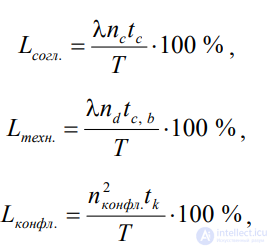
where λ – the intensity of aircraft movement over T = 1 h;
nc – the number of coordinations;
tc – the time spent on coordinations;
nd – the number of radio exchanges;
 – the average duration of radio exchanges;
n – the average number of conflict situations at a given λ in the specific control zone;
tk – the additional time required to resolve a conflict situation.
The degree of the air traffic controller's workload determines their ability to manage air traffic in a given zone. The maximum permissible workload determines
the controller's capacity. Capacity is the provision of reliable and safe air traffic control for the maximum possible flow of aircraft, given the structure of the airspace, the characteristics of air traffic, and the working procedure, while using all available radio-technical and navigation aids. In other words, capacity can be defined
as the maximum number of aircraft that an air traffic controller can service per unit of time.
Excessive controller workload is frequently a contributing cause of various kinds of incidents. Thus, the excessive workload of a controller at the Sverdlovsk Regional Center on 16
January 1986 became a contributing cause of a breach of safe separation intervals in the
control of air traffic between two Tu-154 aircraft. At the moment the shift was taken over, the controller had 10 aircraft under control (fig. 3.1). From 21:30
to 21:52, the controller worked with an impermissible workload (KZ = 0.85–0.90). From 21:52
to 21:56, the workload was at or below the standard level. During the period from 21:57
to 22:12, work was carried out at the maximum permissible workload. According to directive No. 927/U of 24.12.85, the controller was to be given a break in
work of at least 20 minutes. Because a second controller was unavailable for valid reasons,
no break was provided. The acceptance of the Tu-154 aircraft occurred during a period when the controller had not fully recovered their capacity for work. The controller himself explains the situation that arose as a result of his attention being diverted to resolving
a matter with the monitoring controller regarding his illness, and also by the fact that, under
complex air-situation conditions, ensuring flight safety is in some sense easier, since it requires
the mobilization of all mental functions (concentration of attention, working memory, continuous solving of mental tasks). By the time of the dangerous convergence, the air situation was simple, and following the mobilization there was a relaxation of mental functions.
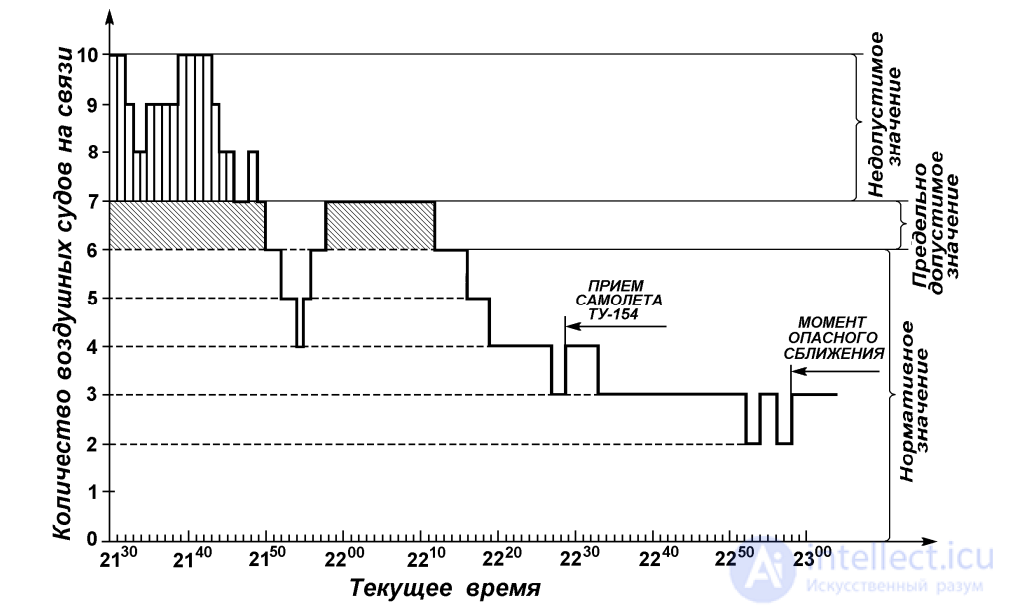
Fig. 3.1. Workload of the "Vostok" sector controller
(after: Collection of information bulletins…, 1988)
As the flight-operations director Yu. Zvyagin (1986) points out, the flight-operations management group's work is sufficiently effective at a certain number of aircraft during a flying shift.
If the number of aircraft exceeds this figure, conditions arise that are conducive to erroneous
actions. Thus, in 8–14% of cases, the flight-operations director issues commands without a specific addressee, without properly delving into the air situation (making inaccuracies, issuing commands not specified by instructions). Errors of this kind increase during the fifth hour of work. It even reaches
the point where, due to excessive information load, the director of the near-field zone, for example, misses individual control commands when crews transition to another flight level or to another area of responsibility. One of the typical errors of the flight-operations director and
air traffic controllers is the loss of the overall picture of the relative positions of aircraft within their areas of responsibility. As an illustration of how greatly information overload can affect the quality of air traffic control, Yu. Zvyagin described the following situation.
As flight-operations director, he authorized a crew to taxi onto the runway for takeoff. At that moment a telephone call came in, and then it became necessary
to speak over the loudspeaker communication system: on landing, one of the aircraft's
braking parachute had failed to deploy. At this time, a report came in from a crew located above the outer marker beacon. The flight-operations director switched on the floodlights and cleared the aircraft to land, after which he realized his
error: "And then it was as if I'd been struck by electric current: in the beams of the floodlights, a silver supersonic aircraft stood frozen on the runway. And another was coming in to land…" The flight-operations director sent
the approaching aircraft around for a go-around. Yu. Zvyagin (1986) emphasizes that taking into account the capacity of the members of the flight-operations management group, and mutual assistance (mutual correction)
within this group, is an indispensable condition for flight safety.
It should be noted that the same value of capacity for two air traffic controllers may be identical, but achieved through different amounts of energy expenditure
(one air traffic controller performed a given task flawlessly at the limit of their capabilities, while the other
still had some reserve remaining). To denote this phenomenon, the concept of operator reliability was
introduced. Reliability represents the same effectiveness (the operator's ability, over a certain period of time, with a given accuracy and under
certain conditions, to perform professional activity), with the sole difference
that it relates not only to a person's current capabilities but also to their potential (reserve) capabilities.
Psychophysiological reliability is the operator's ability to perform professional activity flawlessly while maintaining their psychophysiological
characteristics at an optimal level over a given interval of time, under
given environmental conditions.
To manage air traffic, air traffic controllers must simultaneously use a large volume of information. Depending on how long a given piece of
information is retained, it may be divided into permanent information, stored in long-term memory, and operational information, held in short-term memory.
Permanent information may remain unchanged for even several years
(the main governing documents, instructions, and the equipment used to carry out radar monitoring). Periodically, governing documents and equipment
undergo changes, and this is sometimes very difficult for controller personnel to accept (stereotypes that have formed over decades of work are extremely difficult to break). An example is a situation that arose in the air traffic control service of one airport.
In connection with an equipment upgrade, the aircraft mark on the radar screen, which had been in the form of a rectangle, was replaced by a mark in the form of a cross. This innovation caused dissatisfaction among the staff, expressed in demands to restore the marks to
their previous appearance: "We are used to those marks; the new marks are difficult to associate with aircraft" (Yevstigneyev D.A., Karnaukhov V.A., 2005).
Operational information is constantly changing information (parameters characterizing the speed, altitude, and position of individual aircraft, weather forecasts, the runway friction coefficient). In contrast to permanent information, the requirements for
operational information, given its extreme instability and the difficulty of forecasting it,
are different (they involve the air traffic controller's readiness for its constant change and dynamics).
M.A. Dmitrieva (1964) proposed dividing the information used by the air traffic controller in solving operational tasks into five groups.
1. Permanent information (requirements of instructions, airport call signs, radar scale, purpose of control devices, direction of runways and corridors). This information
remains unchanged for months and years.
2. General reference information (reports on weather forecasts, on the current
magnetic landing heading). This information is retained for several hours and is recorded in a log. Most often it is transmitted to aircraft crews in unprocessed form, and less often it is used by the controller for decision-making.
3. Specific reference information (reports on aircraft arriving and preparing
for takeoff – information on the direction of approach or departure, altitude, destination, and prescribed flight regime). Specific reference information creates readiness to solve ATC (air traffic control) tasks and is used to
create in the controller's mind a spatio-temporal image of the air situation. It is retained in memory and in records. It is kept until it is used (it is not used immediately upon receipt)
– from 30 minutes to several hours.
4. Operational information (reports from aircraft crews, from controllers at other control points, data from radar screens on the speed, position, and altitude of aircraft). This information is tied to a specific task and is intended for immediate use (it is processed immediately upon receipt). The result of the processing (the solving of the operational task) is a command transmitted to the crew. The retention time of this information is determined by the time needed to solve the operational task (from a few
seconds to a few minutes).
5. "Decreasing" information – data on aircraft that have landed and left the area of responsibility.
In terms of its content, information about the air traffic process and its conditions
may be divided into the following groups (Adrianova V.E., 1974).
1. Information characterizing the progress of individual aircraft flights, their
current status.
2. Information characterizing the air traffic process as a whole – the horizontal and vertical distribution of aircraft and the trend in the change of this distribution.
3. Information about the meteorological situation.
4. Information about the technical equipment and condition of airports (the presence of radar landing aids, signal lights, runway condition, the flight-technical characteristics of various aircraft types, fuel reserves, and radio-communication stability).
On the basis of all the aforementioned types of information, a spatial model of the air situation is created. The use of the constructed model and the making of decisions in accordance with this
model is the main element of the air traffic controller's mental activity. Knowledge of the
existence of these various types of information is necessary for determining priority
information for the purpose of planning actions to manage air traffic.
Let us dwell on the nature of "decreasing," or "trace," information – information about the
success (or failure) of the air traffic controller's actions in managing air traffic for
aircraft that have already left their area of responsibility (particularly under difficult conditions).
As an example of how detrimentally trace information can affect flight
safety, let us cite an aviation event involving a Yak-40 aircraft, described by A.N. Orekhov (1989).
Weather conditions at the airport were rapidly deteriorating: rain and gusty winds were intensifying. In connection with
this, the controller at the command dispatch point (KDP) informed the crew of an An-2 aircraft,
which was approaching to land under visual flight rules, that it would be best to divert to an alternate
aerodrome. The An-2 commander disregarded the information transmitted by the controller and reported that his minimums allowed him to make the landing. In response, the KDP controller
once again informed the aircraft commander about the heavy rain, to which the latter replied "understood," but did not change course. Three minutes later, the KDP controller
cleared the An-2 to land, and the landing was completed successfully. At the same time, another aircraft – a Yak-40 – was heading toward the airport, whose commander requested the visibility on the runway. In response to the request, the KDP controller replied: "2,000 is being reported." That visibility had been recorded 4 minutes earlier; in reality it was 500 m, which the weather observer wanted to report to the controller. This, however, did not happen, because the KDP controller did not want to
listen to the weather observer, citing being busy. In addition, the approach controller who gave clearance to the Yak-40 to land was also unaware of the deterioration in the weather that had occurred.
10 seconds before this, the KDP controller decided to query the weather service himself, where he was told
that visibility was 500 m, with a rain shower and strong gusty wind observed. Not at all expecting such a forecast, he ordered that this information be verified once more. At
this time, the approach controller, with difficulty correlating the movement of the Yak-40's mark on the radar amid thunderstorm clutter, was guiding the crew through the descent parameters. Through joint efforts, the aircraft
was brought toward the runway, almost touched it, but was lifted above the runway by a strong gust of wind. The crew decided to go around, but
were unable to carry it out. The aircraft ran off the end of the runway, broke off a landing-gear strut, struck a structure with its wing, knocked down several trees, then crossed a highway and caught fire. A fateful role in this aviation event was played by the successful landing of the An-2, which made the air traffic controller's thinking less critical, subordinated to trace information
about the successful landing of the preceding (An-2) aircraft.
The information used by the air traffic controller can also be divided into quantitative and qualitative. Quantitative information generally exists in digital form and is displayed on indicators. It includes information on the location, flight level, speed, heading, and maneuvers of the aircraft. Qualitative information, characterizing the reliability, accuracy, and trustworthiness of the data, is most often not displayed on indicators. Obtaining it, and its quality, depends on how the incoming information is perceived and
processed, which is determined both by the characteristics of the
information itself and by the abilities of the air traffic controller.
A characteristic feature of the air traffic control system is the presence, among its subsystems, of a group of people. The presence of people significantly complicates the forecasting of object behavior within the system, introducing an even greater element of uncertainty.
Owing to incorrect forecasting of the behavior of aviation specialists and an inability to anticipate
the development of one or another conflict situation, a large number of aviation events have occurred. Therefore, the ability that determines an air traffic controller's professional suitability is the ability to forecast not only the air situation, but also the actions
of their colleagues (controllers on their own shift, in adjacent zones), of pilots, and also of their immediate supervisors. This ability finds its expression in the concept of social intelligence.
Social intelligence is an integral intellectual ability that determines the success of communication and social adaptation. Social intelligence integrates and
regulates the cognitive processes associated with the reflection of social objects (a person, a group of people). It ensures an understanding of people's actions and deeds, an understanding
of a person's speech production, as well as of their nonverbal reactions (facial expressions, postures, gestures). Social intelligence is a cognitive component of an individual's communicative abilities
and a professionally important quality in "person-to-person" occupations (Mikhailova E.S., 1996).
Low social intelligence correlates with a person's high propensity for conflict. If
we speak of conflicts during controller shifts, examples of sources of conflict situations among air traffic controllers include (Yevstigneyev D.A., Karnaukhov V.A., 2005):
- controllers' dissatisfaction with the flight-operations director's distribution of the workload
during the shift;
- the flight-operations director's biased attitude toward particular controllers, excessive
monitoring of task performance, doubts about a controller's competence, and mistrust of them;
- differing working styles among controllers, discrepancies in the principles of handing off
aircraft to one another at sector boundaries, and a lack of emotional empathy;
- envy toward controllers who are in a more privileged
position and are favored by management.
From everything said above, it follows that, given the specific nature of the activity, not everyone
can work as an air traffic controller. What, then, is necessary to ensure the success
of professional activity? According to T.K. Chernaenko (1981), there are five factors that determine an air traffic controller's professional success.
1. The level of professional knowledge, skills, and abilities.
2. The level of development of professional abilities:
– responsiveness (the ability to quickly and accurately solve suddenly arising tasks);
– intellectual abilities (flexibility of thinking, criticality, the level of development of spatial representations, the ability to conduct systemic analysis, the ability
to forecast);
– resistance to stress (the ability to overcome emotional arousal, to remain composed in difficult, unforeseen situations, and under conditions of considerable air traffic intensity);
– volitional* personality characteristics (the ratio between features of volitional impulse (decisiveness, boldness, initiative) and volitional restraint (self-control, patience, persistence, prudence)).
*Will – activity directed at overcoming obstacles on the way to satisfying a given need.
3. The level of responsibility and discipline.
4. Personal dedication to one's work.
5. The ability for effective group interaction.
Using the method of expert assessment (43 experts took part), it was established that each of
the five factors has a different significance (weight). Each factor was rated on a ten-point overall scale (Table 3.1).
Table 3.1
Weighting coefficients of indicators of air traffic controllers' professional success
(after: Chernaenko T.K., 1981)
| Indicators | Weighting coefficients |
|---|---|
| Professional knowledge, skills, abilities | 2.7 |
| Professional abilities | 2.4 |
| Responsibility and discipline | 2.3 |
| Interest in the profession, dedication | 1.4 |
| Ability to cooperate | 1.2 |
According to I.M. Kutsevich and N.I. Rodionov (1981), the professional success of air traffic controllers should be evaluated according to the following qualities:
1) the ability to identify what is essential in the flow of information;
2) the timeliness of issuing commands;
3) adherence to the necessary sequence of work operations;
4) independence in decision-making;
5) reliability of work when the air situation becomes more complex;
6) speed of switching attention in the course of ATC;
7) the ability to assess the air situation;
8) speed of becoming familiar with the air situation when taking over a shift;
9) speed and correctness of decision-making;
10) timeliness and accuracy in carrying out a supervisor's instructions;
11) the ability to foresee changes in the air situation;
12) the ability, if necessary, to switch to backup ATC facilities;
13) activeness in clarifying information during briefing when necessary;
14) the ability to conduct conversations over the loudspeaker communication system (LCS) in a calm manner.
In order to reach a conclusion about an air traffic controller's professional success, the authors also propose determining:
1) whether the air traffic controller commits violations of work procedure;
2) whether they put forward proposals for improving the work of the service;
3) whether they are late for work;
4) whether there are preconditions for aviation events due to their fault.
One of the leading abilities of an air traffic controller is the ability to forecast situations. The basis of this ability is knowledge of a large number of patterns of possible
development of events (these are determined, first and foremost, by the volume of information about conflict situations in the airspace and the methods for resolving them over the entire history of air traffic
control), combined with the ability not only to recognize, in a specific
situation, one or another pattern known from history and make use of it (that is, to use a ready-made pattern), but also to create new combinations, thereby ensuring a rich repertoire of information-processing algorithms, which is necessary in order to
solve a familiar problem in yet another way and to be able to solve a completely new one as well!
An illustration of an insufficiently developed ability to forecast the air situation is the dangerous convergence of a pair of fighter jets with a Tu-134 aircraft, described by A.
Medenkov and S. Rysakova (1989). The area controller had 11 aircraft under radio contact, and
in the flight plan of the operational duty officer responsible for monitoring flight regimes was a flight of a pair of fighter jets.
The time and place at which the fighters would cross the air route at an altitude of 9,600 m had been designated.
The controller's attention was focused on the Tu-134 aircraft, which was flying at an altitude of 9,000 m.
After the next crew report, the controller instructed a change of course and a climb to
9,600 m. Four minutes later, the Tu-134 commander reported reaching the assigned flight level, and a further 25 seconds later, that two fighter jets had crossed his course at that altitude. The operational duty officer had been controlling the fighters "blind" – there were no marks on the radar screen. Moreover, after
takeoff the fighters had deviated from their route, but this was considered insignificant at the command post. The Tu-134 crew's report of a dangerous convergence was so
unexpected to the controller that he took it for a report from the crew of another aircraft, flying at an altitude of 10,800 m. Only after asking the call sign to be repeated did the controller understand what had occurred.
The area controller's actions stemmed from the assumption that the pair of fighters had already
crossed the route, and that the Tu-134 had exited the no-fly zone at 9,600 m. In
fact, the fighters had been delayed in taking off and, having deviated from their assigned course,
had crossed the route outside the established restricted zone. At this time, the Tu-134 was being brought onto the route by the controller. The operational duty officer responsible for monitoring flight regimes had an inadequate
picture of the air situation because information about the fighters' deviation from their route had not been received from the command post. Their marks could not be identified on the radar screen. In turn, the controller likewise did not have a clear picture of the air situation,
since there was no information about the delayed takeoff of the fighters or about their deviation from course. Thus, both the controller and the operational duty officer were counting on events developing according to plan, without allowing for the thought that some kind of failure might occur. As
A. Medenkov and S. Rysakova (1989) point out, in 69% of cases a dangerous convergence of aircraft occurs
in connection with an inadequate picture of the air situation on the part of the persons managing flights.
1. What methods (besides those listed) exist for calculating the workload of air traffic controllers?
2. Among the factors identified in this chapter as influencing an air traffic controller's workload, which do you consider the most dangerous?
3. What is the relationship between the permanent and operational conceptual models?
4. Is it possible to achieve full correspondence between the spatial model of the air situation as an image and the air traffic controller's working procedure?
5. What are the similarities and differences between the air traffic controller's and the pilot's perceptions of the air situation?

Comments