
Lecture
Based on all types of sensations, memory, and mental activity, crew members form a flight image, which is the main regulator of activity on board an aircraft.
The concept of the «flight image» has evolved, and a common understanding of this phenomenon was not reached immediately. Thus, Yu.P. Dobrolensky and V.A. Ponomarenko (1976) understand the flight image as a visual representation of the aircraft's motion and the associated
system of instrument readings together with characteristic non-instrumental information. In every flight, on the basis of instrumental (coming from the instruments) and non-instrumental (extra-cockpit information, vibrations, g-loads, noise) information, the pilot
compares the actual flight image with the assigned or desired one and, on the basis of accumulated experience, ensures their practical coincidence. When performing maneuvers, an experienced
49
pilot, scanning the instrument panel with a glance, does not read the instrument readings but merely confirms that the needles and indicators are in the required positions on the scale. The pilot reads the instrument readings only when he notices that one of the needles
has deviated from its expected position. The more experienced the pilot, the clearer the flight image, and consequently
less effort is expended on maintaining or changing the flight regime. If
preparation for instrument flight is insufficient, it is harder to hold the assigned regime, and,
in eliminating small deviations in one of the parameters, the pilot, as a rule, loses
control over the other instruments – «the needles run away». Surveys of flight personnel allowed the authors (Dobrolensky Yu.P., Ponomarenko V.A., 1976) to identify two components within the flight image – the navigational and the piloting component. The navigational component consists of the
following. In the course of preflight preparation, while plotting the route on the map, the pilot
thinks through the entire flight in terms of regimes, altitudes, and directions, and marks out checkpoints
and landmarks. This representation is maintained throughout the flight – the route is already being plotted on an imagined map. To determine his exact position, however, the pilot uses numerous navigation instruments, systems, and the flight chart, on the basis of which he determines the aircraft's actual position. According to Yu.P. Dobrolensky and V.A. Ponomarenko (1976), the piloting component is more complex, since it does not
have a simple visual analogue. Some pilots identify the aircraft with themselves, while others see the aircraft as if from outside – from extra-cockpit space.
As Yu.P. Dobrolensky and V.A. Ponomarenko (1976) note, the transition to automated control, alongside its positive aspect, also has a negative one – an involuntary erasure of the flight image in consciousness occurs. Under automatic control the pilot
continuously monitors the flight regime by instruments but, since he is not directly flying the aircraft, involuntarily reduces his psychophysiological activity; the flight image
becomes impoverished, which naturally lowers readiness for immediate action in the event of a failure of the automatic control systems. This is precisely why it is necessary to constantly monitor
the operation of the automatic systems and be ready to take over control at any moment.
The skills of actively perceiving flight instrument readings while using automatic control systems are best trained through exercises that include failures of these systems.
The importance of an adequate flight image is emphasized in the work of first-class military pilot
K. Senkov (1976). The author devoted his work to describing situations in which distortion of the flight image occurs. Distortions of the flight image can arise from insufficient flight experience, as well as from the absence (or distortion) of necessary information (both visual and instrumental). Let us dwell on one example
50
that demonstrates how the quality of task performance depends on the completeness of the flight image. Missile carriers were being refueled in the air. During the approach to the tanker aircraft, it is extremely important to pilot the missile carrier precisely: permissible deviations up, down, right, left must not exceed 1–2 meters. To maintain such a
flight regime a system of reference points is needed, which the pilot uses to determine the aircraft's position in space. In this case the reference points are primarily visual: the tanker, the clouds, the celestial bodies. The co-pilot reports: «Approaching cirrus cloud cover. It will be higher.» As soon as the edge of the clouds moved over the
tanker, the pilot immediately got the sensation that the tanker had sharply dropped its nose: against
the background of the clouds it seems that the tanker has gone into a descent. Knowing this feature, the pilot
should refrain from the urge to lower his own aircraft (Senkov K., 1976). This example illustrates one of the visual flight illusions with which we will become acquainted in
chapter 4.
K. Senkov (1976) confirms the data regarding the negative effect of automatic systems. A pilot not burdened with directly flying the aircraft
(with the autopilot engaged) reads and uses information much more fully in order to
form a correct flight image; more time remains for assessing the situation and making decisions. The author warns that automation is a benefit only for an active pilot, one who uses automatic systems only in cases when it is impossible to
do without them. A passive pilot, however, may at a certain moment find himself without the necessary
flight image. This is also dangerous because the pilot may lose his aircraft-handling
skills.
The type of indication has a direct bearing on the flight image, and first-class test pilot
N. Bezdetnov (1976) attempted to look into this question. Some types of aircraft are fitted with attitude indicators with reverse indication («a view from the ground toward the aircraft»), in which
the aircraft silhouette on the instrument is movable, while others have direct indication («a view from the aircraft toward the ground»),
in which the silhouette remains stationary and the artificial horizon moves instead. The author emphasizes that if a person is entirely healthy, it will never seem to him that the natural horizon is moving by itself! Yet when flying in clouds, a pilot using an attitude indicator of the «view from the aircraft toward the ground» type has to control precisely the moving horizon from a «stationary» cockpit, which is, of course, unnatural. It is possible to adapt
to this type of indication, but it requires additional effort. The indication type
«view from the ground toward the aircraft» appears the most suitable for the correct distribution of a pilot's strength and attention during a complex flight. The indication type «view from the ground toward the aircraft»,
in which the pilot controls the silhouette of the aircraft, provides the most complete information about
51
the flight, facilitates instrument flying and the moment of visual contact with the ground; piloting becomes automatic (Bezdetnov N., 1976).
G. Butenko and G. Skibin (1977) arrived at a similar conclusion regarding the type of indication
. The authors emphasize that the effectiveness of forming and maintaining the flight image is largely determined by the quality of the information model and, above all, by the correspondence between the type of attitude-indicator indication and the pilot's conceptual model, the image
formed by his entire past experience. Reverse indication allows the pilot to form a correct, reliable flight image (even before flights, during training using an aircraft model in class, pilots deal with the «view from the ground toward the aircraft»!). Subsequently
an even greater number of works appeared emphasizing the unnaturalness of direct indication. Thus, Yu. Yakimov (1989) reports that with direct
indication a pilot reacts to a tilt of the artificial horizon line as if it were a bank of the aircraft, since he is always controlling the aircraft and himself, not the horizon line! Reverse
indication, on the other hand, corresponds to the natural and habitual conception of the aircraft's position in space. Both in instrument flight and in visual flight, errors in determining bank and pitch are absent when reverse indication is used, whereas with
direct indication they amount to 19.6 and 19% respectively. The latent (Lat. latentis – hidden) period
of the pilot's response actions during instrument flight increases in the case of direct indication
by 0.6 s.
First-class military pilot S. Ivanov (1977) put the following meaning into the concept of the flight image:
«If you close your eyes during a visual flight, you continue, as it were, to see (feel, imagine) the aircraft's position relative to natural landmarks
– that is, a flight image arises. The whole complex of sensations participates in creating the flight image… They signal the maintenance or change of the flight regime, and the spatial position.» As S. Ivanov notes, the skill of creating a flight image can be developed
on a simulator and later in flight. To this end, before beginning some maneuver, having set the initial regime, the author would close his eyes and perform the maneuver blind, and upon emerging from it, would check visually and by instruments the accuracy with which the bank, pitch angle, and roll-out onto the assigned heading had been created. As a result, it became possible to perform all simple maneuvers without looking at the instruments, checking oneself only at the moment of entry into and recovery from the maneuver. This made it possible to avoid getting into difficult situations and to avoid succumbing to illusions.
According to Honored Test Pilot of the USSR V. Tsuvarev (1977), the flight image is
a concrete representation of the aircraft's position in space and of the flight as a whole, arising periodically or created by the pilot as needed on the basis of acquired experience, existing skills, and the influence of internal
52
(in-cockpit) and external sources of information. In his article, V. Tsuvarev (1977) raises the question of what exactly distinguishes the flight image from the instrument analogue
of the flight image (he was prompted to this by an article by I.B. Kachorovsky (1976), in which the latter
uses these terms). In the author's opinion, the flight image is above all a general,
concrete, visual representation of the aircraft's position in space, in which the qualitative side predominates over the quantitative one. The instrument analogue of the flight image, on the other hand, is a narrower, abstract, formalized representation of individual components of the flight image, in which the more precise quantitative side predominates over the qualitative one. The flight image is formed involuntarily, or created as needed, on the
basis of the pilot's entire life experience, skills, and knowledge, and all sources of information,
including the instrument analogue. The instrument analogue of the flight image, in the author's opinion, is created
solely on the basis of in-cockpit information and associative connections between this information and the actual flight image, connections fixed through practice
.
V. Rubin and V. Kuznetsov (1977) proposed yet another definition of the flight image. The flight
image is a mental model of the flight, formed as needed in the pilot's consciousness as a result of cognitive mental processes (sensations, perceptions, memory,
thinking) on the basis of experience, knowledge, skills, and abilities, taking into account the pilot's individual psychological characteristics as a person. In their work the authors present a flight situation in which the pilot, upon an instrument failure, was forced to construct a flight image adequate to the developing situation. The situation was as follows. In a fighter aircraft, an intercept mission against an airborne target was to be carried out, with a landing at the meteorological
minimum. After the airborne target had been shot down, the pilot turned the aircraft toward the airfield and began descending, during which he entered cloud cover. All attention was concentrated on maintaining the descent regime. The heading indicator scale began slowly drifting to the left. The pilot wondered: «Could the heading system really have failed?». After this
he turned his attention to the attitude indicator – there was no bank. But the turn-indicator needle had moved
almost all the way to the right. The pilot concluded: «So there is a bank after all! I must immediately determine which of the instruments has failed.» The pilot smoothly moved the control stick
to the left. The turn-indicator needle returned to the zero index, the heading system scale
stopped moving, but the attitude indicator began showing a 35° left bank. It became clear – the attitude indicator had failed. The pilot reported the incident to the flight controller, who replied:
«Stay calm. Fly by the backup instruments.» The pilot's attention was concentrated on these instruments, but it was very difficult to exclude the attitude indicator from his field of view – skills of attention distribution and switching, brought to the point of automatism, were now
53
in effect working against him. The pilot's gaze kept returning to the attitude indicator, and the control stick, as if
of its own accord, deflected to the right, countering the fictitious bank.
As the authors (Rubin V., Kuznetsov V., 1977) note, the pilot uses operational
images that are parts of the mental (conceptual) model of a particular flight
(in other words, parts of the flight image). The main property of an operational image is its
mobility, its variability in the course of piloting depending on the existing conditions. The formation of the conceptual model, or of operational flight images, depends not
only on the pilot's training and experience but also on the volume and nature of the information he perceives. The set of information that allows the pilot to judge the aircraft's position in
space, the parameters of its motion, and the operating modes of various systems is customarily called, as V. Rubin and V. Kuznetsov (1977) indicate, the information model, or the instrument analogue of the flight. Using it, the pilot, depending on the nature and purpose of the task, stabilizes the flight parameters or changes them according to certain laws. In other words, in
instrument flight the pilot interacts, as it were, not with the aircraft itself but with its analogue – the information model of the flight. In doing so, he is deprived of the ability to directly observe the object of control and the correctness of his control actions. As a result of perceiving and processing instrument information, the pilot forms a mental model of the flight and operational images, comparison of which with the information model allows him to determine the degree of coincidence between the expected and the actual, as well as to further control the aircraft with regard to the real situation and forecasting of the future one. The situation described by the authors, involving the failure of the attitude indicator, demonstrates that when defects appear
in the information model of the flight, the mental model becomes distorted. In the described situation, with the
failure of the attitude indicator, the change in the information model did not allow the pilot to immediately determine the cause of the situation that had arisen. He was forced, after changing the flight regime, to carry out a search for the necessary information. The dynamics of the search for the failed instrument consisted in
structuring operational images, in comparing them with the expected flight image. The basis for the decision was a newly formed image of the situation that had arisen, that
is, an operational mental model of the flight. During the subsequent descent, the deficiencies in the information model caused a change in the stereotype of information perception and provoked impulsive actions by the pilot to counter the false bank, making it difficult to maintain the assigned regime. In addition, V. Rubin and V. Kuznetsov (1977) provide valuable
information about the peculiarities of flight-image formation while piloting in various
regimes: manual, semi-automatic, automatic. Thus, in a simulator flight, when an
54
attitude-indicator failure is introduced, the time needed by one and the same pilot to detect this fault in
semi-automatic mode is greater than in manual mode. The same pattern is observed for the failure of other instruments.
To form the flight image, the pilot uses instrumental (obtained from
instruments and signaling devices) and non-instrumental (obtained from surveying the extra-cockpit space, from the perception of angular and linear accelerations, and from the perception of forces on the
control levers) information. The flight image is formed on the basis of the perception
of a set of instrumental and non-instrumental signals, as well as knowledge and past experience retrieved from memory. In other words, the flight image is the result of mental
activity, the essence of which is a certain dynamic synthesis of information currently being perceived and information
retrieved from memory (Ponomarenko V.A., Lapa V.V., 1985). The content of the flight image depends on the flight conditions, the task being solved, the pilot's state, the scope of his knowledge, memory, and predominant type of thinking.
According to V.A. Ponomarenko and N.D. Zavalova (1981), the structure of the flight image includes
three components: – the image of spatial position; – the fork image; – the feel of the aircraft.
The image of spatial position is the main component of the flight image, providing spatial orientation – the pilot's awareness of the position and the nature of the aircraft's movement in space relative to the earth's surface and other
extra-cockpit landmarks, as well as of the state and dynamics of individual flight parameters
related to movement in three-dimensional space (Ponomarenko V.A., Zavalova N.D.,
1981; Ponomarenko V.A., Lapa V.V., 1985). In the transition from visual flight to instrument
flight, the involvement of analyzer systems and thought processes in spatial
orientation shifts toward thought processes: the pilot does not directly see his spatial position and is forced to imagine it on the basis of instrument readings (an image of the aircraft's spatial position is formed). As
V.A. Ponomarenko and N.D. Zavalova (1981) point out, when performing any aerobatic figure by instruments,
the pilot actualizes memory images imprinted while performing analogous figures in
visual flight, that is, in the process of processing coded information he relies on the visual images formed during visual flight. The fork image is a representation of the flight regime, comprising a comparison of the assigned and actual position of the
needles on the instruments indicating the specific state of the controlled parameter (Ponomarenko V.A., Zavalova N.D., 1981), or in other words – the discrepancy between the actual and required
indicators (Zavalova N.D., Lomov B.F., Ponomarenko V.A., 1986). The feel of the aircraft is
a representation of changes in flight parameters, based on the perception of non-instrumental signals.
55
N. Kryukov and M. Kremen (1983) presented their own view of the formation of the flight image in
the course of flight training. In the authors' words, throughout the entire preparation of a cadet for
upcoming flights (in classrooms, laboratories, on simulators, at the airfield using technical training aids, aircraft models, and visual aids), he
forms a general reference flight image, representing a program of actions and the volume of information needed at each moment. When performing a specific task, on the basis of instrumental and non-instrumental information, the pilot forms
a current flight image. Comparison of the reference and current flight images
produces a stable program of control actions appropriate to the situation.
As a method for the active and purposeful formation of the flight image, the authors chose the method of reference points. A reference point is a limited region of space and time on the assigned flight trajectory in which a characteristic change of the dominant parameters occurs according to a specific program. The choice of reference points, their
number and location on flight trajectories possessing continuous curvature, is determined by the nature of the change in g-load, angle of attack, and pitch angle, while on trajectories with linear segments it is determined by the pitch angle or by the onset of a change in flight regime. In individual cases this choice is dictated by a required action (extension and retraction of flaps, landing gear, etc.) in controlling the aircraft or using its systems. Each reference point is fixed on the flight trajectory (aerobatic figure) and is characterized by
the following features: the parameters determining the beginning of entry into the aerobatic figure
or exit from it; the beginning or end of the steady-state value of the dominant flight parameter; the onset of a change in the nature of variation of the dominant flight parameter
(from decreasing to increasing or vice versa); the position of the most characteristic landmarks.
The method of reference points makes it possible to optimize the structure of information gathering both at the points themselves and between them (Kryukov N., Kremen M., 1983). By a reference point A. Plotnikov and
A. Safronov (1987) mean a place on the aircraft's flight trajectory at which a change of the leading parameters begins or ends. For a turn, the leading parameters
are bank and g-load; for a combat turn – bank, pitch, and g-load; for a Nesterov loop – g-load.
The application of the reference-point method to the formation of flight sense, understood
as the pilot's ability to use non-instrumental signals for piloting, is the subject of a work by N. Kryukov and A. Vorona (1987). As the authors note, aerobatic flights occupy a very important place in
this, since the aircraft's spatial position is constantly
changing, and the non-instrumental signals corresponding to each segment of the figure are well perceived and fixed in memory against the background of the visual picture of the movement
56
of the visible parts of the aircraft relative to the natural horizon. In those trained by means of
this method, the purposeful formation of the flight image led to the ability to «read» one's own sensations while piloting in the same way as instrument readings. Thanks to the reference-point method, the various motions in the air were reduced for pilots to a few dozen typical flight situations. The presence in pilots' memory of their integral reference images significantly narrowed the range of unforeseen in-flight situations.
In their subsequent work, N.D. Zavalova, B.F. Lomov, and V.A. Ponomarenko (1986) revised the structure of the flight image, in particular replacing the concept of the «fork image» with a synonym: instead of it they began to use the concept of «instrument image». Fig. 2.14 shows a
diagram illustrating the structure of the flight image.
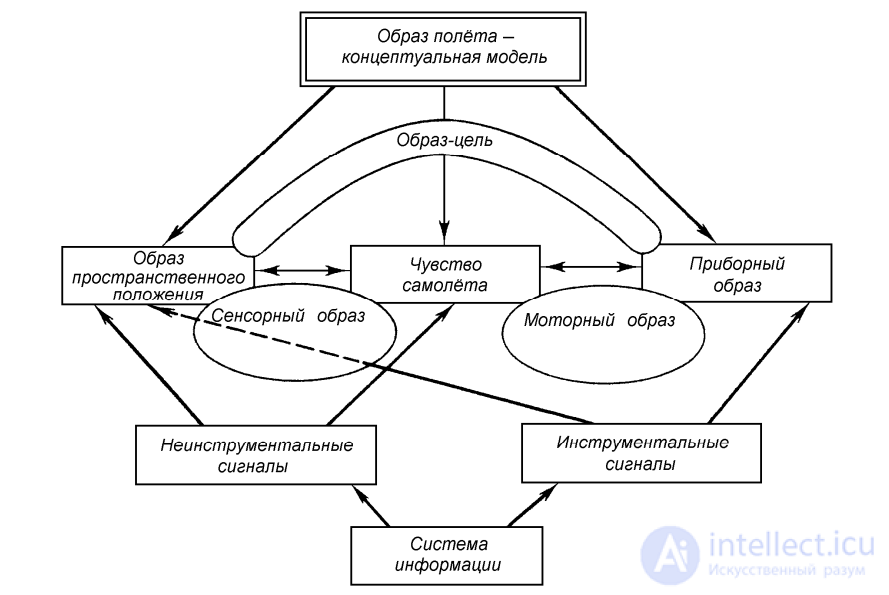
Fig. 2.14. Structure and content of the mental image regulating a pilot's actions
(after: Zavalova N.D., Lomov B.F., Ponomarenko V.A., 1986)
The flight image (conceptual model) was defined by N.D. Zavalova, B.F. Lomov, and V.A.
Ponomarenko (1986) as a basic component of mental reflection, formed in the
course of training and professional practice. The flight image includes the goals and objectives
facing the pilot, a system of knowledge about the object of control, and a system of motor programs implemented in flight. When performing specific actions, one of the three components of the flight image comes to the fore: the image of spatial position, the feel of
the aircraft, the instrument image. The image of spatial position regulates the pilot's spatial orientation. The image of spatial position must be constantly maintained, modified in accordance with the aircraft's maneuvers, and must resist the destructive
57
influence of non-instrumental signals when these convey information contradicting the
instrumental data. The instrument image is a reflection of the discrepancies between the assigned and
current flight regimes, formed on the basis of perceiving information about the deviation
between the assigned and actual value of a flight parameter. This image regulates the motor component of actions, ensuring the implementation of the motor program. The feel of the aircraft is a peculiar fusion of the person with the aircraft, which allows him to physically
feel the aircraft's movements – the person's ability for correct and sensitive perception and
subconscious selection of all sensory stimuli important for controlling the aircraft,
and for successful responses to them through movements of the control levers. The formation of the feel of the aircraft is linked to the arrival of non-instrumental signals. The feel of the aircraft is, first and
foremost, linked to muscular sense. The feel of the aircraft ensures the performance of movements aimed at forestalling deviations not yet reflected on the instruments.
The components of the flight image possess strictly defined temporal characteristics. An indispensable condition for constructing a flight image that corresponds to real flight
situations is the pilot's adequate perception of time, which will be discussed separately when
we address the role of probabilistic forecasting in the activity of flight personnel (chapter 5).
It should be remembered that in the course of flight training the flight image is enriched with ever new
elements, and this process is endless, since the number of flight situations is endless: every flight, just like any piece of information read or heard, will
bring the flight image closer and closer to the events actually occurring. Thus,
the flight image is nothing other than a conditioned-reflex (and hence formable)
formation, designed to ensure the maximum adaptation of crew members to flight.

Comments