
Lecture
There are several approaches to understanding communication that help researchers and practitioners make sense of this complex process. Here are a few of the main approaches:
The interpersonal approach:
The systems approach:
The psychological approach:
The semiotic approach:
The communicative approach:
The cultural approach:
The ethical approach:
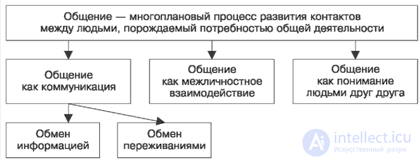
In Russian psychology there are several approaches to understanding communication. It seems preferable to proceed from the principle of the indissoluble unity of communication and activity, rather than reducing communication to one of
its aspects – either to the exchange of information, or to interaction, to the influence
of one communicating party on another, or to the process of interpersonal perception.
Today communication is a widely branching field of psychology, studied at the theoretical, empirical and applied levels.
The subjects of research include the psychological structure and mechanisms of communication;
the interrelation of communication with a person's mental processes, properties and states;
the processes of interpersonal perception; the features of situational communication. Various types of communication receive scientific grounding: communication in
conflict situations, managerial communication, phatic communication and others.
Human communication performs many functions. Thus, by the criterion of the goal of communication alone, the following functions are distinguished:
Analyzing these functions from the standpoint of the activity approach makes it possible to distinguish three interrelated sides of communication: communicative, interactive and perceptual.
The communicative side of communication reflects the exchange of information
between interlocutors, taking into account the relations between them and their individual personal characteristics. The exchange of information in the process of communication is an active
process, one that takes into account the subjective significance of the information for both interlocutors and the possibility of it influencing the partner's behavior and state.
The means of the communicative process are verbal and nonverbal sign systems. The elements of the verbal sign system are language and speech.
Speech includes facial expressions, gestures, postures; paralinguistics and extralinguistics (tone, loudness, timbre, range of sounds, pauses, laughter, coughing, and
so on); proxemics (the spatio-temporal parameters of communication); visualistics (the characteristics of eye contact between interlocutors).
The interactive side of communication reflects the interpersonal interaction of people in the process of their joint activity. It is aimed at managing a partner's behavior through a system of psychological methods of influence, taking into account the social norms and public values
characteristic of a given community.
The perceptual side of communication reflects the process of forming an image of the interlocutor, perceiving them as a person, without which such mutual knowledge, successful joint activity is unthinkable. The psychological image of an interlocutor is formed on the basis of their actions, behavior, charisma, external
characteristics, views and goals. The mechanisms of perceptual communication are based on the possibility of self-awareness through another person and are expressed in the phenomena of identification and reflection. Identification is a way of understanding an interlocutor through an attempt to put oneself in their place.
Reflection is the phenomenon of a person's awareness of how they appear to their interlocutor or to the audience listening to them. In the process of two-way communication, reflection gives rise to six images, reflecting the personal, emotional and cognitive characteristics of each of the interlocutors:
– the image of the «self» as they see themselves;
– the image of the «self» as they actually are;
– the image of the «self» as they appear to the interlocutor.
In other words, six interlocutors take part in communication at the same time, so to speak. If such representations concern their joint activity, then it is a matter of a special form of reflection, namely subject-reflexive relations.
Each of these approaches offers a unique perspective on communication and can be useful for analyzing, understanding and improving communicative processes in various contexts and spheres of life.

Comments