
Lecture
Preschool psychology is a field of psychology that studies the development and behavior of children from birth to school age, usually up to 6-7 years old. This period involves intensive physical, cognitive, emotional and social development in children. Here are some of the main aspects studied in preschool psychology:
Physical development: Research on the physical development of preschoolers includes growth, weight, motor skills and coordination of movements. It is important to monitor how children develop their physical skills and abilities.
Cognitive development: This aspect of preschool psychology studies how children develop their cognitive abilities, such as thinking, perception, attention and memory. It is important to help children develop their cognitive skills through play and learning.
Emotional development: Psychologists study the emotional state and development of preschoolers. This includes understanding and managing one's own emotions, as well as developing empathy and social skills.
Social development: This area examines children's interactions with other children and adults. Psychologists study how children learn social skills, how friendships form and how their social understanding develops.
Speech and communication development: An important aspect of preschool psychology is the study of the development of speech and children's ability to communicate. This includes studying the development of vocabulary, grammar and communication skills.
Play development: Play plays an important role in the development of preschoolers. Psychologists study how children play, which games they prefer, and how play affects their development.
Understanding preschool psychology helps parents, educators and child-development specialists better understand the needs and characteristics of this age group and provide them with appropriate support and stimulation for healthy development.
A child's adaptation to kindergarten is a process involving the gradual adjustment of the child to a new environment, routine and social conditions of the childcare facility. This process can be challenging for both the child and their parents or guardians. Effective adaptation to kindergarten can make the transition smoother for all parties and reduce stress.
Here are some tips and strategies that can help with a child's adaptation to kindergarten:
Prepare the child in advance: Tell the child what to expect at kindergarten. Show photos or videos from the kindergarten so they know what the place looks like and what happens there.
Gradual introduction: Start the adaptation with short visits to kindergarten and gradually increase the length of stay. This can help the child get used to the new environment.
Establish a routine: Create a stable daily routine for the child that resembles the routine at kindergarten. This will help the child anticipate what will happen next and feel more confident.
Positive farewells: Arrive at kindergarten earlier than usual so you have time to say goodbye to the child. Farewells should be warm and positive.
Supportive staff: Talk with the teachers and other kindergarten staff so they know about your concerns and the child's needs. Make sure the staff are ready to care for the child and support them during adaptation.
Be patient: Adaptation can take some time. The child may experience stress or dissatisfaction at first, but they will gradually adapt and start to feel more comfortable.
Provide support at home: Discuss the child's day at kindergarten with them. Help them talk about their feelings and impressions. Support them emotionally and physically during the adaptation.
Create rituals: Rituals, such as celebrating a successful day at kindergarten or special moments together with the child after kindergarten, can help them feel more comfortable.
It is important to remember that adaptation to kindergarten can be an individual process for each child. Some children will need more time than others to feel comfortable and confident in the new environment. The main thing is to remain patient, support the child and cooperate with the teachers to ensure a gentle and successful introduction to kindergarten.
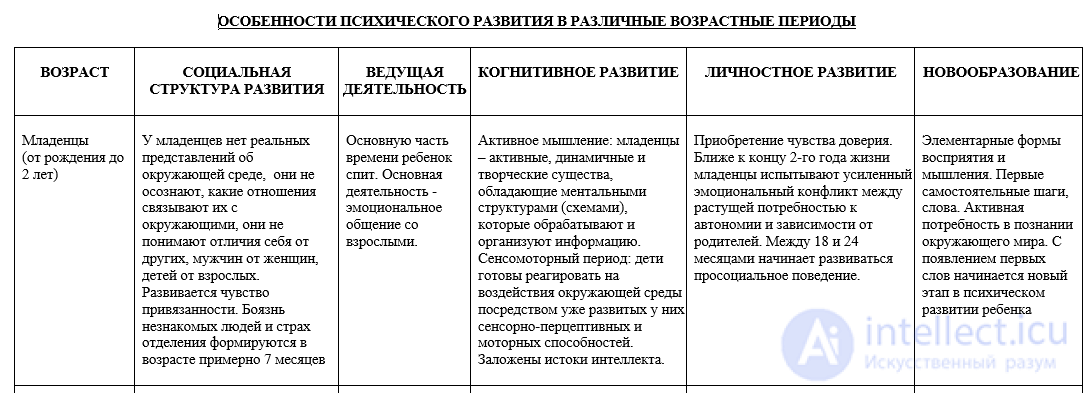
The psychological characteristics of children aged 0 to 1 year are very important, since it is during this period that the fundamental aspects of their development are formed. Here are several key psychological characteristics of this age group:
Physical development: During the first year of life the child grows and develops quickly. At this stage it is important to provide proper nutrition, sleep and care for the child in order to support their physical health and growth.
Sensory perception: At this age children actively explore the world through their senses. They are interested in various textures, sounds, smells and tastes. This is the time when children begin to form ideas about the world through perception.
Emotional attachment: The development of emotional attachment to parents or primary caregivers is one of the important aspects of psychological development at this age. The child seeks close physical and emotional contact with adults.
Development of motor skills: In the first year of life children develop their motor skills. They begin to lift their head, roll over, crawl, sit, stand and take their first steps. These are important stages of motor development.
Speech development: Although at this age children usually do not talk, they begin to form basic skills of perceiving and producing sounds. Parents can help develop communication skills through talking and singing.
The stage of stranger anxiety and attachment: Children may go through a phase of stranger anxiety, when they are shy around unfamiliar people, as well as a phase of attachment, when they show attachment to their parents. These phases are normal and often alternate with one another.
Exploring the world: Children actively explore the world around them, using their hands, mouth and eyes. They diligently examine objects, touching them, picking them up, and sometimes tasting them.
Sleep and food: Sleep and nutrition play an important role in the psychological development of children of this age. Regular sleep and feeding routines contribute to physical and emotional well-being.
Understanding these psychological characteristics helps parents and caregivers provide a suitable physical and emotional environment for the child's development. It is important to remember that every child is unique and develops at their own pace, so it is important to be attentive to the needs and interests of the particular child.
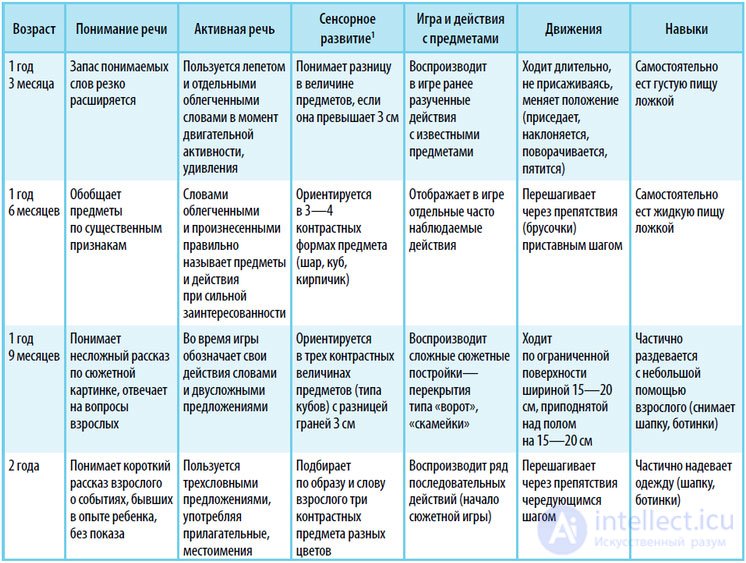
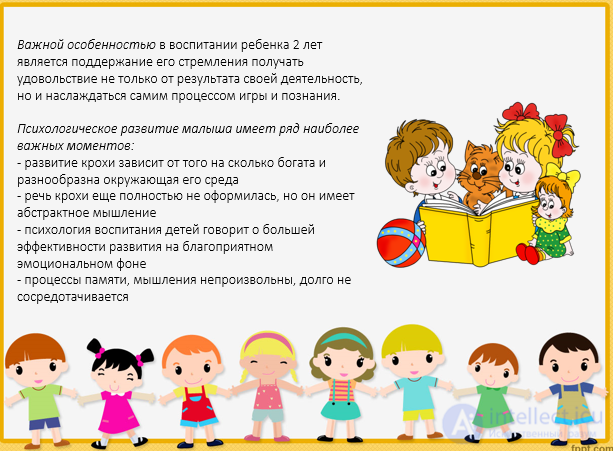
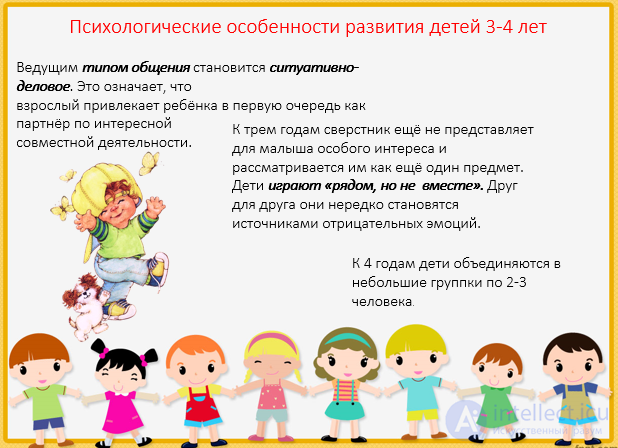
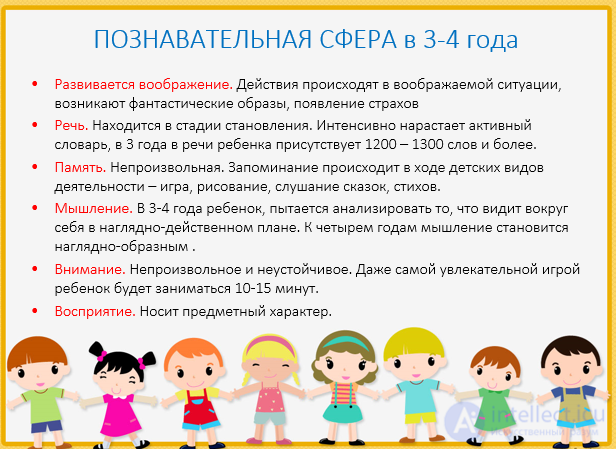
Children aged 3-4 years go through significant psychological changes and develop in various areas. Here are some of the main psychological characteristics of this age group:
Language and communication development: The age of 3-4 years is characterized by active speech development. Children begin to speak in more complex sentences, expand their vocabulary and may start asking questions to understand the world around them.
Fantasy and play: Children of this age have rich imaginations and are actively learning to play. They can create a world of imaginary characters and situations, which contributes to the development of creative thinking.
Social development: At this age children begin to actively interact with other children. They can play in groups, share toys and begin to develop social skills, such as the ability to resolve conflicts and cooperate.
Autonomy and independence: Children aged 3-4 years strive for independence. They may try to dress themselves, put effort into completing various tasks and express their preferences and wishes.
Motor development: Children continue to develop fine and gross motor skills. They can draw, model, cut, and also actively participate in physical games and activities.
Understanding emotions: Children become more sensitive to their own and others' emotions. They may begin to understand and express their feelings, as well as understand which actions cause different emotional reactions.
Ability to learn: Children of this age have an enormous capacity for learning and assimilating information. They can quickly absorb new knowledge and skills, so it is important to provide them with structured learning opportunities.
Development of self-understanding: Children begin to form an idea of themselves and their role in the world. They may start asking questions about their identity and relationships with those around them.
Teachers and parents can help support and develop children of this age by creating a stimulating and safe environment where children can explore, learn and develop. This is also a time when it is important to pay attention to the development of social skills and self-regulation and to support interest in learning.

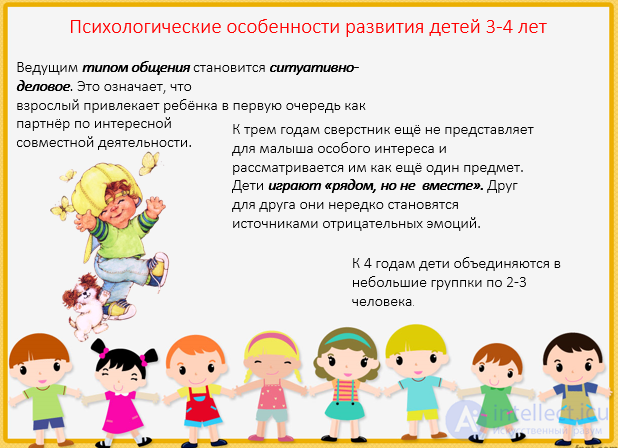
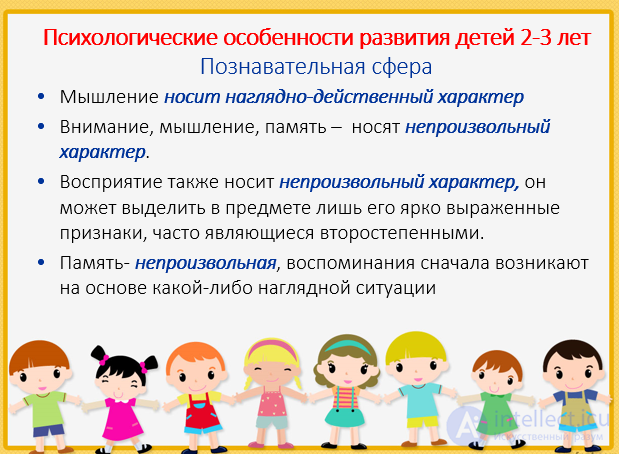
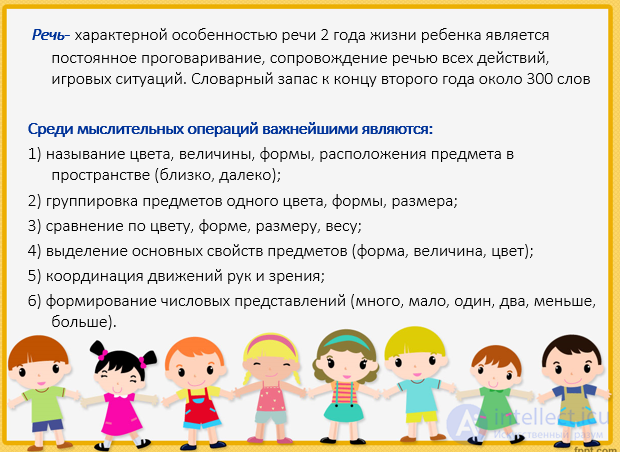
The most important psychological characteristics of children aged 2-3 years from the standpoint of learning and development.
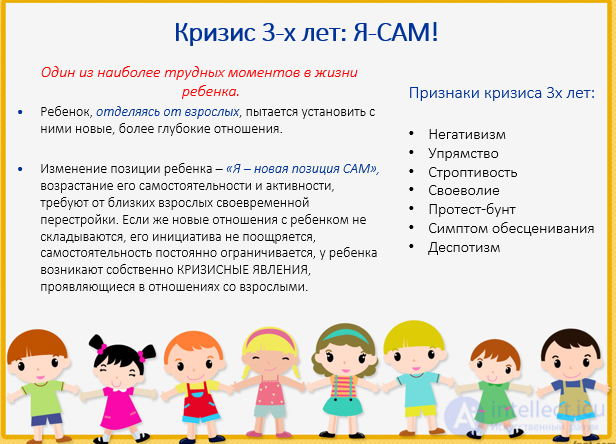
The crisis of three years old – I MYSELF!
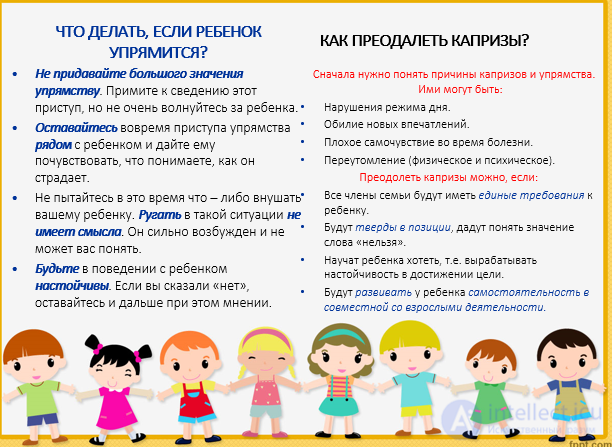
fig. what to do if a child is stubborn, or how to overcome the «I myself» crisis
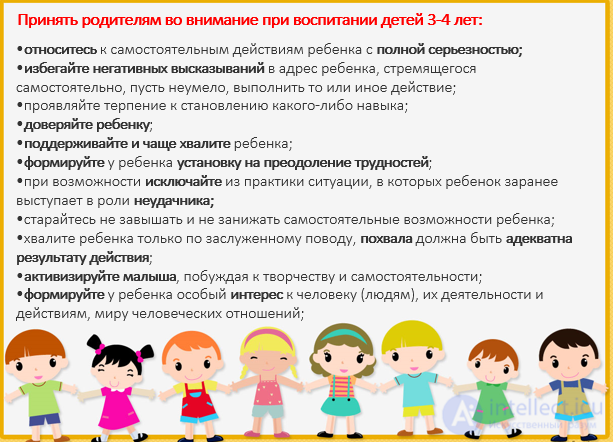
tips for raising children aged 3-4 years
Children aged 4-5 years go through an interesting stage of development, characterized by significant psychological features. Here are some of them:
Speech and communication development: Children of this age usually have well-developed speech. They can speak in more complex sentences, ask many questions and enter into active conversations with adults and peers.
Fantasy and play activity: At this age children continue to actively develop their imagination and play imaginary scenarios. They can invent roles and imaginary friends, which contributes to the development of creative thinking.
Social development: Children aged 4-5 years increasingly actively interact with other children and develop social skills. They can play in groups, share toys and begin to understand the rules of social interaction.
Development of independence: At this age children show interest in independence. They can dress themselves, learn to put on shoes and help with household tasks, such as preparing breakfast.
Motor development: Children develop their motor skills, improving fine motor skills (for example, drawing, cutting, writing) and gross motor skills (for example, running, jumping).
Understanding emotions: Children begin to better understand their own and others' emotions. They can express their feelings in words and distinguish basic emotions, such as joy, sadness, anger and fear.
Self-esteem: Children begin to form an idea of themselves and their abilities. They may show interest in various activities and develop their self-esteem based on successful achievements.
Learning and cognition: The age of 4-5 years is characterized by intensive learning. Children are actively interested in the world and strive to learn as much as possible about it. It is important to provide them with structured educational opportunities and encourage their thirst for knowledge.
This is a time when children continue to form their interests and personality. It is important to provide them with a suitable environment for development and support them in their learning and social endeavors. It is also important to teach children skills for regulating emotions, resolving conflicts and interacting with other people in a social environment.
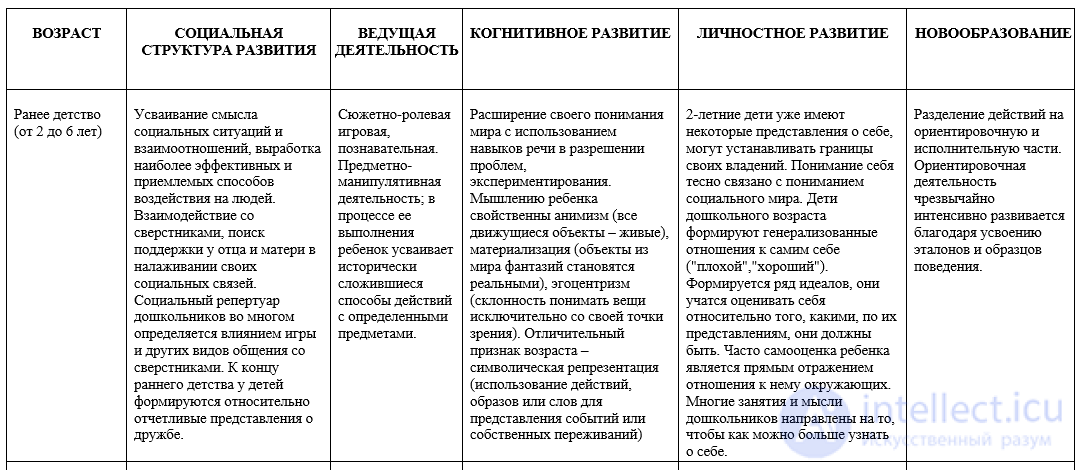
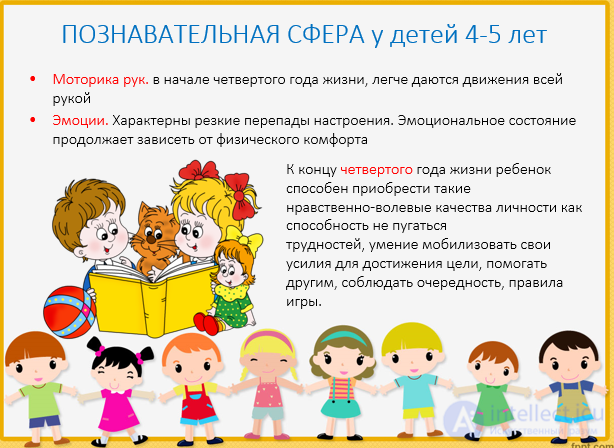
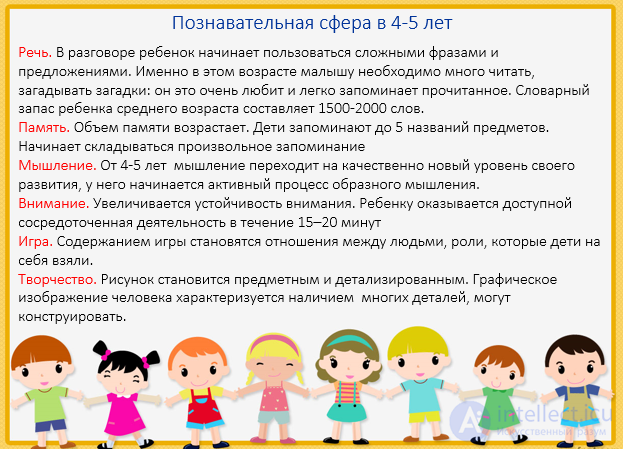
fig. THE COGNITIVE SPHERE in children aged 4-5 years
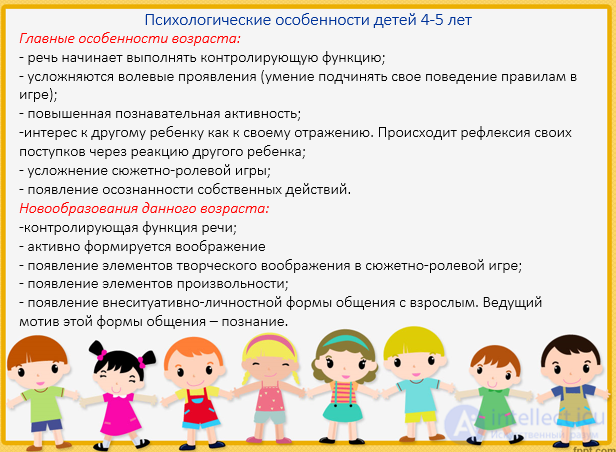
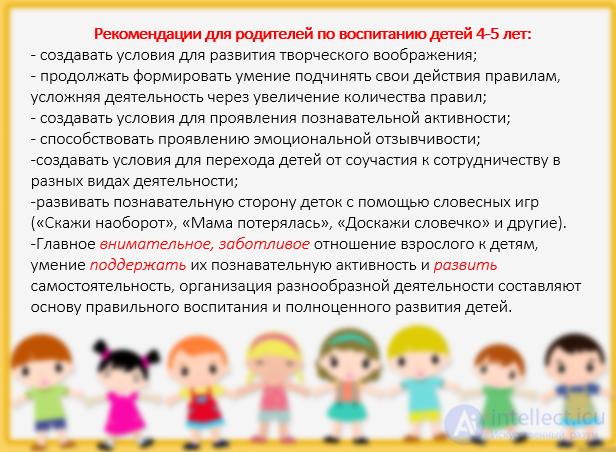
Children aged 5-6 years are in a period of significant psychological changes and development. Here are some of the main psychological characteristics of this age group:
Speech and communication development: Children of this age continue to develop their speech skills. They can speak in more complex sentences, expand their vocabulary and express their thoughts and feelings more clearly.
Literary development: At this age children may show interest in reading and stories. They may begin reading simple books and listening to stories, which contributes to the development of literary skills and imagination.
Social development: Children aged 5-6 years become more independent and self-reliant. They can develop more complex social relationships with other children and adults, learn to share and resolve conflicts.
Development of independence: Children of this age actively strive for independence. They can dress themselves, prepare simple snacks and perform some household tasks under supervision.
Motor development: Children's fine motor skills become more precise, allowing them to draw more complex pictures and write letters. Gross motor skills also improve, allowing them to run, jump and participate in sports games.
Cognitive development: Children of this age actively explore the world around them and are interested in various sciences, such as natural science and mathematics. They begin to develop their logic and abstract thinking.
Self-esteem and identity: Children begin to form an idea of themselves and their identity. They may become more aware of their strengths and weaknesses, which affects their self-esteem.
Friendship and relationships: Children can develop deep friendships with other children and show interest in games where cooperation and interaction are important.
Development of morality and ethics: At this age children begin to develop an understanding of right and wrong behavior. They may begin to become aware of moral norms and values.
Learning and school: In the pre-school age children may begin preparing for school, which includes becoming familiar with letters, numbers and basic mathematical concepts.
This period of development is an important time for preparing for future learning and social life. Teachers and parents can play an important role in supporting and developing children of this age by providing them with structured educational and social experiences.
Children aged 6-7 years continue to actively develop and undergo many psychological changes. Here are some of the main psychological characteristics of this age group:
Development of cognitive skills: Children aged 6-7 years become more capable of analyzing and solving complex tasks. They develop abstract thinking, which allows them to consider more complex concepts and ideas.
Development of speech and reading: Speech becomes clearer and grammatically correct. Many children begin to read with comprehension and become interested in literature.
Social development: Children of this age continue to develop social interaction skills. They are more independent in communicating with other children and adults, learn to resolve conflicts and cooperate.
Development of independence: Children begin to show a higher degree of independence. They can take care of themselves, make decisions and handle some household tasks.
Development of moral values: Children begin to form their understanding of moral norms and values. They may ask questions about what is right and wrong and reflect on it.
Play activity: Even at this age, play remains an important part of development. Children can take part in a variety of games that contribute to their creative and social development.
Learning abilities: Children aged 6-7 years have excellent learning abilities. They can learn quickly and effectively, so it is important to provide them with structured educational opportunities.
Physical development: Children continue to develop their physical skills and motor abilities. They can participate in sports activities and develop their physical activity.
Self-esteem and identity: Children begin to form their idea of themselves, their interests and abilities. They may become more self-aware and compare themselves with others.
School and learning: At this age children may begin schooling in primary school. This is an important stage, which includes mastering reading, writing, mathematics and other subjects.
This is a critical period in children's psychological development, and it is important to create a supportive environment for their learning and growth. Parents and teachers can help children develop their abilities and skills, as well as form moral values and social skills that will be useful in the future.

Comments