
Lecture
The reminiscence bump is the tendency of older adults (over the age of forty) to recall or retrieve a disproportionate number of memories from events that occurred during adolescence and early adulthood . This was identified by studying autobiographical memory and then plotting the age at which memories were encoded to form a lifespan retrieval curve.
Theorists have proposed several explanations, ranging from changes in brain biology to the type of events that typically occur during this period of time. Researchers have consistently observed the reminiscence bump, a period of heightened memory accessibility on participants' lifespan retrieval curves, and the bump has been replicated across a variety of study conditions.
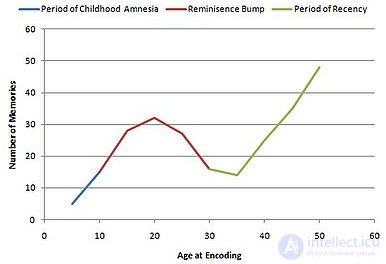
Adolescence and early adulthood are described as important periods for memory encoding, because people typically recall a disproportionately large number of autobiographical memories from these periods. This disproportionate number of memories is associated with the reminiscence bump. The reminiscence bump usually occurs between the ages of 10 and 30, and this is the period during which people generate the most memories on free-recall tasks . Research shows that memories are readily accessible from the reminiscence bump because they are tied to self-identity. Memories found within the reminiscence bump contribute significantly to a person's life goals, self-theories, attitudes and beliefs. In addition, life events that occur during the reminiscence-bump period, such as graduation, marriage or the birth of a child, are often highly novel, which makes them more memorable.
There are three possible hypotheses for the reminiscence bump: the cognitive, the narrative/identity, and the biological/maturational.
The cognitive approach suggests that memories are best remembered because they arise during a period of rapid change followed by a period of relative stability. There is a hypothesized memory advantage for novel, distinctive events followed by a period of stability. Novel events undergo more elaborate cognitive processing, which leads to stronger encoding of these memories. Moreover, the subsequent period of stability increases the stability of the cues for these memories and increases the chances of recall.
The narrative/identity account suggests that the reminiscence bump arises because a sense of self-identity develops during adolescence and early adulthood. Research shows that memories that have greater impact and significance for a person are rehearsed more often while identity is being formed and are therefore better remembered later in life (Ece & Gulgoz, 2014). The formation of self-identity provides additional motivation to use cognitive processes to ensure that these memories are retained. Events from this period are more likely to be organized as a story or a self-narrative, and they benefit from the advantage of schematic organization in memory.
The biological/maturational approach suggests that genetic fitness is improved by having a large number of memories fall within the reminiscence bump. Cognitive abilities peak between the ages of 10 and 30, and the reminiscence bump may reflect this peak in cognitive ability. This account is therefore sometimes called the cognitive-abilities account. Researchers have proposed that the increase in cognitive abilities in early adulthood may lead to more adequate retention of memories during this period of time (Ece & Gulgoz, 2014). The reminiscence bump is caused by age-related differences in encoding efficiency, which result in more memories being retained from adolescence and early adulthood.
There is one more theory that explains the occurrence of the reminiscence bump: the life-script account . The life script refers to a set of culturally significant transitional events that are expected to occur in a specific order at various points in life. In early adulthood, a person begins to make important decisions and gains experiences that shape his or her identity. Thus, memories from this period are remembered as more significant because they played a major role in determining and shaping the person's life script (Habernas & Bluck, 2000). The life script typically includes most of the expected transitional experiences that occur in early adulthood (Gluck & Bluck, 2007), and usually includes positive experiences such as marriage, the birth of a child, or buying a home. Events that deviate from the life script tend to be sad and traumatic. Such events, such as the death of a child, are not culturally expected and often do not show a peak in recall at any particular point in the lifespan. Life scripts act as a way of structuring memory and lead to the expectation that the happiest and most important life events will form the reminiscence bump. Unlike memories of happy events, memories of sad events remain stable across the lifespan and do not produce a bump in recall.
Methodology
Used objects from his environment to elicit memories from his life. Galton compiled lists of keywords to prompt recall. He recorded the amount of time needed to retrieve autobiographical memories associated with a keyword and noted the distribution of memories across the lifespan.
Imitated Galton's technique and asked participants to recall and date autobiographical memories in response to keywords. Participants were asked to share the first memory that came to mind. This method is consistent and reproducible across different conditions, such as the use of different participants or keywords. A consistent peak in recall is observed within the reminiscence bump. However, different types of keywords, such as nouns and adjectives, elicited memories from different periods of time and with different phenomenology.
These researchers presented keywords in the form of common places (restaurants, markets, parks), objects (chair, table, television), positive emotions (happiness, joy, fun), negative emotions (disappointment, pain, sadness), and significant others (father, mother, friend). Participants were asked to retrieve a memory that the keyword reminded them of, recall memories from across their whole life, and recall memories that were at least a year old. Participants were then asked to date the memory to the nearest month and year. The results were plotted on the lifespan retrieval curve, and a reminiscence bump was observed.
Participants are asked to list important personal events on a timeline. Participants are given a timeline with intervals (for example, 5 years per interval) and are asked to fill in events that come to mind and indicate their age at the time of the event. This allows the participant to recall freely, rather than being limited to artificial keywords. The time intervals focus the participant on particular periods and control the amount of time spent searching for memories.
Participants are given a period of time and asked to recall as many personal events from that period as possible. It assesses the ability to generate both personal semantic memories and memories of personal incidents. When recalling personal semantic memories, participants try to produce as many examples as possible of the names of people they know within a 90-second period. This is repeated across three periods of life: childhood, early adulthood, and recent adulthood. When recalling personal incident memories, participants try to produce as many personally experienced events as possible within a 90-second period, and this is likewise repeated across three periods of life.
Subjects share personal events, and researchers compare the involuntary and voluntary memories of younger and older children. Participants read ten words and are asked to recall as many of the words as possible in any order. Participants were then asked to keep a diary of the recall process between two-hour experimental sessions. They were asked to record autobiographical memories as soon as possible, using a two-page questionnaire for each memory. This allowed researchers to track personal thoughts and events.
Participants are asked to give 20 self-statements that begin with «I am…». This makes it possible to gather the concepts and roles that are important for defining the self. The self has no single structure; it is a combination of self-schemas , such as «I am a mother». These self-concepts or self-images are then used as autobiographical memory cues, making it possible to map the distribution of highly self-relevant memories across the lifespan.
Social and cultural influences
The reminiscence bump can be observed in rankings of favorite books, films and records.
Generational identity arises when a person becomes aware that he or she is part of a particular social subgroup, a cultural generation , and internalizes external features of the world. The reminiscence bump occurs during the period of life when people form their individual and generational identity. The earlier years of the bump coincide with the formation of generational identity, and the later years with the formation of adult identity.
The influence of generational identity on the reminiscence bump can be explained by the idea that all members of a subgroup are likely to have memories of similar types of experiences. Evidence for the influence of generational identity on the reminiscence bump has been documented in populations that lived through traumatic events. In 1999, researchers compared younger and older groups of Bangladeshis. The younger group (aged 20–42) showed the usual increase in memories during the reminiscence-bump period, while the older group (aged 46–86) showed a second increase in memories between the ages of 35 and 55. The second peak experienced by the older group corresponded to the period of the Bangladesh Liberation War . The two generations showed similar patterns and timing of memory retrieval within their own subgroup, suggesting that they did indeed have similar experiences, whether or not they lived through the war. This finding may suggest that each generation remembers both personal events and generational events.
Researchers have studied different types of memories to find clues about how the «reminiscence bump» works and how memories are stored and retrieved. Participants were asked to retrieve memories that were classified as public or private, in an attempt to find differences in when these memories were stored. Public events are events that everyone alive at that time knows about and is exposed to (political events, war/assassination, sports/entertainment or news events), whereas private events are experienced only by individuals (relationships, birth/death, work/education, home/leisure, illness and religion). When recalling public events, participants were between 10 and 19 years old, whereas when recalling private events participants were between 20 and 29 years old. Researchers suggest that public events are recalled at an earlier age because that is when people acquire a sense of generational identity. People begin forming their own beliefs and their individual identity, so this experience is rehearsed, practiced and stored in long-term memory. Private events are recalled later, because that is when people develop intimate relationships. Private events are easier to remember and recall because they are unique to each individual and are unlikely to occur under any outside influence. Gender differences
Research shows gender differences in recall. Researchers have found that men have more positive life events around the age of thirty, whereas women have more around the age of twenty. This finding suggests that the timing of important positive life events, such as marriage or employment, differs for men and women. Most major life events begin between the ages of 15 and 30, but a small gender difference is seen in when the event occurs. Researchers have found that the bump appears somewhat earlier in women than in men. The earlier age of the bump in women may be related to earlier hormonal changes during adolescence.
The reminiscence bump has been studied across cultures and has been observed under a variety of cultural conditions and experiences. It is important to consider that the process of remembering takes place within the context of culture, and the memories found within the reminiscence bump correspond to cultural goals, values and belief systems. The age at which the reminiscence bump occurs depends on culture and reflects the age at which a culture identifies people as adults. In Western societies, the reminiscence bump corresponds to adolescence and early adulthood, roughly between the ages of 10 and 30. In Asian cultures, the reminiscence bump appears later than in Western cultures, because adulthood may not be reached until age 30 .
Culture influences not only the age at which the reminiscence bump appears, but also the content of the memories found within it. Western cultures often value individuality, personal agency and uniqueness, where people are encouraged to develop and maintain their own personal beliefs, attitudes and personality traits. Asian cultures, on the other hand, often value group solidarity, communality and interconnectedness, where people are encouraged to develop a sense of self that fits with social roles, duties and responsibilities. Differences in the social norms expressed by Western and Asian cultures influence the focus of memories. People from Western cultures have memories that place the person at the center, and they often have autobiographical memories that are self-focused. People from Asian cultures have memories that express a strong group orientation and often have autobiographical memories that are relationship-focused
A study conducted in 2005 found more precise age data that depended on culture and gender. American women and men showed reminiscence bumps at ages 13 and 17 respectively, whereas Dutch participants showed a more gradual increase in encoding strength around age 15. Studies using an identical methodology found peaks during the same period among Polish and Japanese participants. In support of this research, a study was conducted comparing the distribution of memories among participants from Bangladesh, China, England, Japan and the United States. The study found a greater number of childhood memories among American participants than among members of other cultural groups. Although the timing of the reminiscence bump is generally considered culturally universal, with only a small difference in the period of life from which memories are recalled, there is research supporting the idea that similar life scripts, at least for positive events, can also be found across different cultures.
Research shows that people under the age of 40 also display a reminiscence bump. Initially, this was masked by the possibility of a recency effect . When researchers examined encoding strength values, they showed a progressive increase with participants' age around the reminiscence peak for participants over 50. This shows that the reminiscence peak is stronger in older people than in younger people.
These findings suggest that two processes influence the reminiscence phenomenon: (1) events from adolescence are encoded more strongly than events occurring during other periods of life. (2) Because these events are initially stored more intensively, they will be retrieved more often.
A life script is a schema describing culturally relevant events that people are expected to experience during a certain period of time. (Berntsen and Rubin, 2004). The life-script account holds that the reminiscence bump arises because people use life-script memories to provide a framework for recalling important memories. Life-script events tend to contain more memories during early adulthood, or the reminiscence-bump period, than during any other age period (Berntsen and Rubin, 2004). The life-script account emphasizes the norms and expectations typical of a given culture regarding the timing of major life events. The order and timing of major events can differ across cultures. A life script represents a mental representation of the sequence of normative, major life events. People know the culturally shared expectations for the order and timing of life events in a prototypical life, and are also aware of their own timing relative to these norms. People are assumed to have an internalized, culturally conscious script of the events that make up the expected skeletal life course; this script acts as a template for memories of life events associated with each phase of life.
A script consists of two parts: slots and requirements. Within a life script, slots represent culturally important transitional events that are expected to occur within a limited age period of a person's life course; and a requirement is the prescribed appropriate age for a culturally expected event, which leads to a causal sequence in a series of subsequent events.
Events in a life script are often positive, celebrated and normative. It represents an idealized life story. An ordinary life will also include negative events, and people will learn from their own experience. But a life script is passed down from older generations through stories and by observing the behavior of others, typically older people belonging to the same culture. People also tend to remember more from their youth, because this era is a time of biological maturation, novel experience, the formation of adult identity, and major events within life scripts.
Life scripts have the following ten properties:
(1) A life script is semantic knowledge about a given culture's expectations regarding life events, rather than a form of episodic memory of those events.
(2) A life script represents a series of time-ordered events.
(3) A life script can be described in terms of slots and their requirements.
(4) Life scripts form a hierarchical structure, in which transitional events form a higher-order «scene», within which a number of minor actions or episodes are nested.
(5) Life scripts are used to process stories — in this case, life stories.
(6) The slots and requirements of life scripts are culturally important transitional events and their culturally sanctioned timing.
(7) Because life scripts represent a normative life course, life scripts are not derived from personal actions in recurring contexts, but are transmitted through tradition. Young people who have lived only a small part of their life already know their culture's life script.
(8) Life scripts represent not an ordinary life but an idealized life, from which many common and important events are omitted.
(9) Life scripts are skewed relative to real life in favor of positive events.
(10) Life scripts are skewed relative to real lives in favor of events that are expected to occur during the period covered by the bump.
Studies confirmed the hypothesis:
(1) strong agreement among the events generated by participants, supporting the assumption of a shared cognitive structure
(2) a correlation between the order in which events occurred and their estimated dates, consistent with life scripts having a temporal structure.
(3) a predominance of positive events, consistent with the assumption of an idealized version of life
(4) age estimates for negative events had a higher standard deviation than age estimates for positive and neutral events, consistent with the assumption that negative events have more poorly defined time frames than positive events.
(5) the frequency with which events were recorded was strongly predicted by valence and by whether the event fell within the bump period
(6) a predominance of culturally sanctioned transitional events rather than purely biological events, consistent with the claim that culturally sanctioned transitional events are part of the life script
(7) it is estimated that most positive events occur between the ages of 15 and 30, whereas the lifespan distribution of negative events was relatively flat.
Modifications to the cultural life-script theory include: (1) the theory could benefit from a clearer distinction between specific transitional events and extended periods of stability; (2) the life-script account suggests that queries about negative events should rarely activate the cultural life script, because negative events are often unexpected. Their research was based on individual chapters and specific memories, whereas the cultural life script represents a depersonalized and culturally shared knowledge structure. Finally, cultural life-script theory seems unable to account for the reminiscence bump for public events.
There is preferential access to memories of experiences that match a person's individual self-concept, particularly with respect to mechanisms critical to a person's sense of independence or dependence.
It was found that people had either a strong motivation for intimacy or a distinct motivation for power, and it was found that the intimacy-motivation group recalled peak experiences with a much higher percentage of intimacy themes, whereas the power-motivation group tended to recall peak experiences with strong themes of power and satisfaction.
Generativity refers to caring for and being concerned about those things, products and people that may outlive oneself. It was found that people high in generativity (i.e., who had a history of commitment) more often recalled events related to aspects of generativity. In contrast, those participants who showed no notable tendency toward generativity did not show this bias.
Two groups of people were studied: those associated with personal power, achievement and independence ( the agentic group), and those associated with relationships, interdependence, and so on (the communal group). Agentic types consistently recalled emotional memories of events related to issues of agency , such as dominance, control and humiliation. In contrast, communal types showed a bias toward emotional memories of others, often significant others, in acts of love and friendship.
Different emotions have been shown to affect memory. Life events associated with stronger emotions will be remembered more vividly. In studies of emotional events and the reminiscence bump, older adults tend to remember more positive events than younger adults. As a rule, during the reminiscence bump only happy memories and memories of important events are recalled. It has been postulated that sad events are easier to forget because there may be an increased motivation to forget them. Conversely, people are more likely to recall and relive happy events because they evoke pleasant feelings. A second explanation suggests that memories of positive events may help regulate emotions and even improve mood. Emotions can also be regulated by recalling negative events and comparing them with present positive events. Positive and negative events can also be used to share life experience with others and to compare life events.
Flashbulb memory
Flashbulb memory occurs when a very vivid memory of a traumatic, emotional or significant event is recalled. Researchers commonly use public events, such as the assassination of John F. Kennedy and September 11, as cues when studying flashbulb memories. Participants are asked to recall very specific information, such as where they were, how they felt and what they were doing when the event occurred. Memories of these events are easily recalled, and the person believes that their account of the event is completely accurate.
These memories have been tested in a variety of ways, including measuring the ability to recall details of the event and the effect of additional cues on recall of the event. Denver, Lane and Cherry found that flashbulb memories occurring during the reminiscence-bump period were exceptionally vivid and readily accessible. It is hypothesized that flashbulb memories encoded during the reminiscence bump are so vivid because the events occurred during identity formation and peak brain activity. In addition, these events are well remembered because they undergo more rehearsal due to their serious nature and frequent discussion.
Brain damage
Disruption of autobiographical memory functioning due to damage or disease can have serious consequences for a person's episodic memory . This can distort a person's lifespan retrieval curve and affect the appearance of the reminiscence bump. A person's memories of personal life events may show a different pattern than that of the average person if he or she has brain damage caused by an event such as an accident, a blow to the head, or illness. For these people with brain damage, the lifespan retrieval curve may look different. An example of this is a person having a reminiscence bump between the ages of 5 and 13, rather than between 10 and 30 as is typical of the average person.
Damage to the frontal lobes of the brain can obscure memories and lead to a loss of detail. In more extreme cases, patients may even turn existing autobiographical information into plausible but false memories .
The effect of temporal lobe damage on the reminiscence bump varies greatly depending on the age at the time of injury. This is because patients with damage to the temporal lobes or underlying limbic-system structures may lose the ability to form new memories, especially if the damage is within the hippocampal formation, while retaining access to at least some memories from before the injury. People with this type of brain damage cannot form new memories after the incident that caused the brain damage, but they still have access to memories that occurred before the brain damage happened. If the brain damage occurred at age 10, the person may remember nothing from the ages of 10 to 30 and have no memories from that period.
People with damage to brain regions involved in visual processing, such as the occipital lobes , may develop amnesia. The episodic content of autobiographical memories is encoded predominantly in the form of visual images. If the ability to generate visual images is compromised or lost, access to the specific details of the past stored in episodic images is lost as well. When life events or episodic memories are encoded in the brain, they take the form of pictures or visual images. Such people develop amnesia because they can no longer call up these visual images of the past.
A common psychological phenomenon is severe blurring of autobiographical memory, leading to overgeneral memory . For example, people with clinical depression, schizophrenics, and people suffering from obsessive-compulsive disorder , tend to recall many memories that lack detail (are blurred) and that are much more schematic than typical autobiographical memories. In such cases, a patient asked to recall specific memories of his father might be able to recall only general events, such as «walks in the park after Sunday lunch», and could not produce a single specific memory of one particular walk.

Comments