
Lecture
1. General patterns of development in the prenatal period.
2. Characteristics of development in the prenatal period.
3. Development of systems of prenatal education.
.
Prenatal development takes place at the following levels of
development: morphological and physiological. The empirical
characteristics of development are: accommodation – assimilation, differentiation –
integration.

Prenatal development is the development that takes place before birth,
the intrauterine development of the fetus.
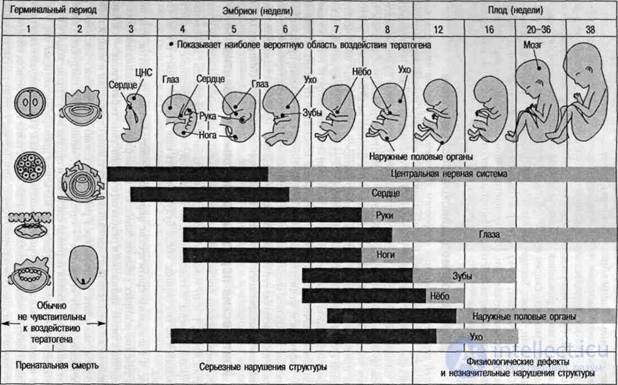
The period of pregnancy, which lasts
approximately 9 months, begins with the fertilization of the egg and
ends with childbirth. It is customarily divided into three unequal parts:
1. The pre-embryonic stage – lasts from zero to two weeks
2. The embryonic stage – covers the period from the third week
to the end of the second month of development.
3. The fetal stage – begins with the third month of development and
ends with the appearance of signs of labor.
3. Development of systems of prenatal education
The phrase "system of prenatal education" is used
here as a generalizing concept to describe organized,
systematic and purposeful influence on the prenatal
community of "mother - fetus", the result of which is the birth of a child
possessing physical health and psychological readiness for
developing new connections with the world. Prenatal education also forms
the prerequisites for early maternal adaptation.
Prenatal education arose not only in response to the needs
of society, but is also driven by a specific demand on the part of expectant
mothers.
The first stage is called family prenatal education, or
prenatal education in small communities, and lasted in Europe until
the beginning of the 17th century. Prenatal education was not part of public
practice, was not mass-scale or state-run, but was carried out according to
the needs of small communities. The content of prenatal education
consisted in passing on ways for a woman to guide herself during
pregnancy and childbirth, and on the other hand it created a certain temporary
community and placed the woman in a special position within the family.
The second stage in the development of prenatal education emerged in
the 17th century, "when midwifery schools were founded, and the practice of
delivering while lying on one's back was introduced." From this time on,
the technologized image of prenatal education takes its start. Midwives disappeared,
the community of mothers disappeared, birth turned out to be torn out of the general
fabric of life, cut off from the family, and the woman in labor became dependent. It is important
to note that prenatal education ceased to exist as a
separate practice, and was replaced by obstetric care with its
own image of the being born as an organism, as one devoid of
experiences. Obstetric care became an obligatory practice, through
which every woman had to pass.
The crisis of the "medical stage" of prenatal education emerged at
the turn of the 1950s–60s. The revival of prenatal education as a distinct
area of educational practice belongs already to the third stage, which
is called the "alternative" stage. Non-traditional prenatal education
includes, first, preparation for natural childbirth with the aim of
softening the critical rupture for mother and child. The second important
point is the development of the mother's ability to receive information about
the condition and behavior of the child during pregnancy. The third part
of prenatal education is the purposeful formation of
the mother's ability to change her own emotional state and transmit
it to the child. The fourth component of prenatal education concerns
close contact between the expectant mother and other pregnant women and a prenatal
mentor.

Comments