
Practice
Literally speaking, SEO is search engine optimization of your website. Like most companies on the Internet, you are striving to win the search marathon, not just to take part in it – where, just as in sports, the main battle is fought for the prize positions in TOP-1, TOP-5, TOP-10, only in this case it’s the search results. SEO stands for Search Engine Optimization, which means optimization for search engines. It is the process of improving a website’s visibility and ranking in organic (unpaid) search results. The goal of SEO is to attract more organic traffic to a website, improve its positions in search engines, and increase its visibility to potential users.
SEO includes various strategies and tactics, such as content optimization, keyword research and usage, building quality backlinks, improving the user experience on the site, technical optimization, and much more. All of these measures help search engines better understand the content and value of a website, which can lead to an improvement in its ranking in search results.
SEO is an important part of the marketing strategy for many organizations and website owners, since a well-optimized site can attract a target audience, increase traffic, and boost conversions. It is a long-term process that requires continuous work and analysis, since search algorithms and requirements change over time.
The Internet space resembles a big «bazaar», and you are the buyer (user). For example, you need a watermelon (a query). To get it, you head to the fruit row (Google or Yandex), and since all the sellers (sites) have roughly the same assortment, you pick a watermelon from the first ten (TOP-10).
This is exactly where the main advantages of using SEO promotion methods become apparent – giving every Internet resource (seller) the opportunity to get «to the front of the row», i.e. onto the first page of the search results (TOP-10). Because beyond the first page there’s hardly any «life» at all.
SEO is an effective lever for the mechanism of increasing traffic to your website, and its use should not be neglected. Because the volume of purchases made in an online store, the number of visits to your resource, and God knows what else all depend on traffic (or rather, it is up to you to decide exactly what you expect from applying SEO within your Internet project). If you want to become more enlightened and level up your site, then you should start with on-page SEO optimization of the resource. And once you have cleaned everything up, fixed it, and polished it to the point where your site shines with correct titles and glimmers with a variety of descriptions, you can move on to the stage of filling the site with content.
Yes, the main pillar of SEO development is text (content, the site’s content). The main one, but not the only one. It is very important to have unique content! With a volume of at least 2500 characters, and a uniqueness of 85%. «Seems clear enough» – you might say. – «What could be simpler?! We do on-page optimization, then write 100,500 articles of 2500 characters each with 85% uniqueness, and that should be it! We should be in the TOP, but no, we’re still in…. Yes, things have moved off dead center, gotten better, but for some reason it’s not bringing us the amount of traffic we need. WHY IS THAT?»
The answer is simple: it’s due to the analysis of behavioral factors by the search engines. The behavioral factors of site visitors give Google and Yandex a very clear picture of how interesting your site’s content is. And that determines what position your resource will hold in the search results. So the text should be at least 2500 characters with a minimum of 85% uniqueness + it must be interesting to your visitors. Thus, all that remains for you to do is to retain the users who came in from «organic» search by means of quality, interesting, and unique content.
There is also another way to get into the TOP – pay money for contextual advertising to Google or Yandex, and then your ad will be shown in the TOP (on the first page of results). But as soon as you stop paying for the advertising, your ads will immediately disappear from the search. And as a result, the traffic to your site will disappear right away too.
Contextual advertising in search looks like this:
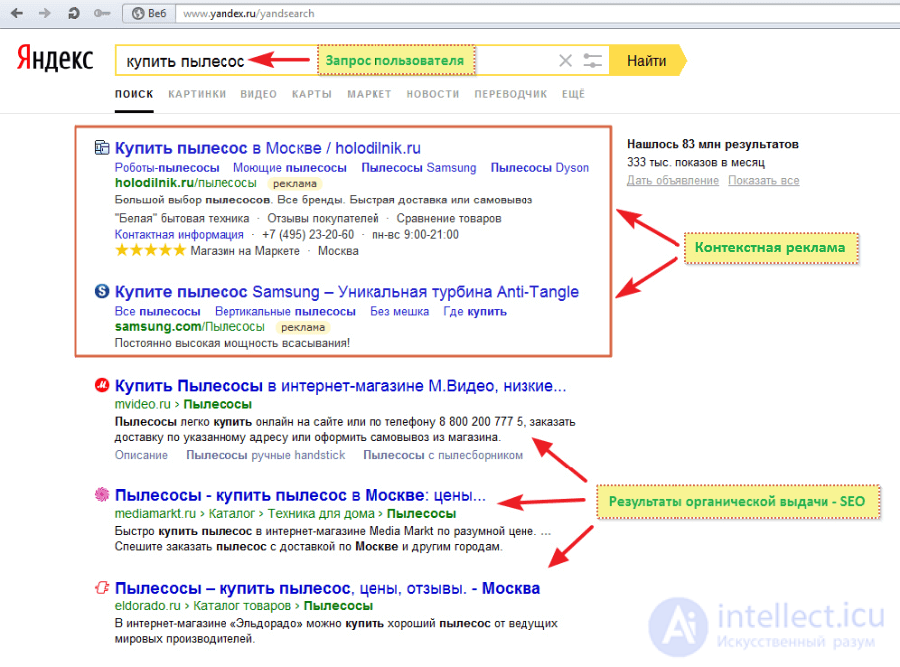
Fig. comparison of contextual advertising and organic results. Contextual advertising is highlighted in red. SEO promotion is highlighted below.
Unlike contextual advertising, SEO promotion holds your positions in the TOP for a long time without constant financial injections into the budget allocated for site promotion. Of course, provided that you have organized the promotion process correctly.
On-page site optimization – these are actions aimed at editing the site’s content so that search engines index it better. This kind of optimization is free, and its effectiveness depends solely on your knowledge and actions.
This is carrying out work to change the internal content of the site (editing meta tags) so that search engines index the content better. The result of on-page optimization depends solely on the level of knowledge and skill of the SEO specialist.
On-page optimization can be broken down into certain stages of work.
First, you need to compile a semantic core (SC). The entire content of the site and its meta tags depend on the SC. A correctly compiled SC will help with site promotion and can increase the number of visitors.
Content optimization — is the optimization of the site’s text content. This process includes the correct distribution of keywords. But don’t forget that if keywords are used with a frequency exceeding 2-8%, search engines may regard it as spam.
Editing robots.txt will help correctly set the actions for search engines, and close off what’s unnecessary from indexing with noindex for Yandex, and nofollow – for Google. And don’t forget to choose the main mirror of the site, with or without www.
A Sitemap is needed if you want all the pages of the site to be in the index. In that case, it needs to be compiled.
Off-page optimization consists of working through Internet directories that cover the subject matter of your resource, as well as working with link exchanges, which allow you to build up your link mass. Carrying out this kind of work is necessary for promoting the site for the main queries. But it’s worth remembering that quantity is not always better than quality. Check the quality of the resources that link to your site. This can be done both manually and automatically, using special link exchanges (we’ve already written about Sape).
And, of course, don’t forget about keywords. You can and should promote your site’s pages using keywords.
If your Internet resource is not in the search engine index because it was recently created, it needs to be added to the search engines (Yandex and Google) using these Google and Yandex Webmaster links.
Use social networks to promote and develop your resource.
Also register the site in search engine directories: Top 100 Rambler, Yandex, and the Google directory. Create and maintain a blog on your resource.
Improving site navigation (usability) and content quality, to attract and retain the TA (target audience), which in turn leads to an adequate search ranking. Don’t forget the «three clicks» rule described by Jeffrey Zeldman. Briefly, the rule states that a user makes approximately 3 clicks on average to reach the goal they need on a site. Although this rule has no proven evidence behind it, it still brings clarity to building an intuitive and logical hierarchy for your site. Choosing, searching the site, ordering a product, etc. should be as simple, convenient, and understandable for the user as possible.
There is a concept known as the «golden triangle of Google». Even though many say that this concept is no longer valid today, the statistics remain unchanged, insisting that users pay the most attention to the upper left corner of a site.
So it’s worth heeding this and using the F-shaped method of placing content on the site in the upper left corner. Use headings, then paragraphs and lists, and don’t forget to highlight keywords. If the text is large, break it up for the user’s convenience.
Here are some basic concepts in the field of SEO (search engine optimization):
Keywords: These are words or phrases that users enter into a search engine to look for information. Using relevant keywords in content and metadata helps improve ranking in search results.
Content Optimization: The process of optimizing the text, visual, or multimedia content of a web page in order to increase its visibility and ranking in search engines.
Meta Tags: HTML tags that provide information about the content of a web page. Some of the main meta tags include the page title (title tag), meta description, and keywords (meta keywords).
Internal Linking: Creating links between different pages on your website. A well-designed internal link structure helps search engine crawlers understand and index all the content of your site.
Backlinks: Links that point to your site from third-party web resources. Quality backlinks from authoritative and relevant sites can help boost your site’s rank in search results.
SEO Analytics: Collecting and analyzing data on your site’s traffic, ranking metrics, conversions, and other metrics in order to evaluate the effectiveness of your SEO efforts and make informed decisions to improve results.
Mobile Optimization: The process of optimizing a website and its content for convenient viewing and use on mobile devices. Given the growing number of mobile users, mobile optimization is becoming increasingly important for SEO.
SEO Audit: An examination of your website aimed at identifying the strengths and weaknesses of your SEO strategy. An audit helps identify problem areas and offers recommendations for improving the visibility of your site in search engines.
Ranking: The position of your website in search results for specific keywords or phrases. The higher the rank, the more visible your site is to users, and the greater the likelihood of attracting traffic.
SEO Strategy: A plan of action developed to improve the visibility and ranking of your website in search engines. An SEO strategy can include keyword selection, content optimization, building a link profile, and other tactics.

Comments