
Lecture
In a real environment, multiple radio-electronic systems (RES) of various purposes and affiliations usually operate together. Considering this set as a complex system, the analysis of electromagnetic compatibility is carried out using various models or a set of them (a system of models).
When creating abstract mathematical models, it is necessary to identify the main dependencies between input and output quantities, which will make it possible to determine the basic properties of the system under consideration or its elements.
When analyzing a large radio system, – a set of RES, the radio channel is considered as an element of the system. The main purpose of a radio channel is to ensure the process of transmitting or extracting useful information with a given quality and speed.
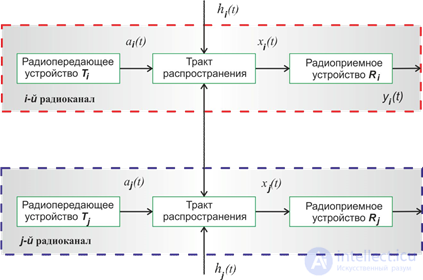
Figure 2.1 - Model of the simplest radio system
With this approach, the system is a set of radio channels (a pair: transmitter Ti – receiver Ri ). It includes a set of links providing the penetration of interference created by sources numbered  surrounding the i -th channel, where N – is the total number of radio channels.
Figure 2.1 shows a model of a simplified radio system (formed by two radio channels). This figure denotes: ai(t) – the useful signal carrying information, hi(t) – interference, xi (t) – the mixture of signal and interference, yi(t) – the output signal. If the interference is additive, then 
The characteristics of radio channels of this type are analyzed in detail in many radio engineering courses.
Abstracting from specific features, the model of a radio system, taking into account the links existing between its elements (radio channels), can be represented as consisting of blocks.
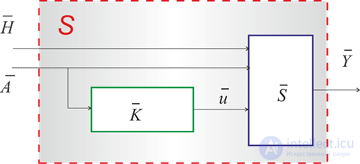
Figure 2.2 - Model of the system – a set of RES
This is the so-called abstract model of the system. The input quantities of the system S under consideration are: the vector of input signals  and the vector of external interference
  , and the output is the vector
  . The internal content of the system is defined by two model blocks. Block
  forms, from the vector of (useful) incoming signals, the vector of system interference



and  denotes a decoupled system (i.e. one in which there is no mutual, intra-system interference). The mathematical notation of the functional dependencies corresponding to the model shown in Fig. 2.2 has the form:


According to this model, the joint existence in the original system of a set of useful signals and external interference is represented as the effect on the input of a decoupled system of the original signals and external interference, as well as a set (vector) of system interference

 . Models of the decoupled system and the coupling block are shown in Fig. 2.3 and 2.4.
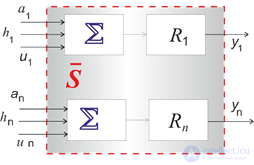
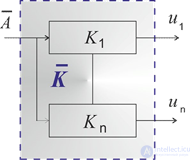
Figure 2.3 - Model of the decoupled system Figure 2.4 - Model of the coupling block

These figures denote:  – summer,
R1,Rn – receivers numbered 1,...n,
 –a set (vector) of operators of the original system,
 – the vector of operators of the decoupled system.

 – vector functions of signals and external interference, respectively,
 – the coupling interference vector.
All undesirable interactions between signals and the mechanism of their formation, regardless of where they occur, are attributed to the coupling blocks Ki and K j .
Let us illustrate the abstract model of the RES system using the example of the simplest situation (Fig. 2.5). Two radio channels numbered i and j are shown schematically here. The undesirable link between radio channels, which contributes to the possible occurrence of mutual interference, is carried out through the propagation path and is shown by a bidirectional arrow. The input quantities are the signals of the radio transmitters ai and a j , as well as external (with respect to the system) interference hi and hj . Such a situation can be called two-signal. Let us represent this situation schematically as a model of the system shown in Fig. 2.5.
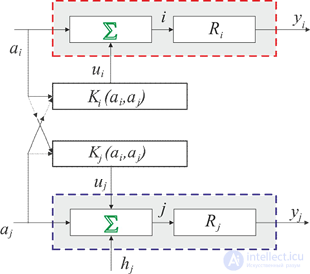
Figure 2.5 - Model of a two-signal situation
In this model, all undesirable interactions between channels, regardless of where they occur, are attributed to the coupling blocks Ki and K j . Each of these blocks can implement both linear and nonlinear effects and forms system interference at its output. The useful signal, external, and system interference are mixed in the summer and fed into the radio receiver Ri or R j of the corresponding channel.
The outputs are the signals yi and y j .
This model makes it possible to identify the following characteristic features of the RES system:
The model considered makes it possible to introduce the concept of an "ideally compatible radio system". A radio system is considered to have ideal compatibility if the relations are satisfied

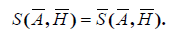
This notation means that in the case of ideal compatibility, the overall system turns out to be decoupled, i.e. the radio channels in the system function independently, in the sense that the output signal of each channel is a function only of its own signal and interference of non-system origin.
 The simplest case of ideal compatibility of a set of RES is achieved when the condition K(A) u 0, is met, which corresponds to the complete transmission of all electromagnetic energy of the useful signal along the path i -th transmitter j -th receiver. An example is the transmission of signals over spatially separated cable or fiber-optic communication lines.
When studying the operation of RES within the system under consideration, it is necessary to use a quality index of the system's functioning (an EMC index). The introduction of such an index makes it possible to make the necessary comparisons and evaluations. The EMC index of a single device is called local, and the EMC index of the RES system, as a whole, is called global.
The local quality index is usually the performance characteristics of the radio channel:
In the general case, the functioning of a complex system is determined by the expression

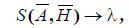
where λ –̶ is the quality index of the RES system; it can be a vector of dimension n . Each projection of this vector is a local quality index.
According to the models considered, the quality index of the system depends on interference of both system and non-system origin. If it is necessary to isolate and evaluate the effects caused exclusively by the mutual influence of radio channels, then all related effects caused by interference of non-system origin must be excluded from consideration.
As an EMC index of the RES system, one can, for example, use a quantitative characteristic of the system under analysis, which is related to the quality of its functioning.
In one approach, the global EMC index can be obtained on the basis of the local quality indices of the radio channels, which must be determined in advance.
Another approach involves introducing a global compatibility index based on the tasks solved at a higher level, where this RES system is considered as an element of a more general system.
The global EMC index should provide an assessment of the efficiency of frequency resource use and the ability to compare different systems and groupings of RES on this basis.
Since, for a given system structure, the main parameters affecting the amount of information transmitted are: frequency band, time, and signal energy, the EMC index based on these three parameters can, in particular, be introduced as follows
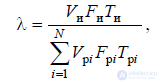
where Vri , Vid – the volumes that cannot be used by other spectrum users due to technical limitations, rules, and regulations; Fri ,Fid – frequency bands, including total spectrum occupancy, Tri ,Tid – the time required for service, N – the total number of RES in the system.
Here, the index “id” corresponds to the ideal case, and “r” – to the real one.
The closer λ is to 1, the more efficiently the radio frequency resource is used.
The EMC problem comprises two tasks: EMC analysis and EMC assurance. The basis for constructing specific models for analysis is the abstract model (see Fig. 2.2…2.4). It is considered appropriate to carry out EMC analysis by sequential decomposition (splitting) of the RES system into n submodels corresponding to an elementary situation. The structural diagram of the i -th submodel of the system is shown in Fig. 2.6.
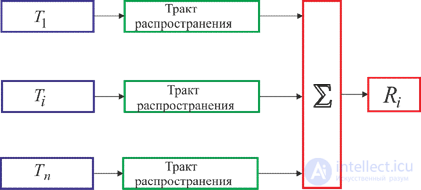
Figure 2.6 - Differential Contribution Model
Compatibility analysis can be carried out as a sequential process consisting of several stages. At each stage, the local quality index i is determined. If the information for each of the interfering channels is sufficient, the model of the elementary situation can be built on the basis of two channels. In this case, the analysis can be carried out in n1 stages, which corresponds to the number of interference sources.
Models built on this principle provide a differentiated analysis of the contribution of interference sources. They are called differential contribution models.
It is precisely such models that are used in practical EMC analysis, since, in addition to assessing compatibility, they make it possible to study the mechanism of system interference formation, identify the sources of the most dangerous interference, and determine the channel through which interference penetrates into the receiver.
Mathematical differential contribution models are used for the analysis of systems and groupings with a sufficiently large number of RES. In this case, a reduction in analysis time is achieved by a selection principle consisting of excluding, at the early stages of analysis, interference sources whose contribution to the total interference is insignificant.
EMC analysis can also be carried out on the basis of the integral contribution model, in which the contribution of an individual interference source is not taken into account. Such a model is applicable in cases where the RES system is not fully defined, i.e. there is insufficient information about the surrounding RES. Or when the number of emitters is so large that it hinders the application of the differential contribution model.
Initial data in the integral contribution model are specified on the basis of statistical data or a hypothesis about the assumed distribution of input quantities. The integral contribution model does not allow the determination of the predominant sources of interference and their penetration channels, and consequently, organizational measures to ensure compatibility cannot be determined either.

Comments