
Lecture
Jet engines are widely used in aviation and astronautics. Their operation is based on the ejection of a high-speed gas jet that creates thrust. In addition to mechanical and thermal processes, various electromagnetic phenomena arise in a jet engine. Electromagnetic radiation accompanies combustion processes, the motion of charged particles, and the operation of the engine's electronic systems.
Electromagnetic radiation — is the propagation of energy in the form of electromagnetic waves. It arises from the accelerated motion of electric charges. In a jet engine such conditions occur constantly:
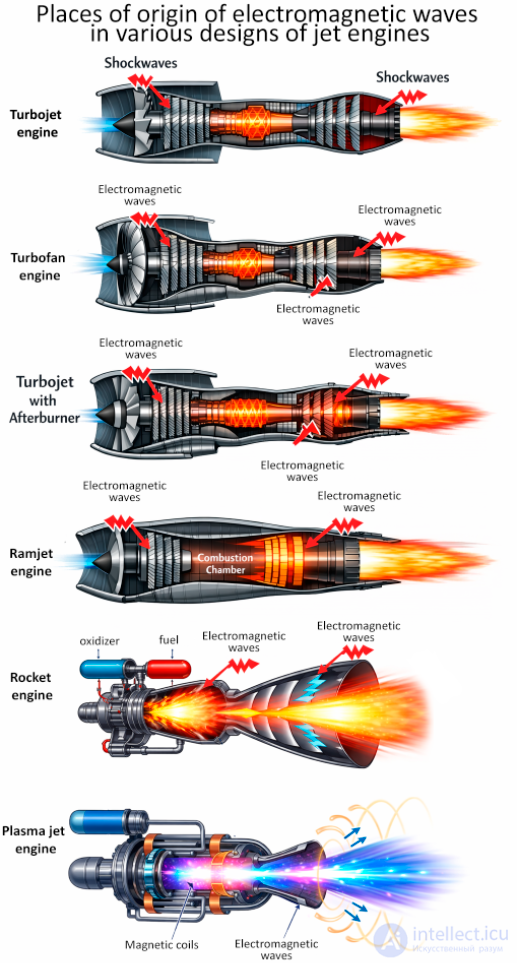
Below are shown the locations where electromagnetic waves arise in various jet engine designs
During combustion of the fuel-air mixture, high temperatures are produced (up to 2000–2500 K). Under such conditions:
This radiation belongs to the infrared range and is the main type of electromagnetic radiation of the engine.
At high temperatures part of the gas becomes ionized — free electrons and ions appear. Their motion:
This is especially pronounced in afterburner chambers and rocket engines.
In the jet stream there arise:
These processes cause fluctuations in the density of charged particles, which also leads to the emission of electromagnetic waves.
Modern jet engines are equipped with:
The operation of these devices is accompanied by electromagnetic radiation in the radio range.
Radiation ranges
Different ranges of electromagnetic radiation are observed in a jet engine:
Practical significance
The engine's infrared radiation is used by:
From the radiation spectrum one can determine:
It is important to take radiation into account for:
Below is an approximate graph of the power distribution of a jet engine's electromagnetic radiation (a typical turbojet engine running on Jet-A kerosene). The X axis is frequency, the Y axis is relative radiation power.
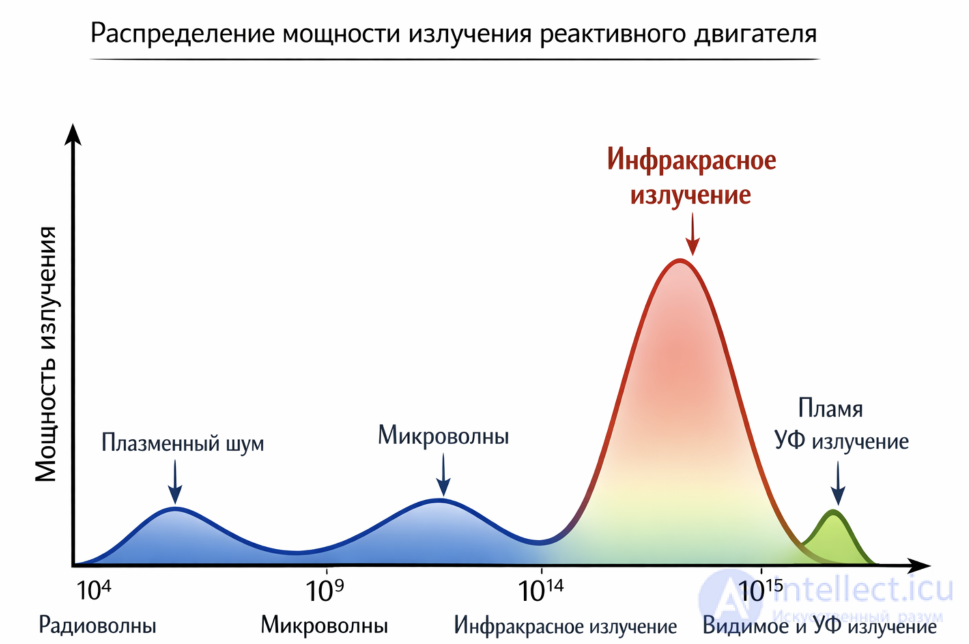
Main peaks:
Physical meaning of the electromagnetic wave power distribution
Low frequencies (radio)
Microwave range
Infrared range — maximum
Visible and ultraviolet
Electromagnetic interference from jet engines can affect radio communication, navigation systems, and onboard electronics. Therefore, special methods have been developed to reduce and suppress it.
Interference arises due to:
Metal shields are used for:
Shielding prevents electromagnetic waves from radiating outward and protects sensitive equipment.
Examples:
Used are:
They reduce high-frequency noise entering the power supply and control circuits.
Proper grounding:
It is important to use a single grounding point and avoid "ground loops".
To reduce interference:
Used are:
This reduces sensitivity to external interference.
For the jet stream:
This reduces the engine's radio-frequency radiation.
This is especially important for:
Used are:
Practical significance
Mitigating interference makes it possible to:
A jet engine emits electromagnetic waves across different ranges. Each range has its own practical application in aviation, diagnostics, and safety systems.
The main source — is the engine's hot jet and heated structural parts. This radiation belongs to
Infrared radiation.
Use:
Example: thermal imagers capture the temperature of the nozzle and the jet.
The flame glow in the combustion chamber belongs to
Visible light.
Use:
From the flame color one can determine:
Excited atoms emit
Ultraviolet radiation.
Use:
Such sensors react quickly to the appearance of a flame.
The ionized jet and electrical equipment create
Radio waves.
Use:
Sometimes the engine's radio noise is used to monitor its condition.
The plasma jet can interact with
Microwave radiation.
Use:
This is applied in scientific research and engine testing.
Summary table of applications of a jet engine's electromagnetic waves
| Range | Source | Use |
|---|---|---|
| Infrared | hot jet | thermal imagers, detection |
| Visible | flame | visual diagnostics |
| Ultraviolet | excited atoms | flame sensors, onboard energy accumulation |
| Radio-frequency | plasma, electronics | analysis of engine operation |
| Microwave | ionized flow | radar measurements |
Electromagnetic radiation in a jet engine is a natural consequence of high-temperature and plasma processes. It arises from fuel combustion, the motion of ionized particles, and the operation of electrical equipment. Studying this radiation is important for engine diagnostics, improving efficiency, and developing detection and protection systems.
The various wave ranges of a jet engine are used for:
Each range provides unique information about the processes inside a jet engine.

Comments