
Lecture
Let us give some basic definitions corresponding to the Radio Regulations of the International Telecommunication Union or the relevant national standard.
Telecommunication – any transmission, emission, or reception of signs, signals, written text, images, and sounds, or messages of any kind, by wire, radio, optical, or other electromagnetic systems.
Radiocommunication – telecommunication carried out by means of radio waves.
Terrestrial radiocommunication – any radiocommunication other than space radiocommunication or radio astronomy.
Space radiocommunication – any radiocommunication involving the use of one or more space stations or one or more reflecting satellites, or other objects in space.
Radiodetermination – the determination of the position, velocity, and/or other characteristics of an object, or the obtaining of information relating to these parameters, by means of the propagation properties of radio waves.
Radionavigation – radiodetermination used for the purposes of navigation, including obstacle warning.
Radiolocation – radiodetermination used for purposes other than those of radionavigation.
Radio direction-finding – radiodetermination using the reception of radio waves for the purpose of determining the direction in which a station or object is located.
Radio astronomy – astronomy based on the reception of radio waves of cosmic origin.
Radiocommunication service – a service involving the transmission, emission, and/or reception of radio waves for specified telecommunication purposes.
Fixed service – a radiocommunication service between specified fixed points.
Fixed-satellite service – a radiocommunication service between earth stations at given positions, using one or more satellites.
Space operation service – a radiocommunication service concerned exclusively with the operation of spacecraft.
Mobile service – a radiocommunication service between mobile and land stations, or between mobile stations.
Broadcasting service – a radiocommunication service in which the transmissions are intended for direct reception by the general public. This service may provide sound transmission, television transmission, or other kinds of transmission.
Land mobile service – a mobile service between base stations and land mobile stations, or between land mobile stations.
Standard frequency and time signal service – a radiocommunication service for scientific, technical, and other purposes, providing the transmission of specified frequencies, time signals, or both, of stated high precision, intended for general reception.
Space research service – a radiocommunication service in which spacecraft or other objects in space are used for scientific or technical research purposes.
Amateur service – a radiocommunication service for the purposes of self-training, intercommunication, and technical investigation, carried out by amateurs, that is, persons duly authorized who are interested in radio technique solely for personal purposes and without pecuniary interest.
Station – one or more transmitters or receivers, or a combination of transmitters and receivers, including the accessory equipment necessary at a given location to carry on a radiocommunication service or the radio astronomy service.
Terrestrial station – a station carrying out terrestrial radiocommunication. In the Radio Regulations, unless otherwise specified, any station is a terrestrial station.
Earth station – a station located either on the surface of the Earth or within the major part of the Earth's atmosphere, intended for communication with one or more space stations, or with one or more stations of the same kind by means of one or more reflecting satellites or other objects in space.
Space station – a station, located on an object which is, or has been, beyond the major part of the Earth's atmosphere, or which is intended to be placed beyond it.
Radio-electronic equipment (REE) – a technical device consisting of one or more radio transmitting and/or radio receiving units and accessory equipment. It is understood that all components of the REE are located in one place.
Radiation – the outward flow of energy from any source in the form of radio waves.
Radio channel – this is a radiocommunication link: radio transmitting device (RTD) – propagation space – radio receiving device (RRD). One RTD can form several radio channels. An operating set of REEs forms a group of radio channels between which interference may arise.
Emission – radiation produced, or the production of radiation, by a radio transmitting station.
Electromagnetic interference is defined as the undesired effect of electromagnetic field energy caused by one or more emissions, radiations, or inductions upon reception in a radiocommunication system, manifested as any degradation of quality, errors, or loss of information that could be avoided in the absence of such undesired energy. Sources of interference may be inside or outside the REE.
Permissible interference – observed or predicted interference which satisfies the quantitative interference criteria and the frequency-sharing criteria contained in the Radio Regulations, or in special agreements provided for under these Regulations, or in ITU Recommendations.
Accepted interference – interference at a higher level than that defined as permissible interference, which has been agreed upon between two or more administrations without prejudice to other administrations.
Harmful interference – interference, which endangers the functioning of a radionavigation service or other safety services, or which seriously degrades, obstructs, or repeatedly interrupts a radiocommunication service.
Any emission capable of causing harmful interference to distress, alarm, urgency, or safety signals on the international distress and emergency frequencies established for these purposes is prohibited
The interference level is measured either in units of electromagnetic field strength (V/m, µV/m) or in units of power flux density (W/m2).
Electromagnetic interference is distinguished by its source, being divided into natural and man-made. The latter is conventionally divided into intentional and unintentional interference.
Unintentional interference – any interference of man-made origin not intended to disrupt the functioning of an REE. Unintentional interference can be radiated or induced in conductors. Electromagnetic interference can seriously degrade the operation of an REE, up to a complete inability to perform its primary function.
By spectral and temporal characteristics, interference is divided into narrowband, impulse, and fluctuation interference.
Narrowband interference is a narrowband oscillation whose parameters change slowly (compared to the center frequency) or remain constant over time. Its frequency spectrum is limited. Sources of this kind of interference can be various communication devices operating in a narrow frequency band.
Impulse and fluctuation interference produce a broad frequency spectrum. Sources of impulse interference are REEs using pulse modulation (for example, radar), as well as certain sources of industrial interference.
Fluctuation interference is a random process – a superposition of a random number of pulses of random magnitude. These can be lightning discharges, cosmic noise, and internal equipment noise.
The electromagnetic environment (EME) refers to the totality of electromagnetic interference in the form of electromagnetic fields (and the currents or voltages induced by them) affecting the operation of an REE. Such an effect may manifest itself both together with the wanted signal and without it, both through the antenna and otherwise.
Radio-frequency resource – the entire range of frequencies suitable for practical use. In a narrower sense: the frequency range allocated for a given kind of use. The entire radio-frequency resource is divided into bands (Table 1).
Table 1 – Frequency bands
|
Band number |
Conventional designation |
Frequency range (excluding lower limit, including upper limit) |
Corresponding metric subdivision |
Abbreviated metric designation of the band |
|
4 |
VLF |
3–30 kHz |
Myriametric waves |
B. Mam |
|
5 |
LF |
30–300 kHz |
Kilometric waves |
B. km |
|
6 |
MF |
300–3 000 kHz |
Hectometric waves |
B. hm |
|
7 |
HF |
3–30 MHz |
Decametric waves |
B. dam |
|
8 |
VHF |
30–300 MHz |
Metric waves |
B. m |
|
9 |
UHF |
300–3 000 MHz |
Decimetric waves |
B. dm |
|
10 |
SHF |
3–30 GHz |
Centimetric waves |
B. cm |
|
11 |
EHF |
30–300 GHz |
Millimetric waves |
B. mm |
|
12 |
|
300–3 000 GHz |
Decimillimetric waves |
|
|
Notes 1. "Band No. N" covers from 0.3 10N Hz to 3 10N Hz. 2. Prefixes: k = kilo (103), M = mega (106), G = giga (109). |
||||
Let us give some basic definitions corresponding to the Radio Regulations of the International Telecommunication Union or the relevant national standard.
Telecommunication – any transmission, emission, or reception of signs, signals, written text, images, and sounds, or messages of any kind, by wire, radio, optical, or other electromagnetic systems.
Radiocommunication – telecommunication carried out by means of radio waves.
Terrestrial radiocommunication – any radiocommunication other than space radiocommunication or radio astronomy.
Space radiocommunication – any radiocommunication involving the use of one or more space stations or one or more reflecting satellites, or other objects in space.
Radiodetermination – the determination of the position, velocity, and/or other characteristics of an object, or the obtaining of information relating to these parameters, by means of the propagation properties of radio waves.
Radionavigation – radiodetermination used for the purposes of navigation, including obstacle warning.
Radiolocation – radiodetermination used for purposes other than those of radionavigation.
Radio direction-finding – radiodetermination using the reception of radio waves for the purpose of determining the direction in which a station or object is located.
Radio astronomy – astronomy based on the reception of radio waves of cosmic origin.
Radiocommunication service – a service involving the transmission, emission, and/or reception of radio waves for specified telecommunication purposes.
Fixed service – a radiocommunication service between specified fixed points.
Fixed-satellite service – a radiocommunication service between earth stations at given positions, using one or more satellites.
Space operation service – a radiocommunication service concerned exclusively with the operation of spacecraft.
Mobile service – a radiocommunication service between mobile and land stations, or between mobile stations.
Broadcasting service – a radiocommunication service in which the transmissions are intended for direct reception by the general public. This service may provide sound transmission, television transmission, or other kinds of transmission.
Land mobile service – a mobile service between base stations and land mobile stations, or between land mobile stations.
Standard frequency and time signal service – a radiocommunication service for scientific, technical, and other purposes, providing the transmission of specified frequencies, time signals, or both, of stated high precision, intended for general reception.
Space research service – a radiocommunication service in which spacecraft or other objects in space are used for scientific or technical research purposes.
Amateur service – a radiocommunication service for the purposes of self-training, intercommunication, and technical investigation, carried out by amateurs, that is, persons duly authorized who are interested in radio technique solely for personal purposes and without pecuniary interest.
Station – one or more transmitters or receivers, or a combination of transmitters and receivers, including the accessory equipment necessary at a given location to carry on a radiocommunication service or the radio astronomy service.
Terrestrial station – a station carrying out terrestrial radiocommunication. In the Radio Regulations, unless otherwise specified, any station is a terrestrial station.
Earth station – a station located either on the surface of the Earth or within the major part of the Earth's atmosphere, intended for communication with one or more space stations, or with one or more stations of the same kind by means of one or more reflecting satellites or other objects in space.
Space station – a station, located on an object which is, or has been, beyond the major part of the Earth's atmosphere, or which is intended to be placed beyond it.
Radio-electronic equipment (REE) – a technical device consisting of one or more radio transmitting and/or radio receiving units and accessory equipment. It is understood that all components of the REE are located in one place.
Radiation – the outward flow of energy from any source in the form of radio waves.
Radio channel – this is a radiocommunication link: radio transmitting device (RTD) – propagation space – radio receiving device (RRD). One RTD can form several radio channels. An operating set of REEs forms a group of radio channels between which interference may arise.
Emission – radiation produced, or the production of radiation, by a radio transmitting station.
Electromagnetic interference is defined as the undesired effect of electromagnetic field energy caused by one or more emissions, radiations, or inductions upon reception in a radiocommunication system, manifested as any degradation of quality, errors, or loss of information that could be avoided in the absence of such undesired energy. Sources of interference may be inside or outside the REE.
Permissible interference – observed or predicted interference which satisfies the quantitative interference criteria and the frequency-sharing criteria contained in the Radio Regulations, or in special agreements provided for under these Regulations, or in ITU Recommendations.
Accepted interference – interference at a higher level than that defined as permissible interference, which has been agreed upon between two or more administrations without prejudice to other administrations.
Harmful interference – interference, which endangers the functioning of a radionavigation service or other safety services, or which seriously degrades, obstructs, or repeatedly interrupts a radiocommunication service.
Any emission capable of causing harmful interference to distress, alarm, urgency, or safety signals on the international distress and emergency frequencies established for these purposes is prohibited
The interference level is measured either in units of electromagnetic field strength (V/m, µV/m) or in units of power flux density (W/m2).
Electromagnetic interference is distinguished by its source, being divided into natural and man-made. The latter is conventionally divided into intentional and unintentional interference.
Unintentional interference – any interference of man-made origin not intended to disrupt the functioning of an REE. Unintentional interference can be radiated or induced in conductors. Electromagnetic interference can seriously degrade the operation of an REE, up to a complete inability to perform its primary function.
By spectral and temporal characteristics, interference is divided into narrowband, impulse, and fluctuation interference.
Narrowband interference is a narrowband oscillation whose parameters change slowly (compared to the center frequency) or remain constant over time. Its frequency spectrum is limited. Sources of this kind of interference can be various communication devices operating in a narrow frequency band.
Impulse and fluctuation interference produce a broad frequency spectrum. Sources of impulse interference are REEs using pulse modulation (for example, radar), as well as certain sources of industrial interference.
Fluctuation interference is a random process – a superposition of a random number of pulses of random magnitude. These can be lightning discharges, cosmic noise, and internal equipment noise.
The electromagnetic environment (EME) refers to the totality of electromagnetic interference in the form of electromagnetic fields (and the currents or voltages induced by them) affecting the operation of an REE. Such an effect may manifest itself both together with the wanted signal and without it, both through the antenna and otherwise.
Radio-frequency resource – the entire range of frequencies suitable for practical use. In a narrower sense: the frequency range allocated for a given kind of use. The entire radio-frequency resource is divided into bands (Table 1).
Table 1 – Frequency bands
|
Band number |
Conventional designation |
Frequency range (excluding lower limit, including upper limit) |
Corresponding metric subdivision |
Abbreviated metric designation of the band |
|
4 |
VLF |
3–30 kHz |
Myriametric waves |
B. Mam |
|
5 |
LF |
30–300 kHz |
Kilometric waves |
B. km |
|
6 |
MF |
300–3 000 kHz |
Hectometric waves |
B. hm |
|
7 |
HF |
3–30 MHz |
Decametric waves |
B. dam |
|
8 |
VHF |
30–300 MHz |
Metric waves |
B. m |
|
9 |
UHF |
300–3 000 MHz |
Decimetric waves |
B. dm |
|
10 |
SHF |
3–30 GHz |
Centimetric waves |
B. cm |
|
11 |
EHF |
30–300 GHz |
Millimetric waves |
B. mm |
|
12 |
|
300–3 000 GHz |
Decimillimetric waves |
|
|
Notes 1. "Band No. N" covers from 0.3 10N Hz to 3 10N Hz. 2. Prefixes: k = kilo (103), M = mega (106), G = giga (109). |
||||
The consumers of the resource are regions or zones (Fig. 1.1), countries, and areas. The radio-frequency resource is used by radio services as well as radio systems.
When considering the use of the frequency resource, three concepts are introduced: allocation, allotment, and assignment of frequencies. The concept of “allocation” applies to radio services, “allotment” – to regions and zones (parts of a region), areas, or countries, “assignment” – to radio-electronic systems and equipment. For the purposes of frequency allocation, the whole world is divided into regions, as shown on the accompanying map (Fig. 1.1).
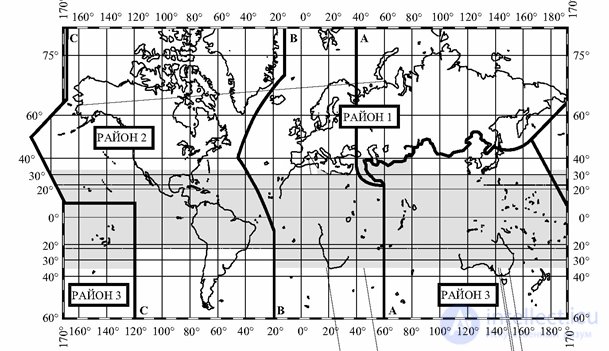
Figure 1.1 Boundaries of regions and zones on the Earth's surface:
Region 1 comprises the zone bounded on the east by line A and on the west by line B, excluding any part of the territory of the Islamic Republic of Iran located between these boundaries. This Region also fully includes the territories of Armenia, Azerbaijan, the Russian Federation, Georgia, Kazakhstan, Mongolia, Uzbekistan, Kyrgyzstan, Tajikistan, Turkmenistan, Turkey, and Ukraine, and the zone between lines A and C located to the north of the Russian Federation. The shaded part is the tropical zone.
Allocation (of a frequency band). An entry in the Table of Frequency Allocations of a given frequency band for the purpose of its use by one or more terrestrial or space radiocommunication services or the radio astronomy service under specified conditions.
Allotment (of a radio frequency or radio-frequency channel). An entry of a specified frequency channel in an agreed plan, adopted by a competent conference, for use by one or more administrations for a terrestrial or space radiocommunication service in one or more specified countries or geographical areas under specified conditions.
Assignment (of a radio frequency or radio-frequency channel). Authorization given by an administration for a radio station to use a radio frequency or a frequency band.
Assigned frequency band – the frequency band within which an REE is permitted to emit, and the assigned frequency – the center frequency in the frequency band assigned to an REE. For space stations, the assigned frequency band includes twice the maximum Doppler shift frequency that may be observed at any point on the Earth's surface. Any new assignment or any change of frequency shall be made so as to avoid interference to other stations that use their assigned frequencies.

Comments