
Lecture
Information model — a model of an object, presented in the form of information describing the parameters and variable quantities of the object that are significant for the given consideration, the relationships between them, the object's inputs and outputs, and allowing the possible states of the object to be modelled by feeding information about changes in the input quantities into the model.
An information model (in the broad, general-scientific sense) — a body of information characterizing the essential properties and states of an object, process or phenomenon, as well as its interrelation with the outside world.
Several types of information models are distinguished, differing in the nature of the queries made to them
An information model in computer science is a representation of concepts, relationships, constraints, rules and operations, intended to define the semantics of data for a specific problem domain .
Building information modelling — is an approach to the construction, fitting-out, operation and maintenance of a building (to management of the object's life cycle), which involves the collection and integrated processing, during the design process, of all architectural-structural, technological, economic and other information about the building together with all its interrelations and dependencies, whereby the building and everything related to it are treated as a single object
The process of collectively creating and using information about a structure forms the basis for all decisions throughout the object's life cycle (from the earliest concepts to detailed design, construction, operation and demolition).
Information modelling — the process of describing or building a model of a subject domain in a form or format that, on the one hand, is easily perceived by a person, and, on the other hand, can easily be converted into a set of elements of an information repository, software components and other constituents of application software. Most often the term information modelling can be seen in the context of describing the process of building ER diagrams or UML diagrams or other schemas or data structures.
In practically all the natural and social sciences, the construction and use of models is a powerful tool of research. Real objects and processes are often so multifaceted and complex that the best way to study them turns out to be building a model that reflects only some part of reality and is therefore many times simpler than that reality. The subject of research and development of computer science is the methodology of information modelling, associated with the use of computer technology and technologies. In this sense one speaks of computer modelling. The cross-disciplinary significance of computer science manifests itself to a large extent precisely through the introduction of computer modelling into various scientific and applied fields: physics and engineering, biology and medicine, economics, management and many others.
Computer modelling includes the process of implementing an information model on a computer and studying, with the help of this model, the object being modelled — that is, conducting a computational experiment. Computer modelling is used to solve many scientific and production problems.
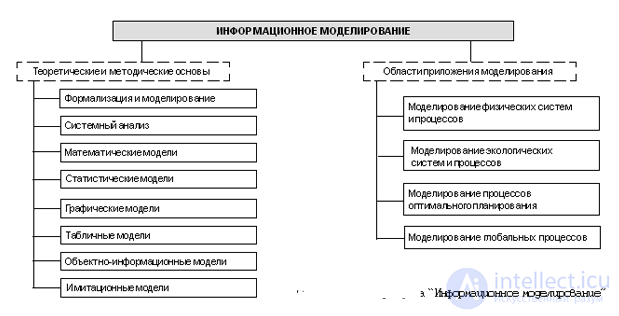
The concept of information modelling is based on the following principles:
The relationships between the objects of an information model determine the data structure.
The following data structures are distinguished:
Linear data structures:
Non-linear data structures:
In software, objects are in certain relationships with one another. There are 3 kinds of relationships: association, generalization and aggregation.
In a one-to-one relationship, each instance of entity A can be associated with one instance of entity B.
Let us consider the entities — Student and Gradebook.
At any given moment a student has one gradebook, while at the same time a given gradebook belongs to one student.
To represent a 1:1 relationship in a relational database schema, two tables are created for each of the objects of the subject domain, and the primary key of one of them (whichever is chosen) is added to the list of attributes of the other object.
If you have two entities, ask yourself:
1) How many objects from B can relate to object A?
2) How many objects from A can relate to an object from B?
If the answer to the first question is — many, and to the second — one (or possibly none), then you are dealing with a one-to-many relationship.
Let us take as an example the entities Department and Lecturer. At any given moment a department contains many lecturers, but each lecturer is subordinate to only one department.
To implement a 1:M relationship in a relational database schema, the primary key of the object on the “1” side is added to the list of attributes of the object on the “M” side.
A many-to-many relationship — is a relationship in which multiple records from one table (A) can correspond to multiple records from another (B).
Let us again take as an example the entity Student and the entity Subject. Each student studies many subjects, while at the same time a given subject is studied by many students.
To implement an M:N relationship in a relational database schema, it is necessary to create an additional table whose primary key will be composite and will represent a combination of the primary keys of the objects participating in the relationship.
A relationship of the generalization type is implemented as a relationship of one parent entity class with several child entity classes. It is used if a constituent part of an object relates to the main object as a class relates to a subclass.
When Generalization is used, the primary key of the parent object is carried over into the primary key of the child objects. It is worth noting that Generalization implements what is known as an inheritance hierarchy. Here the parent object contains attributes that are common to all the child objects.
In aggregation, the parent object (or aggregate) is linked to several child objects (or components). The components of the parent object refer to the aggregate by means of a foreign key that is not part of the primary key. Here the components of the aggregate can exist outside the aggregate (null values of the foreign key are permitted) and can NOT exist outside the aggregate (null values of the foreign key are not permitted).
To represent aggregation, it is necessary to create one table for the top-level object and one table each for the lower-level objects. The primary key of the top-level object is added as an attribute to all the lower-level objects (it becomes a foreign key on the lower-level objects).
Normal forms — are recommendations for database design. You are not required to adhere to all five normal forms when designing a database. Very few databases follow all five normal forms provided in the relational data model. Databases are usually normalized to the second or third normal form. The fourth and fifth forms are rarely used.
The first normal form states that a database table — is a representation of an entity of the system you are creating. Examples of entities: orders, customers, ticket booking, hotel, product, etc. Each record in the database represents one instance of the entity. For example, in a products table each record represents one product.
Rule: every table has a primary key consisting of the smallest possible number of fields.
Rule: fields have no duplicates within each record, and each field contains only one value.
In order for a database to be normalized according to the second normal form, it must be normalized according to the first normal form. The second normal form is concerned with data redundancy.
Rule: fields that are not part of the primary key must not be dependent on the primary key.
This means that you should store in a table only data that is directly related to it and has no relation to another entity. Following the second normal form — is a matter of finding data that is frequently duplicated in the table's records and that could belong to another entity.
1. The method of cognizing the surrounding reality through constructing models of objects and studying them – is:
2. Models that are actual physical mock-ups, in which the properties, structure or behaviour of real objects are represented – are called:
3. Models that describe real objects using special modelling languages are called:
4. Which data structure is organized on the principle: “Last in, first out”?
5. Which data structure is organized on the principle: “First in, first out”?
6. In which data structure does every element, except the outermost ones, have more than one preceding and following element?
7. A multiply linked structure whose elements are connected by directed lines is called:
8. If the lines connecting the elements of a graph have direction, they are called:
9. Which of the models can be considered static:
10. Which model can be considered dynamic:

Comments