
Lecture
Design is called the process of creating a description necessary for building, under given conditions, an object that does not yet exist, on the basis of the initial description of this object (the design specification).
Design reduces to solving a group of synthesis problems and analysis problems. Here synthesis problems are connected with the creation of the object, while analysis problems are connected with studying the properties of the given object.
The solution of the problem of designing a radioelectronic device with optimal characteristics, using parametric optimisation methods /2,8/, includes three stages:
1 – computer modelling of the device;
2 – drawing up the objective function with the choice of optimality criteria;
3 – finding the extremum of the resulting objective function and determining the optimal internal parameters of the device.
Modelling (analysis) of radioelectronic equipment (REE) requires mathematical models at the corresponding levels and is carried out mainly by numerical methods /8/. The main criterion of modelling, along with the required accuracy and adequacy of the model, is performance – the speed of computer calculation of the device's output parameters.
The stage of drawing up the objective function when optimising a device is the most creative and informal one /2,7,8/. The objective function is built on the basis of the output parameters of the device (characteristics) that need to be optimised.
A distinction is made between structural and parametric synthesis.

The goal of structural synthesis is to obtain a structural diagram of the object, containing information about the composition of the elements and the ways in which they are connected to one another. The goal of parametric synthesis is to determine the numerical values of the element parameters. Synthesis is called optimisation if the best structures and parameter values, in a given sense, are determined. The problem of choosing the optimal structure is called structural optimisation, and the calculation of the optimal parameter values for a given structure is called parametric optimisation.
If, based on the results of the analysis, the design solution is deemed not final, then a process of successive approximations toward an acceptable design variant begins. In many applications, to improve the design it is more convenient to vary the values of the element parameters, i.e. to use parametric synthesis based on multivariant analysis. Here the problem of parametric synthesis can be formulated as the problem of determining the values of the element parameters that are best from the standpoint of satisfying the requirements of the technical specification, with the structure of the object being designed unchanged. In that case parametric synthesis is called parametric optimisation. If parametric synthesis does not lead to success, the procedures of structural synthesis are repeated, i.e. at successive iterations the structure of the object is corrected or re-selected.
Fig. 1.3 shows typical synthesis and analysis problems encountered when designing products in the automotive industry. Note that, from the point of view of formalisation and automation, the most complex are the synthesis problems (structural and geometric).
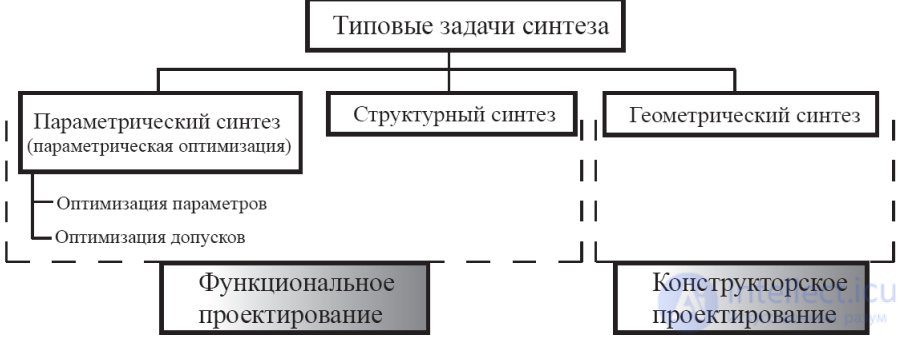
Fig. 1.3 typical synthesis problems
In generalised form the problem of parametric optimisation is formulated as follows.LetD be a region in the parameter spaceP=(p1 ,p2,..., pm)and let a scalar functionW(P),satisfying the condition, be defined in this region
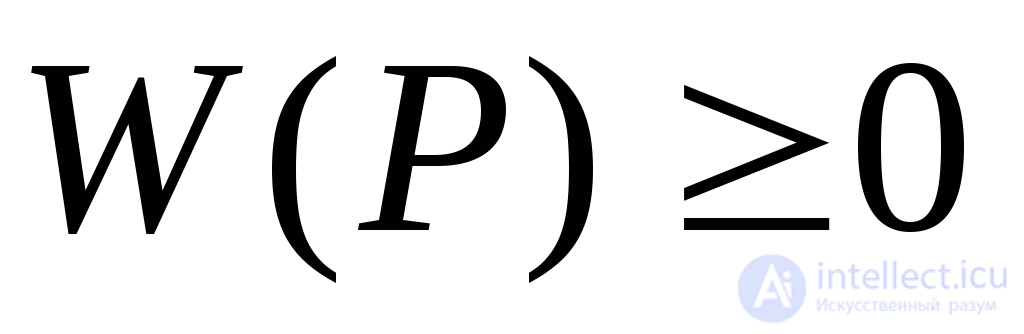
subject to equality-type constraints
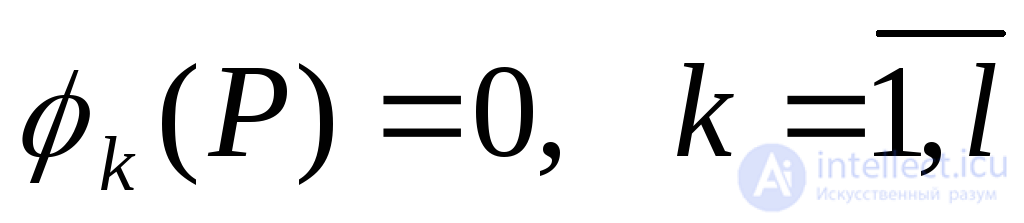
and inequality-type constraints
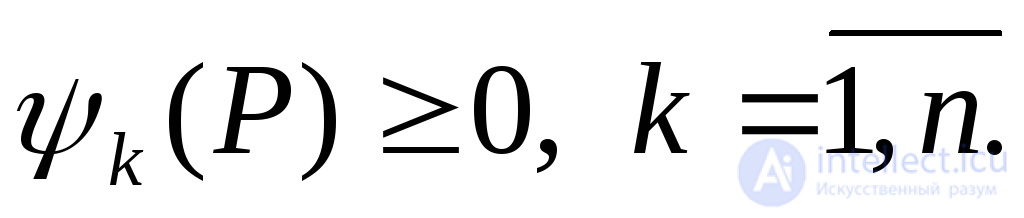
It is required to find the minimum (maximum) of W(P)in the regionDsubject to the stated constraints. If there are no constraints,unconstrainedoptimisation takes place; optimisation in the presence of constraints is called constrained.Unconstrained optimisation is the simplest to carry out. By applying special techniques, optimisation with constraints can be reduced to an unconstrained optimisation problem, but with a number of variables greater thanm.In this course we shall limit ourselves to considering unconstrained optimisation.
Depending on the dimensionality of the parameter space (the value of m) one distinguishes one-dimensional (m=1) and multidimensional(m>1)optimisation.
In optimisation theory the important concepts are those of local and global minima(maxima) of a function, as well as the concepts of unimodal and non-unimodalfunctions.
A point P'is called a point of local minimum of the functionf(P), if there exists aδ-neighbourhood of this point such that

The value f(P')is called the local minimum of the functionf( P).
A point P'of local minimum is called a point of global minimum if for all other points of local minimum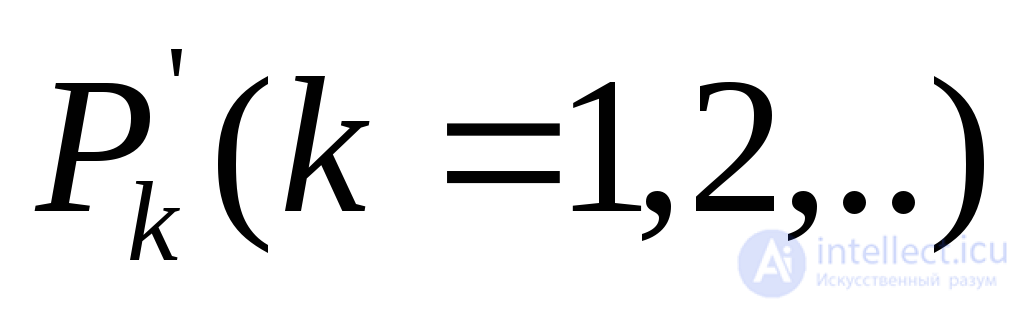 condition is satisfied
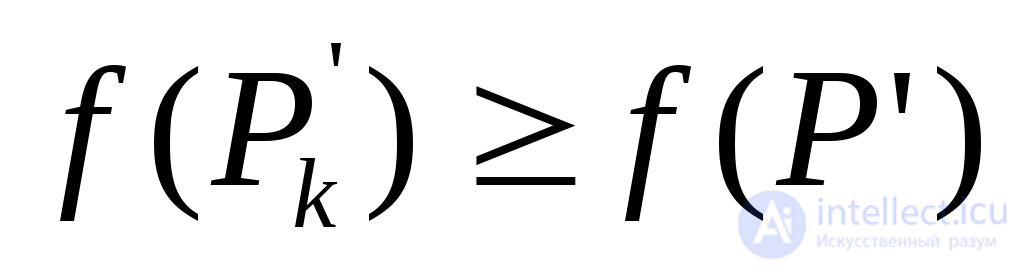 .The valuef(P')is then called the global minimum.
A function is called unimodal in a certain region if it has one minimum (maximum) point in that region; otherwise the function is non-unimodal.
In the general case, the solution of the parametric optimisation problem is carried out by enumerating variants of parameter values chosen in a certain way, comparing them with each other, and choosing the best variant. The algorithm for choosing the next variant of parameter values is called the search strategy.
Most often the solution of the parametric optimisation problem is carried out in several stages. In the first stage, regions of the parameters are identified in which the objective function is unimodal; in the second, the positions of the local minimum points within the regions of unimodality are refined, and then, among the local minimum points, the global minimum point is chosen. Here the most complex stage, and the one that does not lend itself to strict algorithmisation and formalisation, is the first one. Special iterative numerical methods for finding the extrema of unimodal functions are used to carry out the second stage.
+The grid search method can be applied to carry out both one-dimensional and multidimensional optimisation. This method is the simplest to implement and does not require a preliminary identification of the regions of unimodality of the function being optimised, although its use is often associated with high computing-time costs.
The essence of the method is that the continuous region D is mapped to a discrete (grid) region D' The search for the optimal point is carried out among the nodes of the grid region by computing the values of the function being optimised at each node, comparing them with each other, and choosing the node with the minimum value of the function.
The grid introduced on the region D can be either uniform or non-uniform. The accuracy of determining the optimal point depends on the "density" of the grid (the discretisation step of the region D*). Fig. 2.5 shows a block diagram of the algorithm for finding the maximum of the objective function W(P) in a rectangular region with boundaries PL=(PL1,PL2)' and PU=(PU1,PU2)' of the space of two parameters (PL – lower, PU – upper boundaries).
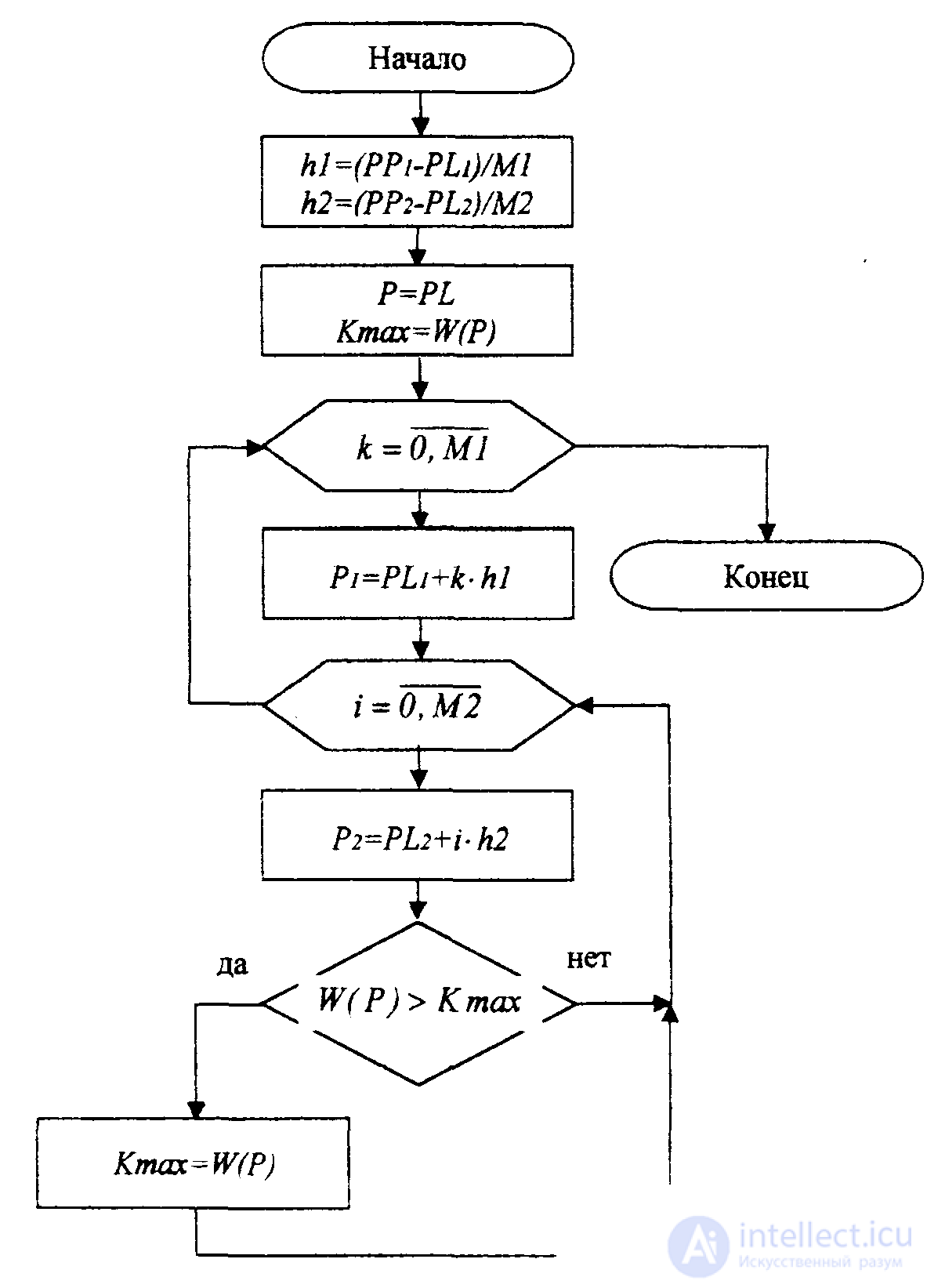
Fig. 2.5
The golden section method is used in one-dimensional optimisation and presupposes the preliminary identification of the intervals of unimodality of the function being optimised.
Let the function f(x) be unimodal on the interval [a,b] and let it be required to refine the position of the minimum (maximum) point x on this interval. Applying the golden section method for this purpose reduces to constructing a sequence of approximations {xk}, such that the minimum (maximum) point of the function lies within the interval of uncertainty of this sequence [xk-1, xk], that is xk-1<x<xk. The iterative process of approaching the optimum point ends when the interval of uncertainty becomes smaller than a predetermined value that determines the accuracy of finding the optimum point. As the criterion for terminating the iterative process it is convenient to choose the satisfaction of the inequality:

where δ determines the relative error of the search for the optimal point. At each step of the golden section method the segment [a,b] is divided at the point
 where
where  is called the golden section. To make use of the unimodality property of the function to reduce the interval of uncertainty, another point x1 is chosen on the segment [a,b], located symmetrically about the midpoint of the segment with respect to the pointx1. When searching for a minimum, if f(x1)>f(x2), then [a, x1 ], is chosen as the next interval of uncertainty, which is equivalent to moving the point b to the point x1 If f(x1)<f(x2), then [x2,b], is chosen as the next interval of uncertainty, which is equivalent to moving the point a to the point x2. When searching for a maximum the signs of the inequalities are reversed.
Fig. 2.6 shows a block diagram of the algorithm for finding the maximum of a function by the golden section method.
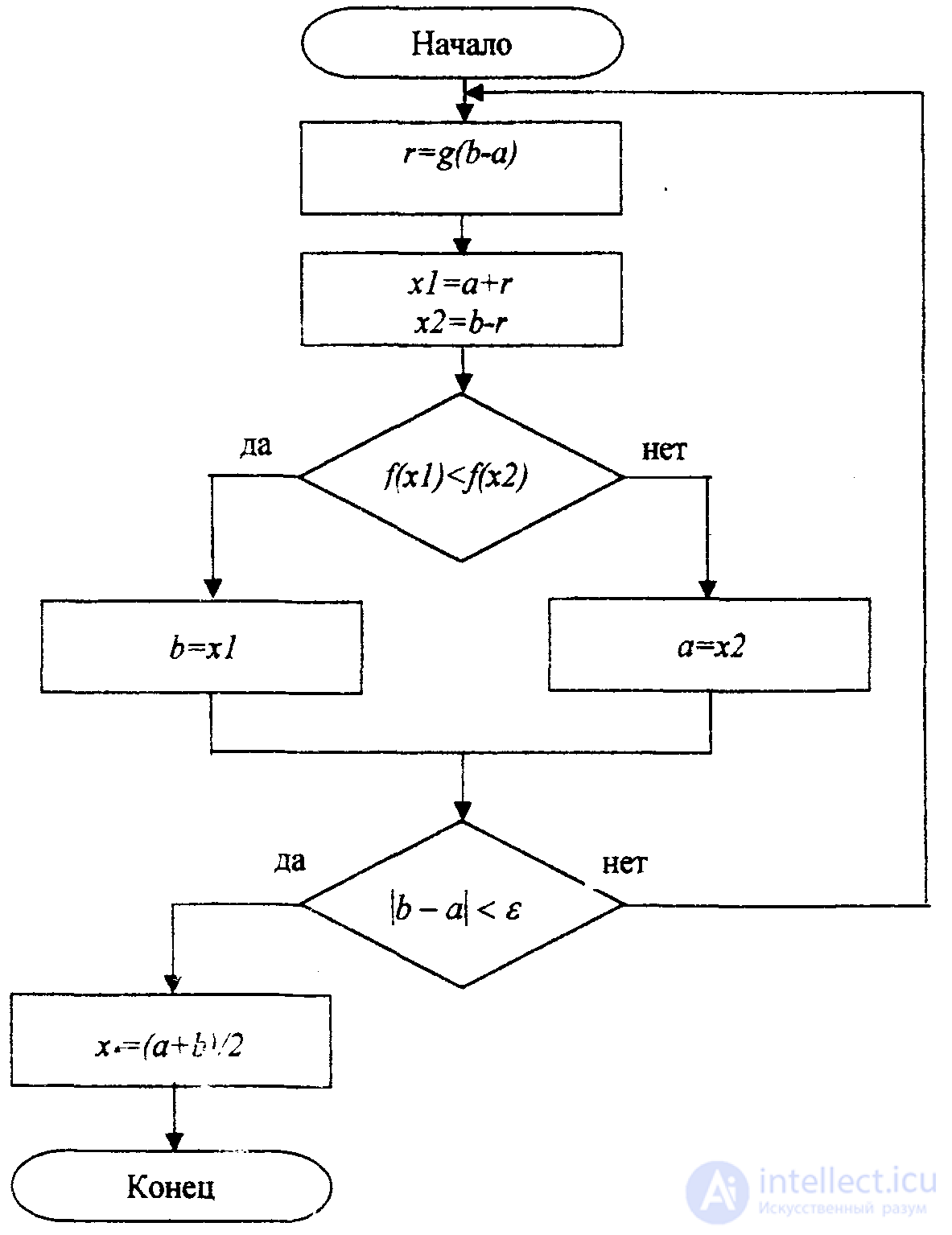
Fig. 2.6
The coordinate descent method is used in multidimensional optimisation and consists in reducing the multidimensional problem to successive one-dimensional problems, which are solved by one-dimensional optimisation methods, in particular by the golden section method.
Let us consider the essence of the coordinate descent method using the example of minimising a function of two variables W (P) = W (p1, p2).
Suppose that a rectangular region is known on the plane P= (p1,p2), where the minimum point of the function  lies, that is
 . At the start, in the rectangular region we choose an initial point
 and fix the coordinate
 , then the function
 will depend on the single variable p1. By the method of minimising a function of one variable we determine the point
 of the minimum of the function
 . Then we fix the coordinate
 and determine the point
 of the minimum of the function
 with respect to the coordinate p2.
In a similar way we move from the point  to the point
 and so on. The algorithm for determining the maximum point is analogous.
As the criterion for terminating the iterative process of coordinate descent one can use the satisfaction of the inequalities:

Fig. 2.7 shows a block diagram of the algorithm for finding the maximum point of the function W(P) by the coordinate descent method.
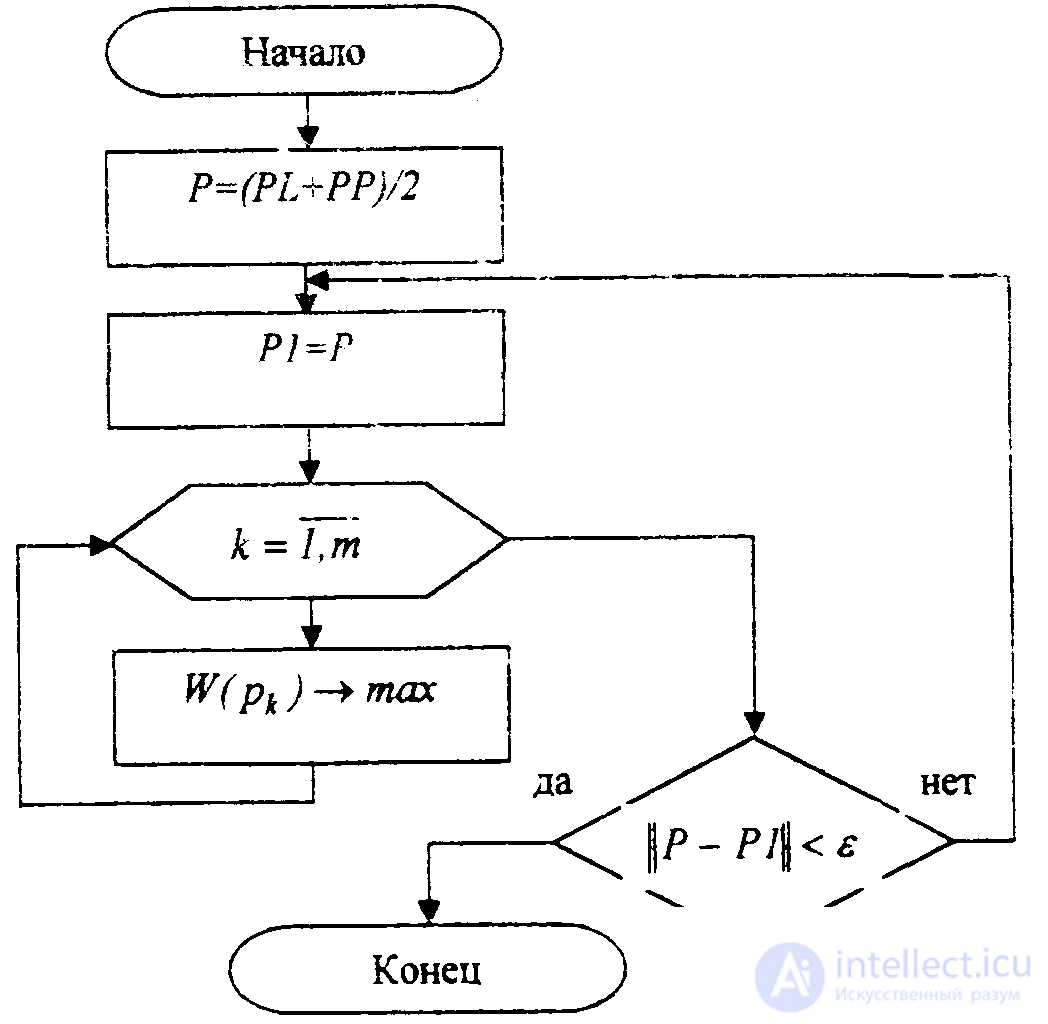
Fig. 2.7

Comments