
Lecture
EPC (Event-Driven Process Chain) — and also eEPC (Extended Event-Driven Process Chain) — are notations for depicting the flow of a business process. The EPC method was developed as part of the work on creating ARIS in the early 1990s. It is used by many organizations for modelling, analysis, and reorganization of business processes.
The key elements of which are Events and Functions.
A business-process diagram in EPC must begin and end with an Event. A Function must always be followed by an Event, i.e. the execution of a Function creates some event (state). Documents, organizational units, information and material flows, elements of the information system (software, databases) have their own graphical notation.
The operators AND, OR, and exclusive OR are used to branch the process.
Event-driven process chain (EPC diagram) — a type of flowchart used for business modelling. EPC can be used to configure an enterprise resource planning (ERP) system, and for business-process improvements.
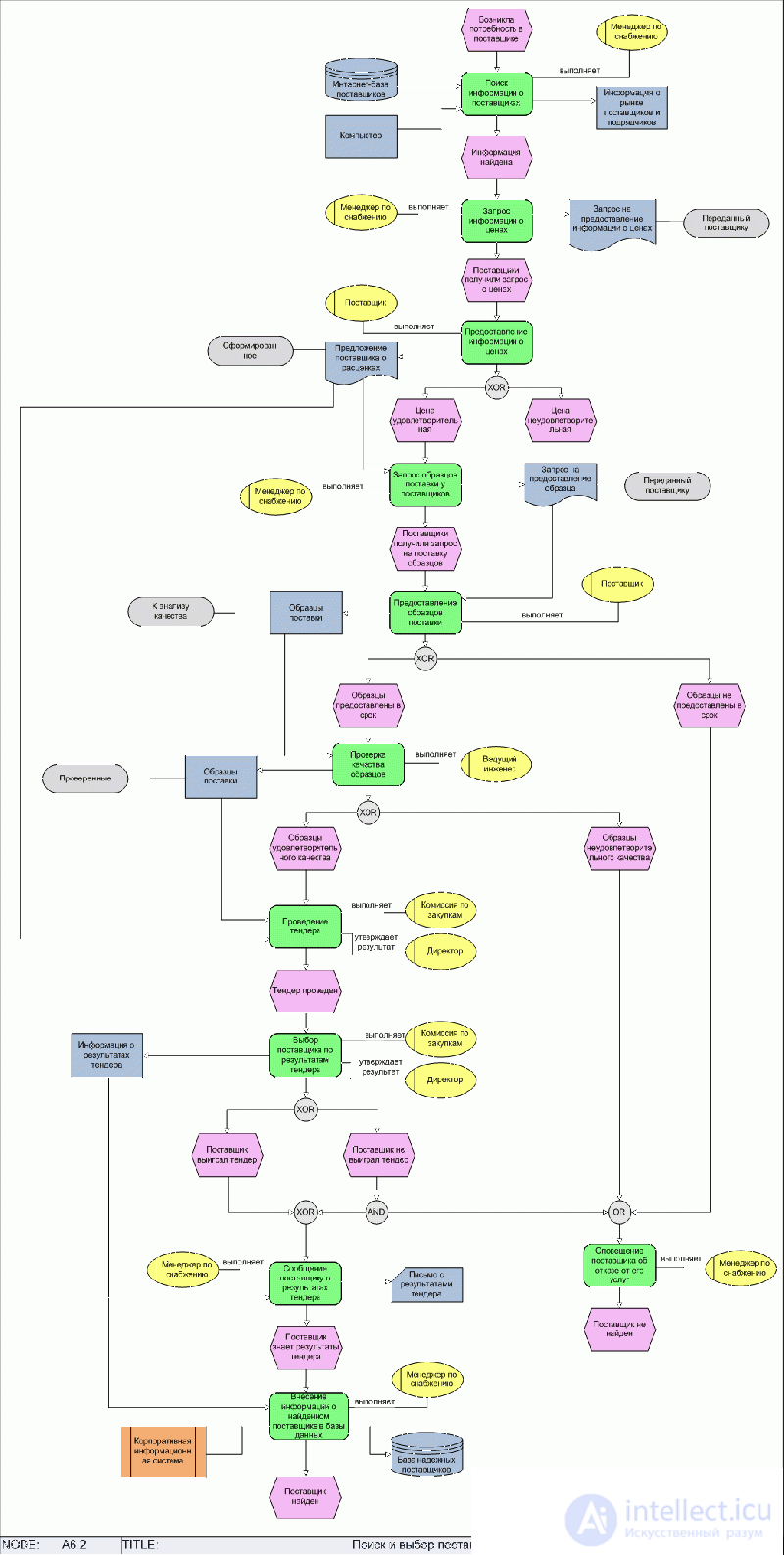
Organizations use EPC diagrams to plan business-process workflows. There are a number of tools for creating EPC diagrams, some of which support a tool-independent EPC data-interchange format — the EPML markup language. EPC diagrams use several kinds of symbols to show the structure of the control flow (the sequence of decisions, functions, events, and other elements) of a business process.
The EPC method was developed by August-Wilhelm Scheer as part of the work on creating ARIS in the early 1990s . It is used by many organizations for modelling, analysis, and reorganization of business processes.
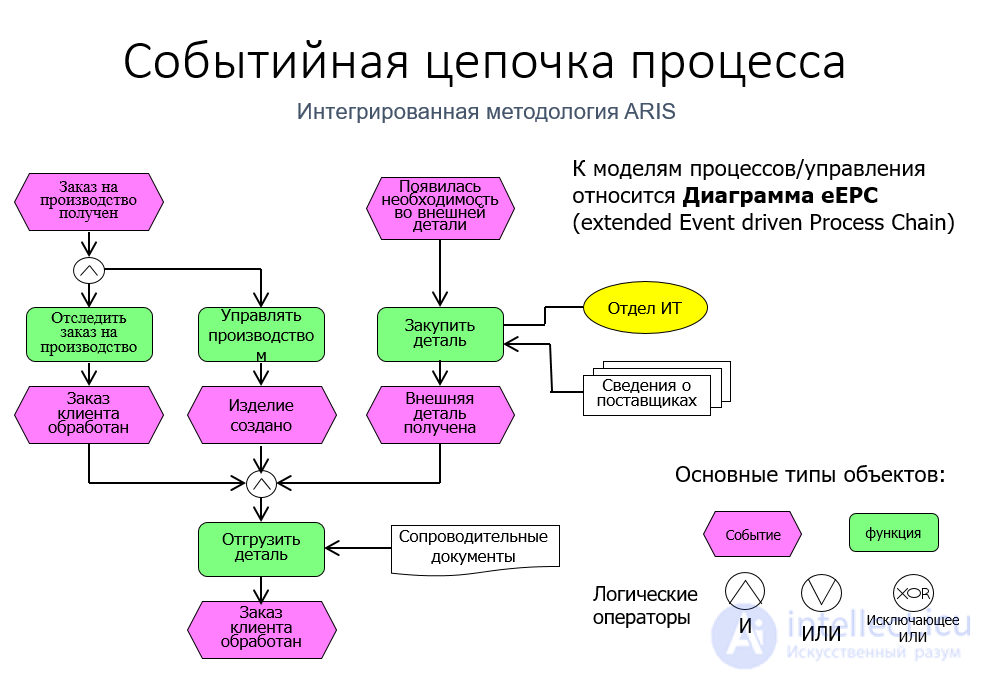
Fig. Event-driven process chain
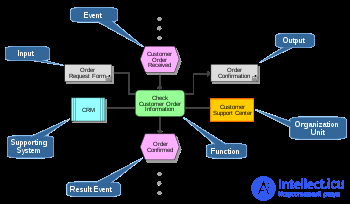
Events are passive elements in EPC. An event is a state that occurs before or after a function, that is, it fixes the state of certain parameters at a particular moment in time. Examples of events: “contract signed”, “requirement recorded”, “material in stock”. In EPC an event is represented graphically as a hexagon. EPC diagrams must both start with an event and end with an event.
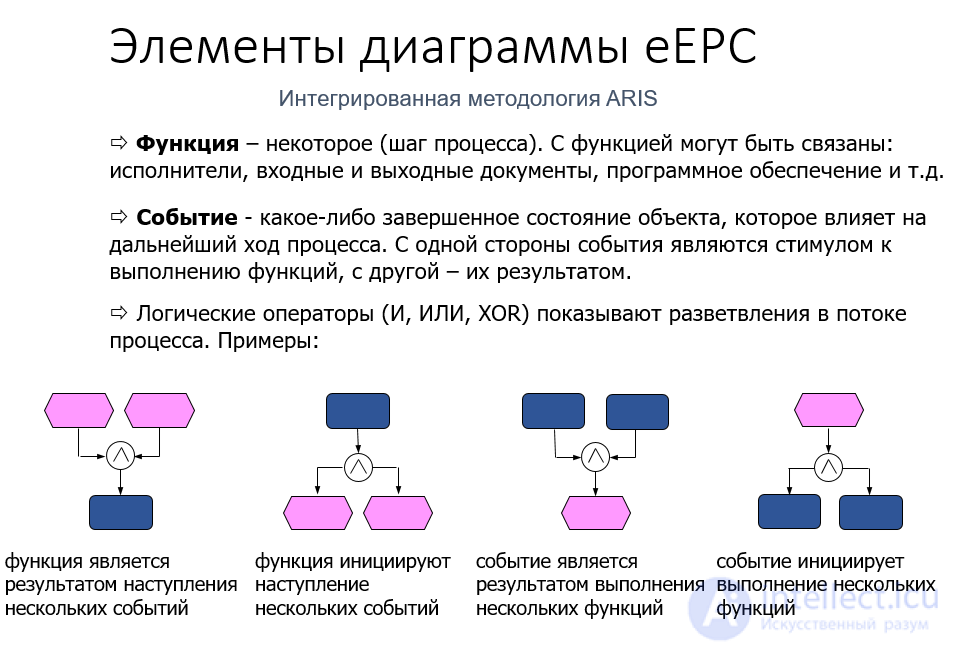
Fig. Elements of an eEPC diagram
Functions are active elements in EPC. A function — is a defined action performed over a certain span of time. Each function can be decomposed.
Organizational unit — a position in an organization (for example, “senior foreman”) or a division of an organization (for example, “procurement department”), an element to which the execution of a function can be assigned.
Information, material, or resource object — objects in the real world, for example business objects, various entities, which can be either input data serving as the basis for a function, or output data obtained by means of a function. Examples are “material”, “order”, depicted as a rectangle.
Logical connector — a control element in the diagram that determines the branching of the workflow depending on the completion of a function or the occurrence of events.
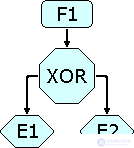
If function F1 has completed, then either event E1 or event E2 will occur
|
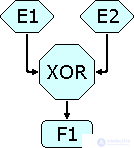
If either event E1 or event E2 has occurred, then function F1 begins
|
Logical relationships — control elements responsible for joining flows together — conjunction, disjunction, or exclusive disjunction.
Control flow connects events with functions, process paths, or logical relationships, creating a chronological sequence or a logical interdependence between them. The control flow is depicted as a dashed arrow.
Information flow — a connection between a function and incoming and outgoing data, from which the function reads changes or into which it writes them.
Organizational-unit assignment — the link between an organizational unit and the function for which it is responsible.
Process path — an element showing the relationship with other processes.
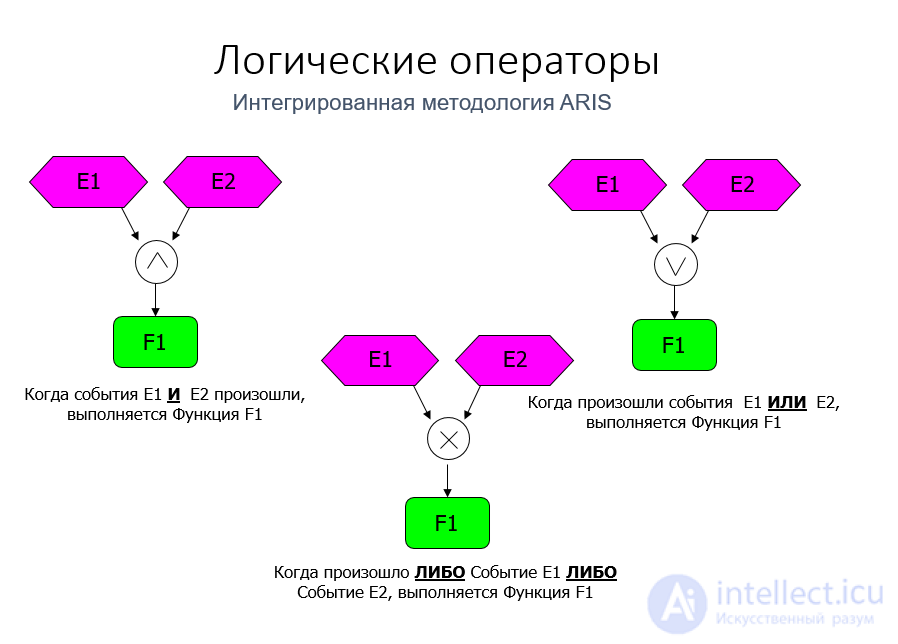
Fig. Logical operators used in eEPC
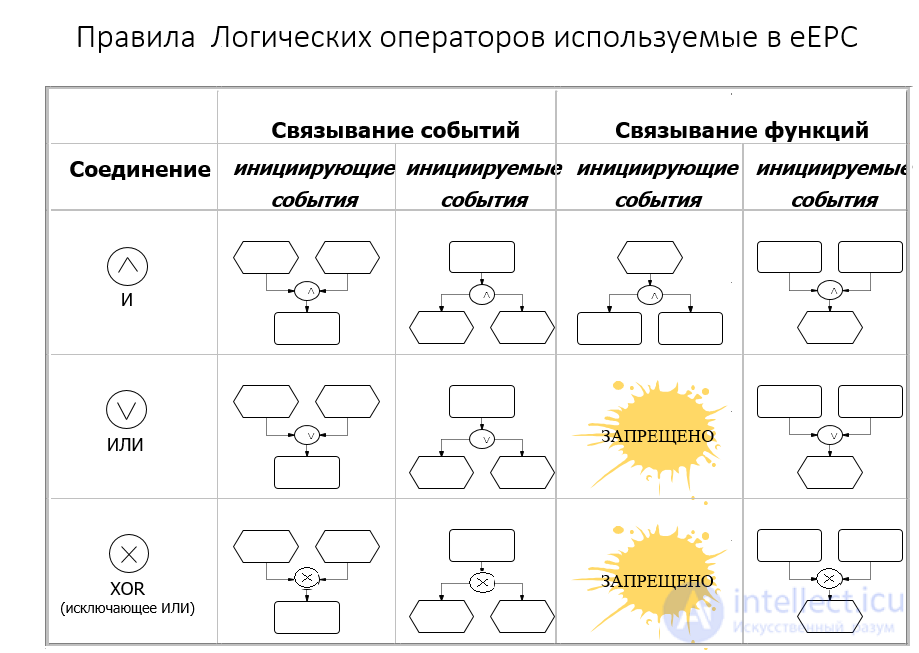
Rules for logical operators used in eEPC
EPC is used at the lower levels of business-model description, when the task is to describe the detailed course of a business process's execution. EPC functions can be decomposed (broken down into detailed business processes only in EPC notation).
Allows a very detailed and precise description of the execution of a business process, showing on the diagram, in graphical form, all the performers and all the objects used.
Has a very wide range of graphical elements, which can make it difficult to understand compared with other notations. Developing processes in this notation and reading them requires prior training of staff.

Comments