
Lecture
A digital twin is a digital copy of a living or non-living physical entity. A digital twin is a digital copy of potential and actual physical assets (a physical twin), processes, people, places, systems and devices that can be used for various purposes. The digital representation provides both the elements and the dynamics of how an Internet of Things (IoT) device operates and lives throughout its entire life cycle. Definitions of digital twin technology used in previous studies emphasize two important characteristics. First, each definition emphasizes the connection between the physical model and the corresponding virtual model or virtual counterpart. Second, this connection is established by generating data in real time by means of sensors. The concept of a digital twin can be compared with other concepts, such as cross-reality environments or collaborative spaces and mirror models, which broadly seek to synchronize part of the physical world (for example, an object or a place) with its cyber-representation (which may be an abstraction of certain aspects of the physical world).
Digital twins combine the Internet of Things, artificial intelligence, machine learning and software analytics with spatial network graphs to create living digital simulation models that are updated and change as their physical counterparts change. A digital twin continuously learns and updates itself from multiple sources so as to represent its status, working condition or position in near real time. This learning system learns from itself, using data from sensors that convey various aspects of its working condition; from human experts, such as engineers with deep and up-to-date industry knowledge; from other similar machines; from other similar fleets of machines; and from larger systems and the environment of which it may be a part. A digital twin also integrates historical data on the machine's past use so as to incorporate it into its digital model.
Across various industries, twins are used to optimize the operation and maintenance of physical assets, systems and production processes. They represent a formative technology for the Industrial Internet of Things (IIoT), in which physical objects can live and interact virtually with other machines and people. [10] In the context of the Internet of Things, they are also called “cyber-objects” or “digital avatars”. [11] A digital twin is also a component of cyber-physical systems.
| Definition | Authors |
|---|---|
| “A digital twin is a set of virtual information constructs that fully describes a potential or actual physical manufactured product from the micro atomic level to the macro geometrical level. At its optimum, any information that could be obtained from inspecting a physical manufactured product can be obtained from its digital twin.” | Grieves and Vickers (2016) [12] |
| “A digital twin is an integrated multiphysics, multiscale, probabilistic simulation of an as-built vehicle or system that uses the best available physical models, sensor updates, fleet history, etc., to mirror the life of its corresponding flying twin”. | Glaessgen and Stargel, (2012) [13] |
| “a digital twin is a real mapping of all components in the product life cycle using physical data, virtual data, and data of their interaction” | Tao, Sui, Liu, Qi, Zhang, Song, Guo, Lu and Nee, (2018) [14] |
| “a dynamic virtual representation of a physical object or system across its life cycle, using real-time data to enable understanding, learning and reasoning” | Bolton, McColl-Kennedy, Cheung, Gallan, Orsingher, Witell and Zaki, (2018) [15] |
| “The use of a digital copy of a physical system for real-time optimization” | Söderberg, R., Wärmefjord, K., Carlson, J. S., and Lindkvist, L. (2017) [16] |
| “A digital twin is a real-time digital copy of a physical device” | Bacchiega (2017) [17] |
| “A digital twin is a digital copy of a living or non-living physical object. By connecting the physical and virtual worlds, data flows seamlessly, allowing the virtual object to exist simultaneously with the physical object”. | El Saddik, A. (2018) |
| In the context of Digital Built Britain, a digital twin is “a realistic digital representation of assets, processes or systems in the built or natural environment”. | The Gemini Principles (2018) [18] |
The emergence of the digital twin concept was linked to the growing digitalization of production processes, in the course of which physical or analogue resources were replaced by informational or digital ones. Organizations followed the latest trends and tried to determine how digital solutions could help them derive both operational and strategic benefit .
Up until the second half of the 2010s, creating computerized systems that reflected the characteristics of physical objects in near real time was impossible because of technical limitations. It was only a substantial breakthrough in the development of digital technologies, which made it possible to increase computing power and reduce the cost of using it, that allowed leading companies to combine information technology with operational processes to create digital twins of enterprises .
Digital twins were anticipated by David Gelernter's 1991 book “ Mirror Worlds” . [19] [20] Both in industry and in the scientific literature it is widely recognized that Michael Grieves of the Florida Institute of Technology was the first to apply the concept of the digital twin in manufacturing. The concept and model of the digital twin were publicly presented in 2002 by Grieves, then working at the University of Michigan, at a Society of Manufacturing Engineers conference in Troy, Michigan. [27]Grieves proposed the digital twin as a conceptual model underlying product lifecycle management (PLM).
The concept, which received several different names, was subsequently called the “digital twin” by John Vickers of NASA in a 2010 roadmap report. [28] The digital twin concept consists of three distinct parts: the physical product, the digital/virtual product, and the connections between the two products. The connections between the physical product and the digital/virtual product are the data that is transmitted from the physical product to the digital/virtual product, and the information that is available from the digital/virtual product to the physical environment.
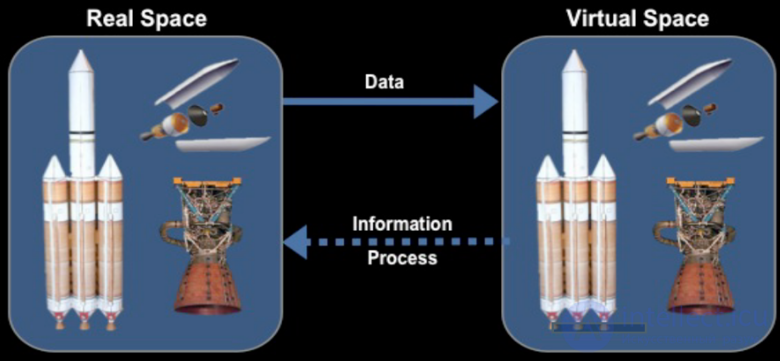
An early concept of the digital twin from Grieves and Vickers
Later the concept was divided into types. [12] The types are the digital twin prototype (DTP), the digital twin instance (DTI), and the digital twin aggregate (DTA). The DTP consists of the designs, analyses and processes for implementing the physical product. The DTP exists before the physical product appears. The DTI is the digital twin of each individual instance of the product after it has been manufactured. The DTA is a collection of DTIs, whose data and information can be used to query the physical product, and for prediction and learning. The specific information contained in digital twins is determined by the use cases. The digital twin is a logical construct, meaning that the actual data and information may be contained in other applications.
The digital twin in the workplace is often considered part of robotic process automation (RPA) and, according to industry analyst firm Gartner, is part of the broader and evolving category of “hyperautomation”.
An example of how digital twins are used to optimize machines is the maintenance of power-generation equipment, such as power-generating turbines, jet engines and locomotives.
Another example of digital twins is the use of 3D modelling to create digital companions for physical objects. [29] [30] [31] [23] [24] It can be used to view the status of a real physical object, which makes it possible to project physical objects into the digital world. [32] For example, when sensors collect data from a connected device, that data can be used to update a “digital twin” copy of the device's state in real time. [33] [34] [35] The term “device shadow” is also used to refer to a digital twin. [36]A digital twin must be a current and accurate copy of the properties and states of a physical object, including its shape, position, gesture, state and motion. [37]
A digital twin can also be used for monitoring, diagnostics and forecasting in order to optimize performance and asset utilization. In this area, sensor data can be combined with historical data, human experience, fleet data and simulation-based learning to improve forecast results. [38] In this way, sophisticated predictive and intelligent maintenance platforms can use digital twins to find the root causes of problems and improve performance.
Digital twins of autonomous vehicles and their sensor suite, embedded in the simulation of road traffic and the surrounding environment, have also been proposed as a means of overcoming the significant challenges of development, testing and validation for the automotive application [39], in particular, when the corresponding algorithms are based on artificial intelligence approaches that require extensive training data and validation datasets.
Additional examples of industry applications:
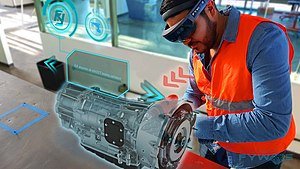
Most often, digital twins are created for the purpose of modelling objects directly related to industrial production.
Examples:
Physical production facilities are virtualized and represented as digital twin models (avatars), seamlessly and closely integrated into both the physical and the cyber space. [48] The physical objects and their twin models interact to mutual benefit.
The digital twin disrupts the entire product lifecycle management (PLM) process, from manufacturing to maintenance and operation. [49] Currently, PLM is very time-consuming in terms of efficiency, production, intelligence, service stages and sustainability in product development. The digital twin can unify the physical and virtual space of a product. [50] The digital twin allows companies to have a digital footprint for all their products, from design through development and throughout the entire product lifecycle. [51] [52]Overall, industries with manufacturing businesses have been strongly affected by digital twins. In the manufacturing process, the digital twin is akin to a virtual copy of recent events at the factory. Thousands of sensors are placed throughout the physical manufacturing process, all of them collecting data across various dimensions, such as environmental conditions, machine behavioural characteristics and the work being performed. All of this data is continuously transmitted to and collected by the digital twin. [51]
Thanks to the Internet of Things, digital twins have become more accessible and may determine the future of the manufacturing industry. The benefit for engineers lies in the real-world use of products that are virtually developed by the digital twin. Advanced ways of servicing and managing products and assets are becoming available, since there is a digital twin of the real “thing” with real-time capabilities. [53]
Digital twins offer enormous business potential by predicting the future rather than analysing the past of the manufacturing process. [54] The representation of reality created by digital twins allows manufacturers to evolve toward expected business practices. [49] The future of manufacturing is determined by the following four aspects: modularity, autonomy, connectivity and the digital twin. [55]As digitalization grows at the stages of the manufacturing process, opportunities open up for increasing productivity. This begins with modularity and leads to improved efficiency of the production system. In addition, autonomy allows the production system to respond efficiently and intelligently to unexpected events. Finally, connectivity capabilities such as the Internet of Things make it possible to close the digitalization loop, allowing the next cycle of product development and promotion to be optimized to increase productivity. [55] This can lead to increased customer satisfaction and loyalty if products can identify a problem before they actually break down. [49]Furthermore, as storage and computing costs become less expensive, the ways in which digital twins are used continue to expand. [51]
Several firms, including General Electric, Arctic Wind and Mechanical Solutions, are investing in digital twins to improve efficiency.
General Electric has a system based on digital twins and uses this software to manage and analyse data from the wind turbines, oil rigs and aircraft that they manufacture. [56] The system that they use for aircraft collects all flight data between London and Paris for each engine. The data is transmitted to a data centre, where a digital twin of each mechanism is created in real time. In this way, General Electric can detect potential defects or malfunctions while the flight is still in progress. Thus, if an engine component is the cause of a malfunction, the maintenance personnel responsible can prepare a replacement part at the airport where the aircraft will land.
Arctic Wind, a company that owns and operates several wind farms in Norway, needed a solution for monitoring the condition of the wind turbines it produces. These turbines are expensive, and all their parts require constant monitoring. Maintaining these turbines is difficult because of extended periods of darkness and low temperatures. To find a solution to the problem of natural disasters, they installed sensors on all their wind turbines, and the data coming from these sensors is transmitted to an office more than 1000 miles away. This provides the digital twins with real-time data on the wind turbines, so staff can visualise any problems as they arise. In addition, the digital twin provides the firm with forecasts for the future, so that they can simulate the turbines’ operation under various extreme conditions. Thus,
Mechanical Solutions Inc. (MSI), a company specialising in turbomachinery, used the Siemens Simcenter STAR-CCM+ software. This software allows product development organisations to make use of a digital twin. MSI successfully implemented this software into its technology chain as a troubleshooting tool. This enabled a cost-effective design process to solve very complex problems that could not have been solved without a digital twin. [57]
Bearing in mind that the definition of a digital twin is a real-time digital copy of a physical device, manufacturers are embedding digital twins into their devices. The proven benefits are improved quality, early fault detection and better feedback to the product designer about product usage.
Geographic digital twins have been popularised in urban planning practice, given the growing appetite for digital technologies within the smart cities movement. These digital twins are often offered in the form of interactive platforms for collecting and displaying three-dimensional and four-dimensional spatial data in real time, with the aim of modelling the urban environment (cities) and the data flows within them. [58]
Visualisation technologies, such as augmented reality (AR) systems, are used as tools for collaborative work in design and planning within the built environment, bringing together data flows from embedded sensors in cities and API services to form digital twins. For example, AR can be used to create augmented-reality maps, buildings and data flows projected onto tables for collaborative viewing by built-environment professionals. [59]
In the built environment, partly through the introduction of building information modelling processes, planning, design, construction, operation and maintenance activities are increasingly being digitised, and digital twins of built assets are seen as a logical continuation – at the level of individual assets and at the national level. In the United Kingdom in November 2018, for example, the Centre for Digital Built Britain published the Gemini Principles, [18] setting out principles for the development of a “national digital twin”. [60]
Healthcare is recognised as an industry in which digital twin technology is disruptive. [61] [50] The concept of a digital twin in the healthcare industry was originally proposed and first used in product or equipment forecasting. [50] With the help of a digital twin, life can be improved in terms of medical health, sport and education through a more data-driven approach to healthcare. [49]The availability of technology makes it possible to create individual models for patients, seamlessly adjusted based on tracked health and lifestyle parameters. Ultimately, this could lead to a virtual patient with a detailed description of the individual patient’s state of health, rather than just previous records. In addition, a digital twin makes it possible to compare individual records with population-level data, making it easier to find patterns with high granularity. [61]The greatest advantage of the digital twin for the healthcare industry is the fact that healthcare can be adapted to the responses of individual patients. Digital twins will not only improve the resolution with which an individual patient’s state of health is determined, but will also change the expected image of a healthy patient. Previously, “healthy” was understood as the absence of signs of disease. Now “healthy” patients can be compared with the rest of the population in order to truly determine who is healthy. [61]However, the emergence of the digital twin in healthcare also has some drawbacks. A digital twin can lead to inequality, since the technology may not be accessible to everyone, widening the gap between rich and poor. In addition, a digital twin will identify patterns within the population, which could lead to discrimination. [61] [62]
Speaking more specifically at the company level, several active companies are investing in and developing healthcare solutions using the digital twin. For example, Philips has explored the idea of a digital version of a patient, so that patients could use a digital twin to act preventively rather than reactively.
“Living Heart” [64] is the result of a collaboration between Stanford University and HPE, in which multiscale 3D models of the heart were created for monitoring blood circulation and virtual drug testing [65], which are still under development, in order to ultimately prevent harmful effects. side effects. [66] Finally, Siemens has developed a similar healthcare digital twin. Using artificial intelligence, doctors can make more accurate diagnoses. [67]
Creating a digital twin is a significant investment. However, by using a cloud platform and a modular organisation, smaller organisations can also contribute to a specific module. [62] One such organisation is Sim & Cure, the first company to bring to market a patient-based simulation model for treating aneurysms. This treatment method makes it possible to predict the deployment of medical devices. Their product, Sim & Size, is an implant consisting of three applications used to treat patients with neurovascular disorders such as aneurysms.
Another industry in which digital twin technology has influenced development is the automotive industry. Digital twins in the automotive industry are implemented using existing data to simplify processes and reduce marginal costs. Automobile designers are currently extending existing physical materiality by embedding digital software capabilities. [69] A specific example of digital twin technology in the automotive industry is the use by automotive engineers of digital twin technology in combination with the firm’s analytical tool to analyse how a particular vehicle is driven. In doing so, they can propose incorporating new features into the vehicle that could reduce the number of road accidents, which was previously impossible on such a short timescale. [70]
Volkswagen is one of the leading automotive companies implementing digital twin technology in its business processes. The use of this technology, which they call the “virtual twin”, has enabled Volkswagen to create digital 3D prototypes of its various car models, such as the Golf. [71] The Pre-Series Centre in Wolfsburg is a specialised department of the virtual prototyping team, where they create digital representations of vehicles that are used from the assembly stage and throughout the vehicles’ entire life cycle. Digital twins support the vehicle production and development process by providing all employees worldwide with detailed, real-time data on the model. Leingang, one of the leaders of the virtual prototyping team, describes how the introduction of digital twins helps Volkswagen optimise the lifecycle management of its products. “Our work helps people in design, quality assurance, body production and assembly. (...) That’s because the “digital twin” allows our colleagues to find out at an early stage exactly what needs to be done when installing a particular component”. [71]Another innovative division in Wolfsburg, the Virtual Engineering Lab Volkswagen, continues to develop the use of digital representations and digital tools in combination with augmented reality. Here they use Microsoft HoloLens, which allows engineers and designers to view and modify digital twins using other technologies, such as gesture control and voice commands. [72]
Unlike traditional players in the automotive industry, who have embedded digital technologies into their traditional products over the past couple of years, a relatively new player, Tesla, Inc., has been engaged in (digital) innovation in the industry since the company entered the market. [73] In addition to driving the transition towards the adoption and mass-market use of electric vehicles, Tesla is innovating in automobiles by embedding software tools into the physical product, including digital twin technology. [73] [74]Tesla creates a digital twin for every electric vehicle it manufactures, which provides the firm with a constant stream of data flowing from the vehicle to the manufacturing plant and back, allowing Tesla to improve vehicle reliability by predicting any kind of maintenance from a distance. [75] The digital nature of Tesla vehicles allows the firm to resolve most maintenance issues remotely using the data obtained from the digital twin, for example, “if a driver’s door is rattling, this can be fixed by downloading software that adjusts the hydraulics of that specific door”. [75] Tesla continues to develop and update its software and other digital technologies in order to maintain its status as a successful innovator. [74]
Comparing the strategies of these two well-known automotive firms, it appears that Volkswagen implemented digital twin technology as an offensive response to Tesla’s innovative approach to the automotive industry. In transitioning to the new technology, Volkswagen framed this challenge as an opportunity, creating a new specialised virtual prototyping department, rather than moving into a new market or niche. [76]
Digital technologies have certain characteristics that distinguish them from other technologies. These characteristics, in turn, have certain implications. Digital twins have the following characteristics.
One of the main characteristics of digital twin technology is connectivity. The recent development of the Internet of Things (IoT) has led to the emergence of many new technologies. The development of the Internet of Things is also contributing to the development of digital twin technology. This technology exhibits many characteristics that resemble the nature of the Internet of Things, namely its connective nature. First of all, the technology provides a connection between the physical component and its digital counterpart. This connection lies at the heart of digital twins; without it, digital twin technology would not exist. As described in the previous section, this connection is created by sensors on the physical product, which obtain data, integrate it, and transmit this data using various integration technologies.[52] For example, the potential for interaction between partners in a supply chain can be increased if the participants in that supply chain are able to check the digital twin of a product or asset. These partners can then verify the status of that product simply by checking the digital twin.
In addition, connection with customers can be increased.
Servitisation is the process by which organisations increase the value of their core corporate offerings through services. [77] In the case of engines, the manufacture of the engine is this organisation’s core offering, and they then add value by providing an engine inspection service and offering maintenance.
Digital twins can be characterised as a digital technology that is both a consequence and a means of data homogenisation. Because any type of information or content can now be stored and transmitted in the same digital form, it can be used to create a virtual representation of a product (in the form of a digital twin), thereby separating information from its physical form. [78] Thus, the homogenisation of data and the separation of information from the physical artefact have enabled digital twins to emerge. However, digital twins also make it possible to store an ever-increasing amount of information about physical products digitally, without that information being tied to the product itself. [69]
As data is increasingly digitised, it can be transmitted, stored and computed in fast and inexpensive ways. [69] According to Moore’s law, computing power will continue to grow exponentially in the coming years, while the cost of computation will decrease significantly. This will therefore lead to a reduction in the marginal cost of developing digital twins and will make it comparatively cheaper to test, predict and solve problems on virtual representations, rather than testing on physical models and waiting for physical products to fail before intervening.
Another consequence of homogenisation and the separation of information is a similarity of user experience. As information from physical objects is digitised, a single artefact can acquire several new capabilities. [69] Digital twin technology allows detailed information about a physical object to be transmitted to a larger number of agents, not limited by physical location or time. [79] In his white paper on digital twin technology in manufacturing, Michael Grieves noted the following about the effects of the homogenisation enabled by digital twins: [80]
In the past, plant managers had an office overlooking the factory so that they could get a feel for what was happening on the shop floor. Thanks to the digital twin, not only the plant manager but everyone connected with the plant’s production can have that same virtual window, not just for a single plant, but for all plants around the world. (Grieves, 2014, p. 5)
As noted above, a digital twin makes it possible to reprogram the physical product in certain ways. In addition, the digital twin can also be reprogrammed automatically. Thanks to sensors on the physical product, artificial intelligence and predictive analytics technologies, [81]a consequence of this reprogrammable nature is the emergence of new functional capabilities. If we again take the engine example, digital twins can be used to collect data on engine performance and, where necessary, to adjust the engine, thereby creating a newer version of the product. In addition, servitisation can also be viewed as a consequence of this reprogrammable nature. Manufacturers may be responsible for monitoring the digital twin, making adjustments or reprogramming the digital twin when necessary, and they may offer this as an additional service.
Another characteristic feature that can be observed is the fact that digital twin technologies leave digital footprints. These footprints can be used by engineers, for example when a machine malfunctions, to go back and check the digital twin’s footprints in order to diagnose where the problem arose. [82] These diagnostics may also be used in the future by the manufacturer of these machines to improve their design, so that the same malfunctions occur less frequently in the future.
In the context of manufacturing, modularity can be described as the design and configuration of products and production modules. [55] By adding modularity to production models, manufacturers gain the ability to configure models and machines. Digital twin technology allows manufacturers to monitor the machines being used and to identify possible areas for improving those machines. When these machines are made modular using digital twin technology, manufacturers can see which components are degrading the machine’s performance and replace them with more suitable components in order to improve the production process.

Comments