
Lecture
Hierarchical Work Structure (WBS) (in English: Work Breakdown Structure, WBS; sometimes Structural Decomposition of Work, WBS) — is a hierarchical breakdown of all the work that must be performed to achieve the goals of the project into smaller operations and actions, down to a level at which the ways of carrying out these actions are entirely clear and the corresponding work can be estimated and scheduled. It also includes defining the intermediate results of all the components that make up this work structure.
Project planning is based on compiling a structured list of works, the completion of which makes it possible to achieve the goals of the project. For this purpose a tool is used that is known under several names:
The essence of decomposition lies in dividing (breaking down) the process into parts according to some criterion or another: by the type of product produced during the work, by functionality, by life-cycle stage, etc. It is important that such a division identify sufficiently simple components – more manageable elements that help to better control the execution of tasks and the achievement of the goal. However, the work breakdown structure differs from a simple implementation schedule, from a document resembling a project plan, and from a list of milestones.
The WBS is intended for detailed planning, cost estimation and ensuring the personal responsibility of those performing the work.
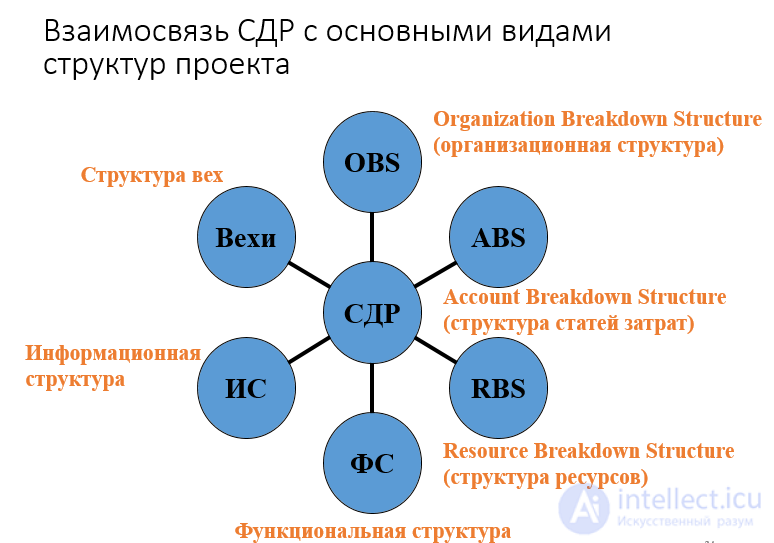
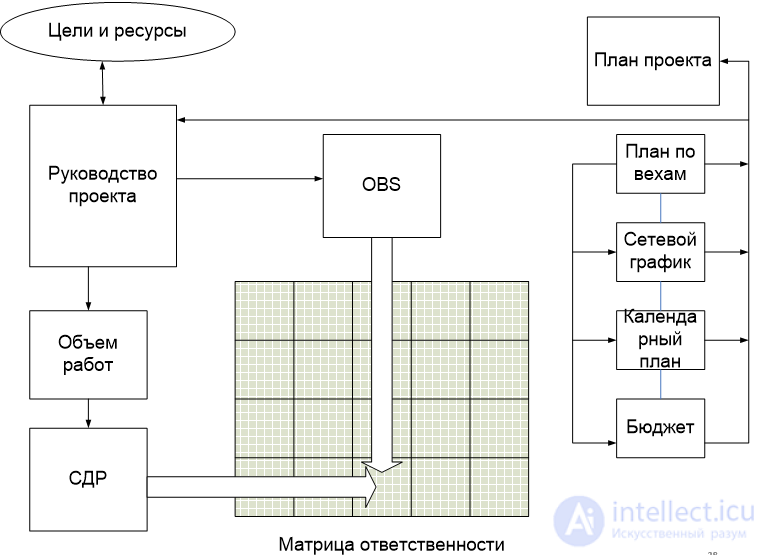
Work — continuous physical or mental effort directed at overcoming obstacles and achieving goals or results; a specific task, duty, function or assignment, often being part of a phase or of other, larger-scale work; something produced or accomplished as a result of effort or the application of skills (qualifications).
Breakdown — division into parts or categories, the identification of simple components.
Structure — a fixed ordered set of objects and the relations between them, the classification of something according to a given criterion.
These definitions mean that the work breakdown structure has the following characteristics:
WBS - is a hierarchical and phased decomposition of the project into phases, deliverables and work packages. It is a tree-like structure that shows the subdivision of the effort required to achieve the goal; for example, a programme, a project and a contract. In a project or contract, the WBS is developed starting from the final goal and successively dividing it into manageable components in terms of size, duration and responsibility (for example, systems, subsystems, components, tasks, subtasks and work packages), which include all the steps necessary to achieve the goal.
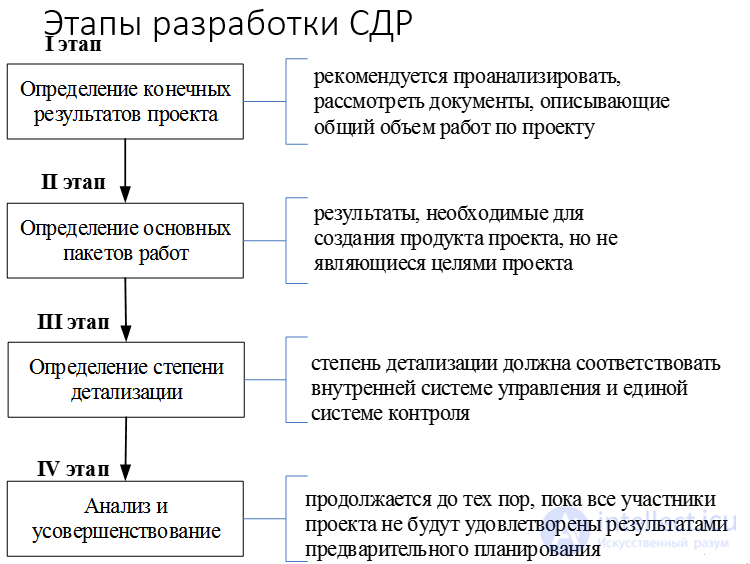
Stages of WBS development
The concept of the work breakdown structure was developed using the Program Evaluation and Review Technique (PERT) by the United States Department of Defense (DoD). PERT was introduced by the US Navy in 1957 to support the development of the Polaris missile programme. Although the term “hierarchical work structure” was not used, this first implementation of PERT did organize tasks into product-oriented categories.
By June 1962, the Department of Defense, NASA and the aerospace industry had published a document for the PERT / COST system, which described the WBS approach. This guide was approved by the Secretary of Defense for adoption by all services. In 1968, the Department of Defense issued “Work Breakdown Structures for Defense Materiel Items” (MIL-STD-881), a military standard requiring the use of work breakdown structures throughout the Department of Defense.
The document has been revised several times, most recently in 2018. The current version of this document can be found in the section “Work Breakdown Structures for Defense Materiel Items” (MIL-STD-881E). It includes WBS definitions for specific commodity systems of defense equipment and addresses the WBS elements that are common to all systems.
The work breakdown structure provides a common framework for the natural development of overall contract planning and control, and serves as the basis for dividing the work into definable increments from which a statement of work, schedule, cost and labour-hours. reporting can be established.
The work breakdown structure makes it possible to sum up the subordinate costs of tasks, materials, etc. into their successively higher “parent” tasks, materials, etc. For each element of the work breakdown structure a description of the task that needs to be performed is created . This method (sometimes called system structure trial ) is used to define and organise the overall scope in the form of a project .
The WBS is organized around the main deliverables of the project (or the planned results) rather than the work required to produce the deliverables (the planned activities). Since the planned results are the desired goals of the project, they form a relatively stable set of categories in which the costs of the planned activities necessary to achieve them can be collected. A well-designed WBS makes it easy to assign each project activity to one and only one terminal element of the WBS. In addition to its cost-accounting function, the WBS also helps to map requirements from one level of the system specification to another, for example a cross-reference matrix mapping functional requirements onto upper- or lower-level design documents. The WBS can be displayed horizontally in outline form or vertically as a tree structure (for example, an organizational chart).
Development of the WBS usually takes place at the start of the project and precedes detailed project and task planning.
The work breakdown structure (Work Breakdown Structure) is the term for a representation of the project executed in the form of a hierarchical work structure, which is achieved by means of sequential decomposition. The tool is aimed at detailed planning, cost estimation, defining and allocating the personal responsibility of the performers, etc. – that is, at the main works and results that define the content of the project.
In a Work Breakdown Structure the elements of the project can be a service, a product, a piece of work, or a group of works (wbs group). Each lower level in the hierarchy details some element of the level above it, but the following principles must be observed:
Implementing these principles in a project results in the work breakdown structure acquiring certain characteristics, namely:
Thus, each successive level of decomposition progressively details the content of the project, which makes it possible to estimate the volumes of work performed, the amount of money absorbed, and the implementation timelines.
In this case, the lower levels of the work packages correspond to relatively small volumes of work, which simplifies the estimation of performance parameters and also helps to clearly define the actions leading to the achievement of the project goals. This approach forms the basis for establishing cost and labour intensity as measurable indicators.
An important principle for designing the work breakdown structure is called the 100% rule. [14] It has been defined as follows:
The 100% rule states that the WBS includes 100% of the work defined by the project scope and captures all deliverables - internal, external, interim - in terms of the work to be completed, including project management. The 100% rule is one of the most important principles for developing, decomposing and evaluating the WBS. The rule is applied at all levels within the hierarchy: the sum of the work at the “child” level must equal 100% of the work represented by the “parent”, and the WBS should not include any work that falls outside the actual scope of the project, that is, it cannot include more than 100% of the work… It is important to remember that the 100% rule also applies to the activity level.[15]
Mutually exclusive: in addition to the 100% rule, it is important that there be no overlap in the definition of scope between the different elements of the work breakdown structure. This ambiguity can lead to duplication of work or to misunderstandings about responsibility and authority. Such overlap can also cause confusion with respect to project cost accounting. If the names of the WBS elements are ambiguous, a WBS dictionary can help clarify the differences between the WBS elements. The WBS dictionary describes each WBS component together with its key milestones, deliverables, activities, scope, and sometimes dates, resources, costs and quality.
If the developer of the work breakdown structure attempts to capture any activity-oriented details in the WBS, they will most likely include either too many activities or too few activities. Too many activities will exceed 100% of the parent scope, while too few will fall below 100% of the parent scope. The best way to adhere to the 100% rule is to define WBS elements in terms of outcomes or results, rather than actions. This also ensures that the WBS does not overly prescribe methods, which allows project participants to exercise greater ingenuity and creative thinking. For new product development projects, the most common method of ensuring a results-oriented WBS is to use a product breakdown structure. Software projects based on features can use a similar method, which consists in using a feature breakdown structure. When a project delivers professional services, the common method is to capture all the planned deliverables in order to create a WBS oriented towards the final result. Work breakdown structures that divide the work by project phase (for example, the preliminary design phase, the critical design phase) must provide a clear division of the phases by deliverables, which are also used when defining entry and exit criteria (for example, an approved preliminary or critical design review). .
A decision must be made as to when to stop breaking the work down into smaller elements. For most projects a hierarchy of two to four levels is sufficient. [17] This will help in determining the duration of the activities needed to produce the deliverables defined by the WBS. There are several heuristics, or “rules of thumb”, used when determining the appropriate duration of an activity or group of activities needed to produce a specific deliverable defined by the WBS.
A work package at the activity level is a task that:
Usually the elements of the work breakdown structure are numbered sequentially in order to reveal the hierarchical structure. The purpose of the numbering is to provide a uniform approach to identifying and managing the WBS across identical systems, regardless of the vendor or service. [18] For example, 1.1.2 Propulsion (in the example below) identifies this element as a level-3 WBS element, since there are three numbers separated by two decimal points. The coding scheme also helps to recognize WBS elements in any written context and makes it possible to map them into a WBS dictionary. [19]
A practical example of a WBS coding scheme
1.0 Aviation System
1.1 Air Vehicle1.1.1 Airframe
1.1.1.1 Airframe Integration, Assembly, Test, and Checkout
1.1.1.2 Fuselage
1.1.1.3 Wing
1.1.1.4 Empennage
1.1.1.5 Nacelle
1.1.1.6 Other Airframe Components 1..n (specify)
1.1.2 Propulsion
1.1.3 Vehicle Subsystems
1.1.4 Avionics
1.2 Systems Engineering
1.3 Program Management
1.4 System Test and Evaluation
1.5 Training
1.6 Data
1.7 Peculiar Support Equipment
1.8 Common Support Equipment
1.9 Operational / Site Activation
1.10 Industrial Facilities
1.11 Initial Spares and Repair Parts
The lowest element in a tree structure, a terminal element is one that is not further subdivided. In a work breakdown structure, such elements (an activity or a deliverable), also known as work packages, are elements that are estimated in terms of resource needs, budget, and duration; are linked by dependencies; and are scheduled. At the intersection of a WBS element and an organizational unit, control accounts and work packages are created, and performance is planned, measured, recorded, and controlled there. [21] A WBS can be expressed down to any level of interest. Three levels are the minimum recommended, with additional levels for, and only for, high-cost or high-risk items and two levels of detail in cases such as systems engineering or program management, [23] with the standard showing examples of WBSs of varying depth, for example software development broken down to as many as 5 levels [24] or a fire-control system down to 7 levels. [25]
A higher-level WBS structure must conform to any standards or templates existing within the organization or domain. For example, U.S. Navy shipbuilding must take into account that naval terms and their hierarchical structure, set out in MIL-STD [26] , are embedded in naval architecture [27], and that the corresponding Navy offices and procedures were built in accordance with this naval architecture structure, so any substantial change to the numbering or naming of WBS elements in the hierarchy would be unacceptable.
In practice, in the process of forming a Work Breakdown Structure one must be able to ask the right questions and organize the structuring process competently. To this end, various algorithmic options are proposed at the initial stage, describing a top-down method of creating a WBS.
Example No. 1:
Example No. 2 using sticky notes and a flip chart:
Next, the final deliverables are broken down into operations, and this cycle continues until it becomes possible to track and control individual tasks. It is important that one work package contain one deliverable.
If project management software is used to create the Work Breakdown Structure – for example, the most common one, MS Project, or its equivalents – then:
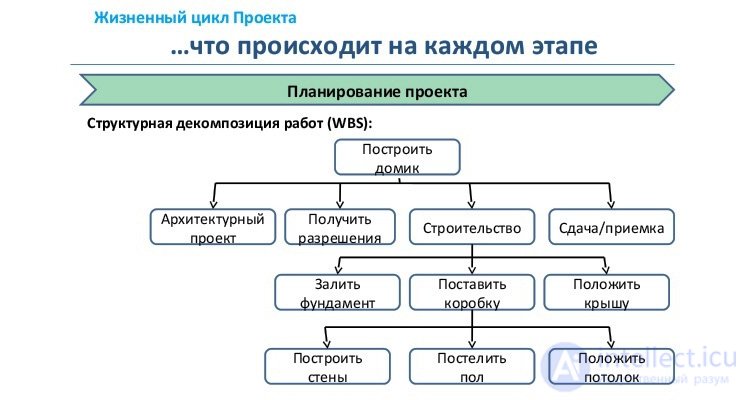
To embed the WBS into the project schedule, the following information needs to be added to the previously created hierarchical structure:
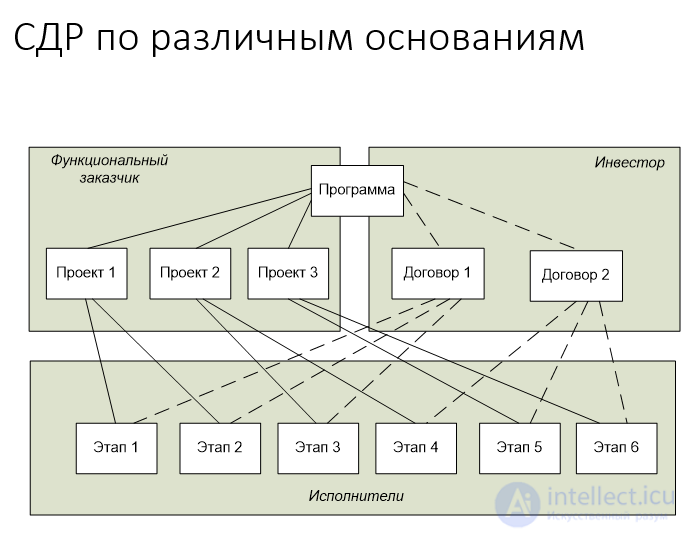
Since work decomposition can be carried out according to different criteria, it is important to ensure that the chosen criterion-based approach necessarily covers the entire scope of the project. A mixed approach is sometimes used, in which different decomposition criteria are chosen at different levels: at the first – life-cycle phases, at the second – organizational structures, at the third – key deliverables.
The structural decomposition tool can be effectively applied in various project manifestations:
A work breakdown structure can either be developed “from scratch” or include components of previously created WBS structures, taken from earlier similar projects or from standardized template variants used by the organization based on their proven success in typical conditions in the past.
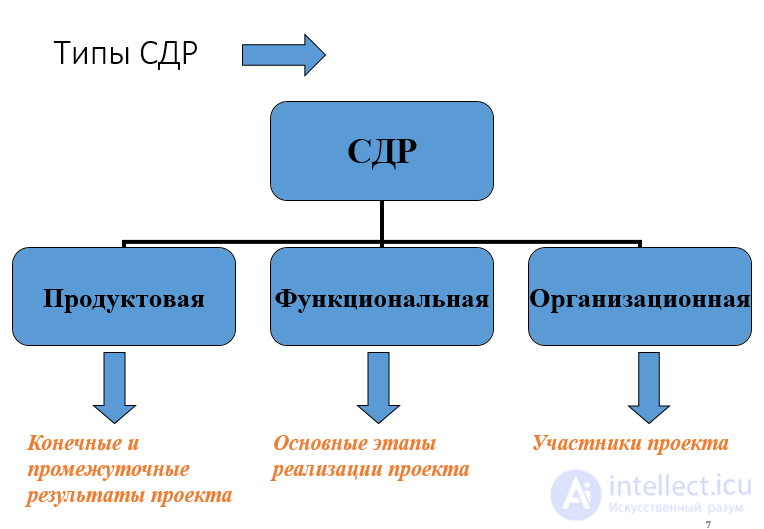
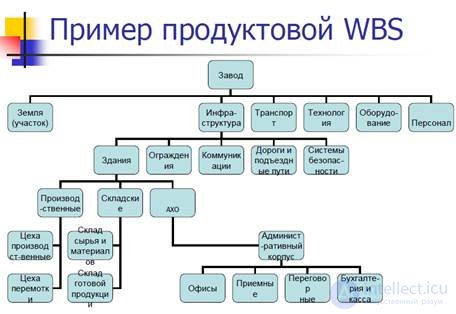
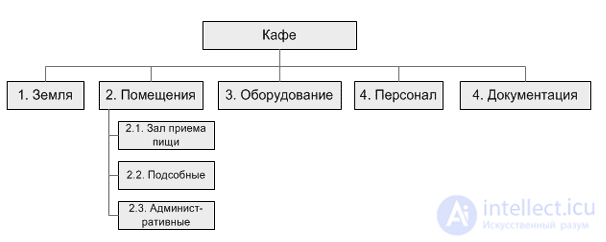
“Product-based” WBS- construction of the WBS by components of the project's product. The elements chosen for the WBS are the product elementsof the project, its tangible deliverables. To name the work packages and individual work items, nouns are used.
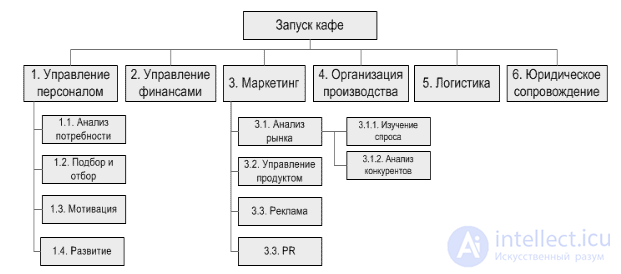
“Functional” WBS- construction of the WBS by functional elements of activity. The elements chosen for the WBS are the elements of the operations of the project's production technology cycle, grouped by functional characteristic. To name the work packages and individual work items, mainly nouns are used.
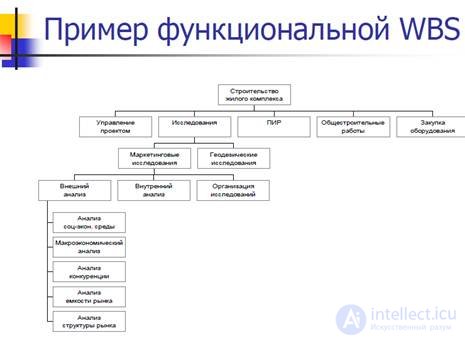
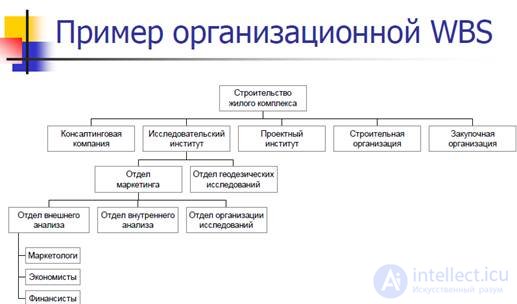
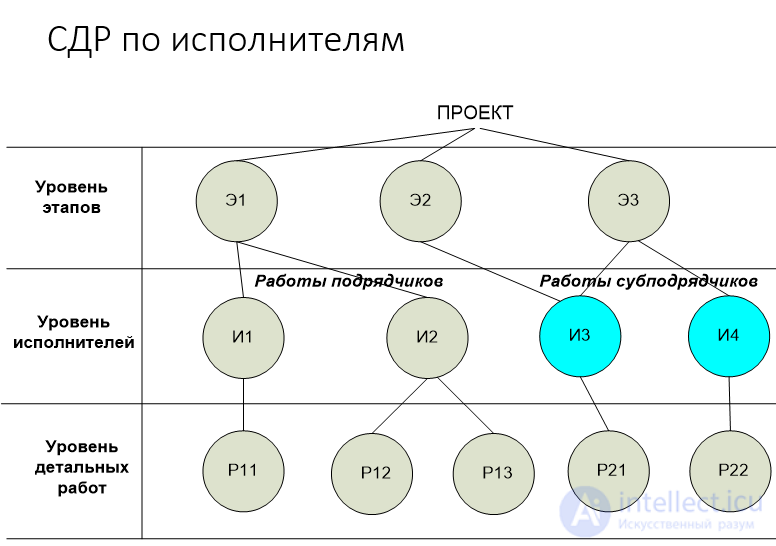
“Organizational” WBS- construction of the WBS by elements of the organizational structure. The elements chosen for the WBS are the elements of the organizational structure or of the organization's structural chart. To name the work packages and individual work items, mainly nouns- the names of functional units - are used
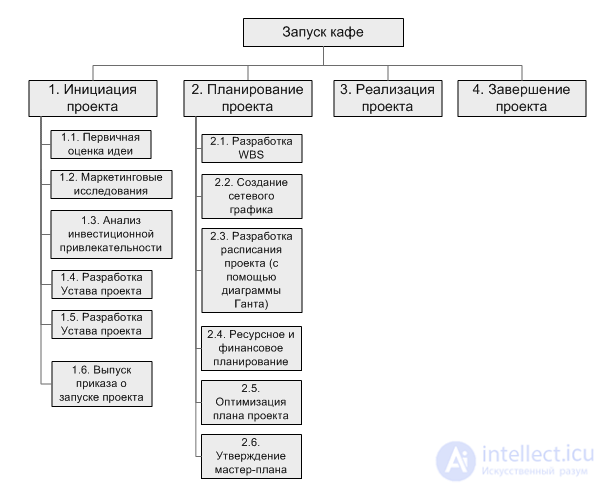
By phases of the project life cycle
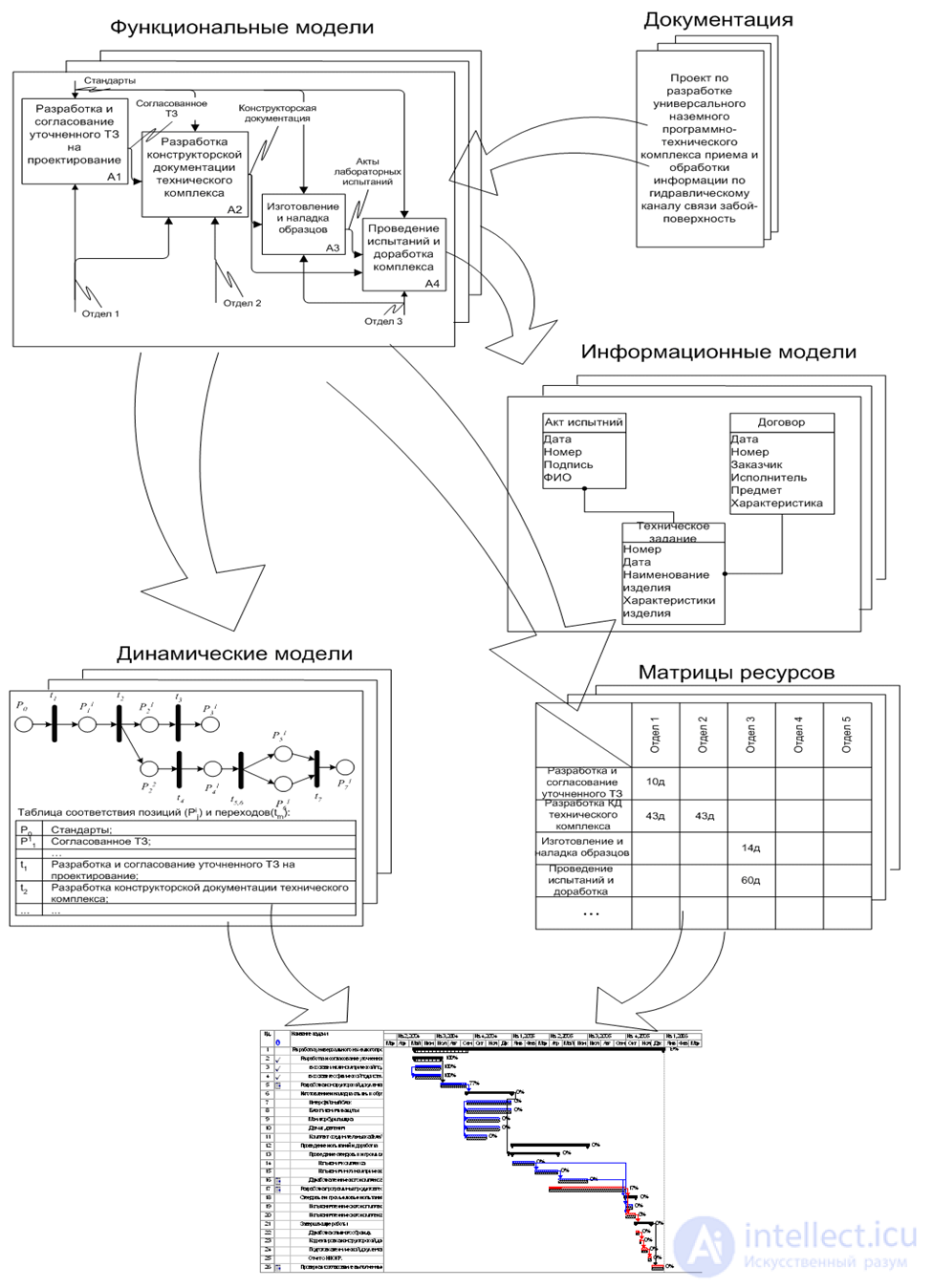
WBS by performers

Comments