
Lecture
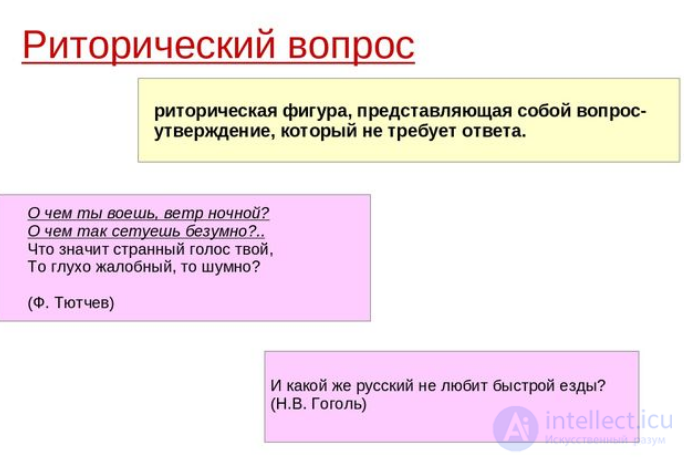
A rhetorical question (erotema) — a rhetorical figure representing a question the answer to which is already known in advance, or a question that the asker himself answers.
In essence, a rhetorical question is a question that requires no answer, or none is expected, owing to its extreme obviousness. In any case the interrogative utterance implies a quite definite, universally known answer, so that a rhetorical question, in fact, represents a statement expressed in interrogative form. For example, someone asking «How much longer must we endure this injustice?» does not expect an answer, but wishes to emphasize that «We are enduring injustice, and for far too long,» while as it were hinting that «It is high time to stop enduring it and do something about it.»
The rhetorical question is used to heighten the expressiveness (to highlight, to underscore) of a given phrase. A characteristic feature of these turns of speech is their conventionality, that is, the use of the grammatical form and intonation of a question in cases that, in essence, do not call for one.
The rhetorical question, like the rhetorical exclamation and the rhetorical address, is a distinctive turn of speech that heightens expressiveness — the so-called figures. A distinguishing feature of these turns is their conventionality, that is, the use of interrogative, exclamatory, and similar intonation in cases that essentially do not require it, owing to which the phrase in which these turns are used acquires a particularly emphatic shade that heightens its expressiveness. Thus a rhetorical question is, in essence, a statement expressed merely in interrogative form, so that the answer to such a question is already known in advance, for example:
Can I behold, in splendor new-arisen,
The beauty of a faded dream?
Can I once more with mantle cover
The nakedness of life I know?
— Vasily Zhukovsky
Clearly, the meaning of these phrases lies in asserting the impossibility of bringing back «the faded beauty of a dream» and so forth; the question is a conventional rhetorical device. But thanks to the form of a question, the author's attitude toward the phenomenon in question becomes far more expressive and emotionally charged.
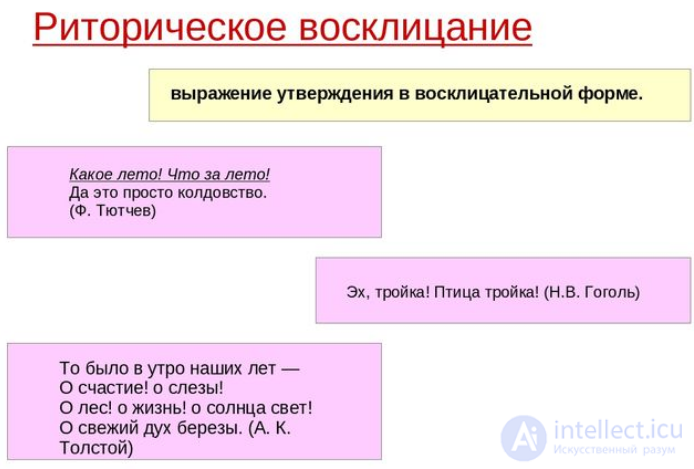
The rhetorical exclamation has an analogous conventional character, in which the exclamatory intonation does not follow from the meaning of the word or phrase, but is arbitrarily assigned to it, thereby expressing an attitude toward the given phenomenon, for example:
Взмах! Взлёт! Челнок, снуй! Вал вертись вкруг! (lit. “A sweep! A launch! Shuttle, weave! Wheel, turn round!”)
Привод вихрь дли! Не опоздай! (lit. “Drive-belt, prolong the whirlwind! Don't be late!”)
— Valery Bryusov
Here the words «взмах» (“a sweep”) and «взлёт» (“a launch”), as well as the words вылет (“take-off”) and влёт (“flying in”), which so to speak register the motion of the machines, are given with exclamations expressing the feelings with which the poet observes these machines, although in the direct meaning of the words themselves there is no ground for exclamatory intonation.
In this same example we also find a rhetorical address, that is, again a conventional address to objects to which, in essence, one cannot address oneself («Shuttle, weave!» and so on). The structure of such an address is the same as in the rhetorical question and the rhetorical exclamation.
Thus all these rhetorical figures are distinctive syntactic constructions conveying a certain elevation and pathos of the narration.
Examples of rhetorical questions
«Who then are the judges?» (Griboyedov, Alexander Sergeyevich. Woe from Wit)
«Where are you galloping, proud steed, / And where will you set down your hooves?» (Pushkin. The Bronze Horseman)
«Was there ever a boy?» (Gorky, Maxim, «The Life of Klim Samgin»)
«And what Russian does not love fast driving?» (Gogol, Nikolai Vasilyevich. «Dead Souls»)
A rhetorical exclamation (epekphonesis, exclamatio) — a device for conveying the culmination of feeling. It conveys the author's various emotions: surprise, delight, distress, joy, and so on. In writing, a rhetorical exclamation is usually a sentence ending in an exclamation mark. When read aloud, rhetorical exclamations are set off by intonation.
What a summer, what a summer!
Why, this is simply sorcery
— Fyodor Tyutchev
The types of rhetorical exclamation are as follows:
Aganaktesis — a rhetorical exclamation expressing indignation
O tempora, o mores!
Original text
— A Latin saying
O maiden, rosiest of all
Among the green mountains —
Germany!
Germany!
Germany!
Shame!
— Marina Tsvetaeva
Cataploke — a rhetorical exclamation in the form of an insertion grammatically unconnected to the context
The Thirtieth Anniversary
Союза — держись, злецы! (lit. "Hold fast to the Union, you wretches!")
Я знаю твои морщины, (lit. "I know your wrinkles,")
Изъяны, рубцы, зубцы — (lit. "flaws, scars, notches —")
Малейшую из зазубрин! (lit. "the smallest of your jagged nicks!")
(Зубами — коль стихне шёл!) (lit. "(with teeth — if the verse fell silent!)")
— Marina Tsvetaeva
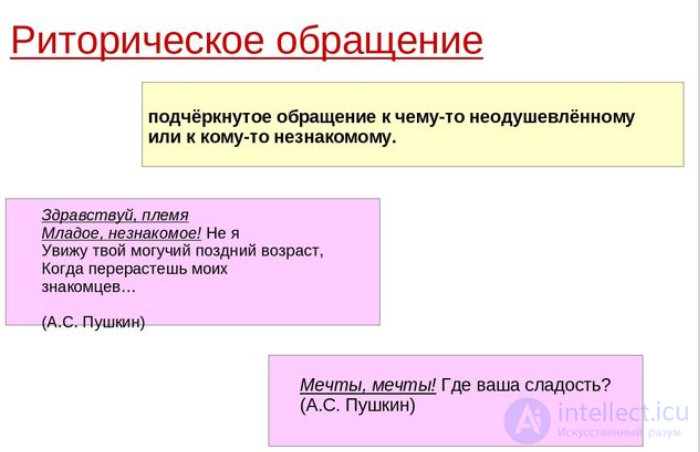
A rhetorical address is a stylistic figure: an address of a conventional character. In it the main role is played not by the text but by the intonation of the address. The rhetorical address is often found in monologues. The chief purpose of the rhetorical address is the striving to express an attitude toward a given person or object, to characterize it, and to intensify the expressiveness of speech. The rhetorical address never requires an answer and carries no question within it.
The rhetorical address, like the rhetorical exclamation and the rhetorical question, is a distinctive turn of speech that heightens its expressiveness. A distinguishing feature of these turns is their conventionality, that is, the use of interrogative or exclamatory intonation in cases that essentially do not require it, owing to which the phrase in which these turns are used acquires a particularly emphatic shade that heightens its expressiveness.
Example of a rhetorical address:
And you, O arrogant scions
Of fathers famed for their notorious baseness,
Who with a slavish heel have trampled down the remnants
Of clans wronged by the play of fortune!
— «The Death of a Poet,» M. Yu. Lermontov
| Figures of Speech | |
|---|---|
| Figures |
Adynaton • Allusion • Amplification • Anadiplosis • Anacoluthon • Anaphora • Antithesis • Antitheton • Apocope • Apostrophe • Attraction • Asyndeton • Hyperbaton •Homeoteleuton • Gradation (Climax, Anticlimax) • Distinctio • Zeugma • Isocolon • Nominative of theme • Inversion • Correctio • Mesarchia •Polyptoton • Polysyndeton • Oxymoron • Parallelism • Paronomasia • Parcellation • Periphrasis • Pleonasm • Prolepsis • Retardation •Rhetorical question • Rhetorical exclamation • Rhetorical address • Symploce • Solecism • Tautology • Exact repetition • Aposiopesis • Chiasmus • Exergasia •Ellipsis • Emphasis • Epiphora |
| Tropes |
Allegory • Antiphrasis • Asteism • Antonomasia • Hyperbole • Dysphemism • Irony • Pun • Catachresis • Litotes • Meiosis • Metaphor • Metonymy • Personification •Pathos • Periphrasis • Sarcasm • Synecdoche • Simile • Euphemism • Epithet |

Comments