
Lecture
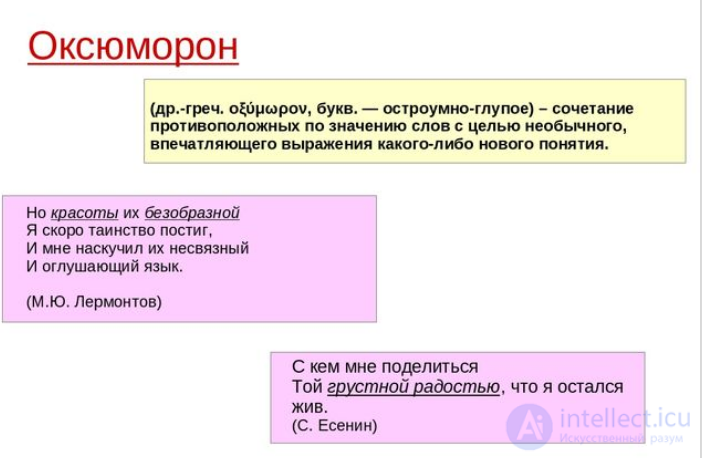
Oxymoron (in Russian also spelled oximoron; Ancient Greek οξύμωρον, lit. — wittily foolish, clever foolishness) — a stylistic figure or a stylistic error — a combination of words with opposite meanings (that is, a combination of the incompatible). An oxymoron is characterized by the deliberate use of contradiction to create a stylistic effect. From a psychological point of view, an oxymoron represents a way of resolving an inexplicable situation.
The oxymoron is frequently found in poetry:
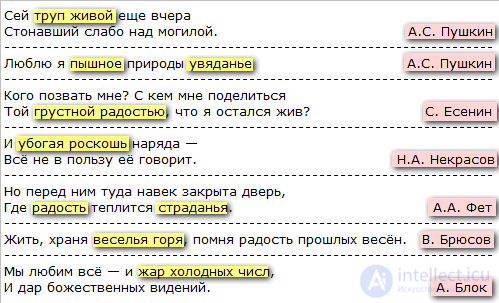
The day has come. From his sickbed rises
Mazepa, this frail sufferer,
This living corpse, who only yesterday
Groaned weakly over his grave.
— A. S. Pushkin. Poltava
Whom shall I call? With whom shall I share
That sorrowful joy of having stayed alive?
— Sergei Yesenin. «Soviet Rus»
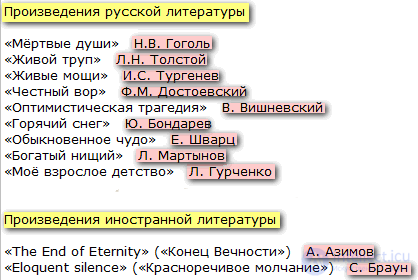
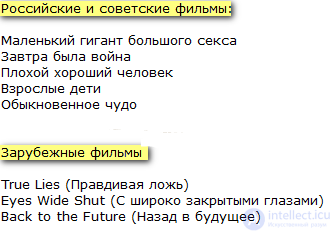
The oxymoron is often used in the titles of prose literary works («Hot Snow», «The Living Corpse», «Dead Souls», «The Unbearable Lightness of Being», «The Endless Dead End», «The End of Eternity»), of films («An Ordinary Miracle», «Eyes Wide Shut», «True Lies», «Dead Poets Society», «Back to the Future»), and of musical groups (Led Zeppelin — «leaden airship», Blind Guardian — «blind guardian», Orgiya Pravednikov — «Orgy of the Righteous»).
Oxymorons are used to describe objects that combine opposite qualities: «a manly woman», «an effeminate boy».
In the novel «Foucault's Pendulum», Umberto Eco's characters fantasize about a «university of comparative uselessness» with a department of oxymoristics. As subjects taught by this department, the author cites «the urbanism of nomadic tribes», «popular oligarchy», «innovative traditions», «the dialectics of tautology», and so on.
In the name of the holiday «Old New Year».
Oxymorons are often used in advertising, and not always in good faith. For example, the expression «investments in the forex market» is an example of a professional oxymoron, since the private currency market, by its very nature, cannot be an object of investment, only of speculation. (In the economic literature there is often an attempt to separate speculation from investment. However, there is no consensus on this. For more detail, see the article on investment.)
One should distinguish oxymorons from stylistic combinations of words characterizing different qualities: for example, the phrase «sweet bitterness» is an oxymoron, whereas «poisoned honey», «a found loss», «sweet torment» are stylistic combinations.
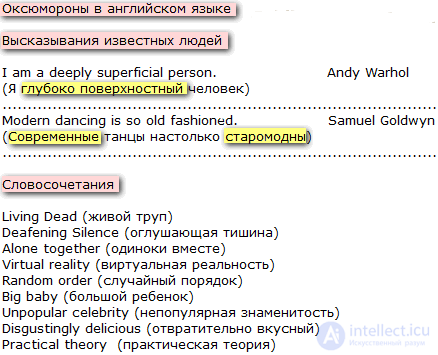
The English language has many commonly used oxymorons. Among them are some that have become so familiar that their contradiction is no longer immediately noticeable. Here is a short list with examples:
The character of the book was not brave enough to fight against the living dead.
The hero of the book was not brave enough to fight against the living dead.
They wanted nothing but to stay at home alone together.
They wanted nothing except to stay home alone together.
The new subject my sister studies at college is called "Practical Theory of Journalism".
The new subject my sister is studying at college is called "Practical Theory of Journalism".
The house was filled with a deafening silence.
The house was filled with a deafening silence.
When I won the contest, I felt bittersweet knowing my best friend wanted to win more than me.
When I won the competition, I felt bittersweet, since I knew my friend had wanted to win more than I did.
If you are a gamer, you'll like to live in virtual reality.
If you're a gamer, you'll enjoy living in virtual reality.
Have you got the original copies of your ID?
Have you got the original copies of your ID?
How can I appear invisible on Facebook?
How can I become invisible on Facebook?
Stop behaving like a big baby!
Stop behaving like a big baby!
| Figures of speech | |
|---|---|
| Figures |
Adynaton • Allusion • Amplification • Anadiplosis • Anacoluthon • Anaphora • Antithesis • Antitheton • Apocope • Apostrophe • Attraction • Asyndeton • Hyperbaton •Homeoteleuton • Gradation (Climax, Anticlimax) • Distinctio • Zeugma • Isocolon • Nominative of theme • Inversion • Correctio • Mesarchia • Polyptoton • Polysyndeton • Oxymoron • Parallelism • Paronomasia • Parcellation • Periphrasis • Pleonasm • Prolepsis • Retardation • Rhetorical question • Rhetorical exclamation • Rhetorical address • Symploce • Solecism • Tautology • Exact repetition • Aposiopesis • Chiasmus • Exergasia •Ellipsis • Emphasis • Epiphora |
| Tropes |
Allegory • Antiphrasis • Asteism • Antonomasia • Hyperbole • Dysphemism • Irony • Pun • Catachresis • Litotes • Meiosis • Metaphor • Metonymy • Personification • Pathos • Periphrasis • Sarcasm • Synecdoche • Simile • Euphemism • Epithet |

Comments