
Lecture
Antithesis, antithesis (from Ancient Greek ἀντίθεσις “opposition”) — a rhetorical juxtaposition, a stylistic figure of contrast in literary or oratorical speech, consisting in a sharp opposition of concepts, propositions, images, or states linked by a common construction or an inner meaning .
Opposition — or antithesis. It consists in juxtaposing utterly contrary objects or phenomena, in order to strike the human soul more forcefully through a rapid alternation of opposite impressions. “Where the table once was heaped with viands, there now a coffin stands; where the din of feasting rang out, there funeral chants now wail... In body I decay to dust, in mind I command the thunder; I am tsar — I am slave, I am worm — I am God.” (Derzhavin).
Antithesis is often confused with another stylistic figure called “oxymoron”, which likewise is based on playing with opposites. Their fundamental difference is that in the first case there is an explicit confrontation of opposite concepts, whereas in the second there is an attempt to fuse them into a single unique phrase. Need examples? Here you are: “fire and water” — that is antithesis, while “fiery water” — that is oxymoron.
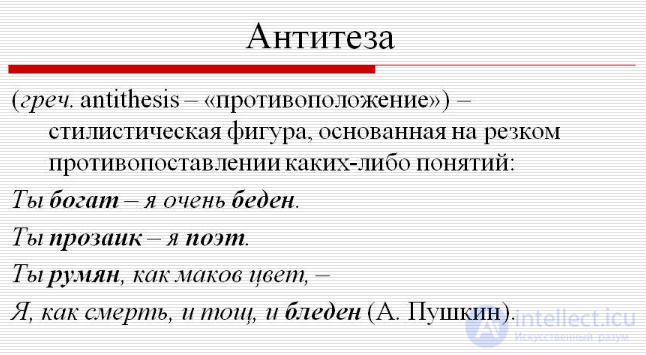
The figure of antithesis can serve as the organizing principle for entire poetic works or for individual parts of literary works in verse and prose. For example, Petrarch has a sonnet (translated by Yuri Verkhovsky) built entirely on antithesis:
And there is no peace — and nowhere are there enemies;
I fear — I hope, I freeze and I burn;
I drag through dust — and I soar through the heavens;
A stranger to all the world — and ready to embrace the world.
In her captivity I know no freedom;
No one wishes to possess me, yet the yoke is harsh;
Love neither destroys me nor loosens its chains;
And there is no end to life, nor bound to torment.
I see — yet I am blind; I am mute — yet I cry aloud;
I long for ruin — yet I beg to be saved;
I am hateful to myself — yet I love all others;
By suffering I live; while laughing, I weep;
Both death and life — are cursed with anguish;
And the cause of this, o donna, — is you!
Descriptions and characterizations, especially the so-called comparative ones, are often built antithetically.
For example, the characterization of Peter the Great in Pushkin’s “Stanzas”:
Now an academician, now a hero,
Now a seafarer, now a carpenter…
— Pushkin, Stanzas
By sharply setting off the contrasting features of the terms being juxtaposed, antithesis, precisely because of this sharpness, is marked by an overly insistent persuasiveness and vividness (which is why the Romantics were so fond of this figure). Many stylists therefore took a negative view of antithesis; on the other hand, a marked fondness for it can be seen in poets of rhetorical pathos, such as Hugo or Mayakovsky:
Our strength — is truth,
yours — the ringing of laurels.
Yours — the smoke of incense,
ours — the smoke of factories.
Your might — the gold coin,
ours — the scarlet banner.
We shall take,
we shall borrow
and we shall win.
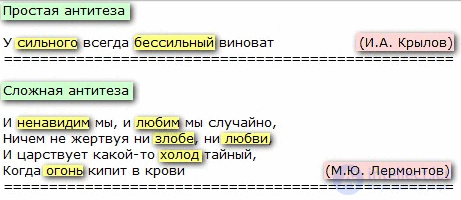
The symmetry and analytical character of antithesis make it especially well suited to certain strict forms, such as, for example, the alexandrine verse, with its clear division into two parts.
The sharp clarity of antithesis also makes it well suited to the style of works that strive for direct persuasiveness, as, for example, declarative-political works with a social tendency, agitational works, or those with a moralistic purpose, and so on. Examples include:
The proletarians have nothing to lose in it but their chains. They have a world to win.
— The Communist Manifesto
He who was nothing shall become everything!
— The Internationale
Antithetical composition is often observed in social novels and plays that contrast the lives of different classes (for example: Jack London’s “The Iron Heel”, Mark Twain’s “The Prince and the Pauper”, and the like); antithesis may also underlie works depicting a moral tragedy (for example, Dostoevsky’s “The Idiot”), and so on.
In this social vein, the device of antithesis was used in a highly distinctive way by Nikolai Nekrasov in the first poem of his cycle “Songs”:
Other folk have a tub of salted meat for their cabbage soup,
But in our soup — a cockroach, a cockroach!
Other folk’s godparents give presents to the children,
But our godparents eat up our own bread!
Other folk think of chatting with a gossip,
But we think only of not having to go begging with a sack?
Because an overt antithesis strikes the eye sharply and is able to focus the attention of those around it, this type of juxtaposition has found particular favor in the sphere of politics, in advertising and marketing activity, and in the mass media.
In the political sphere, the main vehicles for the device of antithesis are slogans and proclamations, the most famous of which probably date back to revolutionary times. Take, for example, a popular slogan from the era of the Great French Revolution of 1789:
Peace to the huts — war on the palaces
Or take the Great October Socialist Revolution of 1917, when there was likewise no shortage of such utterances. I think members of the older generation well remember the famous line from “The Internationale”:
He who was nothing shall become everything!
Or else from the Communist Manifesto:
The proletarians have nothing to lose but their chains. They have a world to win.
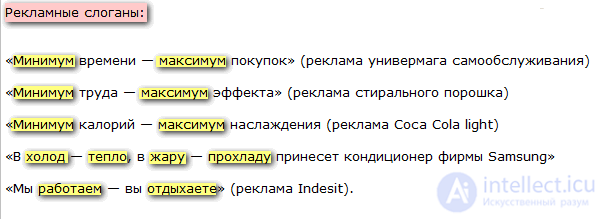
It is perfectly obvious that oppositions catch the eye, which is why they are quite effective in the design of advertisements and video commercials. At every convenient opportunity in our lives we can see or hear popular slogans:
The modern age does not leave a person enough free time. That is why, when reading the news today, regardless of the medium used (electronic or print), people first skim the headlines in search of something interesting.
Naturally, the mass media take this trait of readers into account and employ a variety of unique, attention-grabbing headlines. Antithesis is precisely one of the most effective ways of achieving this. Judge for yourself how well it works in the following headlines from articles in popular publications:
The Poles were unmoved by the German stick and the Brussels carrot
Freedom or Bondage?
How a Pauper Became Rich
An Unhappy Story with a Happy Ending
Beauty and the Beast. The Story of a Catastrophe
| Figures of Speech | |
|---|---|
| Figures |
Adynaton • Allusion • Amplification • Anadiplosis • Anacoluthon • Anaphora • Antithesis • Antitheton • Apocope • Apostrophe • Attraction • Asyndeton • Hyperbaton •Homoioteleuton • Gradation (Climax, Anticlimax) • Distinctio • Zeugma • Isocolon • Nominative of Theme • Inversion • Correctio • Mesarchia •Polyptoton • Polysyndeton • Oxymoron • Parallelism • Paronomasia • Parcellation • Periphrasis • Pleonasm • Prolepsis • Retardation •Rhetorical Question • Rhetorical Exclamation • Rhetorical Address • Symploce • Solecism • Tautology • Exact Repetition • Aposiopesis • Chiasmus • Exergasia •Ellipsis • Emphasis • Epiphora |
| Tropes |
Allegory • Antiphrasis • Asteism • Antonomasia • Hyperbole • Dysphemism • Irony • Pun • Catachresis • Litotes • Meiosis • Metaphor • Metonymy • Personification •Pathos • Periphrasis • Sarcasm • Synecdoche • Simile • Euphemism • Epithet |

Comments