
Lecture
Parcellation — a construction of expressive syntax representing the deliberate segmentation of a text that is unified in intonation and in writing into several punctuationally independent segments (in the terminology of the Swiss linguist Charles Bally — dislocation), for example: “Jeans, a tweed jacket, and a good shirt. A very good one. My favorite! White. An ordinary white shirt. But a favorite one. I put it on… and went off to meet Max” (Evgeny Grishkovets).
The marker of a syntactic break is the period (or another end-of-sentence mark), which leads to an increased frequency in the use of the period, and, in the visual perception of the text, to its intonation.
A parcellated construction has a two-part structure – the base part and the parcellate.
The parcellate is the part of the construction that is formed as a result of the segmentation of a simple or complex sentence and depends (grammatically and semantically) on the preceding context, while at the same time possessing specific structural features.
A. P. Skovorodnikov identifies four functions of parcellation in literary texts: the pictorial, the characterological, the emotive-emphatic, and the expressive-grammatical.
The pictorial function is aimed at artistically concretizing what is depicted. It is used for the following purposes: 1) creating the effect of a slow-motion shot; 2) highlighting details of the overall picture; 3) emphasizing what is important from the standpoint of the artistic-imagistic concretization of what is depicted; 4) creating an unexpected pause, which increases the effect of the unexpectedness of an action's onset; 5) enhancing the effect of an action's duration; 6) heightening pictorial contrast.
The essence of the characterological function lies in reproducing the speech manner of the narrating subject or the character. It is used for:
1) expressing the peripheral connective link characteristic of oral colloquial speech;
2) introducing a colloquial connective intonation into the narrator's speech;
3) creating contexts of free indirect speech;
4) depicting inner speech, and through it – characterizing the state of the subject of that inner speech.
The emotive-expressive function is realized when parcellation “serves as a means of intensifying emotions, emotional evaluation, or an emotional state.” Two cases can be differentiated here:
a) parcellation intensifies the emotionality of the utterance;
b) parcellation does not express a specific emotion, but nonetheless contains an evaluative component.
Parcellation performs the expressive-grammatical function when it serves to express some kind of syntactic relations.
No smoking kitchens. No homeless streets.
Twelve strikes. Four strikes. And six.
And again. Gulliver. Stands. Stooping.
His shoulder. Against a cloud. Heavily. Leaning.
— Pavel Antokolsky. Gulliver
He too went off. To the store. To buy cigarettes.
— Vasily Shukshin
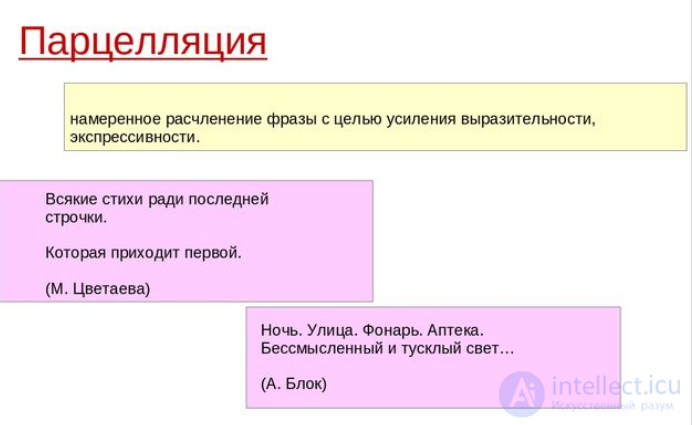
Night. Street. Streetlamp. Pharmacy.
A meaningless and dim light.
Live another quarter century still —
It will all be the same. There is no way out.
— Alexander Blok
| Figures of speech | |
|---|---|
| Figures |
Adynaton • Allusion • Amplification • Anadiplosis • Anacoluthon • Anaphora • Antithesis • Antitheton • Apocope • Apostrophe • Attraction • Asyndeton • Hyperbaton •Homeoteleuton • Gradation (Climax, Anticlimax) • Distinctio • Zeugma • Isocolon • Nominative of Theme • Inversion • Correctio • Mesarchia •Polycasus (Polyptoton) • Polysyndeton • Oxymoron • Parallelism • Paronomasia • Parcellation • Periphrasis • Pleonasm • Prolepsis • Retardation •Rhetorical Question • Rhetorical Exclamation • Rhetorical Address • Symploce • Solecism • Tautology • Exact Repetition • Aposiopesis • Chiasmus • Exergasia •Ellipsis • Emphasis • Epiphora |
| Tropes |
Allegory • Antiphrasis • Asteism • Antonomasia • Hyperbole • Dysphemism • Irony • Pun • Catachresis • Litotes • Meiosis • Metaphor • Metonymy • Personification •Pathos • Periphrasis • Sarcasm • Synecdoche • Simile • Euphemism • Epithet |

Comments