
Lecture
Aposiopesis (also apociopesis, apoziopesis, from Ancient Greek ἀποσιώπησις, «concealment, silence», reticence) — the deliberate breaking-off of an utterance, conveying the speaker's agitation and implying that the reader will guess at what remains unsaid.
Aposiopesis is a concept from linguistics describing the phenomenon of speech being interrupted, or an utterance left unfinished, in the middle of a phrase or sentence. This can happen for various reasons, such as emotional excitement, lack of information, or an inability to continue speaking. Aposiopesis may take the form of incomplete phrases, unfinished sentences, or the omission of words or phrases. The term is often used in the analysis of dialogue and speech in literature and speech genres.
Aposiopesis (apoziopsis) is a stylistic figure of speech consisting in the unintentional interruption of an utterance at its most interesting or tense point. It is a kind of rhetorical device in which the speaker stops and does not finish the thought, creating an impression of understatement or mystery. It can be used to heighten dramatic effect, create intrigue, or hold the listeners' attention.
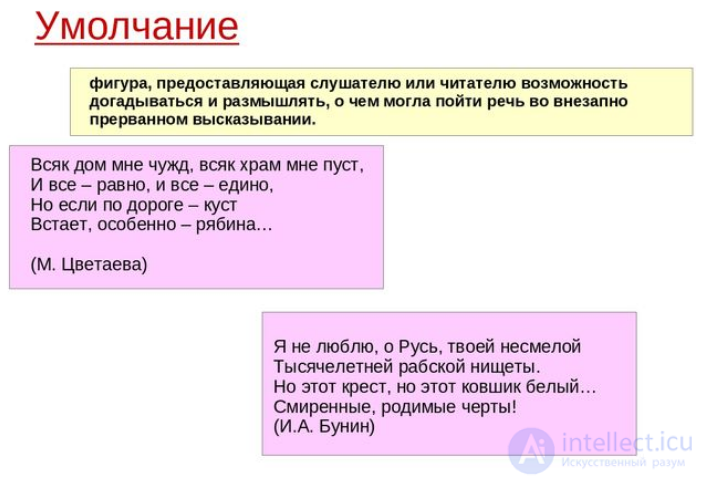
Aposiopesis is used in speech and literature to create an effect of surprise, tension, or intrigue. It can be employed in various contexts and genres, including drama, prose, poetry, public speaking, and even advertising. Here are a few examples of the use of aposiopesis:
Literary example: "He stood before her, his eyes full of grief, his lips trembling... I cannot say what he told her. But her face changed, as though her heart had shattered into a thousand pieces."
In this example, the use of aposiopesis creates intrigue and compels the reader to fill in the missing information on their own.
In literature, drama, rhetoric, and oratory, aposiopesis can be used to:
Create a sense of incompleteness or understatement: "I would like to tell you that I have learned the secret... But it is so important that I cannot tell you right now."
Heighten a dramatic moment: "And at that moment, when I finally saw my enemy, my heart stood still... I could not believe my eyes!"
Create intrigue or a captivating effect: "And then, when all seemed lost... when no one expected a miracle... Suddenly something amazing happened!"
Aposiopesis is widely used in the manipulation of consciousness, though it operates covertly. A writer employing this stylistic device confines himself to a hint. Aposiopesis lends speech an air of significance, prompts the other party to fill in the meaning themselves, and underscores the disproportion between the ostensible depth of the implied thought and the modesty of the expression itself.
It is used both in oratory and in private and business conversation, including of an official character: «If our economy does not undergo serious changes, then …».
Aposiopesis creates tension, and in literature this tension may be resolved either dramatically or comically. Gogol made wide use of the comic resolution of aposiopesis to characterize psychologically primitive characters: «How dare you? Why, I… I serve in Petersburg. I, I, I…» (Khlestakov in The Government Inspector).
V. M. Mokienko notes the use of aposiopesis in place of taboo vocabulary: «why, you…», «you're such a…»
The opposite device, which omits the beginning of a standard set phrase, is called prosiopesis. In Russian, a typical example is the omission of a person's first name, referring to them by patronymic alone («Ilyich») .
Though he dreaded to say it,
It was not hard to guess,
Had it been... but the heart, the younger it is,
The more timid, the more severe it grows...— Mikhail Lermontov. Izmail-Bey
I do not love, O Rus, your timid
Thousand-year slavish poverty.
But this cross, but this white dipper...
Humble, native features!— Ivan Bunin. In the forest, on the hill, a spring, alive and ringing...
"I know what you did, but I cannot..." — in this example the speaker deliberately breaks off the phrase without revealing exactly what he cannot say. This creates tension and arouses curiosity in the listener or reader, since the utterance is deliberately left incomplete and mysterious.
Examples of the use of aposiopesis can be found in fiction, stage plays, film, advertising, and public speaking, where it helps to create emotional tension and capture the audience's attention.
| Figures of speech | |
|---|---|
| Figures |
Adynaton • Allusion • Amplification • Anadiplosis • Anacoluthon • Anaphora • Antithesis • Antitheton • Apocope • Apostrophe • Attraction • Asyndeton • Hyperbaton •Homoioteleuton • Gradation (Climax, Anticlimax) • Distinctio • Zeugma • Isocolon • Nominative of theme • Inversion • Correctio • Mesarchia •Polyptoton • Polysyndeton • Oxymoron • Parallelism • Paronomasia • Parcellation • Periphrasis • Pleonasm • Prolepsis • Retardation •Rhetorical question • Rhetorical exclamation • Rhetorical address • Symploce • Solecism • Tautology • Exact repetition • Aposiopesis • Chiasmus • Exergasia •Ellipsis • Emphasis • Epiphora |
| Tropes |
Allegory • Antiphrasis • Asteism • Antonomasia • Hyperbole • Dysphemism • Irony • Pun • Catachresis • Litotes • Meiosis • Metaphor • Metonymy • Personification •Pathos • Periphrasis • Sarcasm • Synecdoche • Simile • Euphemism • Epithet |

Comments