
Lecture
Casuistry (from Lat. casus — case, casus) — in its common everyday sense, this term is understood as cunning in argument used to prove dubious or false ideas; pettifoggery .
Another source states that casuistry — the theoretical art of applying to individual cases (casus, from Lat. casus — occurrence, incident) general religious, moral, or legal principles that are unquestionable in essence but not always readily applicable to individual life situations . Casuistry arose in the Middle Ages as a theological discipline, intended to apply general moral-theological laws to specific cases and to resolve the questions of conscience that arise in such cases, and it was practiced by the scholastics (theologians and jurists) .
Among medieval scholastics (theologians and jurists), casuistry was a special dialectical device by which some religious, moral, or legal question is broken down into countless minor details and cases, and, instead of resolving the question in principle, an attempt is made to carry out the subtlest and most exhaustive analysis of all possible, and mentally conceivable, cases. The Jesuits were especially notable practitioners of dialectical casuistry. Since then, in theology casuistry has also come to be understood as the doctrine of degrees of sin as applied to varying circumstances. Casuistry became (especially in Catholicism) a theory of “cases of conscience,” regulating conflicts between a person's various moral obligations, when it is necessary to determine the priority of one over another in specific complex circumstances
In jurisprudence, casuistry is understood as the analysis of a given matter, a case (casus), and the derivation from it, through logical and legal interpretation, of certain general principles that supplement norms missing from legislation. In the judicial practice of most countries, it is often necessary to resort to case-based creativity because of new questions raised by increasingly complex life that are not yet reflected in the law
In medicine, casuistry may be understood as “an individual observation (of an injury or disease) that is of scientific and practical interest owing to its rarity and unusualness.”
Psychological casuistry is the description and analysis of both the most typical and the most exceptional cases for the reality under study. This technique is characteristic of research in the field of differential psychology. The individual approach in psychological work with people also predetermines the wide use of casuistry in practical psychology. A vivid example of the application of psychological casuistry is the incident method used in professiography.
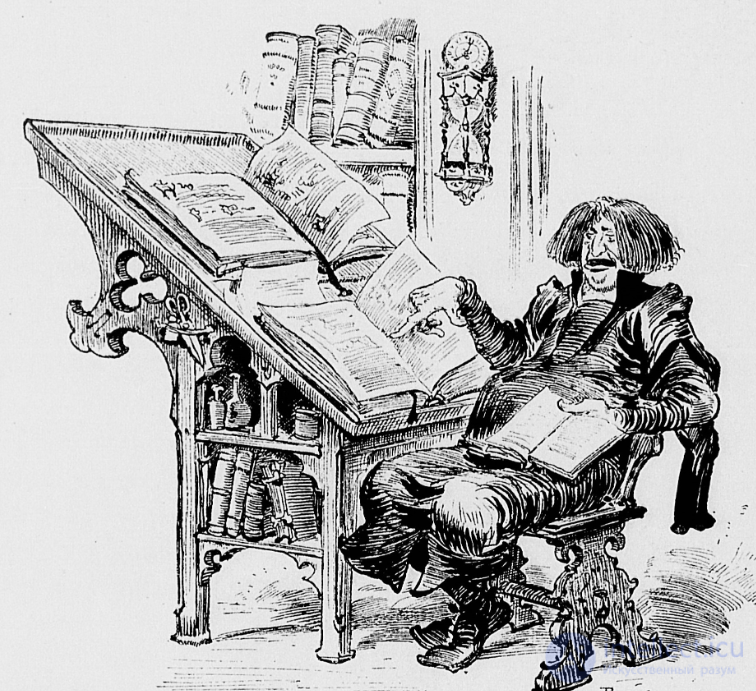
Le grand docteur sophiste , 1886, an illustration of Gargantua by Albert Robida, mocking his casuistic education.
According to an online etymological dictionary, the term and its related noun “casuist,” which appeared around 1600, derive from the Latin noun casus , meaning “case,” especially when referring to a “case of conscience.” The same source states that “[e]ven in the earliest printed uses, this sense was pejorative.”
Casuistry goes back to Aristotle (384–322 BC), but the peak of casuistry fell in the period from 1550 to 1650, when the Society of Jesus employed reasoning based on specific cases, especially in administering the Sacrament of Penance (or “confession”). This term became pejorative after Blaise Pascal's attacks on the misuse of the method in his “Provincial Letters” (1656–57). A French mathematician, religious philosopher and Jansenist. Jansenist sympathizers attacked priests who used casuistic reasoning in confession to placate wealthy Church benefactors. Pascal argued that “repentant” aristocrats could confess a sin one day, repeat it the next, then make a generous donation to the church and return to confess the same sin again, confident that their penance had been assigned only nominally. This criticism tarnished the reputation of casuistry for centuries to come. For example, the Oxford English Dictionary cites an essay of 1738 by Henry St John , 1st Viscount Bolingbroke, to the effect that casuistry “destroys, by distinctions and exceptions, all morality, and effaces the essential difference between good and evil, good and good.” and evil”
In the 20th century, interest in casuistry revived. In his book “The Abuse of Casuistry: A History of Moral Reasoning” (1988) Albert Jonsen and Stephen Toulmin argue that the problem is not casuistry itself, but its abuse; that when properly used, casuistry is a powerful form of reasoning. Jonsen and Toulmin propose casuistry as a method for reconciling the conflicting principles of moral absolutism and moral relativism . In addition, the ethical philosophies of utilitarianism (especially preference utilitarianism ) and pragmatism have been identified as employing casuistic reasoning.
The casuistic method was popular among Catholic thinkers of the early modern period. Among the casuist authors were Antonio Escobar y Mendoza , whose Summula casuum conscientiae (1627) enjoyed great success, Tomás Sánchez , Vincenzo Filliucci (a Jesuit and confessor at St. Peter's ), Antonino Diana , Paul Laymann ( “Theologia Moralis” , 1625), Juan Azor ( Institutiones Morales , 1600), Étienne Bauny , Louis Cellot , Valerius Reginaldus and Hermann Busenbaum (d. 1668).
The development of casuistry was interrupted by the middle of the 17th century by disagreements that arose over the doctrine of probabilism , which in effect held that one could freely choose to follow a “probable opinion,” that is, one supported by a theologian or other authority, even if it contradicted a more probable opinion or a citation from one of the Church Fathers .
Certain kinds of casuistry were criticized by early Protestant theologians , since they were used to justify many of the abuses they sought to correct. It came under famous criticism from the Catholic and Jansenist philosopher Blaise Pascal during his formal polemic against the Jesuits in his “ Provincial Letters” as the use of rhetoric to justify moral laxity, which came to be identified by the public with Jesuitism ; hence the everyday use of this term to denote complex and convoluted reasoning that justifies moral laxity. By the middle of the 18th century, “casuistry” had become a synonym for attractively phrased but ultimately false moral reasoning.
In 1679, Pope Innocent XI publicly condemned sixty-five of the most radical propositions ( stricti mentalis ), drawn mainly from the writings of Escobar, Suárez and other casuists, as propositiones laxorummoralistarum and forbade anyone from teaching them under pain of excommunication . Despite this papal condemnation, both Catholicism and Protestantism permit the use of ambiguous statements in certain circumstances.
G. E. Moore examined casuistry in chapter 1.4 of his book “Principia Ethica ”, in which he argues that “the defects of casuistry are not defects in principle; no objection can be raised against its aim and object. It is a subject that requires adequate consideration at the present level of knowledge.”. Moreover, he argued that “casuistry is the goal of ethical inquiry. It cannot safely be undertaken at the beginning of our investigations, but only at the end.”
Since the 1960s, applied ethics has revived the ideas of casuistry in applying moral reasoning to specific cases in the fields of law, bioethics, and business ethics, so the reputation of casuistry has now improved somewhat.
Pope Francis, a Jesuit, criticized casuistry as “the practice of establishing general laws on the basis of exceptional cases” in situations where a more holistic approach would be pr

Comments