
Lecture
Disputation (Lat. disputatio) — in the scholastic system of education of medieval Europe, a formal method of conducting a debate, carried out with the aim of establishing theological or scientific truth. This process was governed by formal rules, the chief of which were references to established written authoritative sources and a thorough analysis of the arguments of each side. Another category of disputations were interconfessional disputations, intended to prove the superiority of one religious teaching over another.
A disputation is a public dispute on a scholarly or social topic.
Originally the word denoted the public defense of a scholarly work written in order to obtain an academic degree.
The genealogy of the medieval and later culture of conducting disputations is traced back to the pedagogical methods of Socrates, the dialogues of Plato, and other ancient Greek philosophers. Rules for constructing and presenting argumentation, similar to those applied in legal practice, are set out in Aristotle’s “Organon” and “Rhetoric”, and in Cicero’s “De Inventione”[en] .
In the Middle Ages, formal disputation was a method of conducting a competitive discussion, in which one of its participants defended a certain thesis before opponents who raised objections and counterarguments. This method was universally accepted in medieval university practice and was the principal means of training and examination in all four of the main disciplines — the arts, medicine, theology, and jurisprudence. Structurally, the procedure resembled a legal proceeding and was presided over by a master, who, like a judge, rendered the final decision on the outcome of the disputation.
In Russian there are also other words denoting this phenomenon: discussion, disputation, polemic, debate, deliberation. Quite often they are used as synonyms for the word "dispute." This is attested by explanatory dictionaries of the Russian literary language and dictionaries of synonyms. In scholarly research, and in journalistic and literary works, these words often also serve as names for particular varieties of dispute.
A dispute is understood as any clash of opinions, a disagreement in points of view on some question or subject, a contest in which each side maintains its own rightness.
For example, a discussion (Lat. discussio — investigation, examination, analysis) is the name given to a public dispute whose purpose is to clarify and compare different points of view, to seek out and reveal the true opinion, and to find the correct solution to a disputed question. Discussion is considered an effective means of persuasion, since its participants themselves arrive at one conclusion or another.
The word disputation likewise came to us from Latin (disputare — to reason, disputatio — contention) and originally meant the public defense of a scholarly work written in order to obtain an academic degree. Today the word disputation is not used in this sense. This word denotes a public dispute on a scientific or socially important topic.
A disputation has two aspects
1) The logical aspect (rational) – this is demonstrative force, i.e. an effect on the opponent through the truth of a statement by means of facts and the judgments connected with them.
2) The psychological aspect (emotional) – this is persuasiveness, i.e. an effect on the opponent by means of emotions, striking (and perhaps provocative) statements, means of artistic expression, non-verbal means, manipulation, and so on.
Polemic has a different character. This is attested by the etymology (i.e., the origin) of the term itself. The ancient Greek word polemikos means “warlike, hostile.” A polemic is not simply a dispute, but one in which there is confrontation, opposition, a clash of sides, ideas, and speeches. On this basis, a polemic can be defined as a struggle between fundamentally opposing opinions on some question, a public dispute aimed at defending,
upholding one's own point of view and refuting the opponent's opinion.
It follows from this definition that a polemic differs from a discussion or a disputation precisely in its purposive orientation. Participants in a discussion or disputation, in comparing conflicting judgments, strive to

The goal of a polemic is different: one must achieve victory over the opponent, uphold and assert one's own position.
However, it should be borne in mind that a genuinely scholarly polemic is not conducted merely for the sake of victory as such. Relying on matters of principle, polemicists address socially significant questions, and their statements are directed against everything that impedes effective social development.
Polemic is the art of persuasion. It teaches one to support one's thoughts with convincing and irrefutable arguments, with scholarly evidence. Polemic is especially necessary when new views are being worked out, when universal human values and human rights are being upheld, and when public opinion is taking shape. It serves to cultivate an active civic stance.
The word debate is of French origin (debat — dispute, contention). Pleadings is a Russian word attested in the lexicon of the seventeenth century. Explanatory dictionaries define these words as follows: debate — pleadings, an exchange of opinions on some matter, disputes; pleadings — the discussion of some question, a public dispute on some matter.
The words debate and pleadings, as a rule, denote disputes that arise in the discussion of reports, communications, and speeches at meetings, sessions, conferences, and so on.
According to Diogenes Laërtius, the first to use dialogues to expound his teaching was Zeno of Elea (5th century BC). However, Diogenes also claimed that in his lost dialogue “On Poets” he attributed the invention of the dialogue genre to a certain Alexamenus of Teos. In the “Poetics”, Aristotle refers to “Socratic conversations” as an already established genre. It is not entirely clear to what degree Socrates' ideas are reflected in Plato's dialogues. Some light is shed by Plato's Seventh Letter, which contains autobiographical information, in which the philosopher discusses the unsuitability of ordinary language for expressing philosophical ideas. Such concepts as goodness, beauty, or justice cannot be learned from written texts, but only “through benign questions and answers can reason shine forth and an understanding of each subject be born, to the degree that this is accessible to a human being” . According to Kenneth Sayre[en], Plato thereby emphasized the importance of the “dialectical context” of philosophical knowledge, which bears directly on the correct understanding of his Dialogues .
Disputations were one of the principal forms of education at the medieval university, closely linked to the lecture format. The traditional lecture had a four-part structure. The first part consisted of the lecturer reading aloud a portion of the course being studied (littera), and could be omitted if written materials were available. Next came an analysis of the text under discussion down to the level of simple statements (divisio textus). Then a discussion of the highlighted propositions followed. The last part was devoted to especially important aspects of the subject under study, in the form of a real or fictitious dispute, usually introduced by the words dubium est or dubitandum est. Already by the twelfth century the discussion portion of the lecture had become a separate element of the educational process .
The decision to hold a disputation was the prerogative of the instructor, but it was at the same time a significant event for the entire faculty of the university. It was intended above all for his students, who acted as both participants and spectators at once. The instructor chose the day and topic of the disputation. The time was set for after the midday meal, between nones[en] and vespers. On the day of a disputation no other classes were scheduled. Students of other instructors were admitted to participate, while for the students of the instructor holding the disputation, participation was compulsory. At the Sorbonne, a listener (cursor), before being admitted to lecture on Peter Lombard's “Sentences”, had to speak twice at disputations, one of them “sub magistro alterius nationis”, under the chairmanship of the senior master of his own nation of the university. A bachelor who had completed the course had to respond at a disputation before a master who was not his own instructor (“non sub suo magistro”). The topic of the disputation was proposed by the master, who also ensured that during the discussion the speakers did not stray from it .
The holding of disputations was an integral part of the public life of a university town. According to the statute of the University of Bologna, with the beginning of Lent, all who wished were admitted to quodlibetal disputations (disputatio de quolibet), conducted by doctors of the sciences under the chairmanship of the rectors, with all comers. The order of participation in the proceedings was determined by academic degree or social standing. Student disputations took place on weekends .
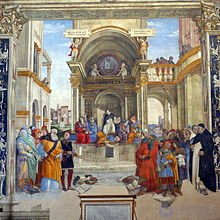
In the Middle Ages, disputations between Christian theologians and their Jewish colleagues were of great importance. The Christian side was often represented by a converted Jew who was well versed in Talmudic literature. The best known disputations are the following:
Although the resemblance of the disputation to a legal procedure had been noted since antiquity, a theoretical basis for this understanding was only established in the nineteenth century. In 1828 the Irish churchman Richard Whately published the treatise “Elements of Rhetoric”, in which he analyzed extralegal methods of argumentation . An essential rule was the “burden of proof”, requiring that the thesis be proved by the one who put it forward .
In German universities, the disputation as a method of defending doctoral dissertations arrived in the Middle Ages and was applied not only in the humanities but also in the natural sciences .
The word “dispute” occurs twice in the Bible according to the King James Version.
Akbar the Great, the third of the Mughal Muslim emperors of India (1542–1605), showed an intolerant attitude toward Hindus and other religions in the early years of his reign, but later showed tolerance toward non-Islamic faiths, abandoning some of the strict laws of sharia. He then began a series of religious debates, in which Muslim scholars discussed religious questions with Hindus, Jains, Zoroastrians, and Portuguese Roman Catholic Jesuits. He treated these religious leaders with great respect, regardless of their faith, and held them in esteem.
The purpose of disputations is to train understanding and the ability to discuss and construct concepts. Disputations offer a discussion of the content of cultural texts. In their form of conduct they have a team character and dialogicity (the presence of an opponent). The clash of two positions in a disputation requires mastery of techniques for effective, clear speech and for organizing communication.
A disputation (from Lat. disputare — to reason, to argue) is a public dispute on a scientific or socially important topic. Its participants seek, by comparing conflicting judgments, either to arrive at a common decision, to establish the truth, or to register the clear advantage of one of the positions. This form of organizing the formation and transmission of concepts has long existed and is used by experienced teachers and organizers. Disputations (and related kinds: debates, discussions, polemics, conferences, etc.) are a historical practice of building thought processes and developing thinking and language. The refinement of these abilities makes it possible, in a changing situation, to form adequate linguistic behavior, to think independently, to produce original and responsible solutions to problems, to formulate judgments precisely and clearly for everyone, and to correctly turn others into one's opponents and like-minded allies.
The disputation in the educational practice of the KLB [Youth Leadership Lyceum] is modified to accord with the key tasks of managerial training. The primary purpose of disputations at the KLB is the mastery (understanding) of a cultural text, as well as the presentation of one's own understanding within the group and in the course of the communicative clash of teams. Two teams take part in a disputation (the one affirming the thesis, and the opponent). Theses are drawn up on the basis of a text that includes a number of key concepts (for example, power, wages, management, administration, politics, etc.). The base text, or selected fragments of it, serves as an occasion for constructing and discussing one's own content for these concepts and for presenting them as interpretations in one's own authorial reading. The management of the course of this intellectual work is carried out by a coach-instructor, who heads a group of experts drawn from the lyceum students. In addition,
In the course of the academic year several tournaments were held, and the following texts were proposed for discussion: N. Machiavelli, “The Prince” (chapters XIII–XV), H. Ford, “My Life and Work” (ch. 8, “Wages”), F. Taylor, “The Principles of Scientific Management” (ch. 2, “Fundamentals of Scientific Management”), H. Fayol, “General and Industrial Management” (“The Doctrine of Administration”), A. Zinchenko, “Who Teaches Learns”, T. Veblen, “The Theory of the Leisure Class”, Socrates “On Justice”, M. Petrov, “In the First Class of the European School of Thought”, C. Savage, “Fifth Generation Management: The Enterprise as a Network of People”, “Liberalism, the Principles of Communism, Conservatism”, “Chrematistics”, “Property”, B. Gates, “Life Is Unfair”. And in the following academic year, Plato's texts “Gorgias” and “Protagoras” were proposed for the work. In the course of the disputations the finalists and absolute winners are determined,
Disputations are included among the game-based methods used in the course of the ILT [Introductory Leadership Training]. The basic principle of this work is: one can learn to do something only by doing it. The method of game-based organization of educational activity has a number of advantages:
Among the most important aspects of the ILT is the development of abilities for the communicative support of group activity. Communication is not identical to socializing. And such a distinction can be introduced only through a special kind of practice. A reflexively recognized and managed communication, and a consciously organized rhetoric, give rise to productive actions in corporate settings; communicative abilities are called for in situations of joint discussion and the preparation of decisions on matters of general significance. A skillfully organized disputation fully answers this task.
Owing to clear organization, and thanks to rules and systematicity, disputations serve as a kind of intellectual training apparatus.
Unlike in debates, in disputations it is more important and appropriate to state one's own thoughts and to present one's own understanding; formal speech etiquette is not of decisive importance. Rhetoric has a practical application here (the rhetoric of communicative action). “The development of thinking in the upper grades of school can be furthered by such an activity as rhetoric, understood as the ability to plan, compose, and deliver public speeches, to conduct a discussion, and to answer questions skillfully.”
Thus, the rules for conducting disputations must answer their main purpose: the mastery of methods of constructive mental work.
1. Approval of the text on which the disputations are to be based.
2. Formation of a group of organizers (tournament manager, hosts, and experts — up to 5 people). This group includes people who have had experience conducting work in groups, as well as experienced players. (Anyone wishing to gain experience in organizing and running the game, including younger players, is invited to join as trainee experts.)
3. Setting the technical assignment for the disputations before the whole body of students (acquainting them with the goals, tasks, text, schedule, procedure for going through the disputations, etc.).
4. Forming the composition of the teams according to the chosen principle.
5. Readiness for the competition. Discussion of questions for understanding (why this particular text, the history of its writing, the contemporary relevance of the topic, etc.). The teams draw up theses on the text and prepare their argumentation. Discussion of possible objections and the formation of readiness to respond. At the disputation it is necessary to prove one's considerations and to present the evidence and arguments confirming the team's advantage and the soundness of the thesis.
6. Conducting the disputation tournament in accordance with the rules and scenario developed.
7. Reflexive analysis after each game in the presence of all participants, as well as at the organizers' seminar (determination of the modes of action, the logic and cogency of the reasoning, and the communicative skills of the disputation participants).
The methodology and organization of the educational-practical disputations can be considered formed and standardized, although this does not preclude innovations in the rules for conducting disputations, which the situation may require (new students, growth in the number of teams, growing interest on the part of participants, the need to revitalize the game component, etc.). Thus, in the current academic year the organizers of disputations at the lyceum proposed a new form of the game — disputations that stimulate active thinking and understanding, allowing students to master methods of constructive mental work more effectively in a short time. All teams, at the first stage, define the concepts contained in the text (the text for tournament I was Plato's “Gorgias”), and give a full characterization of the concepts indicated. The best team is considered to be the one that demonstrates consistent logic, presents convincing proof for its assertions, and characterizes the concepts indicated in the most many-sided way. For the second-stage teams that reached the semifinal, the task changes — they must work out and prove how the concepts indicated are constructed in the text. The finalist teams receive a task of a new level — to present their own understanding of the concepts indicated (taking into account previous reasoning, knowledge, erudition, etc.) and to explain how it is constructed.
In the course of the disputations, the managerial ability to draw on one's own store of knowledge and apply it “here and now” is trained, along with the readiness and ability to apply it for its intended purpose. The procedure of running the disputation tournaments makes it possible to single out and specialize a game-technical group of expert lyceum students. They provide practical preparation and support for the disputations, develop criteria for evaluating the work, and make decisions on winners and losers, taking part in the process of stratifying the collective. The more successful disputants, who have won in the tournaments and reached the final, conduct seminars and reflexive discussions on the results of the games held, implementing tutoring principles in their work. Thus, disputations are an additional and substantive space for carrying out initial managerial training.
The scheme of the disputation can also be used as a developmental method within the structure of general-education subjects. Incorporating such an exercise into the course of a lesson provides training for the intellectual functions, brings in a spirit of creativity, and gives a unique experience of communication. The productiveness of structuring a lesson in this way has been confirmed at the KLB. Discussing contemporary scholarly claims or proofs, using well-known and little-known facts, scholarly conclusions, and proposals, acquires a special significance of responsibility precisely within the framework of a game situation of collision with an opposing (critical) point of view. Such a situation (the disputation) is constructed by the teacher and has an educational character. It may be recalled that truth is born in disputes, which is why the practice of conducting discussions has been used since antiquity for scholarly and educational purposes. Moreover, the disputation opens up additional, powerful reserves for honing communication techniques. During the “live” situation of open and free handling of arguments, defending the team's and one's own position requires, by the rules, singling out the objects and concepts that the players are operating with, being able to interpret them and build a communicative strategy — that is, under conditions of a time deficit, to reflect on the situation and make decisions. From the criteria for evaluating a disputation one can single out the main tasks for the players. On an ascending scale we have: precision in defining a position and a developed formulation of the key positions; observance of the rules for constructing logical inferences in one's judgments, and the appropriate use of proofs; the display of will and inventiveness in making decisions while speaking, under a time limit; the demonstration of the ability to speak concisely and eloquently (emotionally,
Evaluation in such game-based lessons takes place according to the criteria specified in the rules, has a team character, and approximates a rating.
A disputation demands an intense sense of responsibility for one's words and actions, and demands a decisive character and a plan of action within the team. The presence of opponents activates the ability to think creatively and to work in a mode of searching for effective communication.
Rules:
1) Finish your thought (don't get thrown off). Questions are usually put to the speaker after the presentation, so even if someone in the hall raises a hand, do not be distracted by it: you will have time to answer.
2) Answer briefly. Brevity will allow you to answer a greater number of questions and to convey your thoughts to the listeners in detail.
3) Look at everyone, not only at the person who asked the question. Your answer is just as important a part of the presentation as its main body.
A trick in a disputation is any device by means of which one wishes to make the dispute easier for oneself and harder for the opponent.
Permissible tricks:
“stalling the objection”. If the opponent has advanced an argument for which it is hard to find a worthy answer right away, one can ask questions in connection with the argument given, as if to clarify it. One begins the answer from afar, with something not directly related to the matter at hand; one begins by refuting secondary arguments, and then, having gathered one's strength, demolishes the opponent's main arguments, and so on. “Stalling the objection” can also be used so as not to show the opponent one's nervous state.
If, in the course of discussing a disputed problem, one of the polemicists notices that they have made a mistake but does not wish to admit the error openly, they may resort to turns of phrase that allow them to soften and correct the situation:
“answering a question with a question”. A polemicist, finding it difficult to search for an answer or not wishing to answer the question posed, may pose a counter-question. If the opponent starts to answer it, then they have fallen for this trick.
“answering on credit”. Finding it difficult to discuss the problem, they put off the answer for “later”, citing the complexity of the question.
Impermissible Tricks
Withdrawing from the dispute is a trick used by a participant who feels that the dispute is not going in their favor, that they lack sufficient arguments. Therefore they try to “slip out of the dispute”.
Disrupting the dispute (obstruction) — an opponent may be interested in disrupting the dispute, since it is beyond their strength, and so resorts to crude
mechanical tricks:
“Argument to the constable” — the opponent's thesis is declared dangerous to the state or to society, and the opponent, in effect, has their “mouth shut”. The dispute stops, and victory goes to the one who applied the trick.
“Bludgeon arguments”. One gives an argument that the opponent must accept for fear of something unpleasant, often dangerous, or to which they cannot respond for the same reason, and so must either remain silent or devise some kind of “roundabout way”.
Psychological Tricks
1) throwing the opponent off balance. The polemicist uses crude sallies, insults, and blatantly unjust, mocking accusations, and so on. If the opponent “boils over” — the matter is won, because they have lost their chance of success in the disputation;
2) a wager on false shame. Psychologically, people often want to appear better than they actually are, fearing to “lose face” in the eyes of others. It is precisely on this desire to appear a little better that some experienced polemicists play.
For example, citing an unproven or even false conclusion, the opponent accompanies it with phrases such as:
“Surely you still don't know this?”;
“It is a well-known fact that…”, and so on.
In this way he wagers on false shame. If a person does not admit that this is unknown to them, they are “on the hook” of the opponent and forced to agree with their arguments;
3) “greasing the argument” — this too is a trick based on self-regard. A weak argument that could easily be
challenged is accompanied by a compliment to the opponent.
For example:
“As an intelligent person, you will not deny…”;
“Everyone is well aware of your honesty and integrity, so you…”.
Sometimes the opponent is subtly given to understand that they personally are held in special respect, that their intelligence is highly valued, and that their merits are recognized;
4) suggestion. A person speaking with aplomb, in an impressive voice, exerts psychological pressure on those present. In such a situation what is required is inner composure, self-restraint, a businesslike tone, and the ability to steer the conversation away from general phrases toward an examination of the substance of the matter;
5) mockery, and an effort to cut the opponent off, to arouse distrust of their words, a sharply negative assessment of the views expressed, an offensive remark;
6) not infrequently in disputes, references to one's own age, education, and position are used as arguments: “Wait till you reach my age, then you can judge”;
“First get your diploma, and then we'll talk”;
“When you take my place, then you can reason”, and others.
However, a person who is older in age, has a higher education, and holds a certain position is far from always right;
7) “double bookkeeping” — this is a trick based on people's tendency toward duplicity in their judgments.

Comments