
Lecture
Tautology (from Ancient Greek ταυτολογία: ταυτο — “the same” and from λόγος — thought, cause, or speech) — a rhetorical figure consisting in the unwarranted repetition of the same (or cognate) or closely related words in meaning.
Unlike pleonasm, tautology is not justified either logically or emotionally; the repetition serves no purpose at all. Pleonasm, by contrast, offends only against brevity: for example, instead of “they shall not return back” (V. A. Zhukovsky) it would suffice to say “they shall not return,” but the addition here strengthens the poetic quality of the speech and increases its expressiveness. In other words, tautology is an excessive form of pleonasm.
Among the ancient Greeks, tautology was called perissology (Ancient Greek περιττος — excessive) and battology (after Battus, the stammering king of Cyrene who repeated words, or the poet Battus, a lover of unnecessary long-windedness).
«Масло масляное» (lit. "buttery butter")
«Круг круглый» (lit. "round circle")
«Спросить вопрос» (lit. "to ask-a-question a question")
«Шутка юмора» (lit. "a joke of humor"), «шутки шутить» (lit. "to joke jokes")
“Price list of prices” («прейскурант цен») — the word «прейскурант» (“price list”) itself comes from German Preiskurant — “a catalog of prices”
«Старая старушка» (lit. "an old little old-lady")
“VIP person” — the abbreviation “VIP” stands for “very important person,” so the phrase duplicates its own meaning
“IT technologies” — the abbreviation “IT” stands for “information technology,” so the phrase duplicates its own meaning
«Кивнуть головой» (lit. "to nod with the head") — an unnecessary clarification, since one can only nod with the head
«Моргать глазами» (lit. "to blink with the eyes") — an unnecessary clarification
“Secret spy” — an unnecessary clarification, since a spy is secret by definition
“Present-day modern times”
«Сосновый бор» (lit. "pine pine-forest") — the word «бор» itself already means “pine forest”
“Wet splashes of water”
«Должно было бы быть» (lit. "it would have had to be") — a stack of several modal and conditional markers
“Most optimal”
“Approximately several dozen”
“Fiery flame” (“flaming fire”)
“Truthful truth” (“true truth”)
«Я сам своими собственными глазами вижу» (lit. "I myself with my own very eyes see") — a cascading, multiple tautology: «я сам» ("I myself"), «сам своими» ("myself with my own"), «своими собственными» ("my own very-own"), «собственными глазами» ("own eyes"), «глазами вижу» ("eyes I see").
The name of the Russian town of Soligalich: “Salty Salt”. This is noted by the website https://intellect.icu. The first part comes from the Russian word «соль» (“salt”), while the second part comes from the Greek word «галис», Ancient Greek ἅλς — “salt.”
“In the month of February” — an unnecessary clarification that occurs paired with any month name.
“For proforma” («для проформы») — in Latin, "pro forma" means "for form's sake, for appearance's sake." The Russian preposition «для» (“for”) is already redundant here, but we have grown used to this mistake.
The name of the company «AvtoVAZ»: VAZ stands for “Volzhsky Avtomobilny Zavod” (“Volga Automobile Plant”). Because of the added prefix «Avto-» (“Auto-”), which duplicates “Automobile,” it was nicknamed «Dvazhdy Avtomobilny» (“Twice Automobile”).
“Patriot of the homeland” — the word “patriot” (Greek patriotes, “fellow countryman, compatriot” — from patris, “homeland, fatherland”) already contains the meaning “of the homeland.”
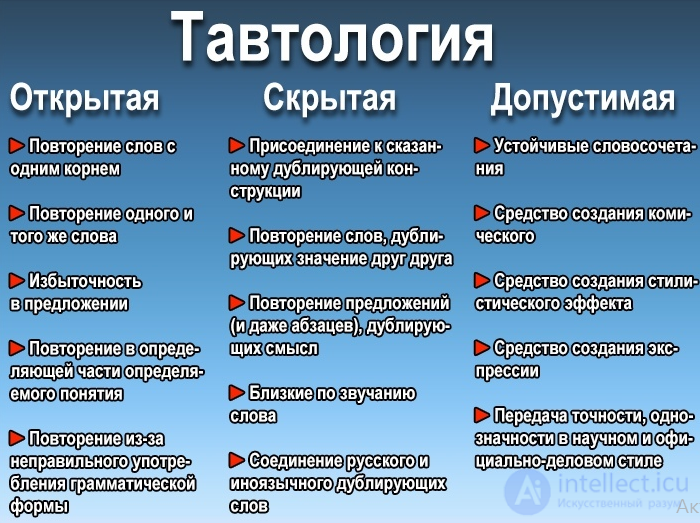
Types of tautology (overt, covert, and permissible)
| Figures of speech | |
|---|---|
| Figures |
Adynaton • Allusion • Amplification • Anadiplosis • Anacoluthon • Anaphora • Antithesis • Antitheton • Apocope • Apostrophe • Attraction • Asyndeton • Hyperbaton •Homeoteleuton • Gradation (Climax, Anticlimax) • Distinctio • Zeugma • Isocolon • Nominative of theme • Inversion • Correctio • Mesarchia •Polyptoton (case variation) • Polysyndeton • Oxymoron • Parallelism • Paronomasia • Parcellation • Periphrasis • Pleonasm • Prolepsis • Retardation •Rhetorical question • Rhetorical exclamation • Rhetorical address • Symploce • Solecism • Tautology • Exact repetition • Aposiopesis • Chiasmus • Exergasia •Ellipsis • Emphasis • Epiphora |
| Tropes |
Allegory • Antiphrasis • Asteism • Antonomasia • Hyperbole • Dysphemism • Irony • Pun • Catachresis • Litotes • Meiosis • Metaphor • Metonymy • Personification •Pathos • Periphrasis • Sarcasm • Synecdoche • Simile • Euphemism • Epithet |

Comments