
Lecture
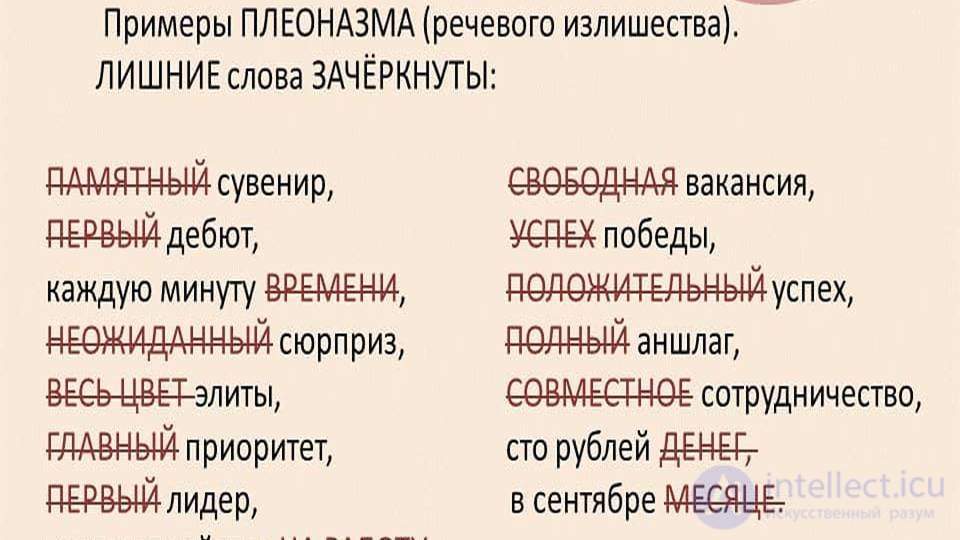
Pleonasm (from Ancient Greek πλεονασμός — excess, superfluity) — a figure of speech in which some element of meaning is duplicated; the presence of several linguistic forms expressing one and the same meaning within a complete stretch of speech or text; and also a linguistic expression containing such duplication.
The term “pleonasm” came from ancient stylistics and grammar. Ancient authors give differing assessments of pleonasm. Quintilian, Donatus, and Diomedes define pleonasm as an overloading of speech with superfluous words, and hence as a stylistic flaw. Dionysius of Halicarnassus, by contrast, defines this figure as an enrichment of speech with words that seem superfluous at first glance but in fact lend it clarity, force, rhythm, persuasiveness, and pathos — qualities unattainable in laconic speech.
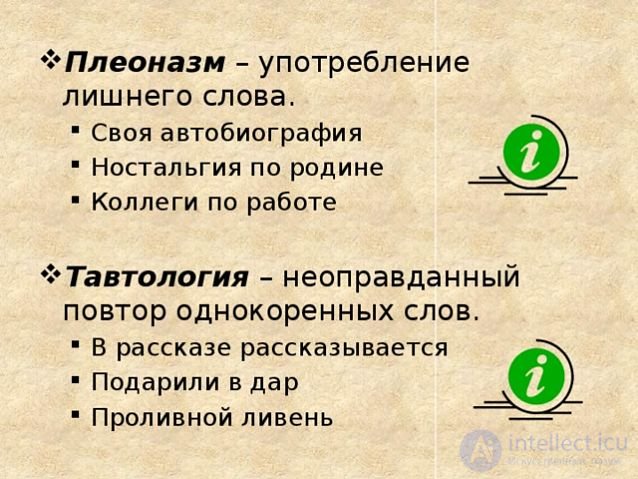
Stylistic figures close to pleonasm are tautology and, in part, periphrasis. The relationship between the terms pleonasm and tautology is understood differently by different linguists. Pleonasm is purely a linguistic term, whereas tautology is both a linguistic and a logical one (though in logic the word is used in quite a different sense).
In a number of cases pleonasm is used deliberately to heighten the emotional effect of an utterance or to create a comic effect (both in written and in spoken speech). In folklore and poetry, pleonasm lends speech melodiousness and emotional coloring and helps create imagery («путь-дороженька», lit. "path — little path"; «полюшко-поле», lit. "little field — field"). More often, however, it is a defect and is used unconsciously.
A distinction is made between syntactic and semantic pleonasm.
Syntactic pleonasm results from the excessive use of function words, for example: “He told me about the fact that he had been hired for another job” (“about the fact” can be omitted without losing the meaning), or “I know that he will come” (the conjunction “that” is not obligatory when joining a clause to the verbal phrase “I know”). Both sentences are grammatically correct, but the words “about the fact” and “that” are regarded in this case as pleonastic.
Semantic pleonasm is more a matter of style and grammatical usage. Linguists often call it verbal redundancy to avoid confusion with syntactic pleonasm, a phenomenon of greater importance for theoretical linguistics. It, too, can take various forms. In many cases of semantic pleonasm, the pleonastic status of a word depends on context. In contrast to semantic pleonasm, an oxymoron is formed by combining two words opposite in meaning.
Among the specific varieties of semantic pleonasm are perissology (or synonymic repetition) and verbosity. In perissology, the semantic meaning of one word is subsumed within another, for example:
“We rose up the stairs”;
“Every customer receives a free gift”;
“There is no other alternative”.
In verbosity, sentences or phrases include words that do not add to the overall semantic load, for example:
“He walked in the direction of home”.
Redundancy is also found implicitly in expressions containing abbreviations: “LEP line” (LEP already stands for “power transmission line”), “SI system” (SI already stands for “International System”), “CD disc” (CD already stands for “Compact Disc”), “VIP person” (VIP already stands for “Very Important Person”).
Sometimes editors and grammatical stylists apply the word “pleonasm” to verbosity itself, also called “logorrhea” (“the given individual of the male sex did, at a time now past, consciously carry out the process of pedestrian transportation at a normal rate of speed in the direction of the object constituting the given individual’s permanent place of residence” instead of “he walked home”).
| Figures of speech | |
|---|---|
| Figures |
Adynaton • Allusion • Amplification • Anadiplosis • Anacoluthon • Anaphora • Antithesis • Antitheton • Apocope • Apostrophe • Attraction • Asyndeton • Hyperbaton •Homeoteleuton • Gradation (Climax, Anticlimax) • Distinctio • Zeugma • Isocolon • Nominative of theme • Inversion • Correctio • Mesarchia •Polyptoton (case variation) • Polysyndeton • Oxymoron • Parallelism • Paronomasia • Parcellation • Periphrasis • Pleonasm • Prolepsis • Retardation •Rhetorical question • Rhetorical exclamation • Rhetorical address • Symploce • Solecism • Tautology • Exact repetition • Aposiopesis • Chiasmus • Exergasia •Ellipsis • Emphasis • Epiphora |
| Tropes |
Allegory • Antiphrasis • Asteism • Antonomasia • Hyperbole • Dysphemism • Irony • Pun • Catachresis • Litotes • Meiosis • Metaphor • Metonymy • Personification •Pathos • Periphrasis • Sarcasm • Synecdoche • Simile • Euphemism • Epithet |

Comments