
Lecture
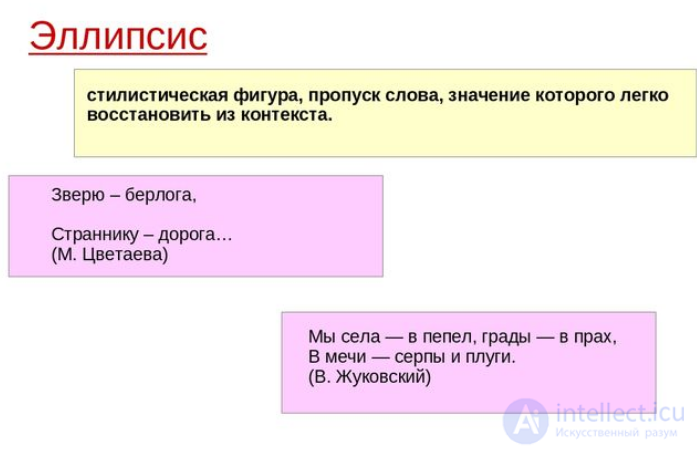
Ellipsis (from Ancient Greek ἔλλειψις — deficiency, lack) in linguistics is the omission from a text or utterance of a sentence element that can be recovered from context.
Ellipsis, in essence, represents a mismatch between semantic and phonetic realization: despite its actual absence from the sentence, elliptical constructions have an interpretation, and often a strictly determinate one. This has given rise to debate about the presumed syntactic structure occupying the gap. There are three main approaches to the structural properties of ellipsis:
1) Elliptical constructions have no syntactic structure at all (Ginzburg and Sag 2000 , Culicover and Jackendoff 2005 );
2) A null element occupies the gap, whose interpretation is a copy of the logical form of the antecedent (Fiengo and May 1994 , Fortin 2007 ). The syntactic form of this element depends entirely on the syntax of the antecedent;
3) An element occupies the gap that has its own syntactic structure expressing the intended meaning (Merchant 2001 ). However, this structure is not realized at the phonetic level.
There are also a number of hybrid approaches, which propose treating ellipsis as a phonetically unrealized structure licensed by the antecedent at both the semantic and the syntactic level.
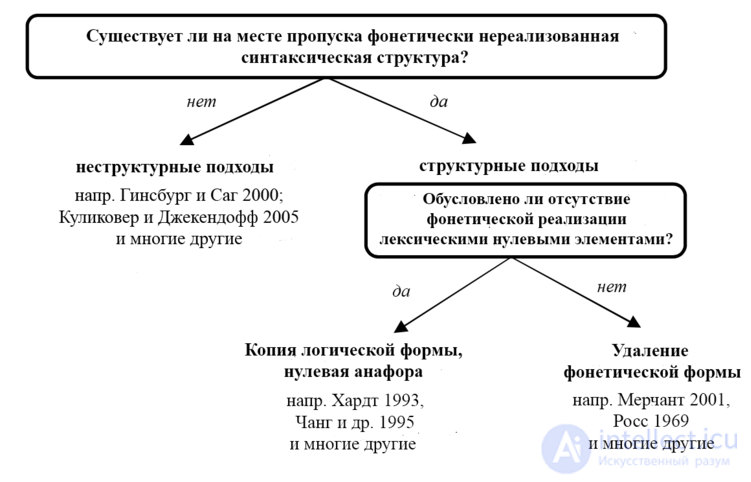
Approaches to Ellipsis as a Syntactic Structure
A sentence containing a gap must satisfy two key conditions:
A sentence element may be omitted only if its meaning can be recovered from context. Thus, uttered out of context, sentence (1a) would be ungrammatical:
(1a) *I know how.
However, when the recoverability condition is met, the gap is permissible:
(1b) He can't solve the problem, but I know how <to solve the problem>.
A sentence element may be omitted only under certain syntactic conditions, which depend on the requirements for ellipsis in each particular language. Thus, in English sentence (2), verb phrase ellipsis is licensed by the auxiliary verb has, whereas comparable structures in French do not permit such usage:
(2a) Aurélie has already paid but Sébastien hasn’t.
(Aurélie has already paid; Sébastien has not.)
(2b) *Aurélie a déjà payé, mais Sébastien n’a pas encore
Aurélie has already paid but Sébastien NE.has not yet.
Day is in love with dark night,
Spring is in love with winter,
Life — with death…
And you?.. You with me!— H. Heine. Leave Me!
A type of ellipsis in which a verbal construction is omitted. It is traditionally held that this type of ellipsis does not occur in Russian. In English, it is one of the most extensively studied .
A type of ellipsis in which the head noun within a noun phrase is omitted:
Of all your articles, I have only read yours <article>.
A type of ellipsis in which an entire indirect question is deleted except for the interrogative pronoun:
Someone was looking for you, but I don't know who <was looking for you>.
It is an elliptical mechanism whereby a deleted non-initial clause is replaced by a phrase (XP) or an adverbial element, often negation.
- He read “War and Peace”, and she did not.
- He read “War and Peace”, and she read “The Master and Margarita”.
A type of ellipsis consisting of a single-word (fragment) sentence used mainly to answer a question that has been posed.
-What's for lunch today? -<For lunch today we have> Soup.
A type of ellipsis in which "the head of one or more non-initial coordinated constituents" is deleted . In English, it typically involves omission of the head verb of a non-initial clause; in Russian it extends to other parts of speech as well.
- I speak English, and he – <speaks> German.
- Mark planted a tree, and I watered <the tree> with water.
A type of ellipsis in which elements of the verb phrase – an auxiliary verb or a copula – are partially deleted.
He wants to go to the cinema, but does not want <to go> to the library.
A type of ellipsis in which a preposition is omitted:
-Who has he been talking with? -<With> Mary.
| Figures of Speech | |
|---|---|
| Figures |
Adynaton • Allusion • Amplification • Anadiplosis • Anacoluthon • Anaphora • Antithesis • Antitheton • Apocope • Apostrophe • Attraction • Asyndeton • Hyperbaton • Homeoteleuton • Gradation (Climax, Anticlimax) • Distinctio • Zeugma • Isocolon • Nominativus pendens • Inversion • Correctio • Mesarchia • Polyptoton • Polysyndeton • Oxymoron • Parallelism • Paronomasia • Parcellation • Periphrasis • Pleonasm • Prolepsis • Retardation • Rhetorical question • Rhetorical exclamation • Rhetorical address • Symploce • Solecism • Tautology • Exact repetition • Aposiopesis • Chiasmus • Exergasia • Ellipsis • Emphasis • Epiphora |
| Tropes |
Allegory • Antiphrasis • Asteism • Antonomasia • Hyperbole • Dysphemism • Irony • Pun • Catachresis • Litotes • Meiosis • Metaphor • Metonymy • Personification • Pathos • Periphrasis • Sarcasm • Synecdoche • Simile • Euphemism • Epithet |

Comments