
Lecture
GRADATION (Lat. gradatio, gradual ascent) is a stylistic figure consisting in the successive intensification or, conversely, weakening of comparisons, images, epithets, metaphors, and other expressive means of artistic speech.
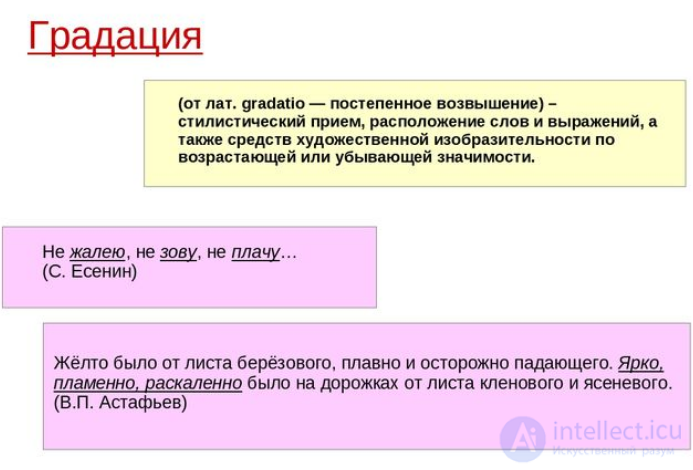
Gradation is a sequence of words, phrases, or sentences, each successive one of which strengthens or lowers the tension or the meaning of the whole phrase. The following types of gradation are distinguished:
climax (a build-up of tension). Example:
I catch your image before our parting,
I am full of it, and grow faint, and tremble…«Anruf an die Geliebte», A. A. Fet.
anticlimax (a fall of tension). Example:
There, mothers under a dark sky
stand in a crowd by the bakery,
and shiver, and are silent, and wait…«Leningrad Poem», O. F. Berggolts.
| Figures of speech | |
|---|---|
| Figures |
Adynaton • Allusion • Amplification • Anadiplosis • Anacoluthon • Anaphora • Antithesis • Antitheton • Apocope • Apostrophe • Attraction • Asyndeton • Hyperbaton •Homoeoteleuton • Gradation (Climax, Anticlimax) • Distinctio • Zeugma • Isocolon • Nominative of theme • Inversion • Correctio • Mesarchia •Polyptoton • Polysyndeton • Oxymoron • Parallelism • Paronomasia • Parcellation • Periphrasis • Pleonasm • Prolepsis • Retardation •Rhetorical question • Rhetorical exclamation • Rhetorical address • Symploce • Solecism • Tautology • Exact repetition • Aposiopesis • Chiasmus • Exergasia •Ellipsis • Emphasis • Epiphora |
| Tropes |
Allegory • Antiphrasis • Asteism • Antonomasia • Hyperbole • Dysphemism • Irony • Pun • Catachresis • Litotes • Meiosis • Metaphor • Metonymy • Personification •Pathos • Periphrasis • Sarcasm • Synecdoche • Simile • Euphemism • Epithet |

Comments