
Lecture
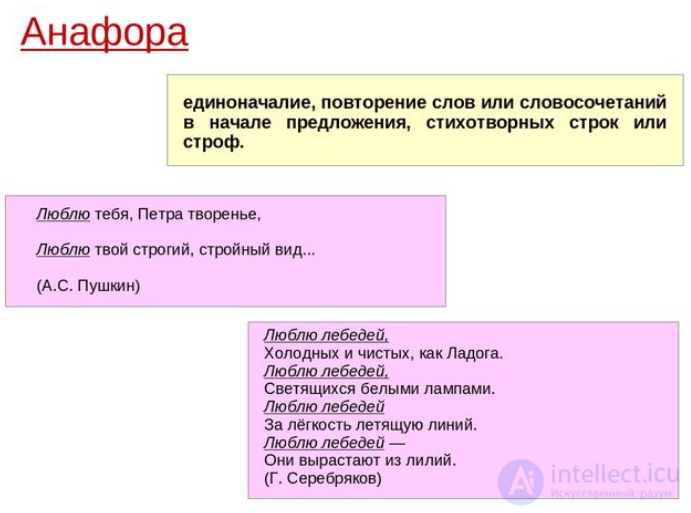
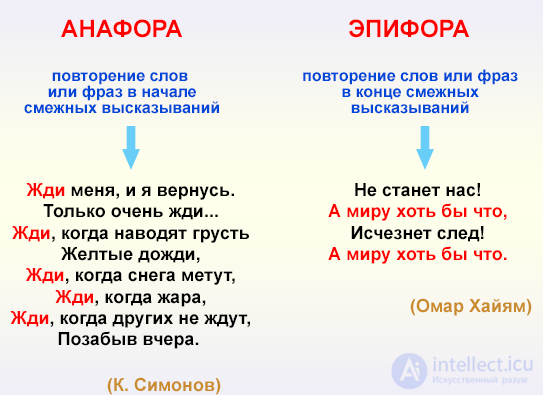
Anaphora (from Ancient Greek ἀναφορά “anaphora,” literally “carrying back”) — a stylistic figure consisting in the repetition of related sounds, a word, or a group of words at the beginning of each parallel unit, that is, in the repetition of the initial parts of two or more relatively independent segments of speech (hemistichs, verses, stanzas, or prose passages). Sound anaphora is a distinctive feature of alliterative verse, but it is also occasionally found in metrical verse (see below):
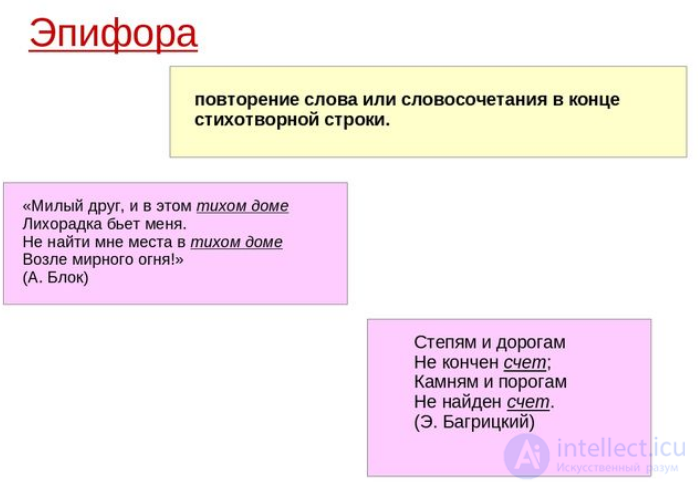
Epiphora (from Greek ἐπιφορά — addition) — a stylistic device consisting in the repetition of the same sound combinations in words, or of words within syntagms, at the end of adjacent or closely situated rhythmic units: verses, stanzas, and so on. It is the opposite of anaphora.
Repetition of the same combinations of sounds:
Грозой снесённые мосты,
Гроба с размытого кладбища (lit. "Bridges swept away by the storm, graves washed out of the flooded cemetery" — note the repeated opening “Gro-”)
— Pushkin, A. S. The Bronze Horseman
Repetition of the same morphemes or parts of words:
The black-eyed maiden,
The black-maned steed.
— Lermontov, M. Yu. The Prisoner
Repetition of the same words:
Not in vain did the winds blow,
Not in vain came the storm.
— Yesenin, S. A. Not in Vain Did the Winds Blow
Repetition of the same syntactic constructions:
Whether I wander along noisy streets,
Whether I enter a crowded temple,
Whether I sit among reckless youths,
I give myself over to my daydreams.
— Pushkin, A. S. Whether I Wander Along Noisy Streets
E A R T H!..
With the moisture of melting snow
It is still fresh.
It wanders on its own,
And breathes like rising dough.
E A R T H!..
It runs and runs
A thousand versts ahead,
Above it a skylark trembles
And sings of it.
E A R T H!..
Ever fairer, ever clearer
It lies all around.
And there is no greater joy, — on it
To live until the day you die.
E A R T H!..
To the west, to the east,
To the north and to the south…
Morgunok would fall upon it, would embrace it,
But his arms are not enough…
— Tvardovsky, A. T.
Combinations of the above-listed types of anaphora are possible. For example:
While the machine gun does not yet crave
To rip apart the throng of men,
The haystack lives and thrives
Among the mills that chew the harvest.
While the army commander does not yet long
To cleave the foe with a single blow,
The barns fill up, and not for nothing,
With the fields’ golden-bearing gift.
While the enemy’s thunder has not yet spoken
Its opening word,
In the fields there can be no other
Catcher of expanses than the agronomist.
— Tikhonov, N. S.
A very rare device is the use of rhythmic anaphora. In the poem cited below, the rhythmic anaphora consists in the pausing of the third beat of the amphibrachic foot in the even-numbered verses:
Све|ча наго|рела. Порт|реты в те|ни. /\
Си|дишь /\ при|лежно и | скромно ты.| /\ /\
Ста|рушке зев|нулось. По | окнам ог|ни /\
Про|шли /\ в те | дальние | комнаты.| /\ /\
Ни|как кома|ра не про|гонишь ты | прочь, — /\
По|ёт /\ и к свету всё | просится |. /\ /\
Взгля|нуть ты не | смеешь на | лунную | ночь, /\
Ку|да /\ ду|ша пере|носится…| /\ /\ (lit.: "The candle has burned low. Portraits in shadow. /\ You sit /\ dutifully and | modestly.| /\ /\ The old woman has begun to yawn. Past the windows lights /\ went by into those | distant | rooms.| /\ /\ No matter what, you cannot chase the gnat | away, — /\ It keeps singing /\ and pressing toward the light |. /\ /\ You dare not | look at the | moonlit | night, /\ Where your | soul is | carried off to…| /\ /\")
— Fet, A. A.
Anaphora can be regarded as one type of fused (run-on) sentence. As a means of linking parts of a sentence and whole sentences, anaphora is found in Old Germanic poetry, where it forms a special stanza known as the “anaphoric trisyllable.”
Often anaphora combines with another rhetorical figure — gradation, that is, with a gradual intensification of the emotional character of the words in the speech, for example, in the Edda: “Cattle die, kinsmen die, the self likewise must die.”
Anaphora is also found in prose speech. Forms of greeting and farewell are most often built anaphorically (in imitation of the folk tradition among minnesingers and troubadours, and also among poets of more recent times). It is interesting to note the historical-cultural background underlying such anaphora.
It was once considered even more important to address the gods in exactly the same way, so as not to anger any one of them, or to address rulers sitting together (for example, at a court, a military council, or a formal banquet):
To the most honorable, most esteemed, most learned and wise-minded gentlemen burgomasters and councilmen, and to the most honorable, distinguished and prudent gentlemen eldermen and elders, together with the entire burghery of all three guilds of the royal city of Reval, my lords and most gracious sovereigns and good friends.
— Balthasar Russow, “Chronicle of the Province of Livonia”
| Figures of speech | |
|---|---|
| Figures |
Adynaton • Allusion • Amplification • Anadiplosis • Anacoluthon • Anaphora • Antithesis • Antitheton • Apocope • Apostrophe • Attraction • Asyndeton • Hyperbaton •Homeoteleuton • Gradation (Climax, Anticlimax) • Distinctio • Zeugma • Isocolon • Nominative of Theme • Inversion • Correctio • Mesarchia •Polycasus (Polyptoton) • Polysyndeton • Oxymoron • Parallelism • Paronomasia • Parcellation • Periphrasis • Pleonasm • Prolepsis • Retardation •Rhetorical Question • Rhetorical Exclamation • Rhetorical Address • Symploce • Solecism • Tautology • Exact Repetition • Aposiopesis • Chiasmus • Exergasia •Ellipsis • Emphasis • Epiphora |
| Tropes |
Allegory • Antiphrasis • Asteism • Antonomasia • Hyperbole • Dysphemism • Irony • Pun • Catachresis • Litotes • Meiosis • Metaphor • Metonymy • Personification •Pathos • Periphrasis • Sarcasm • Synecdoche • Simile • Euphemism • Epithet |

Comments