
Lecture
Это окончание невероятной информации про анализаторные системы.
...
one another by an opening – the helicotrema (Fig. 2.6, 2.12). A single canal, comprising the oval window,
the upper and lower scalae connected by the helicotrema, ends at the round window
(see Fig. 2.6, 2.12). The upper and lower canals of the cochlea are filled with perilymph, and the middle one –
with endolymph. In the scala media is located the sound-perceiving receptor apparatus
– the spiral (organ of Corti) organ (Fig. 2.11, 2.13).
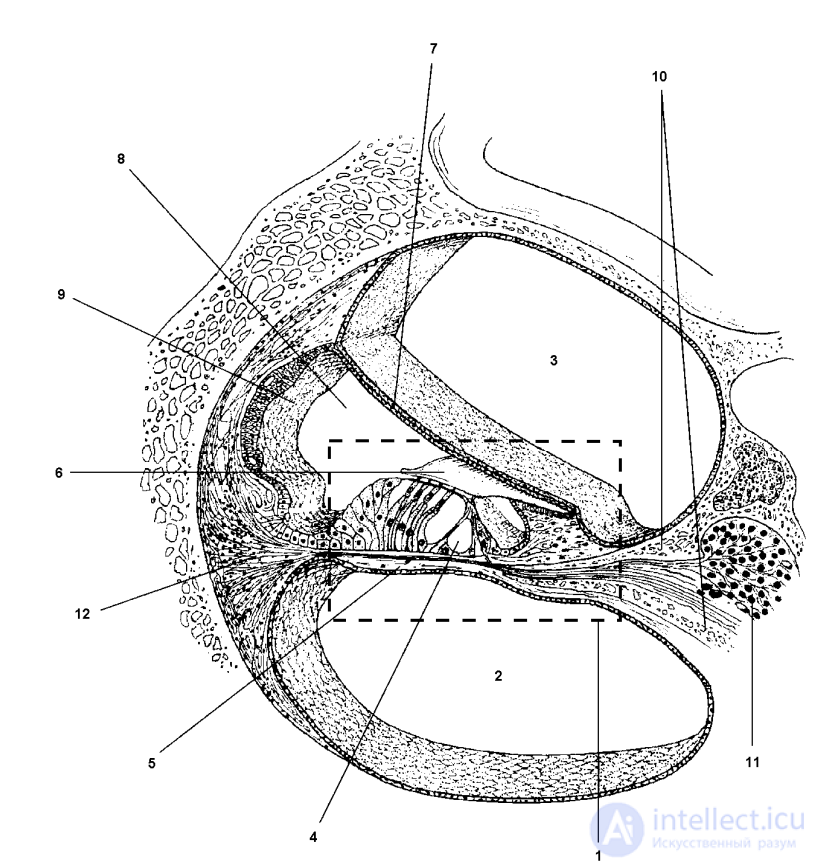
Fig. 2.11. Cross-section of the cochlea
(after: Bloom and…, 1969, 1986; from: Histology…, 2001)
1 – spiral (Corti's) organ; 2 – scala tympani (lower, or tympanic, scala) (part of the perilymphatic space containing perilymph); 3 – scala vestibuli, or scala of the vestibule, or upper scala (part of the perilymphatic space containing perilymph); 4 – tunnel; 5 – basilar (main) membrane; 6 – tectorial membrane; 7 – vestibular
membrane, or Reissner's membrane; 8 – membranous canal of the cochlea (cochlear duct, or scala media) – filled with endolymph; 9 – stria vascularis; 10 – spiral bony lamina; 11 – spiral
ganglion; 12 – spiral ligament
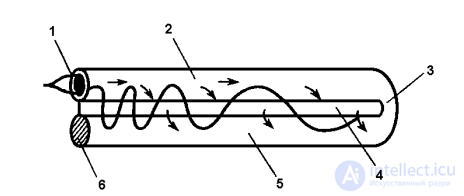
Fig. 2.12. Diagram of the propagation of sound vibrations in the cochlea
(after: Korobkov A.V., Bashkirov A.A., Vetchinkina K.T., 1980)
1 – the auditory ossicle «stapes» in the oval window of the vestibule; 2 – scala vestibuli (upper scala); 3
– helicotrema; 4 – scala media (membranous canal of the cochlea); 5 – scala tympani, or tympanic, scala (lower scala); 6 – round window
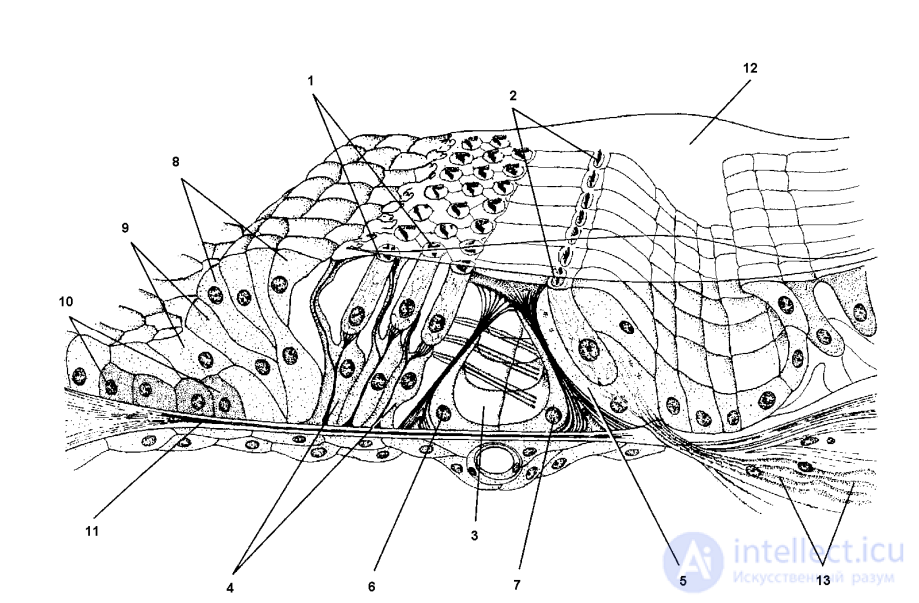
Fig. 2.13. Structure of the spiral (Corti's) organ
(after: Tissues and…, 1979; from: Histology…, 2001)
The mechanosensitive hair cells form several rows: one row of inner cells and 3–5 rows of
outer cells. The inner and outer hair cells are separated by a tunnel formed by outer and inner pillar cells. The tectorial
membrane is in contact with the stereocilia of the hair cells. 1 – outer hair cells; 2 – inner hair cells; 3 – tunnel; 4 – outer phalangeal cells, or cells of Deiters; 5 – inner phalangeal cells; 6 – outer pillar cells; 7 – inner pillar cells; 8 – cells of Hensen; 9 – cells of Claudius; 10 – cells
of Boettcher; 11 – basilar membrane; 12 – tectorial membrane; 13 – myelinated
nerve fibers
Sound waves, acting on the system of auditory ossicles (see Fig. 2.6) of the middle ear,
set the membrane of the oval window (see Fig. 2.12) into oscillatory motion, which, flexing, causes wave-like movements of the perilymph in the upper and lower canals, which gradually die out toward the apex of the cochlea. Such movement of the fluid
is possible thanks to the fact that the mobile membrane of the round window (see Fig. 2.6), as the perilymph moves, can deflect toward the cavity of the middle ear (see Fig.
2.12). Oscillations of the perilymph are also transmitted to the vestibular membrane, and then to the cavity of the middle canal, setting the endolymph and the basilar membrane in motion. Deforming, the basilar membrane displaces the hairs of the hair cells relative to the tectorial membrane. As a result of this displacement, an electrical discharge of the hair
cells arises. There is a direct relationship between the amplitude of displacement of the main (basilar) membrane and the number of neurons of the auditory cortex
(neurons of the cortical division of the auditory analyzer) recruited into the excitation process.
A person perceives sound vibrations with a frequency from 16 to 20,000 Hz. The minimum
sound intensity heard in half of the cases in which it is presented is called the absolute threshold
of auditory sensitivity. Hearing thresholds depend on the frequency of the sound. In the frequency range of
1,000–4,000 Hz, hearing is maximally sensitive. At sounds below 1,000 and above 4,000 Hz, sensitivity decreases sharply: for example, at 20 and 20,000 Hz the threshold sound energy is a million
times higher.
The unit of sound loudness is the bel – the decimal logarithm of the ratio of the actual sound intensity I to its threshold intensity I0 (in practice, the decibel (dB) – 0.1 bel – is more often used as the unit of loudness). The maximum level of sound
loudness that causes a sensation of pain equals 130–140 dB above the hearing threshold. Loud sounds lead to damage to the receptor hair cells, their death, and a corresponding decline in hearing.
A person possesses spatial hearing – the ability to determine the position of a sound source in space. This ability is based on the presence of binaural (Lat. bini – two
+ auris – ear) hearing – the perception of sounds by both ears. The acuity of binaural hearing in humans is very high: the position of a sound source is determined with an accuracy of up to 1 angular
degree. This is possible because the neurons of the auditory system are able to evaluate
interaural (between-ear) differences in the time of arrival of a sound at the right and left ear, and in the intensity of the sound at each ear. If a sound source is located off the midline of the
head, the sound wave arrives at one ear somewhat earlier and with greater intensity than
at the other ear.
In the functioning of the analyzer (first-signal) mechanisms and in the development of sensations, a special role is played by the word, by speech – the second signal system. In the course of individual development (ontogenesis), a person learns to designate this or that sensation by a particular word, so that it is in speech that a person actually becomes conscious of his sensations. Color, smell, and other properties of objects are sensed by a person as qualities inherent
in the object located outside himself. In sensations, a spatial reflection
of the world takes place, the mechanism of which is formed over the course of a lifetime. Thus, the physiological mechanism of sensations can be characterized as a mechanism of conditioned-reflex activity of the analyzers, arising on the basis of a limited number of unconditioned (innate) reflexes. Sensation is the primary form of an organism's orientation in the surrounding environment.
On the basis of the sensations arising in various sense organs during the piloting process, individual elements of the mental image of the flight are formed. The pilots themselves emphasize the importance of sensations in the piloting process as follows (Ponomarenko V.A., Lapa V.V.,
1985): «… changes in the aircraft's position in space cause changes in the forces
acting on the pilot's sense organs… By the change in, or emergence of, sensations the pilot
can judge a change in flight mode. Sensations cannot give precise information about the magnitude of a change, but they signal this change and prompt the pilot to
turn his attention to the instruments in time. When the pilot has a clear idea of
his position in space, sensations help him in piloting the aircraft,
reduce his nervous tension, and allow him to perform other tasks not related to
piloting».
Up to this point we have examined the visual, vestibular, and auditory analyzers, but
these are not the only analyzer systems taking part in piloting and in the creation of the mental image of the flight. In controlling an aircraft, the so-called muscular sense is extremely important, and it is realized with the participation of proprioceptors (Lat. proprius – one's own, particular + recipere – to receive) – receptors located in the muscles, ligaments, tendons, and bones. In the process of controlling the aircraft, the pilot voluntarily (consciously) and involuntarily
(unconsciously) compares information perceived through the proprioceptors with the aircraft's spatial position and the effect of moving the aircraft's controls. The muscular sense allows the pilot, in the course of flight training, to determine
increasingly precisely the magnitude of deflection of the elevators and rudder: at first, the magnitude of control-surface deflection is compared with the readings of the attitude indicator, and subsequently this is no longer necessary – the pilot can set the required magnitude of deflection purely by his own sensations.
Thus, in the course of flight training, new conditioned reflexes are formed, constituting one of the components of the mental image of the flight: sensations come to be experienced not
as such, but as something conveying information about the position of the aircraft.
Часть 1 2 SPECIFICS AND CONDITIONS OF FLIGHT ACTIVITY 2.1. THE ROLE OF ANALYZER SYSTEMS IN THE
Часть 2 - 2 SPECIFICS AND CONDITIONS OF FLIGHT ACTIVITY 2.1. THE

Comments