
Lecture 21 min.
Experimental psychology is the general designation for all kinds of scientific-psychological research carried out by means of various experimental methods.
Experimental psychology represents a general methodological approach that spans the most diverse areas of psychological science.
Experimental methodology in psychology comes down predominantly to laboratory (less often, natural) studies, in the course of which one carries out the preliminary planning and subsequent organization of experiments that are as correct (valid) as possible in scientific-methodological terms and that bear some relation to the most diverse areas of psychological science, including almost all branches of applied psychology.
In particular, of very great importance for the successful development of experimental psychology is the elaboration of effective experimental methods for studying the various problems and questions connected with the psychophysiology of sensation, perception, development, attention, consciousness, learning, memory, thinking, and language.
Recently, experimental approaches have come to be actively applied in social psychology, as well as in the study of psychological motivations and emotions.
The methodology of experimental psychology is based on the following principles:
By experimental psychology is meant the whole of scientific psychology as a system of knowledge obtained on the basis of the experimental study of the behavior of humans and animals. (W. Wundt, S. Stevenson, and others.) Scientific psychology is equated with experimental psychology and contrasted with the philosophical, introspective, speculative, and humanistic versions of psychology. Experimental psychology is sometimes interpreted as a system of experimental methods and techniques implemented in concrete studies. (M. W. Matlin). The term «experimental psychology» is used by psychologists to characterize the scientific discipline concerned with the problem of the methods of psychological research as a whole; by experimental psychology is meant only the theory of the psychological experiment, based on the general scientific theory of the experiment and including, first and foremost, its planning and the processing of the data. (F. J. McGuigan).
Experimental psychology encompasses not only the study of the general regularities in the course of mental processes but also individual variations in sensitivity, reaction time, memory, associations, and so forth.
The task of the experiment consists not simply in establishing or stating cause-and-effect relationships but in explaining the origin of these relationships. The subject matter of experimental psychology is the human being. Depending on the aims of the experiment and the characteristics of the group of participants (sex, age, health, etc.), the tasks may be creative, work-related, play-related, learning-related, and so on. Yu. M. Zabrodin holds that the basis of the experimental method is the procedure of the controlled alteration of reality for the purpose of studying it, which enables the researcher to enter into direct contact with it.
Already in the 17th century, different paths for the formation of psychological knowledge were discussed, and notions of rational and empirical psychology were taking shape. In the 19th century, psychological laboratories appeared and the first empirical studies, called experimental, were conducted. In W. Wundt's first laboratory of experimental psychology, the method of experimental introspection was used (introspection – a person's self-observation of their own mental activity). L. Fechner developed the foundations for constructing the psychophysical experiment; these were regarded as ways of collecting data about a participant's sensations under changes in the physical characteristics of the stimuli presented to them. H. Ebbinghaus conducted studies of the regularities of memorization and forgetting, in which one can trace techniques that became the standards of experimentation. A number of special techniques for obtaining psychological data, in particular the so-called method of associations, preceded the development of schemes of experimental manipulation. Behaviorist studies (behaviorism – a direction in the psychology of the 20th century that ignores the phenomena of consciousness and the psyche and wholly reduces human behavior to the physiological reactions of the organism to the influence of the external environment), which gave paramount attention to the problem of managing stimulus factors, worked out the requirements for constructing a behavioral experiment.
Thus, in the middle of the 19th century, experimental psychology was engaged in studying the elementary mental functions – sensations, perception, reaction time. These works gave rise to the idea of the possibility of creating experimental psychology as a distinct science, different from physiology and philosophy. The first researcher in experimental psychology is justly said to be W. Wundt, who founded an institute of psychology in Leipzig in 1879.
The founder of American experimental psychology is said to be S. Hall, who studied for 3 years in Leipzig in W. Wundt's laboratory. He then became the first president of the American Psychological Association. Among other researchers, one should mention James Cattell, who also received his doctoral degree under W. Wundt (in 1886). He was the first to introduce the concept of the intelligence test.
In France, T. Ribot formulated a conception of the subject matter of experimental psychology, which, in his view, should be concerned not with metaphysics or the discussion of the essence of the soul but with the discovery of the laws and immediate causes of mental phenomena.
In Russian psychology, one of the first examples of methodological work along the path of comprehending the standards of experimentation is A. F. Lazursky's conception of the natural experiment, which he proposed in 1910 at the First All-Russian Congress on Experimental Pedagogy.
Since the 1970s, the course «Experimental Psychology» has been taught in Russian institutions of higher education. In the «State Educational Standard of Higher Professional Education» of 1995, 200 hours are allotted to it. The tradition of teaching experimental psychology in Russian universities was introduced by Professor G. I. Chelpanov. As early as the 1909/10 academic year he taught this course at the psychology seminary at Moscow University, and later — at the Moscow Psychological Institute (now the Psychological Institute of the Russian Academy of Education). Chelpanov regarded experimental psychology as an academic discipline devoted to the methods of psychological research, or more precisely — to the methods of the experiment in psychology.
The classification presented here is based on the classification of B. G. Ananyev, who combined in it all the stages of psychological research, from the organizational stage to the interpretive stage. [Ananyev's classification is given here with some modifications.]
Science is a sphere of human activity whose result is new knowledge about reality that meets the criterion of truth. The practicality, usefulness, and effectiveness of scientific knowledge are considered derivatives of its truth. A method is a set of techniques and operations for the practical and theoretical mastery of reality. All the methods of modern science are divided into theoretical and empirical. In the theoretical method of research, the scientist works not with reality but with a representation of it in the form of images, schemes, and models in natural language. The main work is done in the mind. Empirical research is conducted to verify the correctness of theoretical constructions. The scientist works directly with the object, not with its symbolic image.
In empirical research the scientist works with graphs and tables, but this takes place «on the external plane of action»; schemes are drawn, calculations are made. In theoretical research a «thought experiment» is conducted, in which the object of study is subjected to various trials on the basis of logical reasoning. There is also such a method as modeling. It applies the method of analogies, assumptions, and inferences. Modeling is used when it is not possible to conduct an experimental study. A distinction is drawn between «physical» and «sign-symbolic» modeling. A «physical model» is studied experimentally. In research using a «sign-symbolic» model, the object is realized in the form of a complex computer program.
Among the scientific methods, the following are distinguished: observation, experiment, measurement.
In the 20th century, over the course of a single generation, scientific views of reality changed radically. Old theories were refuted by observation and experiment. Thus, any theory is a temporary construction and can be demolished. Hence the criterion of the scientific character of knowledge: knowledge is recognized as scientific if it can be rejected (recognized as false) in the process of empirical testing. Knowledge for the refutation of which no appropriate procedure can be devised cannot be scientific. Every theory is merely a supposition and can be refuted by experiment. Popper formulated the rule: «We do not know — we can only suppose.»
Under various approaches to distinguishing the methods of psychological research, the criterion remains that aspect of its organization which makes it possible to determine the ways of the researcher's relation to the reality under study. In that case, techniques are regarded as procedures or «techniques» of data collection that can be incorporated into different research structures.
Methodology – a system of knowledge that defines the principles, regularities, and mechanisms of the use of the methods of psychological research. The methodology of experimental psychology, like that of any other science, is built on the basis of certain principles:
The principle of determinism – the manifestation of cause-and-effect relationships. In our case – the interaction of the psyche with the environment – the action of external causes is mediated by internal conditions, that is, by the psyche.
The principle of the unity of the physiological and the mental.
The principle of the unity of consciousness and activity.
The principle of development (the principle of historicism, the genetic principle).
The principle of objectivity.
The systemic-structural principle.
Ever since the creation of experimental psychology, there have been debates about the applicability in psychology of such a research method as the experiment. There are two polar points of view:
The first point of view — about the impossibility of using the experiment — rests on the following premises:
Many adherents of the hermeneutic approach in psychology, based on W. Dilthey's method of understanding, come out as opponents of experimental methods.
Proponents of the second point of view, which grounds the expediency of introducing the experiment into science, maintain that the experiment makes it possible to discover the principle underlying some phenomenon. The experiment is regarded as an attempt at the laboratory re-creation of a simplified reality, in which its important characteristics can be modeled and controlled. The aim of the experiment is to assess the theoretical principles underlying a psychological phenomenon.
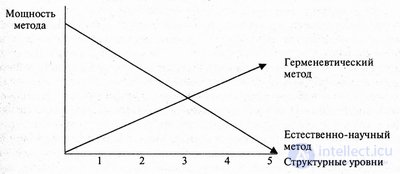
There is also a point of view that can be regarded as a compromise between the two mentioned above — the idea of levels of mental organization. According to it, there are six levels of mental regulation (0 — the physiological level, 1 — the psychophysiological level, 2 — the level of sensory-perceptual processes, 3 — the integrative level of the psyche, 4 — the level of the personality, 5 — the level of individuality). The power of the natural-scientific method has its highest value when physiological processes are considered and gradually falls, tending toward zero at the level of individuality. Correspondingly, the power of the hermeneutic method increases, from a value of zero at the physiological level to its maximum value at the level of individuality. On the diagram this is displayed as follows:

There are four general, interrelated tasks facing scientific research: to describe behavior, to predict behavior, to explain behavior, to manage behavior.
Identifying regular sequences of events, including stimuli or external factors and responses or behavior. Producing clear and precise descriptions is the first step in any scientific inquiry, without which the prediction and explanation of behavior are impossible.
The discovery of the laws of behavior (the presence of constant and predictable interrelations among variables) should lead to the making of predictions with one or another degree of probability.
Finding the causes of the emergence of the behavior under consideration. The process of establishing cause-and-effect relationships is complex and includes many aspects.
The practical application of the laws of behavior discovered in the course of psychological research.
When working with a participant, one must observe the ethics of psychological research. In most cases it is necessary to:
When working with animals:

Comments