
Lecture
Это окончание невероятной информации про .
...
actual weather at the
Vologda aerodrome from 17:32 (the time of takeoff at Veliky Ustyug aerodrome) until 17:55
met the aerodrome minimum of "120 x 1,500 m." Thereafter the visibility fell below the weather minimum: at 18:10 it was 1,280 m, at 18:20 it was 1,080 m. At 18:25, by collusion between the flight
director and the weather observers at the outer marker and main observation point (a transcript of the telephone conversation is given in appendix 2), the latter switched to visual observation using nighttime landmarks and, despite the continuing deterioration in visibility, began transmitting inflated values - 1,500 m (Boltachyov V.Yu., Kharikov A.A., Shcherbakov L.K., 1995, b). At the same time
the observer at the main point knew there was no nighttime landmark at a distance of
1,000 m and that visual visibility could not be determined for intermediate values
between 700 and 1,500 m. From 18:25 to 18:42, despite the actual deterioration of visibility on the runway and repeated warnings about it from the circuit and start
controllers, the weather observer, in response to every query about the weather, kept reporting a visibility of 1,500 m, which was passed on to the
crews of aircraft. The actual visibility was: at 18:25 - 850 m, at 18:30 - 820 m, at
18:35 - 720 m, at 18:40 - 690 m. At 18:42 the outer-marker weather observer, seeing the aircraft on fire, reported to the circuit controller and to the main observation point: "Fog, visibility
700 m, vertical visibility 100 m."
The Yak-40's approach to landing was carried out using the NDB approach system. After passing the middle marker, the crew increased its vertical rate of descent and reduced heading to 150°, which, at a distance of 2 km from the runway, resulted in a lateral deviation of 150 m to the left and a descent 40 m
below the glide path. At the decision height, with no reliable visual contact with ground references, the crew made no attempt to go around. At a speed of 200 km/h, with a right
bank of 5° and heading 169°, the aircraft struck the tops of trees at a height of 20 m. As it continued, the aircraft, breaking up from impacts with the trees, traveled 204 m and at 18:41
struck the ground 96 m from the outer marker. The aircraft was completely destroyed and burned. Three crew members were killed and two were injured.
The disaster exposed the true norms operating within the aviation sector, showing
that there existed not only a vicious and all-pervading practice of using administrative leverage (in this case, the flight director's pressure on the weather observers) to resolve professional matters, but also an equally rapid willingness to submit
to that administrative pressure. Driven by a desire not to suffer at the hands of management, subordinates readily go along with violations, naively believing that management will credit them for these "merits" in the future ("blessed naivety!"). As we see, in pursuit of
illusory dividends, such people not only fail to profit but even end up
facing criminal prosecution (people inclined to use administrative leverage are guided by the principle of achieving their goal "here and now" and have no intention whatsoever of repaying those who carried out their plan, whereas in the minds of
those who carried it out, they believe they rendered their boss invaluable assistance, which will be compensated for in the future). How often do we come to understand this only after our actions have turned into a loss: "if only I could take it all back!"
The personal qualities of air traffic controllers and an unhealthy atmosphere within a controller shift have repeatedly provided fertile ground for aviation accidents. As an illustration let us use the account of a disaster given by A.N. Orekhov (1989). The aircraft was operating a
passenger flight on the route "Minsk - Kuibyshev - Tyumen - Surgut." The disaster occurred on 27 February 1988 during an attempted approach to a runway 2,600 m long
and 44 m wide. The destination aerodrome (Surgut) had two landing courses (71° and 251°), equipped with all the necessary lighting and radio equipment. For the Tu-134A aircraft,
approaching to land on heading 71° was more advantageous - by the shortest distance - whereas for
the controllers it created inconvenience - it was necessary to switch
over the runway lights and activate all the equipment for magnetic heading 71° (aircraft were normally accepted with a landing heading of 251°), and also to redirect the weather observer to the opposite end of the runway, corresponding to heading 71°.
By the time the Tu-134 approached, the weather along heading 251° was gradually deteriorating. The crew
addressed the area control center controller with a request: "Please, could you provide us runway
heading 71," to which they were told to coordinate the change of landing heading with the DPP controller. The latter contacted the SDP controller: "The little Tupolev is asking for runway heading
71." The SDP controller replied after 8 seconds: "What's it to us? If they bring him in by radar, then
fine." Thus he in effect granted the change of landing heading, setting the
condition of a radar-guided approach. This was not enough for the approach controller, and,
wanting to obtain official authorization, he asked: "Is there any kind of chief around?" This last phrase sheds light on the nature of the relationship between the flight director and the controllers of his shift. The approach controller knew perfectly well, in asking about a "chief," that there was no one on the SDP other than the flight director among the "chiefs." The controller knew perfectly well what the flight director's name was, but chose to refer to him differently - with a note of contempt (Orekhov A.N., 1989).
To the question about a chief, the start controller replied: "Yes, I'll call the flight director." The flight director did not come on the radio himself, but confirmed through the SDP controller
the permission to change the landing heading, after which he went to the landing controller to "tip him off" to bring the aircraft in by radar on heading 71°, but gave no instructions whatsoever about switching on all the radio equipment or relocating the weather observer.
During the investigation it was established that the flight director understood: "The Tu-134 is requesting
a straight-in approach on heading 71°," and therefore all the radio equipment needed to be switched on, not just the approach radar. As for relocating the weather observer to the new landing heading, the flight director, by his own account, did not bother, since the "good weather" (visibility
of all landmarks) allowed weather observations to be conducted from magnetic heading 251°.
Despite the Tu-134 crew's request to "please reconfigure the beacons, the ILS system," the ILS glide-path system was not reconfigured to the new heading - it was decided to bring the aircraft in by radar, and
the crew did not object to this.
The landing controller brought the aircraft onto the runway. His statement: "500, runway ahead of you"
is confirmed by the navigator's phrase: "Runway on course." Then something quite unexpected happened -
the aircraft, with an increasing left bank, began drifting off course (the course deviation had begun
1-2 s earlier but had been unnoticeable). The landing controller noticed on the approach-radar display that the aircraft's blip had moved sharply up from the glide-slope line and to the left of the course line. At this
final stage of the approach path (less than 500 meters from the runway threshold) the landing controller is no longer
in control and bears no responsibility. Still not understanding what was happening, he transmitted over the air, naming the
aircraft's registration number, but the crew did not respond.
Either the navigator or the co-pilot noticed the aircraft's deviation: "Course." The captain frantically
"searched for the ground" straight ahead in a state of mental stupor, that is, not noticing either the instrument readings or the altitude values being read out and
called out loudly by the flight engineer (Orekhov A.N., 1989). Apparently the captain heard the word
"course," since he rolled the aircraft from a left bank into a right one. Over the runway threshold (to the left of it) at
a height of 40 m the aircraft was in a non-landing attitude, which called for a go-around,
but the captain continued the approach. 1.5-2 s before touchdown he attempted to go
around, but this decision came too late. The aircraft struck the ground with its right landing gear, bounced back into the air, then flipped over, caught fire, and, continuing a few more meters as a burning fireball, finally fell to the ground. 1-2 s before impact the landing controller issued the instruction to go around.
After the crash the flight director ordered a control weather reading to be taken - and specifically from the threshold with heading 251°, instead of 71°. A.N. Orekhov (1989) points out that this can be regarded as nothing other than an attempt to conceal the truth. The aircraft crew reported that the cause of the disaster was a sharp and completely unexpected deterioration in visibility
due to a rising fog, smoke, and a layer of industrial haze over the aerodrome on the side of heading 71°. In the captain's words, they were flying "in patchy milk," so at times he could see and at times could not see
the runway. The flight director insisted that he had not even suspected such weather conditions. As A.N. Orekhov (1989) rightly points out, the weather over the aerodrome was deteriorating, at least along heading 251°, and to say with certainty that meteorological conditions were better along heading 71° would have required
sending a weather observer there.
The change of magnetic heading from 71 to 64.5° during the descent from the middle marker to the runway threshold suggests (Boltachyov V.Yu., Kharikov A.A., Shcherbakov L.K., 1995, b) a mismatch
between the visibility data given to the crew and the actual visibility, since otherwise
the captain would not have allowed the aircraft to drift off the runway centerline while crossing the threshold without taking measures
to correct the lateral deviation. According to the captain's statement, during this time he was distracted from instrument flying and was trying to establish visual contact with the approach and runway lights, but saw "beneath him" only isolated flickering lights; the co-pilot
did not carry out monitoring instrument flying. Lacking reliable visual
contact with ground references, the captain continued the descent and, failing to maintain the flight parameters
set by the controller, with the landing lights switched off (already at a height of 110-100 m due to the light-screen effect that had formed), placed the aircraft in a non-landing attitude. On crossing the runway
threshold at a speed of 286 km/h the aircraft was at an altitude of 38 m and a lateral offset from
the landing course of 50 m to the left. Distracted by the attempt to visually determine the aircraft's spatial position, and striving to complete the landing no matter what, the captain did not go around, even though he had sufficient altitude margin to do so (Boltachyov
V.Yu., Kharikov A.A., Shcherbakov L.K., 1995, b). The aircraft touched down at a distance of
714 m from the ILS runway threshold and 113 m from its centerline, on the grass strip, with a load factor of 4.6. 17 passengers and 3
crew members were killed, and 28 passengers and 3 crew members were injured.
What drew the most criticism from the pilots participating in the investigation was the radar-guided approach, whereas the crew had asked for the "system," that is, an approach using the ILS glide-path system. The flight director explained his decision to bring the aircraft in by approach radar with the following circumstances:
1) switching on the ILS system, under the conditions at the time, would have taken about five minutes, and
moreover it would have caused additional trouble for the support staff;
2) the landing controller had extensive work experience.
An example of an aviation occurrence made possible by a combination of crew errors and
ATC service errors is the landing of a Yak-40 aircraft on a runway closed to
flights. While operating the flight on the route "Chardzhev (Turkmenistan) -
Ashgabat (Turkmenistan)" on 4 June 1997, the crew of a Yak-40 aircraft landed on runway 11/29, which was not the assigned runway and was closed to flights, instead of runway 12/30. Ashgabat aerodrome has two non-intersecting runways, positioned relative to
each other at an angle of 10°. The threshold of runway 11/29 extends 360 m beyond the threshold of runway 12/30, and the distance between the threshold centerlines is 302 m. Both runways have identical markings.
On approach using the NDB approach system on magnetic heading 296° under conditions of limited visibility, the threshold of runway 11/29 comes into the field of view. At the time the decision was made, the weather along the route
and at the destination airport met the captain's minimum (50 x 700 m) and the aerodrome's minimum (120 x
1,800 m).
At a distance of 8 km the crew reported readiness to land and received the controller's clearance for the
approach. In the area of the middle marker the aircraft encountered heavy rain showers with
visibility deteriorating to 1,500 m. The crew had not been warned of the possible deterioration in
visibility - at the time landing clearance was received the crew had been given information from the landing controller of a visibility of 2,000 m. On passing the inner marker the crew found itself in an ambiguous situation, in which, according to calculations and the readings of the automatic direction finder
(ADF), the aircraft should have been on the final approach course for runway 12/30, which should have projected to the right of the aircraft's longitudinal axis. The crew was in fact conducting the approach onto
runway 11/29.
During the landing roll the crew saw ahead of them a Tu-154 aircraft, standing at a distance of
1,200 m from the threshold of runway 11/29 at a temporary parking stand, which came as a complete surprise to the crew given their confidence that they had landed correctly. To avoid a collision, the crew
made a turn to the left off the runway centerline. The aircraft ran off onto sodden ground,
passing the Tu-154 aircraft at a distance of 20 m.
The commission investigating this incident concluded that the occurrence resulted from a combination of the following factors (Informational..., 1997):
- the captain's incorrect decision to carry out a landing under conditions of
limited visibility (2,000 m) on a runway not equipped with visual approach lighting;
- passive management of the aircraft by the flight director in difficult meteorological conditions
(thunderstorm activity, rain showers, hail in the aerodrome area);
- failure to switch on the visual lighting equipment of the primary (working) runway 12/30 under conditions of horizontal visibility corresponding to the aerodrome minimum for the NDB approach system, which caused the crew to mistake the more clearly visible runway 11/29 for the
primary runway. It is important that the Ashgabat aerodrome's visibility minimum of 1,800 m requires
the mandatory activation of the visual lighting equipment of runway 12/30, which runway
11/29 does not have; otherwise this minimum is not valid at a visibility of 2,000 m, which is what the captain relied on. The captain was not aware of this particular feature, and had the system been switched on, he would have been able to see the runway from the decision height.
The recommendations developed by the commission investigating the incident were as
follows.
1. Include in Rossaeronavigatsiya's "Aeronautical Information Publication No. 13" for the aerodrome a warning: "On approach with a magnetic heading of 296° the runway
with a heading of 286° is more clearly visible."
2. Require air traffic controllers, in cases where an aerodrome has adjacent runways, in order to
identify the working runway, to switch on the lighting equipment during daylight before the aircraft reaches the fourth turn on an NDB approach when horizontal visibility is 3,000 m or less.
The next aviation occurrence, illustrating violations of operating procedure by
controllers, is the rejected takeoff of a Tu-134 aircraft (No. 65808) at Boryspil airport
(Ukraine, Boryspil) on 9 October 1986 (fig. 13.1).
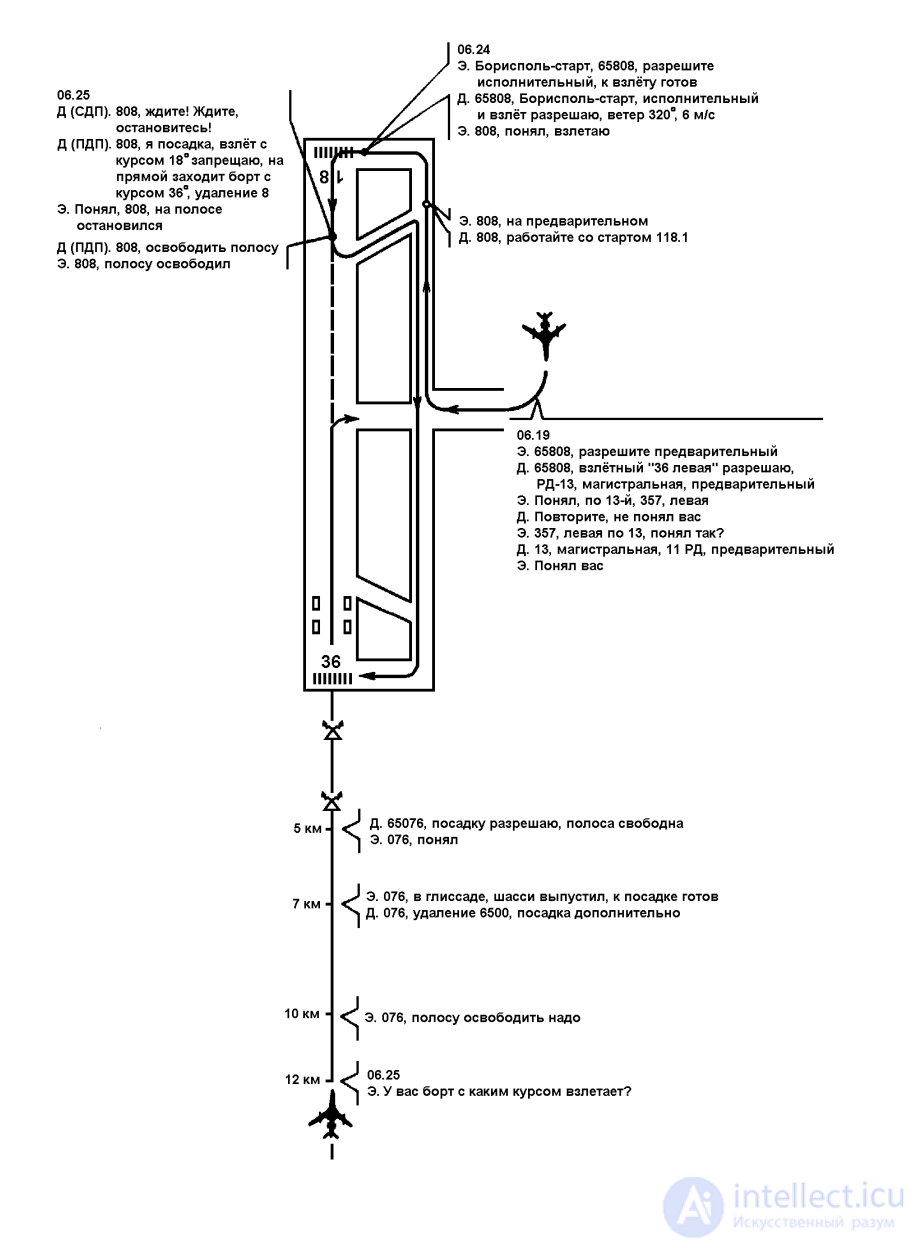
Fig. 13.1. Diagram of the movement of Tu-134 aircraft No. 65808 and the approach of Tu-134 aircraft No. 65076
at Boryspil airport on 9 October 1987
(from: Collection of information..., 1989)
At 06:19 the crew of the Tu-134 aircraft (No. 65808) requested clearance to enter the holding point. Taxi controller N.S. S. cleared it to taxi to the holding point on takeoff
heading 357°, giving the taxi route twice. He subsequently did not monitor the aircraft's movement. The crew of the Tu-134 aircraft (No. 65808), without complying with the taxi controller's instructions, took up the
holding point on the opposite heading - 177°. After the crew reported reaching the
holding point, the taxi controller, without verifying the aircraft's position, transferred it to
the control of the start controller (Collection of information..., 1989).
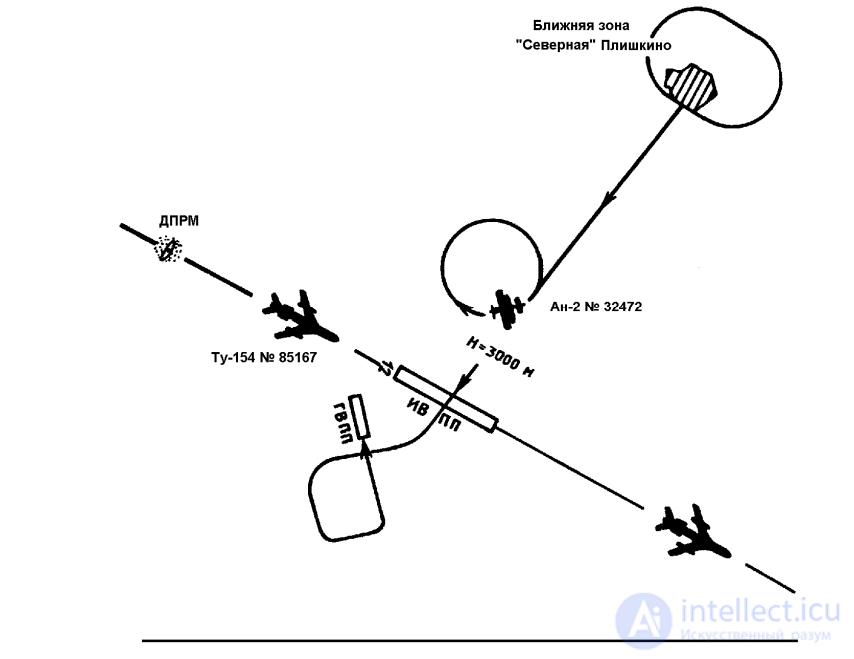
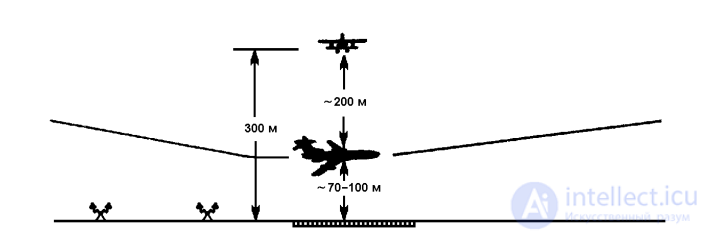
Fig. 13.2. Diagram of the violation of separation in the takeoff and landing area of Irkutsk airport by aircraft
An-2 No. 32472 and Tu-154 No. 85167 on 16 January 1987
(from: Collection of information..., 1989)
At 06:24 the crew of the Tu-134 aircraft (No. 65808) requested the start control point (SDP) controller for
clearance to line up on the runway and take off with a rolling start.
Start controller V.K. D., without determining the aircraft's position and without having received a report
"runway clear" from the auxiliary start controller, cleared it to line up and take off,
even though another Tu-134 aircraft (No. 65076) was on final approach on heading 357°. Auxiliary start controller V.S. A. took no action to prevent the takeoff of the Tu-134 aircraft (No. 65808) on a heading opposite to the landing heading. Only
after a query from the crew of the Tu-134 aircraft (No. 65076): "What heading is that aircraft taking off on?",
did the SDP controller V.K. D. determine that Tu-134 aircraft (No. 65808) was taking off head-on toward Tu-134 aircraft (No. 65076), whereupon he informed it: "808, hold, stop!" The landing control point (PDP) controller intervened: "808, this is Boryspil, landing control, I forbid takeoff on heading 18, an aircraft is on final approach on heading 36, distance 8," and the crew
of the Tu-134 aircraft (No. 65808) rejected the takeoff.
The next example illustrating the problem of violations of operating procedure is the violation of separation rules that occurred at Irkutsk airport on 16 January 1987
(fig. 13.2). At 09:36 DPK controller V.G. P., having received a report from the crew of the An-2 aircraft that it had passed over the settlement of Plishkino (the near holding area before crossing the runway centerline), did not analyze the air situation and cleared the An-2 crew to
descend to an altitude of 450 m over the Ushakovka river. At that time a Tu-154 aircraft, which was flying training circuits, was in the area of the fourth turn for an approach with a go-around. Instead of directing the An-2 aircraft into the holding area, the DPK controller, without determining safe intervals at the moment of crossing the runway, cleared the An-2 crew to continue
its descent and approach (Collection of information..., 1989).
As a result of the violations committed by the controller, at the moment the Tu-154 aircraft passed over
the runway at an altitude of 70 m, the An-2 aircraft was at an altitude of 300 m and a distance from the runway of 3 km. To avoid a dangerous convergence with the Tu-154 aircraft, the An-2 crew independently performed
a right turn, which it reported to the controller.
Let us recall that at this same aerodrome, on 4 November 1974, a collision occurred between an An-2 and an An-12 (chapter 9), and this tragedy, as we can see, taught no lesson. This fact once again
confirms that the overwhelming majority of flight hazards are already known, just as the types of aviation occurrences are known, and so all that remains is to be aware of them so that aviation occurrences are not repeated. Knowledge of aviation occurrences is a unique means of preventing them in the future!
1. Is it possible to achieve full correspondence between the spatial model of the air situation as a mental image and the operating procedure?
2. Identify the similarities and differences between the air traffic controller's and the pilot's conceptions of the air situation.
3. What drives air traffic controllers to knowingly violate operating procedure?
4. What types of interaction within controller shifts contribute to the emergence of abnormal situations and
errors?
5. Are air traffic controllers sufficiently informed about the possible psychological states of pilots?
6. What measures are needed to prevent air traffic controllers from making errors in interacting with aircraft crews?
Часть 1 13 PROBLEMS AND FEATURES OF INTERACTION BETWEEN CREW MEMBERS AND AIR TRAFFIC CONTROLLERS
Часть 2 - 13 PROBLEMS AND FEATURES OF INTERACTION BETWEEN CREW MEMBERS

Comments