
Lecture
Это окончание невероятной информации про .
...
right turn in order to turn away from the obstacle on the takeoff heading and, at the same time, head for a point
entered into the GPS receiver as the start of the route.
After a 60° turn, the aircraft's longitudinal axis was at a 90° angle to the wind
direction. In this position, the aircraft's airspeed differed only slightly from the ground speed recorded by the GPS receiver, at 93 km/h. According to the Certification Center's findings, the stall speed of the aircraft at a weight of 737 kg in the flight configuration is 87 km/h. The Flight Operations Manual gives it as 89 km/h. Converted to the actual weight of the aircraft in this flight, the stall speed works out to 95–97 km/h. To execute a correct
turn without losing altitude requires an additional increase in speed, depending on the bank angle. At a bank angle of 30° and a flight weight of 830 kg, the required speed for safely executing
the maneuver at the given angle of attack should be about 115 km/h. When performing the turn at
a lower speed, an additional increase in wing angle of attack is required to generate the load factor needed for the turn. The turn was performed while climbing, which also required
an increase in lift, and consequently in angle of attack. Given the significant speed deficit,
these pilot actions resulted in the wing reaching angles of attack exceeding the critical value, with the aircraft subsequently stalling. Owing to insufficient altitude margin,
the pilot did not manage to correct the resulting situation, and the aircraft, in a right bank, struck the ground and broke apart (Informatsionny…, 2009, No. 8).
It turned out that on 12 June 2009 the pilot had already carried out a similar takeoff from
Menzelinsk airfield (en route to Urmantau). With all similar weight and speed characteristics and a comparable headwind component, the straight-line segment of speed buildup and climb to 100 m amounted to more than 2,000 m. The fact that the speed parameters during
the takeoff corresponded to the speeds recommended by the Flight Operations Manual indicates that the pilot did not take into account
the effect of the additional weight on the aircraft's flight characteristics. This flight ended
successfully only thanks to the presence of a large obstacle-free zone, which allowed the required speed to be reached without having to perform maneuvers at low altitude and low speed.
The pilot held a commercial pilot license issued on 24 April 2008
by the Tatarstan Department of State Aviation Oversight of the Federal Service for Transport Oversight. The pilot had a total flight time of 460 hours, of which 55 hours were on the Ts-150L aircraft.
The problem of aircraft overloading has repeatedly been addressed in various
publications. In particular, a series of articles by G. Aralov (2001, a, b, v) is devoted to this. G.
Aralov (2001, b) notes that a particularly dramatic situation has developed with Il-76 flights
from China: the rights of Russian airlines are being infringed, crew members are not allowed onto
the weighing platform before the aircraft's departure, which has repeatedly given rise to serious conflicts between crew members and airport personnel. The poor reputation of flights from China is also
due to unscrupulous carriers who, guided solely by the pursuit of maximum
profit, deliberately overload their aircraft. The most striking thing
is that practically all cargo airlines operating flights from
China violate the loading rules for Il-76 aircraft. A technology of systematic aircraft overloading, accompanied by the preparation of falsified documentation, has become established.
One way of counteracting overloading, as G. Aralov (2001, b) notes, is to allow crew members access to the weighing platform. Since access to the platform is forbidden, it is not possible to hold the aircraft commander accountable for an overload. G. Aralov (2001, b) describes a scheme by which excess loading of an aircraft occurs. Airport workers weigh the aircraft and, in order to
absolve themselves of responsibility for the overload, record a weight of no more than 48 tons in the cargo waybill. For
this cargo, standard documents are drawn up and kept on file at the airport. Then a cargo agent, having colluded with the shipper, delivers an additional 5 tons of cargo, which is loaded onto the aircraft. No copies of the cargo waybills for this are kept on file at the airport. One of the means of protection against aircraft overloading has become determining the aircraft's weight immediately before departure. G. Aralov (2001, a) reports on an already fairly well-developed
program abroad for automatic determination of aircraft weight and balance. In
particular, in 1999, an automated weight-and-balance determination system fully meeting ICAO requirements was installed at the airport of the capital of Colombia. The weighing platform is a steel frame with reinforced concrete surfacing, resting on hydrostatic columns. The automated weight-and-balance
determination system includes four weighing platforms for the main landing gear, each with a rated load
of 150 tons, and one platform for the nose gear with a rated load of 50 tons.
The combined system load capacity is 400 tons. The automated system's computer calculates the aircraft's weight and balance, compares the resulting data with the limits contained in the database, displays them on screen, and stores them for further analysis. At the same time,
the aircraft type and registration number, its operator, flight number, runway condition, wind speed, and atmospheric
conditions are displayed on the screen, which makes it possible to calculate the operational limits for a given flight
and to decide on the legitimacy of the departure. The data indicated are transmitted to the air traffic
management and airport security services.
Another measure for preventing overload is the creation of a restraining cage (measuring
3,260 × 3,500 × 16,500 mm) that provides access to all units and emergency-escape
hatches inside the cabin: there is a 350 mm gap between the cage and the fuselage panels.
The cage's structure is designed for an axial load of 6 units (Aralov G., 2001, v).
From everything set out above it follows that there is a persistent failure among crew
members to understand that overloading an aircraft not only can, in itself, lead to
a crash, but also significantly reduces the aircraft's service life – both due to landing gear failure and the appearance of waves on the fuselage skin, and due to the shifting of unsecured cargo
during turbulence or a hard landing, as well as the additional loads on all of the aircraft's structures. An entirely different crew, one that never committed an
overload, may pay for all this with their lives: structural wear from a previous overload can lead to
equipment failure or structural breakup. In order to prevent what has already become a
common practice of overloading aircraft, the special cages mentioned above are created,
limiting the volume of the cargo cabin to an acceptable size. However, here too a number of
airlines choose to bypass the legitimate manufacturers of these cages (design bureaus) –
building their own cages to their own designs, out of materials not intended to withstand the flight loads placed on them.
Of course, if pilots understood just how dangerous overloading is, such special measures in this regard would not be necessary. Pilots time and again try
to develop their own operating procedures, dismissively brushing aside a number of
rules found in the existing governing documents. Besides the fact that pilots behave extremely unprofessionally in this matter (lacking the relevant education, they attempt to
criticize and call into question the operational standards established by design bureaus), they permit themselves, in order to justify their illegal actions, statements
such as: "If they paid properly, no one would take on extra cargo." An even more specific situation arises when a crew is forced to overload an aircraft either by airline management or by semi-criminal structures, who blackmail crew members or threaten members of their families, or threaten the impossibility of further work at the airline.
A detailed analysis of the investigation into the circumstances of the Il-76 crash near
Abakan airport (Khakassia), which was linked to overload, is presented in the work of V.Yu. Voytsekhovskiy and A.V.
Roldugin (1997). This analysis will help to show, even more fully and clearly, that an
overloaded aircraft requires an entirely different approach to handling it, but no one ever taught the crew
this! Whereas the technique for handling an aircraft with a normal load has
been worked out and enshrined in the relevant instructions, no technique for handling an overloaded aircraft
exists, and in this regard the crew has to, by trial
and error, acting in the role of a test pilot (a role which the crew has no right to assume), work out rules for operating under overload conditions. Thus, the crash
occurred in complex weather conditions, at night, on 27 November 1996. Under conditions of restricted
visibility (snow, visibility 2,200 m), while climbing at a distance of 13.4 km, the aircraft struck rising ground at an altitude of 609 m (10 crew members and 13 passengers were killed). As
was found by the investigation commission, the aircraft's collision with the rising ground
became possible for the following reasons.
1. Omissions by Abakan airport officials in observing the established procedures
and rules for organizing flights, expressed in the failure to enter data on obstacles in the "takeoff surface" into the aeronautical information
publications, which prevented the crew from performing the calculations necessary to clear the obstacle, or from taking other measures
to avoid it, and prevented the air traffic controller from preventing the collision. During preparation for the flight, the crew was not briefed by the airport's duty navigator about the obstacles
on the takeoff heading, which should have been taken into account when calculating the maximum takeoff
weight of the aircraft to ensure the required climb-out trajectory.
2. Violations in observing the established procedures and rules for conducting flights, expressed in the crew's failure to maintain the established departure
scheme owing to exceeding the maximum takeoff weight.
3. Omissions in observing the established procedures and rules for air traffic
control at Abakan airport, expressed in the failure to take measures to promptly return the aircraft to its intended track when it deviated from the established departure
scheme.
According to the crew's radio communications at the takeoff hold point, the aircraft's takeoff weight and
center of gravity were 190 tons (maximum takeoff weight) and 30.3% MAC respectively; the same weight was also declared on departure from Ramenskoye airport for Abakan airport. Takeoff was carried out on a magnetic heading of 21° (true heading 26°) at takeoff engine power
(flaps 30°, slats 14° (according to radio communications data), stabilizer trim angle –4°).
The takeoff roll was carried out with the control column deflected "forward." The direction of the roll was maintained
by corresponding pedal deflection to angles not exceeding ⅓ of their full travel. Liftoff from the runway occurred at an indicated airspeed of 296 km/h; the takeoff-roll distance was 2,800 m. The main takeoff parameters are given in Table 11.1.
Table 11.1
Takeoff parameters of the Il-76MD aircraft
(from: Voytsekhovskiy V.Yu., Roldugin A.V., 1997)
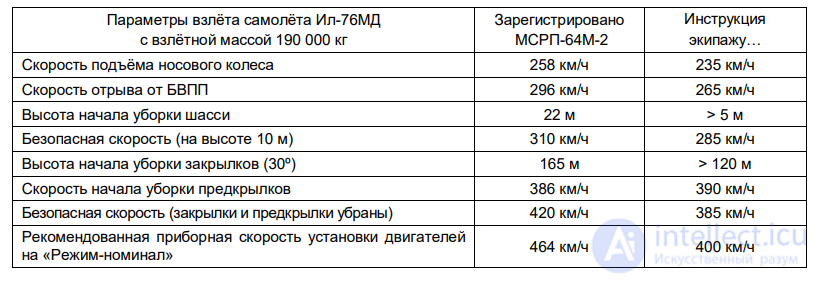
The data in the table indicate that there was a tendency to exceed the indicated speeds recommended by the aircraft's flight crew operating instructions, at practically every stage of the takeoff. 43 seconds after the aircraft's liftoff (at 1 minute 41 seconds of flight), during
the descent over flat terrain, the ground-proximity warning system – GPWS – activated briefly (2.5 s). Following this, the navigator-inspector issued the instructions: "Climb," "Climb, climb." Despite
this, the flight continued with only a slight gain in altitude and an accelerating rate of increase
in indicated airspeed. By the time the high-lift devices were retracted, at an altitude of 185 m, the indicated
speed was 420 km/h (exceeding the safe speed with the high-lift devices retracted by
35 km/h). After the high-lift devices were retracted, until the aircraft's collision with the rising ground, the flight was conducted at takeoff engine power (despite the fact that the indicated airspeed considerably exceeded that recommended for setting the engines to "Rated power").
23 seconds before the recording ceased, while already flying over mountainous terrain, during the
turn onto the departure heading from the airfield, the GPWS activated a second time (for 3.5 s). At that point, the minimum geometric altitude while passing over the top of the high ground
was 10 m. Despite this, no action was taken by the crew to put
the aircraft into a vigorous climb. One second before the aircraft's collision with the
second area of high ground (75 m according to the radio altimeter), a third activation of the GPWS was recorded. Changes in the parameters characterizing the aircraft's handling, and the
radio-communication data, indicate that before the collision with the high ground the crew took no action to
put the aircraft into a climb.
On the basis of the data presented above, it was concluded that, while piloting the aircraft during the takeoff, the crew, focusing mainly on the factor of maximum
takeoff weight, despite the "sluggish" climb, tried to maintain an increase (at an
accelerating rate) in indicated airspeed and, apparently, did not anticipate the presence of an obstacle on the flight path (Voytsekhovskiy V.Yu., Roldugin A.V., 1997). As was established in
the course of the calculations, the aircraft's takeoff weight at Abakan airfield exceeded that at
Ramenskoye airfield (taken as 190 tons) by approximately 8 tons.
Another illustration of the aspect under consideration is the aviation event that occurred on 8 August 2000 with an Il-18 aircraft of the "IRS AERO" airline while flying the route "Nalchik – Sochi – Çorlu." During the loading of the aircraft at Nalchik, the crew
and the airport's ground-service personnel violated the aircraft's loading standards (Informatsionny…, 2000, No. 10).
During preflight preparation, the commander determined a preliminary fuel load of
18,000 kg, given that there were 100 seats on board the aircraft. The customer informed the crew of
the presence of additional passengers, after which the commander made the unjustified decision
to install 22 additional seats and drain 2,000 kg of fuel. The co-pilot passed
the ADP controller false information about there being 130 seats in the passenger cabin, in accordance with which the traffic-handling controller issued documents for 130 passengers. The summary load sheet
and balance chart attached to the flight plan did not correspond
to the actual load and center of gravity. The actual takeoff weight at Nalchik airport was 61,175 kg and did not exceed the maximum permissible value of 61,200 kg, whereas the landing
weight at Sochi airport was 58,175 kg, that is, it exceeded the maximum permissible value
by 6,175 kg. From Sochi airport to Çorlu airport only 122 passengers were sent (matching
the number of seats on the aircraft), and 8 passengers were taken off the flight.
The fourth aspect is that deliberate violations of regulatory documents are provoked
by imperfect regulatory documents, inadequate performance by ground services, and ambiguous instructions from air traffic controllers. To illustrate this aspect, let us examine aviation events associated with landing and taking off below the weather minimum. It should be noted that this group of aviation events is far from uniform, and
the reasons underlying a crew's decision to land below the weather minimum
vary considerably. In these cases, both deliberate and entirely unintentional violation of operating procedures occurs.
The crew of an Il-18 aircraft made a landing at Khanskaya airfield (Maykop, Adygea) on 2
February 2001 in weather below the established minimum for this airfield. Before departure from Ras al-Khaimah airport (United Arab Emirates), the aircraft was fueled with 15,500 kg, which corresponded to a flight time of 5 h 30 min
with a 50 km/h headwind and provided a fuel remainder of 3,000 kg at the decision altitude for Khanskaya
airfield (Informatsionny…, 2001, No. 5). Because the headwind turned out to be stronger than calculated, and because icing occurred and it was not possible to climb to
a higher flight level, the flight time increased to 6 h 15 min. This meant that the fuel reserves at the decision altitude for Khanskaya airfield could not ensure a diversion
to the selected alternate airfields of Baku and Mineralnye Vody. Because of this, the aircraft commander
selected Krasnodar airfield as the alternate. Guided by data on the actual weather at Khanskaya airfield (150 ´ 4,000 m) and the absence of
information on any restrictions at this airfield (according to the preflight information bulletin), the aircraft commander, in agreement with the controller, decided
to descend and carry out a landing. On the leg from the third to the fourth turn, the controller received updated information about the weather conditions and passed it to the crew. The lower
edge of the cloud base turned out to be at a height of 100 m, and the airfield's landing minimum was set at "150 ´ 2,200 m." Despite this information having been received and acknowledged by the crew,
a decision was made to carry out the landing. During the approach, the
crew switched to visual flight, but the aircraft was not in a landing attitude and
the landing was not carried out. Taking into account the limited fuel reserve, as well as uncertainty about favorable weather conditions at the alternate airfield, the crew went
around and successfully landed the aircraft. The investigation commission concluded (Informatsionny…, 2001, No. 5) that the aircraft's landing under conditions below the weather minimum became possible owing to: a) the use of the en-route fuel reserve
because of a strengthening headwind, flight in icing conditions, and flight at a low flight level; b) an inaccurate weather forecast for the airfield; c) the crew's lack, at the time of
flight preparation, of information about the landing-minimum restrictions at Khanskaya airfield. In connection with this event, the investigation commission recommended organizing
round-the-clock transmission of weather information for Khanskaya airfield into the data bank.
Another incident, involving a Tu-134A landing in visibility below the minimum, occurred on 15 February 2001 at Arkhangelsk airport. The minimum for Arkhangelsk airport
on a director-mode approach is defined as "70 ´ 900 m." At Pulkovo airport, during preflight preparation, the aircraft commander, on the basis of information available that the weather at the destination airfield was above minimum, made the decision to depart. As the aircraft
approached Arkhangelsk airport, the approach controller passed the crew the actual weather: "140 ´ 500 m." As visibility improved, the crew was cleared to descend to 1,500 m on a heading for the NDB. This was followed by clearance for an approach
as visibility improved to 1,000 m, and after entering the glide slope – clearance to land. Down to the decision altitude, the flight proceeded without deviations. At a height of about 90 m, the aircraft
commander decided to land, having established reliable visual contact with the
runway. After this, the controller reported that visibility had become worse than the
minimum. In response, the aircraft commander said that he had the runway in sight and had already made the decision to land. The aircraft touched down 23 s after receiving the information about visibility below minimum. The investigation commission noted that this
incident occurred as a result of the crew's failure to go around after the controller's report of a deterioration in visibility below the airfield minimum, received after the decision to land had already been made (in violation of clause 7.6.15 of NPP GA-85). In connection with this, the commission proposed revising this clause with regard to going around after the decision to land has been made at the decision altitude (Informatsionny…, 2001, No. 5).
The situation described is fairly typical. A commander, visually observing the runway and being confident that nothing except the "pointless" observance of the formality of not violating the minimum stands in the way of a successful
landing, perceives information he receives about various obstacles to
carrying out the landing as a mere formality, complaining about the imperfection of the governing documents. Such thoughts arise because readiness to land is already present: when assessing
the probability of a successful landing, it is extremely difficult to abandon a decision already made, to do everything by the book – both out of a desire to land sooner, and out of fear of losing authority in the eyes of other crew members. Of those commanders who invariably fulfill all the requirements of the governing documents and are not inclined toward any kind of
adventurism, many say reproachfully: "Yes, that one certainly won't crash, he's afraid of everything, that's why we fly less than other crews, always waiting; a real pilot is made by
risk and enthusiasm, not pedantry and tedious rule-following."
In some cases, a landing below the established airfield minimum is quite unwittingly provoked by controllers' instructions, which raise the crew's hopes of being able to land. Such an incident occurred with a Yak-40 aircraft while
flying the route "Ramenskoye – Ukhta" on 21 October 2000. At flight level 6,300 m, on entering
Ukhta airport's zone, the weather corresponded to the minimum (visibility 800 m, fog, vertical visibility 70 m). On the leg from the outer to the inner marker beacon, the crew received information about a deterioration in visibility to 700 m (which is below the airfield minimum)
and the controller's instruction to go around, and then to climb to 1,500 m and divert to the
alternate airfield of Pechora. After a further analysis of the weather conditions, the controller imprudently suggested that the crew attempt another approach, during which the controller constantly updated the weather and informed the crew of it. After completing
the third turn, the crew received information that the weather was below minimum and, in response to the controller's question about their decision, reported that they were continuing the approach. After the fourth turn, the crew received data showing a vertical visibility of 50 m, which did not meet the landing minimum, and continued the approach. The controller took no measures to prevent the violation
and cleared a descent to a height of 400 m. Having raised the crew's hopes of a possible improvement in weather conditions, when that improvement failed to materialize, the controller, feeling somewhat guilty himself
(having himself suggested waiting for a possible improvement, and now, with conditions
below the weather minimum, refusing the landing?!), did not oppose the landing below the weather minimum.
Thus, once again, the mundane mechanisms of human communication proved stronger than the strict prohibitions of the governing documents (failing to live up to expectations turned out to be a far
heavier feeling than incurring punishment for violating operating procedures). At
a height of 70 m the crew established visual contact and reported to the controller that they were ready to land. The landing was carried out successfully, at a vertical visibility of 50 m and a runway visual range of 900 m (airfield minimum "60 ´ 800 m"). During the investigation it was found that, in addition to this, the rules of radio-communication phraseology were also violated: the crew did not report reaching the transition level and setting the airfield pressure, and
the approach controller did not require confirmation from the crew that the pressure setting had been made (Informatsionny…, 2001, No. 2).
In a somewhat similar way, events unfolded on 2 May 2006 in the vicinity of Sochi airport. At night, in complex weather conditions, an A320 aircraft of the "Armavia" airline crashed. 50 minutes before entering the Sochi airport zone (21:10:21), the
crew requested the actual weather conditions in the airfield area from the approach controller. The weather conditions were below the airfield minimum – 170 ´ 2,000 m (instead of 170 ´ 2,500 m), but
the commander decided to proceed to the destination airfield. Subsequently (21:16:07), the approach controller once again transmitted weather data to the crew (again below the airfield weather minimum), but on this occasion without indicating the "at times" trend. As the
investigation commission concluded, the inaccuracies made by the approach controller were not
directly related to the cause of the crash, but did influence the crew's initial
decision to return to the airfield of departure. Having decided to return, the crew of the aircraft, at 21:
26:31, once again requested the approach controller for the actual weather at Sochi airport. At 21:
30:49, the controller reported: "Armavia 967, visibility 3,600 meters, lower cloud base
170 meters, over the past 30 minutes. The weather is marginal, but workable." After this report, the crew changed their decision to return to the departure airfield. During the descent and approach
for landing, the crew was continuously informed of the actual weather at Sochi
airport. At 22:03:29, the crew did not report (and the approach controller did not request from the crew) the approach system and mode selected, which is a violation of the operating procedures
of the approach and landing controller. At 22:07:35, on the instruction of the Sochi approach controller, the crew
stopped their descent at a height of 600 m, since the lower cloud base was 160
m. At 22:09:33, the crew was handed off to the final approach controller (the lower cloud base corresponded to the airfield minimum). At 22:10:46, the crew reported ready to land, and the final approach controller passed the crew information on distance 10 km, visibility 4,000 m, lower cloud base 190 m, and cleared them to land. At 22:11:40,
the final approach controller passed the crew the instruction "…stop your descent, cloud base 100 m,
climb right to 600 m," which did not comply with the requirements of the governing documents, but had no direct effect on the outcome of the flight. At 22:13:03, the aircraft
struck the water surface, broke apart, and sank.
There are other cases as well: amid fluctuating weather conditions, the controller asks the aircraft commander: "Weather is at the limit of minimum, your decision?" The commander often responds to this with: "…landing." Within the time allotted to the commander for making the decision, in a situation of uncertainty, he is unable to properly assess the situation. An illustration of this is the landing of a Tu-154 aircraft below the established airfield visibility minimum. The incident occurred on 20 March 2006 at Barnaul airfield.
On approach to Barnaul airfield (23:30), the weather conditions were as follows:
visibility 400 m, fog, visibility along the runway approach lighting 1,000 m, vertical visibility 70 m. Before crossing
the outer marker beacon, the actual weather did not change. At 23:53, the weather observer (during the transition from dark to light time of day) reported to the tower controller: "23:54, visibility 300, runway 450, supercooled fog, vertical 70, 23:54, twilight."
At 23:53, before crossing the decision altitude, the controller, in violation of radio-communication phraseology rules (the phrase "below minimum" was omitted), informed the crew: "Sibir
217, as of 53 minutes past, 450 visible on the runway, lower cloud base 70. Your decision?" 19 seconds later the controller queried the crew again. The crew responded 21 seconds after being informed of the deteriorating weather: "Sibir 217, visual contact established, runway in sight." The crew continued
their descent in violation of NPP GA-85, did not take into account the deterioration in runway visibility during the aircraft's landing at the moment of transition from dark to light time of day, and did not confirm with the controller the values of meteorological visibility and runway visual range.
According to the explanations of the aircraft commander, the crew understood the controller's message
as an improvement in the weather from 400 to 450 m, taking into account only the meteorological visibility value.
Violation of the weather minimum also occurs during takeoff. Thus, the crew of an
A-310 F-OGYQ aircraft of the "Aeroflot – Russian International Airlines" airline, on 24 October 2000, carried out a takeoff in violation of the airfield's visibility minimum. During
preparation for the flight and while taxiing, the weather corresponded to the takeoff minimum. At the takeoff-hold point, the crew received information about a deterioration in visibility to 150 m. At
this point, the crew mistakenly took the visibility value for category "B" as being for category "C" and
"D," an error encouraged by the controller's remark that an aircraft was following behind them for takeoff with a minimum of
150 m. The crew reported to the controller their minimum of 150 m and, with the controller's permission, carried out
the takeoff, which constituted a violation, since at Sheremetyevo airport the takeoff minimum for aircraft of the "Aeroflot – Russian International Airlines" airline is 200 m.
The investigation commission noted the existence of various documents, their differing interpretation and application by the airport's air traffic control service when assessing
the takeoff minimum for the same aircraft types belonging to foreign
and Russian airlines. For foreign airlines, ATC is guided by
the AIP, according to which an aircraft's takeoff is not restricted by weather conditions. At the
same time, for the same aircraft types of the Russian Federation, two documents apply: NPP GA-85 and the "Technology of Work of ATC Controllers," which restrict aircraft takeoffs based on the
minimum.
The fifth aspect is that, after unintentional or deliberate violations of regulatory
documents, crew members deliberately attempt to conceal information about the violations committed. Let us first analyze an aviation event involving a Yak-40 aircraft that occurred
on 9 February 2008 at Bugulma airport, which most vividly illustrates the aspect
in question.
The crew was flying the route "Kazan – Bugulma." The aircraft's
touchdown occurred on the main landing gear within the landing markers at a speed of ~230
km/h, followed by a hard drop of the nose gear and its separation from the runway, the cause of which was the crew's failure to maintain the specified parameters and flight regimes during landing (Informatsionny…, 2008, No. 4). The commander decided to go around. The repeat approach and landing were carried out successfully.
After landing, the flight engineer wrote in the aircraft's logbook: "No comments," but after discovering, during the post-flight inspection, the absence of the pin under the retracted-position lock hook
of the nose gear, he crossed out this entry and, at the insistence of the aviation technician, who was refusing to
accept the aircraft, made a different entry: "Retracted-position bracket on the
nose-gear fork broken off." On inspecting the nose-gear well, corrugations in the panel skin up to 4 mm high were found between frames 6–7 and 7–8 on beams TO-150-OOA-1 and TO-150-OOA-2.
It was not possible to determine the load factor at landing, since the flight data recorder tape drive continued operating for 119 minutes after landing, erasing the recorded
flight parameters. The investigation commission sent a request to the A.S. Yakovlev
Design Bureau regarding the load factor and the causes of the damage sustained on this flight. The design bureau's reply was as follows: "Contact between the bracket with the
pin for the retracted-position lock hook of the nose gear and the runway concrete, with destruction of
the bracket, is possible only in the event of a hard landing, a 'porpoising' bounce onto the nose gear, with the nose shock strut and
tire fully compressed, and with the main gear separated from the runway. It is not possible to determine the exact value of the load factor from the results of measuring the deformation in the area where the nose gear is attached, but it is certain that it exceeds the design value."
The investigation commission concluded (Informatsionny…, 2008, No. 4) that the absence
of recorded flight parameters on the flight data recorder was caused by deliberate actions on the part of crew members and
the avionics technician, aimed at concealing the hard landing of the aircraft.
Thus, it is far more advantageous to report a violation that has occurred than
to conceal it: had the crew not tried to conceal the hard landing, they would have been sent for
retraining to prevent similar landings in future, whereas in the case of concealment, an entirely different level of liability applies – liability for criminal conspiracy. It turns out – the event is the same, yet the liability in the case of reporting and in the case of concealment is entirely different!
Unfortunately, the case described above is not an isolated one, and it is very important that every crew
member becomes aware not only of their responsibility to themselves, but also to those who
will be operating damaged equipment in the event that the aircraft's departure beyond
operational limits is concealed. In this connection, let us consider one more aviation event. At night,
during an interception in clouds, a fighter pilot very vigorously corrected his aircraft's heading onto the target,
after which he lost spatial orientation. Speed rapidly increased, altitude decreased sharply. After breaking out of the clouds, stars appeared overhead – at that moment
the pilot realized that the fighter was in an inverted position, and that what he had taken for
stars were the lights of populated areas. He rolled the aircraft out of the bank, and then pulled
the control stick toward himself with such force that, from the resulting load factor, his vision briefly darkened – a "black veil." The fighter pulled out of the dive so low (at an altitude of 100 m) that
the pilot felt an urge to draw up his legs, since it seemed that at any moment they would catch on the trees and buildings
beneath the aircraft. After landing the pilot looked at the accelerometer (from Lat.
accelerare – to accelerate + Gr. metreo – I measure): the instrument's needle had pegged at the stop, indicating
that the load factor had exceeded 10 g, which was subsequently confirmed when he analyzed the SARPP recording
(SARPP – automatic flight-parameter recording system) of the
flight (Ivanov G., 1982).
After landing, the pilot was torn by conflicting thoughts: whether to report what had happened or
not. Toward the first option he was pushed by a fairly pronounced sense of conscience and a feeling of responsibility for the life of the pilot who would take his place in the cockpit of the aircraft on which he had created
a load factor exceeding 10 g. Toward the second he was pushed by: the desire to avoid a debriefing procedure that would be shameful for him (particularly hard for him, as an instructor, was the thought of the presence at the debriefing of
young pilots), and the desire to keep his leadership position (deputy
regiment commander). With these thoughts in his head, he went to the laboratory of the objective-control group, deciding to analyze the SARPP recording of his flight. The recorded flight
parameters showed: the pilot had corrected his aircraft's heading onto the target, switched his attention to the sight, while continuing to increase the bank angle with the control stick, until it reached 120°. Then the fighter, having previously been climbing, began to descend. The pilot then took the aircraft
into a steep spiral. To get out of this position, he created the load factor mentioned above (Ivanov G., 1982).
The pilot stole the analyzed recording from the laboratory. His conflicting thoughts
continued to further unsettle him: added to them were feelings connected with yet another dishonorable act – the theft of the flight-parameter recording. At times the pilot was on the verge of confessing everything,
and at other times he again suppressed such thoughts. But then another pilot took his place in the cockpit
of that same aircraft on which the load factor of over 10 g had been exceeded. Before taxiing out, the
engine was tested at various power settings. At maximum power, the technician noticed barely
visible traces of fuel leaking on the wing. The aircraft's takeoff was postponed. Engineers and technicians carried out a thorough inspection of the aircraft and discovered a crack in the wing spar. The next morning
the regiment commander summoned his deputy and, with difficulty maintaining a calm tone, asked: "Where's
the SARPP recording?" The pilot took the tape out of his pocket and told him everything, exactly as it had happened.
Now put yourself in this pilot's place. Would you have been able to work in this collective after what happened, would you have been able to look in the eye that other pilot, who had come so close to
taking off in a damaged aircraft, or those specialists of the objective-control group, from whom a tape recording of flight parameters had been stolen, or those subordinates whom he would still have to prepare for the performance of demanding and responsible tasks? It is clear that, in such a situation, self-respect
can no longer be recovered, and no one will have any need of his remorse.
A second illustration of the aspect under consideration is the behavior of crew members following a serious incident that occurred on 21 January 2001 involving an An-24 aircraft
on landing at Surgut airport. A hard landing of the aircraft occurred. No entry
regarding this was made by the crew in the onboard documentation, and it was not reported to the command staff (Informatsionny…, 2001, No. 6). Active piloting down to the decision altitude was carried out by the co-pilot; the landing, with flaps deployed to
30°, was carried out by the aircraft commander. From a height of 20 m at an indicated airspeed of 220 km/h,
the vertical rate of descent was increased to 4.5 m/s, and at a height of 10 m it was 5 m/s.
From this height the crew began the flare, setting the engines to idle power (according to the Flight Operations Manual
this setting is made at the end of the flare, at a height of 0.5–1 m). Inadequate elevator control actions resulted in the vertical speed being reduced only to 3.4 m/s. Without completing the flare maneuver, at a vertical speed of 3.28 m/s, the aircraft's wheels
struck the runway. The maximum load factor was 3.43 g. After this incident, the crew "calmly," in gross disregard of flight-safety norms and rules, carried out another 10 flights!
The investigation commission established that the clearance of the co-pilot and flight engineer to fly had been carried out in violation of the governing documents, and that the crew
had been formed with deviations from what was prescribed.
The crew of an An-24 aircraft at Beloyarskiy airport on 29 March 2001 likewise did not report a hard
landing. The vertical load factor at the first touchdown
was 2.84 g, and at the second – 1.65 g (Informatsionny…, 2001, No. 10). After the engines were shut down, the flight engineer reported that he had recorded a high load factor, after which
the aircraft commander decided to continue the flight, and upon arrival at the home base of Tyumen did not require an entry to be made in the logbook regarding the hard landing!
The crew of an An-74 aircraft, while flying the route "Komsomolsk-on-Amur – Keperveyem," on
6 and 9 April 2001, exceeded the maximum permissible takeoff weight (by
1,120 and 3,991 kg respectively). The crew concealed the violations they had committed and falsified the flight documentation (Informatsionny…, 2001, No. 6).
On 11 March 1999, the crew of a Tu-134A performing a regular passenger flight on
the route "Chelyabinsk – Domodedovo" committed a whole series of violations of operating procedures and,
under pressure from the aircraft commander, concealed this information from the flight command
staff, without recording the violations that had occurred in the logbook. On approach for landing, the aircraft commander, at excessive speeds, essentially in automatic
mode, having information from the controller about another aircraft ahead making an approach to land,
after the fourth turn (at a height of 400 m), became confused and, without warning the other
crew members, with the autopilot engaged, with the landing gear extended and the flaps deployed to 20°, and the stabilizer set to a position of –2.5°, made the decision and began
a go-around. During the repeat approach for landing, the crew committed a whole
host of violations of flight limitations (the maximum permissible circuit speed,
the procedure for stabilizer trim changes, and flap retraction). No entry regarding the violations was made in the logbook,
and no work was carried out to determine the aircraft's technical condition or the possibility of its continued operation. The commander persuaded the co-pilot and
the flight engineer "not to make a fuss," after which the crew flew this aircraft on to Chelyabinsk. All the violations were uncovered during the decoding of flight-data recording equipment at
Chelyabinsk airport on 20 March 1999. Between 11 and 20 March, this aircraft
had made 17 flights (carrying 893 passengers, with 131 crew members involved in these flights, counted across all crews)!
In conclusion, let us note the following. However advantageous a violation may seem (overload, under-fueling for the sake of economy, cutting corners on the route, etc.), refraining from violation, even despite certain penalties
(for example, from management for excessive spending, or for expressing disagreement with management), is always more advantageous, since
these penalties bear no comparison whatsoever to the emergency and catastrophic
situations that have resulted from violations that seemed acceptable at the time (Evstigneev
D.A., Kopysov V.Kh., 2007).
In order to become fully imbued with this conclusion, to understand the extreme danger of deliberate violations, let us recall the circumstances we analyzed of the Il-62 accident
and try to imagine how events might have unfolded had one of the crew members of that
aircraft expressed disagreement with the actions of the commander-general director before the accident.
It is known that one of the crew members said after the accident that he now knows the price of safety and will never again dare to fly with someone he does not trust. But before the accident, this person already had this information; he knew what kind of aircraft commander
he was dealing with. The only thing missing was the aircraft engulfed in flames. Let us nevertheless return to
what would have happened if one of the crew members had dared to voice disagreement with the ill-fated commander. Surely, this person would have had a very difficult time: at the very least, this would have meant the creation of unbearable working conditions, and at worst – dismissal. In either case,
the person would have reproached himself for his honesty and for expressing justified disagreement with the unprofessional actions of the commander. But if he had compared this situation with
what he had to experience on 22 October 2002, he would have chosen the first situation,
never the second. Thus, more often than not, we do not even suspect how many
times we have saved ourselves from tragic events. Indeed, how could one suspect this,
1
if the tragedy never happened. However difficult it may be for us to make a decision in one conflict situation or another (meaning an intrapersonal conflict, involving the coexistence of mutually exclusive needs – "to speak – not to speak," "to act – not to act"), it is necessary to calculate the severity of the consequences of each of the decisions we might make,
that is, it is necessary to foresee what has not yet happened. In drawing up an accurate forecast, we
can be helped by strict adherence to regulatory documents and knowledge of the consequences of their violation, as expressed in aviation events throughout the entire history of aviation.
1. By what means can deliberate violations of operating procedures be prevented?
2. Which of the five aspects of the problem of deliberate violations of regulatory documents in aviation examined here seems to you the most dangerous and hardest to eradicate?
3. Are there precedents for solving the problem of deliberate violations, and if so, thanks to what measures did an airline manage to achieve such results?
4. What specific information do aviation specialists lack in order to understand the full danger of deliberate violations of operating procedures?
Часть 1 11 DELIBERATE VIOLATIONS OF REGULATORY DOCUMENTS IN AVIATION
Часть 2 - 11 DELIBERATE VIOLATIONS OF REGULATORY DOCUMENTS IN AVIATION

Comments