
Lecture
Это продолжение увлекательной статьи про .
...
created), the
less time he will spend on deliberative thinking and, correspondingly, the less likely he is to depart from the sequence of actions specified by the standard operating procedure);
3) due to performing actions not characteristic of the specific flight phase.
The presence of unauthorized persons in the cockpit as a cause of poor crew teamwork
manifested itself very vividly on March 22, 1994, on the flight "Moscow – Hong Kong." During the flight, the children of one of the pilots came into the cockpit, and he allowed them to sit at his
station. First the pilot's daughter took the pilot's seat, then his son took the seat. The son spent a long time applying force to the control column, as a result of which the autopilot partially disengaged (in the aileron/bank control channel), a peculiarity of the Airbus 310 that had not been known before this event. The pilots lost time trying to understand what
had happened – "since they believed the aircraft was entirely under the control of the autopilot." The time lost resulted in an inability to prevent the aircraft's crash. The aircraft crashed 91 km from Novokuznetsk; 75 people died in the crash (Analysis..., 1995).
When examining various types of deliberate violations of operating procedures as a factor contributing to poor teamwork, it should be remembered that such violations, as a rule, are combined with a whole range of other violations, thereby introducing even
greater uncertainty into the situation and reducing the likelihood of a favorable outcome. The absence
of an established and rehearsed course of action under conditions of deliberate violation of
regulatory documents has repeatedly been the cause of serious aviation events. An aviation event that shows the full severity of the consequences of deliberate violations of regulatory documents is the crash of a Tu-134A that occurred
on August 27, 1992, near Ivanovo airport. Gross violations of operating procedures
occurred both on the part of the crew members and on the part of the air traffic control
service.
At a distance of about 75 km from Ivanovo (at an altitude of 6,000 m) the crew switched to the approach controller, reporting their distance, altitude, and alternate airport. The approach
controller informed the crew of the active landing heading, 292°, of departmental aviation operations in the Sinaya Osoka area, and cleared them to descend to 1,800 m by Lezhnevo. The altitude
for reaching the Lezhnevo turning point was set at 1,500 m, but because departmental aviation was operating at altitudes up to 1,500 m, the approach controller cleared descent
only to 1,800 m. The crew acknowledged the information received and requested activation of the short-range radio navigation system (RSBN). As it turned out, the approach controller forgot to
switch on the RSBN 30 minutes before the estimated landing time and instructed the ERTOS
(radio equipment and communications operations) technician to switch on the said
system only after the crew's request. An experiment conducted by the investigation commission showed that 3 minutes 48 seconds elapse from the moment the RSBN is switched on to the start of its stable
operation. As a result, the crew could only receive information from the RSBN starting at a distance of 20–
25 km. It is notable that the flight operations supervisor did not monitor the approach controller's work and did not correct the errors he made (Boltachev V.Yu., Kharikov A.A.,
Shcherbakov L.K., 1995b).
Analysis of the aircraft's flight path showed that after passing the "Suzan" handoff point, the Tu-134 gradually deviated to the right of the established corridor (4 km wide) and, at a distance of 57 km from Ivanovo, flew outside the airway.
The crew's navigator detected the deviation and informed the captain of the need to
turn left to regain Lezhnevo, but the aircraft continued to drift to the right. This
indicates that the captain deliberately allowed a deviation from the flight pattern in order to
shortcut the route, seeking to bring the aircraft directly to the point of the fourth turn. The approach controller failed to comply with the requirements of NPP GA-85 regarding monitoring
the crew's adherence to the assigned flight path, and with the approach controller's operating procedures regarding passing the crew position information while flying in the airport area.
At 22:39:20, at a distance of 28 km, the crew reported to the controller that they had reached
1,800 m. In fact, at that moment the altitude was about 2,000 m. The controller
confirmed the distance and instructed them to maintain 1,800 m until further notice. At 22:39:
40 the controller informed the crew of a distance of 25 km, cleared them to descend to
1,500 m, and handed the crew off to the landing controller. After switching to the landing controller, the first officer took over the radio communications. Upon making contact, the crew reported
descending to 1,500 m and requested a localizer/glideslope approach in director mode.
The controller cleared them to descend to 500 m by the fourth turn. The crew began the descent while simultaneously turning right to a heading of about 20°. By this point the aircraft
was abeam Lezhnevo with a lateral deviation of 9 km from the airway centerline (5 km from its boundary). At 22:40 the aircraft reached the transition altitude (1,200 m) and was leveled off. At this time the aircraft was approximately three kilometers from the airport traffic pattern, in the area of the third turn. The flight altitude was 1,200 m (instead of 500 m), speed – 450 km/h (instead of 400 km/h), the wing high-lift devices and landing gear were not extended, the stabilizer
– in the cruise position (Boltachev V.Yu., Kharikov A.A., Shcherbakov L.K., 1995b).
The landing gear was extended at a speed of 410 km/h in the area of the fourth turn, which
is a violation of the Tu-134's flight manual. During the fourth turn
the controller passed the crew information on distance, 10 km, without reporting the amount of
lateral deviation, which was 1,700 m, a violation of operating procedure. The aircraft came out of the fourth turn with flaps retracted and the stabilizer in the
cruise position, at a distance of 8,600 m, an altitude of 500 m, with an indicated airspeed and
vertical speed of 390 km/h and 10 m/s respectively. Despite not being in a landing configuration, the crew continued the approach under severe time pressure caused by the need to perform, almost simultaneously, the operations of: – rolling out onto the landing heading; – capturing the glideslope; – reducing the indicated airspeed; –
extending the flaps to the landing position; – repositioning the stabilizer.
Crew interaction turned out to be completely broken down. In practice, only the captain was flying the aircraft, and he was not taking in information coming
from the other crew members. After coming out of the turn, the navigator suggested to the captain that the flaps be extended to 20°, and the first officer suggested repositioning the stabilizer, but the captain did not respond,
trying instead to roll out onto the landing heading. The rollout maneuver was performed with a left bank of up to 20°. The rate of descent was first reduced to 6–7 m/s, then again
increased to 12 m/s. The aircraft approached the glideslope from above, at an altitude of 320 m and with a
lateral deviation of 1,400 m.
At an altitude of 350 m, because of the high rate of descent, the ground proximity warning system (GPWS) activated, but the crew did not respond to it, nor to
its subsequent activations.
Immediately after the first activation of the warning, the captain, rolling the aircraft out of its left
bank, gave the command to reposition the stabilizer to 2.5°, which was carried out
by the first officer in a single (!) step, whereas according to the flight manual repositioning the stabilizer from cruise to landing position is to be done in three steps (Boltachev V.Yu., Kharikov A.A., Shcherbakov L.K., 1995b).
At the moment the stabilizer was repositioned, the aircraft was 1,000 m to the right of the localizer course, at
a distance of 6.3 km from the runway threshold, at an altitude of 270 m, with an indicated airspeed and vertical
speed of 385 km/h and 8 m/s respectively. As a result of repositioning the stabilizer in
a single step, an abrupt rebalancing of the aircraft occurred (a load factor of
1.35 was realized). In the process the aircraft transitioned from descent into a climb with a vertical speed of 6
m/s and a decrease in indicated airspeed to 350 km/h. To correct the altered parameters the captain pushed the control column forward (the elevator moved from –8° to
6°) and held it in this position for about 7 s (a load factor of 0.7 was realized). The aircraft
again entered a descent with a vertical speed of 10 m/s, causing the GPWS
to activate again.
At a distance of 4,500 m the aircraft had a lateral deviation of 200–300 m, an angular deviation of 30°, and an altitude of 200 m. To roll out onto the landing heading, the captain began a right turn with a bank of up to 35°. The turn was performed uncoordinated, without maintaining the required vertical load factor, as a result of which the rate of descent increased to 15–16 m/s. The outer marker was crossed during the turn at an altitude of 170 m (210 m per the published procedure) with an indicated airspeed and vertical speed of 360 km/h and 12 m/s respectively. The aircraft was to the left of the landing
heading by 40 m and below the glideslope by 40 m. The navigator reported to the crew: "Crossing the outer marker" (Table 10.1).
At an altitude of 120–110 m the captain began rolling the aircraft out of its bank, taking practically no measures to reduce the rate of descent (the left lateral deviation was 130
m). At an altitude of about 80 m the navigator made a final attempt to convince the captain of the need to go around. 2 seconds after this (at an altitude of 70–60 m) the control column was
sharply pulled back (the elevator moved to 10° nose-up within 0.5 s). Such a rate of
movement could only have been caused by an attempt to avoid colliding with an obstacle,
which the crew had evidently spotted visually. This reduced the rate of descent to 6 m/s, but
the lack of altitude margin made it impossible to prevent a collision with trees at an altitude of 20–26 m. On striking the trees,
the right wing began to break apart, as a result of which the aircraft flipped over and, after 512
m, struck the ground at a distance of 2,450 m from the runway threshold. Everyone on board
the aircraft (77 passengers and 7 crew members) died (Boltachev V.Yu., Kharikov A.A., Shcherbakov L.K., 1995b).
During the investigation of the crash, an engineering-psychological assessment was carried out of the
crew members' state and actions. A review of the crew members' professional qualities and work experience
revealed that the first officer, navigator, and flight engineer were, at the time of the accident, still at the stage of developing their professional skills and had very little
flight time on the Tu-134 (111, 336, and 193 hours respectively). By contrast, the captain was a
highly experienced pilot: total flight time – 14,000 h, on the Tu-134 – more than 2,000 h. Interviews with flight
personnel who knew the captain well (or had flown with him before) showed that the captain was
characterized by authoritarianism in his judgments, as well as an inflated level of aspiration,
which was particularly evident in his relationships with less professionally experienced crew members. These traits were mitigated in cases when flights were carried out
with a crew whose members' professional competence gave the captain no cause for doubt (Boltachev V.Yu., Kharikov A.A., Shcherbakov L.K., 1995b).
Table 10.1
Excerpt from the tape recording of the conversations of the crew members
of Tu-134A No. 65058, recorded by the onboard MS-61 flight recorder,
and of the crew's radio communications with the Ivanovo airport controllers,
recorded by the controller's tape recorder
(according to: Boltachev V.Yu., Kharikov A.A., Shcherbakov L.K., 1995b)
V.Yu., Kharikov A.A., Shcherbakov L.K., 1995b):
| Time | Speaker | Message text |
|---|---|---|
| 22:39:51 | First officer | Ivanovo Landing, 65058. Descending to 1,500, have the information, 744, director approach |
| 22:39:57 | Controller | 65058, Landing, approach cleared, transition 1,200, pressure 744, descend to the fourth turn, 500 |
| 22:40:05 | First officer | 058, transition altitude 1,200, 500, at 744 |
| 22:40:11 | Navigator | Take up heading 20 |
| 22:40:44 | Captain | Transition altitude, level off. Set it |
| 22:43:00 | Captain | Stabilizer 2.5 |
| 22:43:02 | First officer | 2.5 |
| 22:43:04 | Captain | And everyone's just sitting there... [swearing]... it's already 300 meters! |
| 22:43:07 | Navigator | Right, we're already on the glideslope. Nothing's been extended. Let's go around, Nikolaich |
| 22:43:14 | Navigator | We'll make a circuit – that's all |
| 22:43:23 | Navigator | Crossing the outer marker |
| 22:43:25 | Controller | 058, outer marker |
| 22:43:28 | ― | (intercom button press) |
| 22:43:29 | Navigator | Go around, Nikolaich! |
| 22:43:31 | ― | End of MS-61 recording |
As the authors note, these traits of the captain's were known within the airline, and with a proper approach to crew scheduling, the crew should
have included specialists close to the captain in age and flying experience – so as
to "neutralize" his authoritarian behavioral style. The need for heightened diligence in crew scheduling was also dictated by the fact that the captain's past flying record indicated the possibility of him making incorrect and unjustified decisions under more difficult conditions. In 1991, while landing in
hazy conditions, the captain made an incorrect decision to use the landing lights during the flare. When a light-reflection screen effect appeared, he incorrectly assessed the cause of the reduced visibility and made a second erroneous decision – he switched on the windshield wipers. While
performing this action in close proximity to the ground, the captain became distracted from flying, as a result of which the aircraft touched down on the shoulder of the runway (Boltachev V.Yu., Kharikov A.A., Shcherbakov L.K., 1995b).
In the view of V.Yu. Boltachev, A.A. Kharikov, and L.K. Shcherbakov (1995b), staffing
the crew with individuals of limited professional experience and a lower level of aspiration, in
combination with the captain's authoritarian leadership style, resulted in the captain
becoming the crew's sole leader, making decisions unilaterally and not trusting
the other crew members. Moreover, the deterioration of relationships among crew members
during the flight was, in all likelihood, further aggravated by errors made by the first officer and navigator during an approach at Mineralnye Vody airport. The remarks made by the captain to the first officer and navigator may have been the decisive factor that determined the style of subsequent behavior within the crew.
As it turned out, the crew's behavior was determined not only by the relationships between
the people making it up, but also by the atmosphere that had developed at the airline over the preceding years. Serious shortcomings were identified relating to the organization of monitoring
of crews' compliance with flight rules using flight data recorder information.
This work had been organized unsatisfactorily at the Ivanovo airline. At the
time of the inspection, not a single one of the flight-data processing tools available at the airline was in working order! Over the five years preceding the crash, a decline was found in the number of flights that had been checked. Thus, in 1991
40% of flights on Tu-134 aircraft and 14% on An-24 aircraft were checked. Even
in the flights that were checked, the checking was formal in nature. Recording of identified
deviations was carried out unsatisfactorily. Thus, in 1992 the flight squadron received no information about a single case of a flight being performed with violations. This state of affairs
created an atmosphere of lack of oversight and impunity among flight personnel, which bears direct relevance to the crash near Ivanovo (Boltachev V.Yu., Kharikov A.A., Shcherbakov
L.K., 1995b).
A study conducted by A.I. Onufrash (1981a) of the individual psychological characteristics of pilots who made errors or violated flight rules made it possible to identify the following patterns. Negative personality traits were the cause of erroneous actions in 63.8% of cases. The most characteristic psychological shortcomings were: excessive self-confidence, overestimation of one's own
professional capabilities, and a lack of self-criticism. In addition, the author (Onufrash A.I., 1981a)
places in this same group attention disorders, absentmindedness, and an inflated level of aspiration (with, as a consequence, stubbornness and conceit).
To study the connection between pilots' psychophysiological characteristics and the nature of their erroneous actions, a comparative assessment was made of certain psychophysiological qualities, abilities to interact under difficult flight conditions, and pilots' erroneous actions. Based on assessments given by squadron commanders, pilots in each group were ranked
according to rank. Pilots were ranked according to each mental function (attention,
switching of attention, thinking when identifying patterns, thinking when composing sentences, overall memory capacity, memory capacity with correct placement
of objects, thinking when reading compass indications), the values of which
were obtained through experimental psychological testing.
As a rule, there was a match between the assessments of interaction abilities and the levels
of pilots' mental functions. A more pronounced correspondence between interaction abilities and mental functions was found in the group of MVS GA pilots, when interference was used during the psychological study (Onufrash A.I., 1981a). The
pattern discovered is presented in Table 10.2.
As an illustration of how a first officer can positively influence the outcome
of a flight in the event of the captain's inadequate perception of the flight situation, consider the event
involving an ATR-42. The approach at "Tolmachevo" airport (Novosibirsk) was performed
during the day in good weather conditions to runway 25 (landing heading 252°). The surface wind was unsteady. During the descent, the controller informed the crew of a change in the landing heading – to
heading 72° (the reciprocal of the landing heading – an approach to runway 07). An approach to runway 07 was used
rarely (due to the proximity of flight-restricted areas to the approach pattern) and, as a result,
was unfamiliar to the crew. The aircraft's captain was actively flying, while monitoring and radio communication were handled by the first officer. The report of the change in landing heading came from the controller when the aircraft was passing through 2,700 m. The crew had to reset the course selectors, the frequencies of the marker beacons and ILS, the approach procedure in the FMS (flight
management system, which uses GPS data), and look up the approach charts in the aeronautical information publication.
Table 10.2
Comparative data on the percentage distribution of pilots in the "best" and
"worst" groups by psychological qualities and by ability to interact
(quality of professional performance under difficult flight conditions)
(according to: Onufrash A.I., 1981a)
Names of groups by ability to interact
(quality of professional performance)

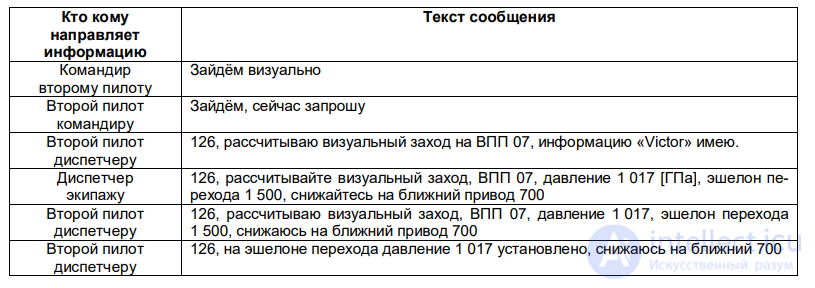
The captain suggested to the first officer that they perform a visual approach (Table
10.3). During the descent, all systems were reconfigured for an approach to runway 07. The change in landing heading required an increase in the rate of descent, but even this increase did not allow the required altitude to be reached by the reference point – a distance of
5 km (from this distance the visual maneuvering zone begins, by the start of which an altitude of 700 m must be reached).
50
Table 10.3
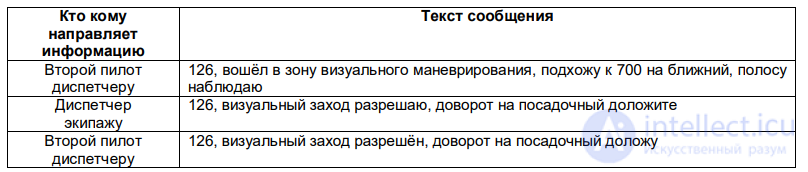
During the descent to an altitude of 700 meters the crew established visual contact with runway 07, which the first officer reported to the controller (Table 10.4).
Table 10.4
Rollout onto the landing heading was carried out significantly higher and closer to the runway than required, the speed was high (around 200 knots), and the high-lift devices had not been extended (the high-lift devices should have been set to an intermediate position –
flaps at 15°) upon entering the visual maneuvering zone. The approach was not stabilized.
The first officer understood that the approach was extremely unsafe, but the captain wanted to
complete the landing no matter what (Table 10.5). The first officer insisted on going around
and, to end the argument that had arisen, contacted the air traffic controller, announcing over the air that they were going around. The captain had no choice but to comply and carry out the only correct decision – to go around. The approach taken by the first officer to influence the captain (presenting him with a fait accompli – pressure via
"putting it on tape") proved to be an entirely correct way of resolving the conflict
situation. It must be said that a very large number of aviation events connected with crew members ignoring one another could have been avoided if this method had been used by one of them. Fortunately, many people, through their own experience of struggling with colleagues, do eventually arrive
at similar conclusions and successfully use this method.
Table 10.5
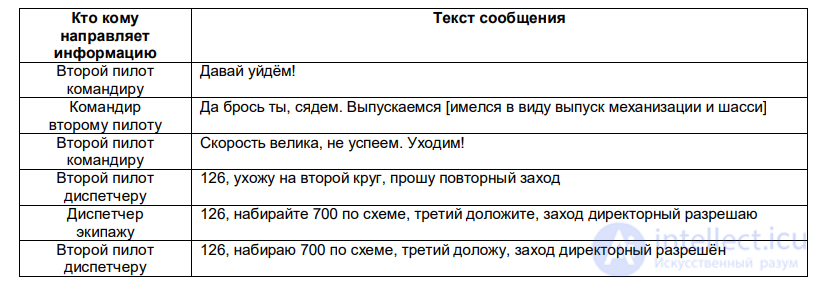
The captain of the ATR-42 was extremely displeased by the initiative shown by the first officer. The crew carried out a repeat approach and landed safely. While taxiing to
the stand, the captain admitted that the first officer's decision had been correct and timely!
All the other aviation events connected with deliberate violations of regulatory documents in aviation are examined in Chapter 11.
Let us now turn to the second section of the chapter – the problem of incompatibility
among crew members – the last of the causes of poor teamwork we identified. Cases of incompatibility include everything connected with one crew member's personal inability to tolerate another crew member for various reasons (the non-satisfaction of various needs).
Incompatibility and conflicts can be caused by various reasons. In discussing
compatibility and crew scheduling, one should remember that compatibility is not
something rigid, given once and for all (Evstigneev D.A., Kopysov V.Kh., 2007):
first, for a certain period of time people may be compatible, but after
certain events, after each person's characteristics become clearer to the other, they may move out of the category of compatible into an entirely different state, into different principles of interaction, sometimes
leading to the breakdown of relationships and the accumulation of hostility toward one another;
second, compatibility is a probabilistic category, encompassing some limited
set of a person's characteristics on which he suits another
person, is compatible with him, but as soon as one steps outside this set and examines other characteristics, uncovering them, it may turn out that these people are not only incompatible, but actively hostile toward one another. Sometimes a mismatch in even a single characteristic will
prevent a person from interacting normally with another;
third, compatibility is not so much a set of qualities that determines smooth relations with another person, as it is constant, everyday work on oneself.
When forming a crew, the main effort should be directed at preventing clear cases of incompatibility. All other cases (without overt confrontation), whatever their combination, will not
have as strong an effect on the ultimate outcome of the interaction. A final assessment of the phenomenon of compatibility is given in the conclusion to Chapter 14.
The first example of incompatibility among crew members is the incident involving the landing of an Il-76 at an airport not planned for in the flight assignment, on June 24, 1998.
The crew included the captain, first officer, navigator, flight engineer, and radio operator. The flight was flying the route "Gander (Canada, Newfoundland) – Wichita (USA, Kansas)" to McConnell airport. There was no cloud cover in the airport area, and visibility was more than 10 km.
At a distance of 350–320 km the crew received clearance from McConnell airport
air traffic control to perform an ILS approach to runway
19 Right, with a subsequent transition to runway 19 Left. At a distance of 20 km the crew
brought the aircraft into the localizer course zone of the ILS for runway 19 Right, which
they reported to air traffic control. From a distance of 17 km the captain began
to carry out a maneuver for a visual approach (without clearance from air traffic control
to do so) to runway 18 of Jabara airport, which was located ahead of
the aircraft at a distance of 6 km to the right of the assigned course zone, and which the captain mistakenly took to be runway 19 Left at McConnell airport. At a distance of
17 km the aircraft was in the equal-signal zone of the localizer course, below the glideslope, descending, in the
configuration "gear down, flaps 0°." At this time the navigator informed the crew:
"Distance 17 km, do not descend!" The captain did not respond to this
information, and the first officer went along with this: he did nothing, did not inform the captain that
the aircraft was below the glideslope, and took no measures to prevent the premature descent. At a distance of 15 km from the runway at McConnell airport
the aircraft was below the glideslope, to the right of the course zone, but the captain continued
the descent. The navigator remained passive, stopping his reports to the crew about deviations
from the calculated parameters. The crew landed at Jabara airport, and the navigator
reported that the destination airport was still 11 km away. The crew reported the landing to McConnell air traffic control. The controller informed the crew that they had made an
unauthorized landing at another airport, possibly Beech airport. The crew
reported to McConnell air traffic control: "Yes, we've landed at another airport." Believing that the landing had been made at Beech
airport, the captain requested from McConnell air traffic control
the frequency on which they could contact Beech airport's tower controller and obtain clearance
for takeoff. The controller gave the frequency of Beech airport's tower controller, warning that
it was not currently active, and that they could report their actions on another frequency, on which
UNICOM was operating. The captain, not knowing which airport they were at, without
contacting Jabara airport's air traffic control, without clearance, taxied onto the runway
and took off. After takeoff the crew reported to McConnell air traffic control:
"We took off from runway 18. Runway is clear." In the end
the crew landed at McConnell airport on runway 19 Left.
So, among the many factors that led to this incident, let us highlight the following:
- absence of proper preliminary preparation (the flight route was not studied
using aeronautical charts, nor was the destination airport area);
- the first officer's inaction, when he was obligated to inform the captain that
the premature descent of the aircraft was impermissible;
- the navigator's indecisiveness and timidity, his inability (unwillingness) to assert his own
position.
This example illustrates that the conflict within the crew on this flight did not take any
"extreme" form, but this type of conflict, though covert, carries no
less danger than an open conflict. It should be noted that the covert conflict mentioned had its own history of development: it included periods of open confrontation, the result of which was a firmly established opinion regarding the captain – "he's always alone in
the cockpit, there's no point arguing with him." The incident of landing at a different airport clearly
revealed the danger of this kind of thinking. Ceasing to work with a person, writing it off on the grounds that none of our actions will change anything, is always easier than trying to change the situation, acting in a psychotherapeutic mode – helping, first of
all, the captain himself understand why it seems to him that if someone suggests a particular solution, it necessarily undermines his authority, humiliates him – since for some people even the mere fact that others do something better than they do
is humiliating, and such reactions most often go
unrecognized, yet the reaction is present nonetheless, despite this lack of awareness, and quite a strong one at that (Evstigneev
D.A., Kopysov V.Kh., 2007). Another question that needs to be answered is why the captain ignores the other crew members. Surely he knows how many aviation events
have occurred precisely because of poor teamwork and incompatibility among crew members. He knows! But at what level – conscious or unconscious?
One crew member needed to go through a serious accident in order to "feel" for himself what compatibility and safety really mean. Only after this happened was he finally
able to say: "I won't fly anymore, I'll stay on the ground, and I will never
go on a flight with someone I have doubts about, someone I'm incompatible with." As can be seen, people learn fastest from
their own mistakes rather than from those of others.
Remember that the frequently noted dictatorial, authoritarian behavior of an aircraft captain is perceived by that captain himself as exemplary, as evidence of his
authority. In doing so the captain may have no idea that such behavior, in a number of cases, looks like
petty tyranny, like something absurd. In this connection an attempt must be made to
help the captain understand that authority is something other than what he takes it to mean.
The easiest way to achieve this is by giving examples from flying practice in which another (not the
captain) crew member suggested the correct solution and thereby saved the situation (Evstigneev D.A., Kopysov V.Kh., 2007).
We have just examined an aviation event that illustrates one of the most painful problems in aviation – a captain ignoring the other crew members, creating
an unworkable atmosphere within the crew. This problem was very clearly formulated by a representative of
the New Zealand Air Line Pilots' Association: "...a captain will not fulfill
his duties as captain if he creates an atmosphere in which one of the members
of his crew does not dare voice his thoughts about any of his actions" (Important..., 1994).
So why is creating a friendly atmosphere in the cockpit so important? It is important for the following reasons (Evstigneev D.A., 2010a).
1. By establishing a friendly, businesslike atmosphere within the crew, we raise the
sensitivity threshold (and thereby reduce that sensitivity) to negative
information: in a crew with friendly relations, an affective state, should abnormal situations arise, will occur much later than it would
under an unfriendly atmosphere.
2. By establishing friendly relations within the crew, we create more comfortable working conditions, thereby delaying the onset of fatigue and nervous exhaustion.
3. By establishing friendly relations within the crew, we liberate people and
create conditions in which, during an abnormal situation, each crew member will
consider it his duty to help the others and to search for the correct solution.
Let us now dwell on how to create this businesslike, friendly atmosphere. Its formation begins already on the ground. To free crew members from constraint, the captain
should address them with words such as: "A flight is always somewhat unpredictable; it's impossible to foresee everything that might happen
either with the aircraft or with me, so whenever any deviations or errors occur, tell me about them – only joint action can save the situation." When
such rules are established, crew members no longer fear voicing their opinion, no longer fear
being ridiculed or ignored, and each of them thereby becomes a reliable
helper in every normal and abnormal situation. Such a stance produces a sense of
being "needed," which mobilizes all the crew members: "after all, the captain may ask for help at any moment!" (Evstigneev D.A., 2010a). The feeling of being needed is the experience of
positive emotions arising from the satisfaction of the needs for respect, self-actualization, and self-improvement.
It is clear that the doubts voiced by crew members may turn out to be either justified
or unjustified. How should the captain behave in each case? If the concerns prove justified, this behavior should absolutely be reinforced, its importance emphasized, and thanks given for the help. If the concerns prove unjustified, this behavior should
also be reinforced, while using the situation for teaching purposes – explaining why the concerns were not justified, where the logical error occurred, while emphasizing the importance of voicing any thoughts regarding the progress of the flight, and stressing that
under other circumstances voicing these same concerns would have saved the situation (Evstigneev D.A.,
2010a).
A vivid illustration of just how important a businesslike and friendly atmosphere
aboard an aircraft is, is provided by the conversations within the crew of the Il-76 that crashed
in Leninakan on October 20, 1989. The most "telling" phrases from
the intracockpit conversations are given in Table 10.6.
Table 10.6. Preliminary transcript of the tape recording (Mars-BM) of the radio communications of the crew of Il-76 No. 76466
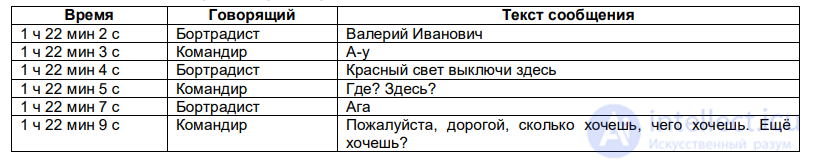
The nature of the captain's remarks clearly reveals an unworkable atmosphere, under which it is entirely unsurprising that an error was made in setting the pressure, which in turn led to the aircraft's collision with high ground. There are plenty of phrases by which one can characterize the captain or any other crew member. To illustrate this,
let us cite the intracockpit conversations and the circumstances of the crash of an An-12 near Chelyabinsk (Balandino) airport on May 26, 2008, at 20:11 local time
(14:11 UTC). The flight was flying the route "Chelyabinsk – Perm" with seven
crew members and two maintenance specialists on board. The aircraft's takeoff weight
and center of gravity did not exceed the limits.
The crew completed pre-takeoff preparation and began carrying out the "Before engine
start" checklist, during which they did not confirm that the flight data recorder (MSRP) was switched on, and it remained switched off. After completing the checklist the crew requested clearance to start engines from the ground movement controller. During engine start there were no
deviations in the operation of the aircraft's systems. The crew then carried out the checklists
"Before taxiing" and "At the holding point." After the "At the holding point" checklist was completed, a conversation took place among the radio operator, the flight engineer, and the instructor radio operator, indicating that a fault had occurred in the aircraft's
electrical power system (Table 10.7). Note the remark "yeah... with
it" in the table. It was precisely this remark that became the starting point in the development of the catastrophic situation. This remark
sums up an attitude toward flight safety standards, and consequently toward the experience
of all preceding generations of aviation specialists.
Table 10.7
Excerpt from the tape recording of the intracockpit conversations of the crew of An-12BP (according to: Informational Bulletin..., 2008, No. 9)

According to the investigation commission (Informational Bulletin..., 2008, No. 9), red warning lights for a generator failure of the SGO-12 of the first and second engines illuminated on the AC power panel at the radio operator's station.
While carrying out the "At the takeoff position" checklist, the crew switched on the MSRP, and the captain handed control over to the first officer. The takeoff was performed on
a magnetic heading of 91° at takeoff engine power with flaps extended
to 15°. After the flight engineer reported the flaps retracted, a change occurred in the situation
aboard the aircraft, prompting the captain's question: "What's that?", to which the flight engineer replied:
"The doors, the gear doors have opened." The gear-doors-open signal was false and was, in all
likelihood, caused by a stray electrical pulse passing through the landing gear door
position indication system. Following the false activation of the gear-door-open
warning, the audible alert falsely activated twice, and a voice
message from the ST-3400 TAWS early ground-proximity warning system sounded – "TOO
LOW, GEAR." By this time a report had come from the accompanying specialists' cabin of smoke appearing in the aircraft's cargo cabin, after which the captain gave the
instruction: "Well, take a quick look... see what's going on there." After this
the captain received a suggestion from the radio operator: "Let's go in, I think, or... that's it, let's request," to which the captain replied: "Wait, wait." This reply shows that
the captain was trying to make sense of the situation that had arisen, to assess the degree of danger.
The first officer then reported: "My attitude director's failed," after which the captain took over control
of the aircraft: "Understood, I have control." According to the MSRP recording, the failure of the first officer's ADI-1 was
due to a loss of electrical power. The captain assessed the seriousness of the situation and
decided to land at the departure airport: "Taking heading 315, turning left... understood, report, we're turning left, going back [swearing]."
The investigation commission noted that during the period when the false
activation of the gear-door-open warning and the ST-3400 TAWS occurred,
the ADI-1 failed, and the first signs of smoke appeared, the MSRP recorded a step change in the level of all recorded analog parameters, which also indicated malfunctions in the aircraft's onboard electrical system.
In response to the approach controller's question "Gromov 96-75, what's the reason?" the radio operator replied: "Smoke
in the cabin." The source of the smoke was in the cargo cabin. The approach controller informed the flight operations supervisor: "Smoke in the cabin, Gromov 96-75, requesting priority landing," to which
the flight operations supervisor replied: "...smoke in the cabin, they'll be approaching on heading 91°." After a series of false alerts (in particular, the activation of the emergency locator beacon), the radio operator reported yet another fault – the tripping of the CB-5 rudder trim circuit breaker:
"Rudder... rudder tripped... tripped out." The tripping of this circuit breaker results in the loss of control and indication of the rudder trim. The malfunctions in the onboard electrical system continued: the "Remove any engine's propeller from feathering stop" message appeared, and the "Lower the landing gear" siren activated abnormally.
As the aircraft was completing the third turn, the first and second
engines shut down on their own, followed by the feathering of their propellers. As
was established (Informational Bulletin..., 2008, No. 9), the engines shut down because fuel supply stopped due to a stray electrical signal reaching the
solenoid valves. The crew's last transmission was: "Gromov 96-75, on land... on the fourth turn, 400, approaching, continuing the approach." At about this moment the bank angle
reached 32°, and the MSRP recording registered the "Excessive bank" alert.
According to the commission's conclusion, the accident occurred as a result of the aircraft striking the ground, which resulted from the aircraft's loss of roll controllability due to failure of the aileron control cabling during the priority approach
back to the departure airport. The failure of the aileron control cabling most likely occurred due to severe overheating of a control rod and its subsequent rupture. The overheating of this rod could have been caused by a fire in the wiring harnesses of the aircraft's onboard electrical system, as evidenced by the smoke in the cargo cabin, the abnormal activation of various warning systems, the failures of aircraft equipment, and the self-shutdown of two engines. The aircraft had been built in 1968.
Incompatibility among crew members can also manifest against a backdrop of poor psychophysiological condition. An example of this is the accident involving an An-12
that occurred on February 22, 1986. For 1 hour 13 minutes the crew, due to cabin depressurization, was unconscious, and the first to begin recovering from the hypoxia caused
by the depressurization was the first officer. The entire burden of flying the aircraft fell on him. Upon regaining consciousness, the first officer established contact with air traffic control,
after which he was instructed to make an emergency descent. During the descent and approach for
landing, the An-12's main landing gear and flaps failed to extend, all while there was a struggle
between the first officer and the captain, who, under the effect of hypoxia, was displaying clearly inadequate behavior. The radio exchange between the Chelyabinsk area control center controller and the An-12 crew (Collection of Informational..., 1988) is given in Appendix 1. Thanks to the first officer's great self-control and competence, and to the competent actions of the flight operations supervisor, who brought in the crew of another An-12 for consultation, the aircraft made a
safe landing at Ufa airport.
An example of flagrant incompatibility is the relationship that developed between
the captain and first officer of the Tu-134 that crashed at Kurumoch airport (Samara region) on October 20, 1986. The flight was flying the route "Sverdlovsk – Kuibyshev – Grozny." By collusion among the crew members, in violation of NPP GA-85,
the captain of the Tu-134, during a revenue flight, made the criminal decision to perform the approach with the training curtain closed. At an altitude of 60 m, in violation of NPP GA-85, the captain continued the approach with the curtain closed, and the first officer failed to comply with the NPP GA-85 requirement to go around. Only 1 second before touchdown did the captain give the command to open
the curtain. The aircraft, without flaring, at a high rate of descent and a load factor of 4.8,
touched down hard, broke apart, and caught fire. The cause of the crash was irresponsibility in
crew selection and scheduling, and shortcomings in the organization of flight operations.
The approach at Kurumoch airport was carried out at a time when the localizer/glideslope system was undergoing maintenance, yet the crew nevertheless used its
readings. In addition, when the curtain was opened the aircraft was in a non-landing configuration, and the captain tried to correct the situation with abrupt
control-column movements. The combination of all these circumstances led to a hard landing; the aircraft flipped over, broke apart, and caught fire. As G.S. Krylova (1991) notes, at the crash site,
fuel leaking from the tanks ignited. The fire spread over an area of
about 150 m
under the center wing box and wing. Through the break in the fuselage, the flames penetrated inside
the aircraft. Foam firefighting was initially carried out by three airport fire trucks, after which two more trucks arrived at the crash site. Containing the exterior fire took a total of 7.5 minutes, after which, within 1.5–2 minutes, the fire inside the fuselage was extinguished. Evacuation of people was carried out
mostly after firefighting was completed.
During interviews with members of other crews it emerged that the first officer had previously been a Tu-134 captain, but had been removed from that position. A relationship of rivalry and hostility had developed between the captain and the
first officer. The captain had also previously performed approaches with the curtain closed at Sheremetyevo airport down to an altitude of 30 m, demonstrating
his skill and superiority over the first officer!
Regarding the crash examined here and similar aviation events, the following
conclusion should be drawn. If there is no time for correctly resolving a conflict,
or if criminal actions are being taken by one of the crew members, then in place of the recommendations listed above, more decisive and even aggressive actions become necessary –
the only actions that can be set against a clear error and save the situation. If there is a person in the crew whose presence clearly threatens safety,
one should not display false, and in this case entirely unwarranted, delicacy
(a psychotherapeutic approach) – such a person does not deserve it, and one's position toward
him must be formulated immediately and clearly, without exposing oneself or others to
danger (Evstigneev D.A., Kopysov V.Kh., 2007).
Let us give an example of the behavior of the captain of a Boeing 737 of "Sibir" airline –
behavior that can be regarded as exemplary and far-sighted. The far-sightedness of his
behavior lies in the fact that he voluntarily reported what happened aboard the aircraft on November 18, 2006: after takeoff from Domodedovo airport, the crew failed to confirm
that the autopilot was engaged and lost track of the bank angle (Informational Bulletin...,
2007, No. 3). This behavior on the captain's part shapes the crew's working rules for the future:
after this, other crew members will no longer be inclined to conceal any given fact. Since
the captain was not afraid to answer for his own actions, he is ready at any moment to hold both
himself and others accountable. The behavior described will inevitably have an invigorating effect on all
crew members, and the strength of this effect will exceed that of any repressive
measures! Timely reporting of abnormal and emergency situations that have occurred
to management is a very good test of pilots' attitude toward flight safety.
It is not merely a test of one's attitude toward flight safety, but a test for the presence of personal qualities such as responsibility, professionalism, and the desire to protect other crews
from what happened to them. Timely reporting of what happened on board fosters
a proper attitude toward safety within the crew, and in this regard the leading role belongs to the aircraft's captain – the chief champion of flight safety principles (Evstigneev
D.A., Kopysov V.Kh., 2007).
To counteract conflicts (both those that give rise to incompatibility and those generated by it),
one needs to understand their nature and have a certain set of tools available
for use when they arise.
Conflict (Latin: conflictus – collision) is a state that arises as a result of the needs of one person contradicting the needs of another. Conflicts are inevitable, since the needs of one person will inevitably contradict one or another
of another person's needs. Moreover, in a number of cases conflicts are necessary – thanks to them
people can learn about each other's needs and work out a joint solution for getting
out of a difficult situation. Positive (productive) conflicts stimulate the development of the
personality. Negative (destructive) conflicts can also stimulate personal
development, but their main characteristic will be a breakdown in interaction, in the bond between
people.
The following stages can be identified in the development of a conflict:
- the potential formation of contradictory tendencies between partners;
- the partners' recognition of the conflict situation;
- conflict actions;
- resolution (or escalation) of the conflict.
A strategy for behavior in a conflict situation can be expressed through a style of avoidance,
accommodation, confrontation, cooperation, or compromise (Vorozheikin I.E., Kibanov
A.Ya., Zakharov D.K., 2004).
The avoidance style is characterized by an unwillingness to cooperate, to make active efforts to defend one's own interests, and by a tendency to escape the conflict. The avoidance style is used in the following cases.
1. The problem underlying the conflict, the subject of disagreement, does not deserve particular attention, expenditure
of energy, or time.
2. The opponents deliberately avoid complications in their relationship.
3. There is another (non-conflict) way to achieve one's own goals.
4. One of the participants in the conflict situation is not confident of the correctness or appropriateness
of his own claims.
5. One of the participants in the conflict has as his opponent a person of higher status, or a manipulative person deliberately creating a conflict situation to his own advantage.
6. Some time is needed to analyze the situation, mobilize forces,
or attract more supporters to one's side.
The accommodation style is characterized by a readiness to smooth over the conflict situation, to preserve harmony in the relationship through yielding and trust. Typical situations in which the accommodation style is used are as follows.
1. The problem underlying the conflict is not significant.
2. The opponents understand that by making concessions to one another they gain a good, cooperative relationship.
3. There is a deadlock situation requiring one to sacrifice part of one's own interests
in order to reduce the tension and hostility that has arisen.
4. One of the participants in the conflict wishes to offer the other support.
5. The conflicting parties are in a competitive (but not fiercely competitive)
relationship.
The confrontation style implies active, independent actions aimed at achieving one's own interests without taking the opponent's opinion into account. The confrontation style is chosen in the following situations.
1. The problem is of vital importance.
2. The participant in the conflict is in a no-lose situation.
3. The participant in the conflict holds high status and is confident that his proposed solution to the problem is the best one.
4. There is no alternative to using a different style of behavior in the conflict
situation.
The cooperation style presupposes that the participants in the conflict maximize the realization of their own interests through a joint search for a solution. Situations in which this style is used are as follows.
1. The problem is important to the participants in the conflict situation.
2. The participants in the conflict have equal status, or disregard
any existing difference in status between them.
3. The participants in the conflict, of their own free will, on an equal footing, strive to reach
agreement on a mutually beneficial solution to a significant problem.
Compromise presupposes a willingness on the part of the conflicting parties to resolve
their differences by resorting to various concessions. This style is used in the following situations.
1. The conflicting parties are well informed about the causes of the conflict.
2. Conflicting parties of equal status, having mutually exclusive interests,
recognize the need to accept the existing state of affairs.
3. Conflicting parties of different status are inclined to reach an agreement
in order to gain time, conserve energy, and avoid unnecessary losses.
4. As the situation develops (changes), the opponents adjust their goals.
What else is it necessary to know about conflicts, besides the five classic styles of behavior in a
conflict situation? What must one know in order to resolve conflicts competently – so
that if any residual effect remains after the conflict, it is the smallest possible one? As a word of caution, let us note that it is more than incorrect to regard conflict solely as something negative. Sometimes only through a conflict situation can
a particular problem or question be resolved, and if not for the conflict, the situation would have remained
unresolved for a long time, and the conflicting parties would never have moved to a new, more effective stage of
interaction, would never have learned the true motives behind each other's behavior.
As recommendations for resolving conflicts and optimizing the performance of a
flight crew, in addition to those noted earlier, it is important to know the following points.
1. The first thing that needs to be determined is to understand the causes of the conflict (precisely which
needs are being blocked in the process of communication), to identify the object of the dispute and its true value. It often turns out that the causes of a conflict are unconscious in nature,
and it is precisely this lack of awareness of the situation, its distorted perception, that gives rise to especially extreme forms of conflict.
2. Always remember that a conflict can arise at any time, and that it is precisely
this that can become the prelude to an emergency situation (something that may happen only once in a lifetime
– but a once that will be remembered forever).
3. Wherever possible, one should avoid letting a conflict situation drag on. Letting the resolution of a conflict drag on has two consequences. The first consequence: ever-increasing tension threatens to erupt into an affective outburst, to which the opponent will react accordingly (he had no idea whatsoever that his behavior had been oppressing
the other person in some way). The second consequence: the object of the dispute, over which the struggle is being waged and which remains undivided for a long time, becomes subjectively ever more valuable (owing to the effort expended on the
struggle), even though its actual value remains unchanged. Winning in such a situation sometimes becomes
"a matter of principle," and yet, in the event of victory, the person is met with extreme disappointment –
it turns out that what was fought over for so long did not, after all, have such value, and that the only
thing gained in this struggle is a ruined relationship and health lost as a result of psychological trauma.
4. One should constantly put oneself in the partner's place, try to look at the conflict situation from his point of view, and conduct the dispute as constructively as possible, without slipping into
assessments of the partner's personal qualities. As soon as we make a judgment about the opponent's personal characteristics, we shut off any possibility of being heard and understood: even if
our position is more than justified (if the opponent really did engage in
improper behavior deserving a firm response), the moment we make a negative judgment about his personal qualities, the person stops taking us in (we ourselves have granted him the right not to respect us), which manifests either as retaliatory aggression ("oh, so that's how it is...") or as
withdrawal from any further interaction.
5. When we make a remark, when we reproach a person for a particular behavior, we provoke a corresponding
indignation in response (expressed either as open resistance and indignation, or as concealed tension). This happens because every person, in engaging in a particular behavior,
perceives it as normal. By making a remark, we block the person's need
to behave as he wishes, that is, we encroach on his freedom. For this reason, remarks and
similar statements should be made as tactfully as
продолжение следует...
Часть 1 10. Crew Interaction Under Poor Teamwork and Incompatibility Among Crew Members
Часть 2 - 10. Crew Interaction Under Poor Teamwork and Incompatibility Among
Часть 3 - 10. Crew Interaction Under Poor Teamwork and Incompatibility Among
Часть 4 - 10. Crew Interaction Under Poor Teamwork and Incompatibility Among

Comments