
Lecture
The Medical Control Card of a physical culture practitioner — is an official document that records the medical, social, and sports data of a person engaged in physical culture or sport. It is used to monitor health status, analyze living conditions, and track the dynamics of sporting results.
The card must be filled in with maximum accuracy and care, since it is used by doctors, coaches, and sports organizations.
Anthropometric data — is a set of indicators reflecting a person's physical development, functional capacity, and level of fitness. For physical culture practitioners and athletes, properly maintaining such tables is very important: they make it possible to track the dynamics of growth, strength, and endurance, and to identify individual characteristics of the body.
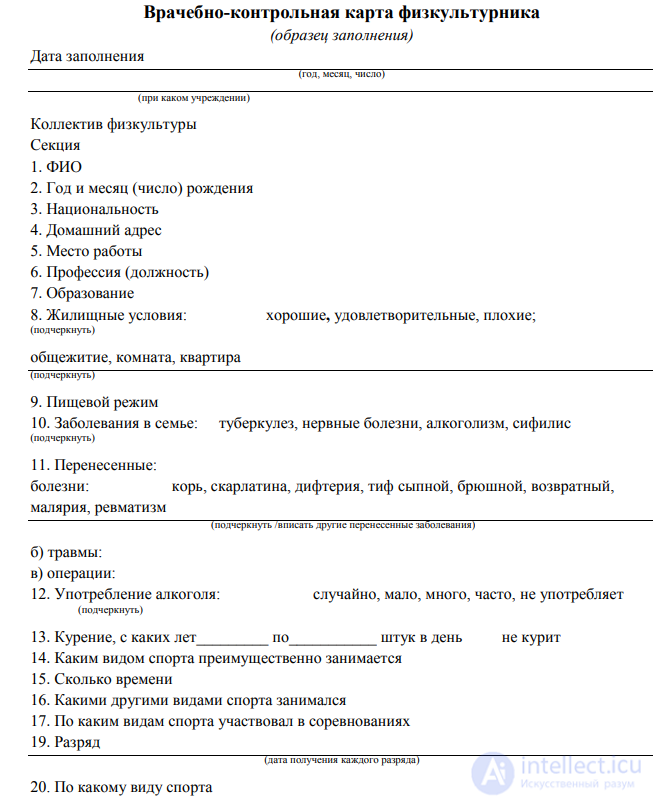
Date completed (year, month, day) (institution)
Physical culture group
Section
1. Full name
2. Year and month (day) of birth
3. Nationality
4. Home address
5. Place of work
6. Occupation (position)
7. Education
8. Housing conditions: good, satisfactory, poor; (underline)
dormitory, room, apartment (underline)
9. Diet
10. Family illnesses: tuberculosis, nervous disorders, alcoholism, syphilis (underline)
11. Past:
illnesses: measles, scarlet fever, diphtheria, typhus, typhoid, relapsing fever,
malaria, rheumatism (underline / write in other past illnesses)
b) injuries:
c) operations:
12. Alcohol consumption: occasionally, little, a lot, often, does not drink (underline)
13. Smoking, from what age_________ to___________ how many per day does not smoke
14. Which sport is practiced primarily
15. For how long
16. What other sports have been practiced
17. In which sports has competed
19. Rank/category (date each rank was obtained)
20. In which sport
The year, month, and day are indicated.
The institution at which the card is maintained is also recorded (for example: a sports club, a university, an enterprise).
The name of the group is recorded (for example: «FC Dnepr», «student track and field section»).
The specific section or sport is indicated.
Full name — in full, without abbreviations.
Date of birth — year, month, day.
Nationality — as in the passport.
Home address — complete, including postal code.
Place of work — organization, enterprise, or educational institution.
Occupation (position) — specific specialty or position held.
Education — secondary, specialized secondary, higher.
One option is underlined: good, satisfactory, poor.
The type of housing is specified: dormitory, room, apartment.
The nature of the diet is briefly described: regular, irregular, balanced, monotonous.
Special features can be indicated (for example: vegetarianism, therapeutic diet).
The relevant options are underlined: tuberculosis, nervous disorders, alcoholism, syphilis.
Other hereditary or chronic illnesses are added if necessary.
Illnesses: marked with a checkmark or underlined (measles, scarlet fever, diphtheria, etc.).
Injuries: recorded with the year and nature indicated (for example: «fracture of the left arm, 2018»).
Operations: the type and date are indicated (for example: «appendectomy, 2015»).
One option is underlined: occasionally, little, a lot, often, does not drink.
The age at which smoking started and stopped is indicated.
The number of cigarettes per day is recorded.
If the person does not smoke — «does not smoke» is noted.
Main sport — the one practiced primarily.
Length of involvement — number of years or months.
Other sports — all previously practiced sports are listed.
Competition participation — the sports and level of competitions are indicated (school, city, regional, national).
Rank/category — the date each sports rank was obtained and the sport it relates to are recorded.
Allows the doctor to assess health status and identify risks.
Gives the coach information about sports preparation and possible restrictions.
Serves as an official document for clearance to compete.
Helps track the dynamics of physical development and sporting achievements.
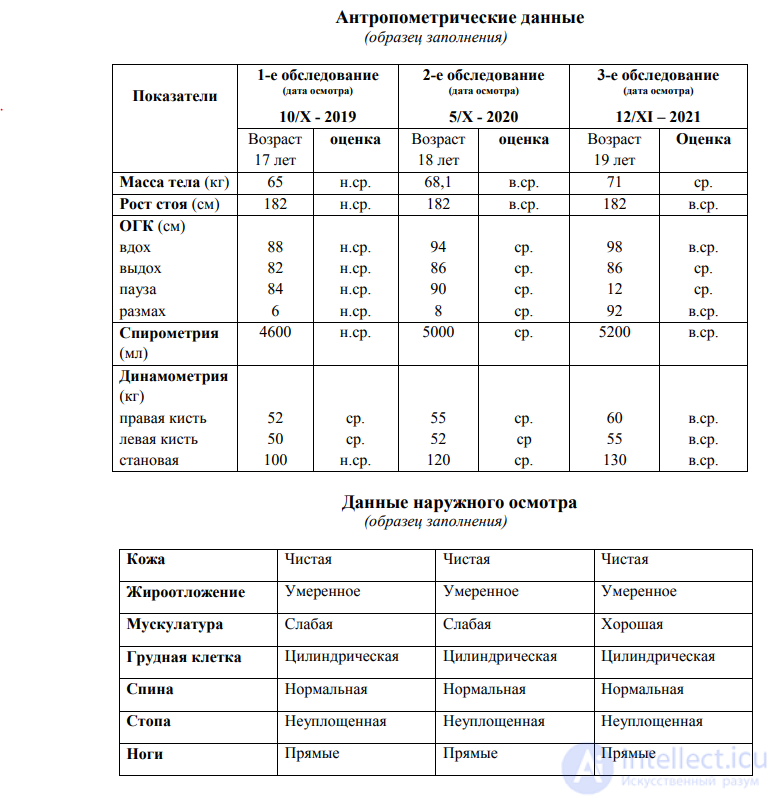
Age — the full age at the time of examination is indicated.
Date of examination — the exact date (day, month, year) is recorded.
Assessment — a brief characterization of the level of development (for example: below average, average, above average).
Body weight (kg) — measured in the morning, on an empty stomach, without excess clothing.
Standing height (cm) — measured with a stadiometer, without shoes.
These indicators make it possible to assess the harmony of development and calculate the body mass index (BMI).
Measured with a tape measure:
Inhalation — maximum expansion of the chest.
Exhalation — minimum position after a full exhale.
Pause — average state during calm breathing.
Range — the difference between inhalation and exhalation, reflecting the elasticity of the chest and the work of the respiratory system.
Vital lung capacity (VC, ml) — determined using a spirometer.
This indicator reflects the volume of air a person can maximally inhale and exhale. The higher the value, the better developed the respiratory system.
Measurement of muscle strength:
Right hand — grip strength of the right hand.
Left hand — grip strength of the left hand.
Deadlift strength — measured with a dynamometer while lifting a load. These indicators characterize the level of strength training.
Body weight and height are usually higher, so it is important to track the ratio of muscle mass to fat tissue.
Dynamometry is of key importance: hand grip strength and deadlift strength indicators are often used to assess athletic form.
Spirometry in men is generally higher, due to greater lung capacity.
Body weight is recorded especially carefully, since fluctuations may be related not only to training but also to physiological factors.
Height and chest circumference are often lower, but the range of respiratory movement in women can be more indicative for assessing respiratory system fitness.
Dynamometry in women is generally lower, but it is important to record progress — even small changes reflect an increase in strength.
Spirometry in women is lower, but the dynamics of development (an increase in VC) is an important indicator of training effectiveness.
All measurements are taken under identical conditions (morning, before training, without shoes or excess clothing).
The same instruments are used to eliminate discrepancies.
Data is recorded annually or quarterly to track dynamics.
The table must indicate the units of measurement (kg, cm, ml).
Comments are added if necessary (for example, «after illness», «during a period of intensive training»).
Allow an objective assessment of physical development.
Help adjust training programs.
Form the basis for medical monitoring of health status.
Make it possible to compare indicators between different age groups and sexes.

Comments