
Lecture
Some exercises and movements can be dangerous to health, especially with incorrect technique or excessive load. The greatest risk comes from sharp twisting motions, deep weighted squats, kettlebell swings, and exercises on machines with a fixed trajectory. At work, sharp bending, lifting heavy objects without proper technique, and prolonged static sitting are dangerous.
Arguments:
Adaptability of the body: the human body is capable of adapting to loads. Even extreme exercises can be safe if the load is increased gradually.
Context and technique: any movement becomes safe with correct technique, control, and consideration of individual characteristics.
Example: weighted squats. For a beginner this can be dangerous, but if you start with bodyweight, gradually add load, and monitor technique — the exercise becomes safe.
Analogy with applications: any software application can be safe if it is used correctly. Even complex systems (for example, banking apps) are safe when the rules are followed: passwords, two-factor authentication, updates.
Arguments:
Risk always exists: even simple walking can lead to injury (slipping, falling). That is, absolute safety does not exist.
Individual limitations: what is safe for one person may be dangerous for another. For example, running is beneficial for most people, but with joint problems it can cause harm.
Example: push-ups. For a healthy person — safe, but with shoulder joint problems it can cause injury.
Analogy with applications: any application is potentially unsafe. Even a calculator can contain bugs, and a text editor — vulnerabilities. There is no absolute guarantee of safety, because there is always a risk of error, hacking, or misuse.
Experts identify a number of movements that most often lead to injuries:
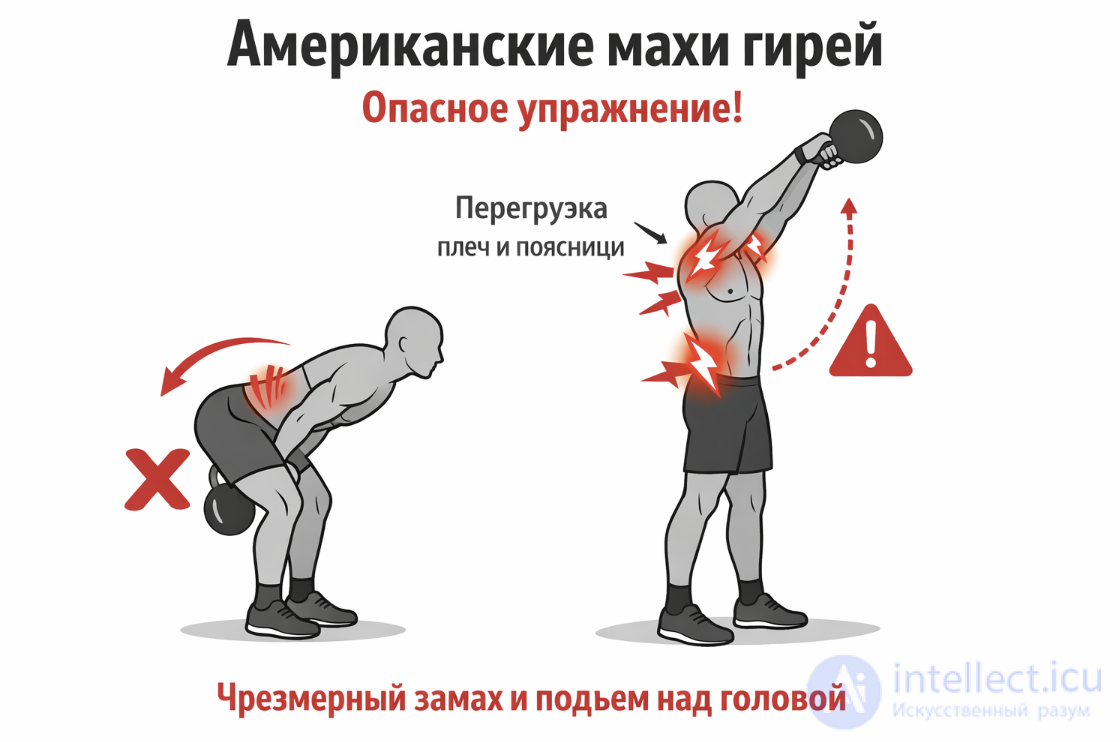
American kettlebell swings – overload the shoulder joints and lower back, especially with an incorrect range of motion. Note: it is precisely the excessive backswing and raising the kettlebell overhead that make this exercise dangerous. In the classic version of the kettlebell swing, the movement ends at chest or eye level, which significantly reduces the load on the spine and shoulder joints.
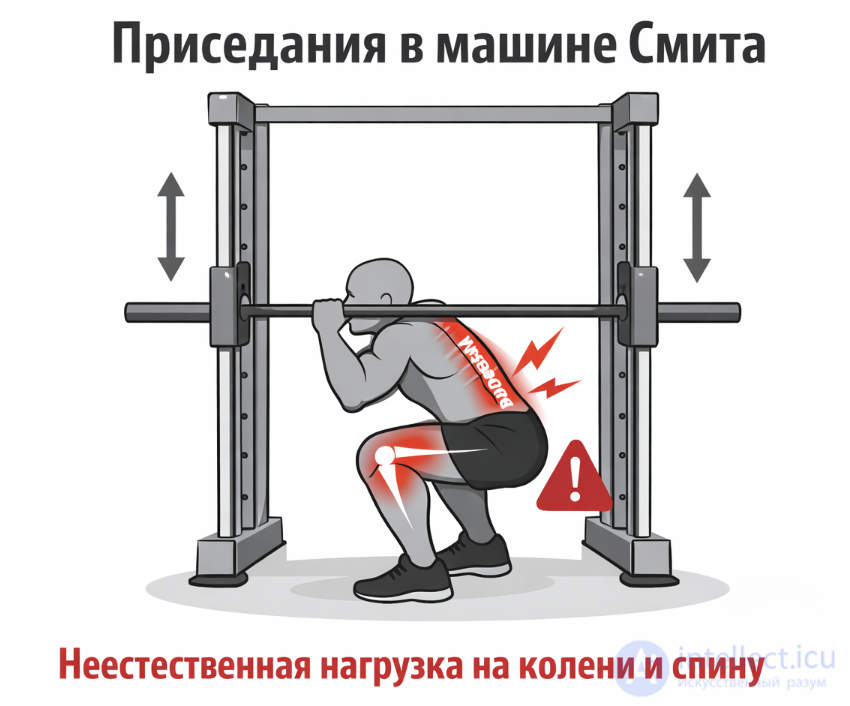
Smith machine squats – the fixed trajectory creates an unnatural load on the knees and spine.
Abdominal crunches – with excessive repetition they increase the risk of damage to the intervertebral discs.
Here is a diagram of an abdominal crunch — it shows how performing this exercise repeatedly can cause overload in the lumbar spine. Sharp movements and strongly rounding the back when lifting the torso are especially dangerous.
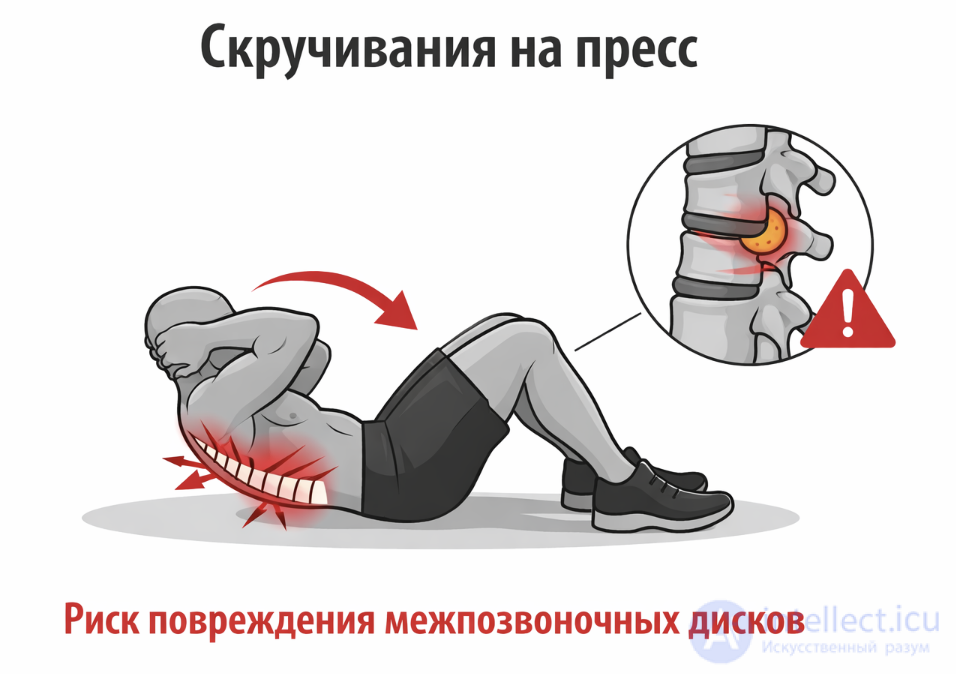
On the right of the image — an enlarged fragment of the spine with damaged intervertebral discs. This is a typical problem with excessive crunches, especially if the core muscles are insufficiently developed or the technique is faulty.
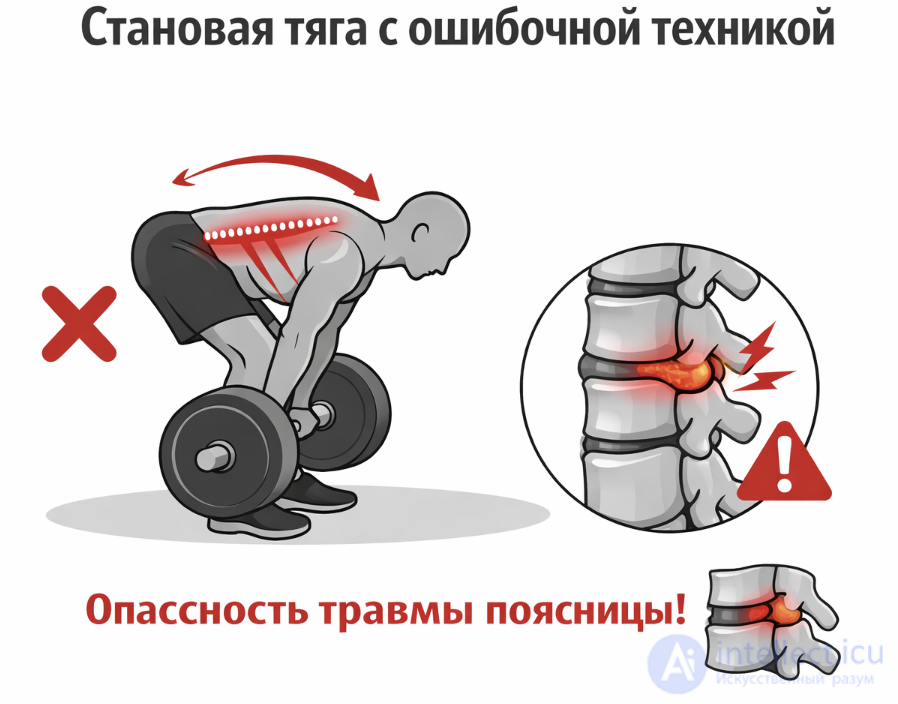
Deadlifts with incorrect technique – can cause serious lower back injuries.
Here is a diagram of a deadlift with incorrect technique — it shows how rounding the back while lifting the barbell creates dangerous load on the lower back. This is especially critical when the weight is heavy and the core muscles are insufficiently engaged. At the bottom of the image — an enlarged fragment of the spine with a herniated intervertebral disc, typical of incorrect lifting technique. Red lines and warning signs highlight the risk zones.
Box jumps – dangerous for the knee joints and ankles with insufficient preparation.
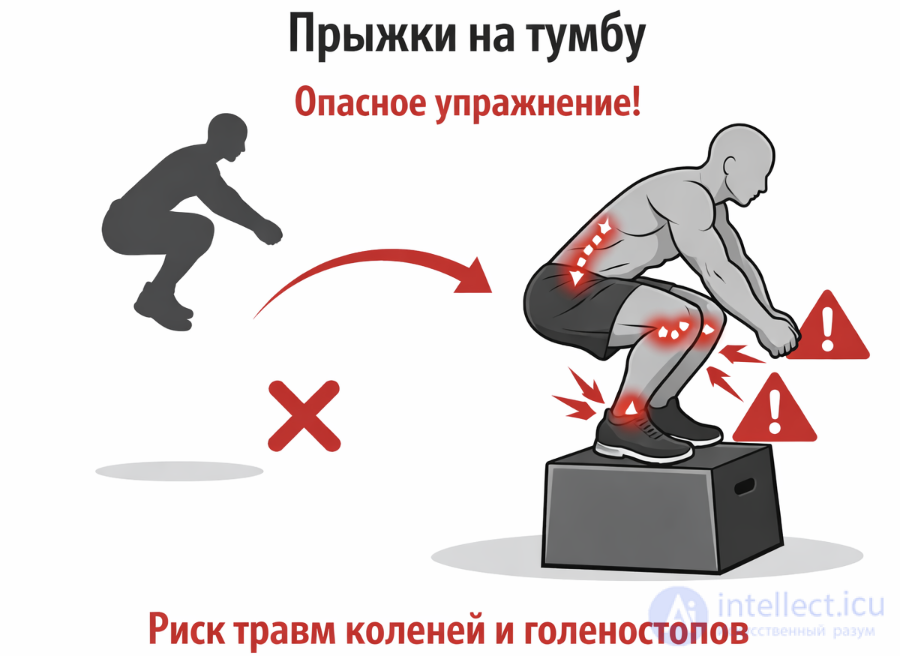
Above is a diagram of box jumps. It shows how landing with incorrect technique can damage the knees and ankle joints. Red lines indicating risk zones and warning signs are specifically marked. This exercise is especially dangerous for unprepared athletes and for those with poorly developed or previously injured knee and ankle joints.
Seated barbell press – overloads the shoulder girdle and cervical spine.
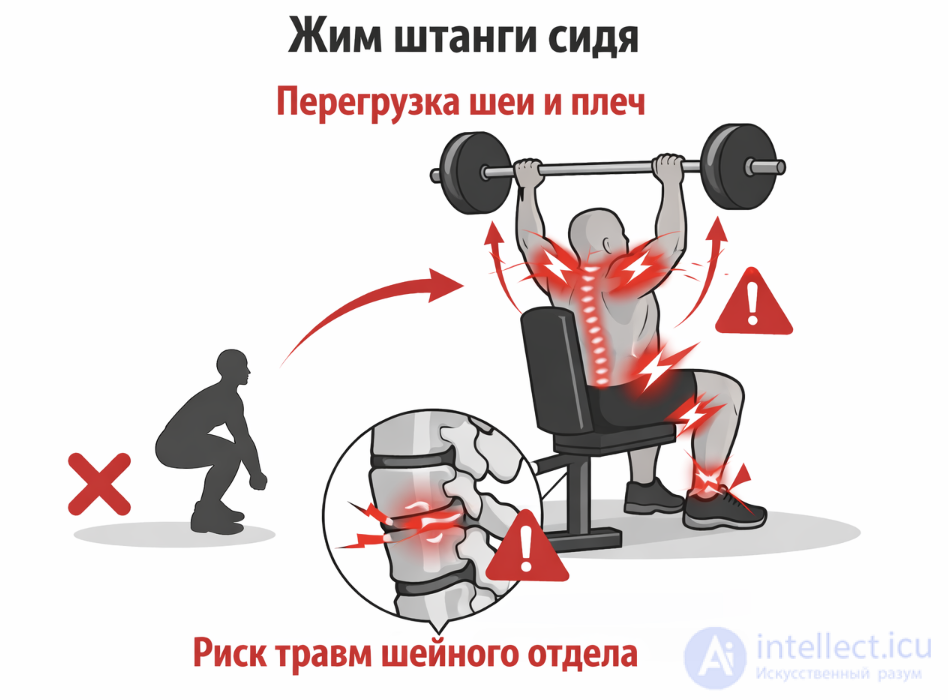
Above is a diagram of the seated barbell press. It shows how lifting the barbell overhead in a seated position overloads the shoulder girdle and cervical spine, which can lead to injuries.
Red zones indicate tension in the shoulders and neck, and at the bottom — a close-up fragment of the spine, highlighting the risk to the cervical region.
Not only sport, but also work activity can be injury-prone:
Lifting heavy objects without bending the knees – leads to overload of the lower back.
Sharp bending and twisting of the torso – increases the risk of hernias and sprains.
Prolonged sitting without a break – causes blood stagnation, back and neck pain.
Working with raised arms overhead – overloads the shoulder joints and causes chronic pain.
Monotonous repetitive movements (for example, on an assembly line) – can lead to overuse syndromes (carpal tunnel syndrome, tendon inflammation).
Comparative table: sport vs. work
| Category | Dangerous movements/exercises | Main risks |
|---|---|---|
| Fitness | Kettlebell swings, Smith machine squats, crunches, box jumps | Joint and spinal injuries, sprains |
| Work | Lifting heavy objects without proper technique, sharp bending, prolonged sitting, overhead work | Hernias, back pain, chronic joint conditions |
In sport: always monitor technique, avoid excessive weights, replace injury-prone exercises with safer ones (for example, a plank instead of crunches).
At work: use ergonomic furniture, take breaks every 40–60 minutes, lift heavy objects with bent knees rather than the back.
General rule: avoid sharp movements and prolonged static positions, strengthen the core muscles to protect the spine
Certain exercises can trigger cardiac arrest in unprepared people or in those with undetected cardiovascular disease. The greatest risk is associated with sudden, high-intensity loads, especially without a warm-up, pulse monitoring, or medical clearance.
1. High-intensity interval training (HIIT)
Sharp spikes in heart rate, especially with insufficient preparation.
Risk of arrhythmia, ischemia, and sudden cardiac arrest in people with heart conditions.
2. Sprints and running at maximum effort
Raise blood pressure and heart rate to extreme values.
Dangerous with hypertension, angina, aneurysms.
3. Strength exercises with maximum weight
Deadlifts, bench press, weighted squats — cause breath-holding (the Valsalva maneuver), which sharply raises intrathoracic pressure.
Can lead to cardiac arrest in the presence of heart failure or atherosclerosis.
4. Deep breath-holding (in yoga, diving, breathing practices)
Disrupt oxygen balance, can cause hypoxia and arrhythmia.
5. Hot training (sauna + physical exertion)
Overheating + exertion = risk of heat stroke and cardiac dysfunction.
People with undiagnosed heart defects (for example, hypertrophic cardiomyopathy).
Those who have not had an ECG or stress test before starting training.
People with hypertension, diabetes, obesity, especially after age 40.
Those taking medications that affect heart rhythm (beta-blockers, antidepressants).
| Precaution | Why it matters |
|---|---|
| Medical check-up before training | Reveals hidden pathologies |
| Heart rate monitoring (chest strap sensor) | Prevents overload |
| Warm-up and gradual increase in load | Reduces the risk of arrhythmia |
| Avoid training while unwell | Colds and dehydration increase the strain |
| Do not train in the heat or after alcohol | Increases the risk of cardiac arrest |
Sudden death during a marathon — most often associated with undetected cardiomyopathy.
Cardiac arrest in the gym — during a maximum-weight bench press without a spotter.
Heart attack after HIIT — in beginners who had not undergone a medical examination.
Cardiac arrest in a schoolchild during a physical education class
Some exercises can provoke or aggravate hemorrhoids. The reason is that they create excessive pressure in the pelvic and rectal area, disrupt blood circulation, and increase venous stagnation.
Heavy squats, deadlifts, bench press.
Breath-holding sharply raises intra-abdominal pressure → increasing the load on the blood vessels of the rectum.
Planks, handstands, holding weight overhead.
Prolonged muscle tension causes blood stagnation in the pelvic veins.
Crunches, lying leg raises.
Increase pressure on the lower abdomen and rectum.
Box jumps, jump rope, burpees.
Sharp impacts and landings increase strain on the blood vessels and can trigger a flare-up.
Prolonged exertion + friction in the pelvic area → risk of inflammation and worsening symptoms.
Increased intra-abdominal pressure.
Disrupted venous outflow.
Mechanical friction and microtrauma.
Weakness of the vessel wall in people with a predisposition.
Choose moderate cardio loads: walking, swimming, cycling.
Do stretching and breathing exercises.
Avoid holding your breath — always breathe rhythmically.
Work with moderate weights, without maximal loads.
Take breaks and avoid prolonged static tension.
There are a number of exercises that increase the risk of ligament sprains and even fractures. This is usually related to sudden movements, excessive load, or incorrect technique.
Box jumps and jump rope – with poor landing it is easy to injure the ankle or knee ligaments.
Football and basketball training (sharp changes of direction) – often lead to sprains of the knee's cruciate ligaments.
Yoga with deep stretches – excessive effort can cause a tear of the hip joint ligaments.
Weighted strength exercises (squats, presses) – with incorrect technique the load goes onto the ligaments rather than the muscles.
Heavy-weight strength exercises without a spotter (bench press, deadlift) – a dropped barbell can lead to fractures.
Gymnastic elements (somersaults, acrobatics) – a landing error can cause fractures of the arms, legs, or spine.
Contact sports (judo, wrestling, hockey) – falls and holds often result in bone injuries.
Sudden movements → the ligaments do not have time to adapt.
Poor conditioning → the muscles do not support the joints.
Overloading with weight → the load exceeds the strength of the bones and ligaments.
No warm-up → the tissues are less elastic and are easily damaged.
Always warm up and stretch.
Work with moderate weight and gradually increase the load.
Use spotting and correct technique.
Strengthen the core muscles and joint stabilizers.
Avoid sudden movements and excessive ranges of motion.
Safety is relative: an exercise or application can be safe when used correctly, but unsafe when rules are broken or individual characteristics are ignored.
Examples of this universality:
Exercises: running, yoga, strength training — all of them are simultaneously safe (with a sensible approach) and unsafe (when limitations are ignored).
Applications: social networks, banking services, games — all of them are safe with correct setup and use, but unsafe with carelessness or misuse.

Comments