
Lecture
The most problematic issues for young people during their student
years are the state of their conditions, such as: parameters
of body length and mass, the level of physical fitness,
functional capabilities, and the performance of specific motor activity. The
planning of corrections to a student's motor capabilities depends
on their motor tasks: - from simple skills to more
complex ones; - toward improving skills in a specific sport;
- toward the methodological grounding of independent training; - toward
determining the causes of difficulties and errors; - toward developing
independent training sessions [25]. The founder of the system of
physical education in Russia, P.F. Lesgaft, believed that the natural
sciences, especially anatomy, physiology, and psychology, draw attention to the
formation of a young organism at various periods of
its development. That teachers must act «consciously, without gross errors
that harmfully affect the correct course of the organism's development».
In his works, Pyotr Frantsevich wrote «…Our actions will be
meaningful and conscious only if we not only know but
also understand the changes taking place in the organism». With
the help of the means and forms of physical education
and sport, one can consciously correct deficiencies in physical development.
Correction of body length. Parameters of physical development at
student age are amenable to correction to varying degrees: hardest
of all is height (more accurately, body length), significantly easier
are body mass (weight) and individual anthropometric indicators (chest circumference,
waist, hips, etc.). It is even more difficult in the
case of persistent pathologies of physical development in young people.
Most often, schoolchildren who rarely attend 95 physical education classes
drag along a trail of functional problems that, of course,
affect the external parameters of the body, above all
the posture. Under the influence of physical loads, blood supply
to all tissues improves, metabolism is enhanced, and, particularly important,
a biologically active substance is formed in the body -
somatotropic hormone (STH). This hormone (somatotropin) affects the increase in
bone length and, consequently, a person's height. The direct site
of the hormone's action on the bone is its terminal
formation - the epiphyseal cartilage, which is gradually replaced by
bone tissue, i.e. bone growth occurs. Optimal mechanical stimulation
of the epiphyses enhances the action of the hormone. In
recent years it has been established that physical loads of
moderate intensity lasting 1.5-2 hours can increase STH in the
body by more than three times. Sports games (basketball, volleyball,
badminton, tennis, etc.) have an effective influence on increasing body
length. It is recommended to combine them with loads of
moderate intensity (swimming, skiing, running) 2-3 times a week for
40-120 minutes. Daily special jumping exercises (rope skipping, repeated
hopping, choreographic jumps) and exercises hanging from a bar or
gymnastic wall also promote growth (Appendix 6, fig. 5.14). Hanging
exercises, moreover, strengthen the muscular «corset», counteract the settling of
the vertebrae, and help maintain good posture. Over the course
of a day, an adult's height can change by up
to 2-3 cm. This depends on changes in muscle tone,
the state of the intervertebral cartilage discs, and a person's
posture, which affects their actual and visually perceived height.
In the morning, when the straightening muscles are toned, a
person's height is greater. By evening the muscles get tired,
the depth of the spinal column's curves increases, the person
stoops, and body length decreases. Stretching exercises (see fig. 2.4).
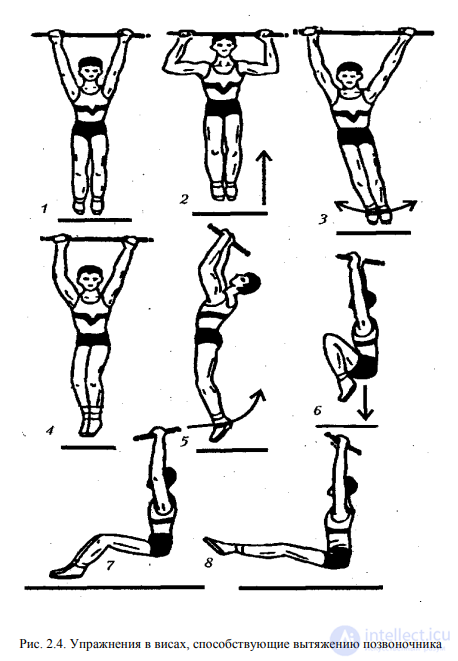
Fig. 2.4. Hanging exercises that promote spinal stretching 1 - relaxed hang
- overhand or underhand grip; 2 - pull yourself up (or
at least try to do so), then, relaxing as much as possible
and as if «lengthening the body», hang; 3 - in the
hang, tilt the straight legs right-left («pendulum»); 4 - in the hang,
turn the torso right-left (legs together); 5 - in the hang, arch
backward, tilting the head and legs back in an arc; 6
- in the hang, raise the legs bent at the knees toward
the stomach; pull up in this position; when lowering, relax and
stretch downward, straightening out; 7 - in the hang, having raised the
legs bent at the knees, straighten them into an «angle» (or try
to do so); 8 - in the hang, raise the straight
legs as high as possible; when returning to the starting position, arch
the lower back as much as possible, tilting the head back
Correction of body mass. Unlike height, body mass can be changed both
in the direction of decrease and in the direction of increase, with
systematic engagement in specific physical exercises or sports (with dietary correction).
Body mass is closely related to a person's height. The weight-height indicator
(Quetelet index) is calculated by dividing body mass (g) by height
(cm); the quotient obtained should be around 350-420 for men and 325-410
for women. This indicator shows an excess or a deficiency of body
mass. Correction of body mass is quite achievable at student age.
It is harder to change stereotypical lifestyle habits. Therefore prevention or treatment
of obesity is a problem that is partly psychological as well.
Whether or not you need to change your body mass is something
you will decide for yourself when assessing the proportionality of your
body. It remains to choose the sports (exercises) for regular training, especially
since some types help reduce weight (all cyclic sports: swimming, middle- and
long-distance running, cross-country skiing, etc.). Mixed-mode fitness programs: aerobic-anaerobic, without rest
pauses, for 60 minutes, at least four times a week. Correction of
motor and functional fitness is related to the peculiarities of developing
a person's coordination and functional abilities. In the course of a single
lesson it is practically impossible to solve all the tasks connected with
developing motor-coordination abilities (MCA) at the same time. It is advisable
to improve coordination of movement (possible combinations): arms and legs, arms and
torso, legs and torso, arms - legs - torso. In other
series of sessions, promote the development of coordination of movements of the
arms, legs, and torso together with the ability to maintain dynamic and
static balance. Then develop whole-body movement coordination. Methodically starting with small
muscle groups, involving progressively larger muscles in the work, taking into account
the intensity of motor activity and the solving of educational tasks.
Coordination exercises can be used in any part of the lesson (session).
Table 2.4.1 Lesson-by-lesson model
for developing coordination abilities
Ability being formed
/ Body parts /
Exercises / Lessons 1-3
/ Lessons 3-6 /
Lessons 6-9 /
Lessons 9-12 / Lessons
12-16 Maintaining body balance
(stability). 1. Legs: stances
- wide stance
with feet apart, stance
with feet apart, closed
stance, stance on one
leg. Steps. Balance exercises.
Jumps, hops. Running
exercises. Marked for lessons
1-3 and 3-6. 2.
Arms: flexion, extension, abduction,
adduction, arc, circle.
Direction: up, down, forward,
right, left. Choreographic positions.
Marked for lessons 1-3
and 3-6. 3.
Torso: bends, turns, twisting.
Marked for lessons 3-6.
Coordination of motor actions.
4. Legs + arms:
combining movements. Marked
for lessons 3-6. Coordination
of motor actions. 5.
Legs + arms +
torso: combining movements.
Marked for lessons 6-9.
Static balance. 6. Static
balance: holding the body
in a stance
on one leg -
on the floor, on
a narrow marked line,
on a gymnastic bench,
on a beam,
on a bar. Marked
for lessons 6-9. Dynamic
balance. 7. Dynamic balance:
holding the body
while performing combinations (routines)
of acrobatic, gymnastic, and
choreographic exercises. Marked for
lessons 6-9, 9-12,
and 12-16. Accuracy of
motor action. 8. Accuracy
of motor action: throws,
tosses. Depth jumps. Dismounts
from apparatus into
a landing. Technique of
exercise performance. Tossing and
catching objects. Marked for
lessons 9-12. Spatial
orientation. 9. Spatial orientation:
moving the body in
space - walking, running
backward, sideways (right,
left), with a turn
of 180 degrees or
360 degrees. 99 Marked
for lessons 9-12 and
12-16. Obstacle course.
Circuit training. Orientation in
time. 10. Orientation in
time: simple exercises (1-2
movements) for sensing
time intervals of 1,
3, 5, 10 seconds.
Exercise combined with spatial
orientation for a
given time interval. Marked
for lessons 12-16. Rhythm.
11. Ability to perform
movement in a given
rhythm: performing exercises
to musical accompaniment. Marked
for all lesson ranges:
1-3, 3-6, 6-9, 9-12,
and 12-16. Legend:
U - lesson; 1-3,
3-6 – serial numbers
of the lessons. In
lessons with a
focused development of coordination
abilities, the physical-activity regime
should not lead to
the appearance of
signs of fatigue. Exercises
should be performed as
many times as they
are performed in accordance
with the motor
task and without gross
errors. When several types
of MCA are developed
simultaneously, coordination exercises
should first be performed
with the arms, then
with the legs, the
torso, and the
whole body. To develop
the sense of balance,
it is recommended to
first perform exercises for
static balance and
then for dynamic balance
[20]. Correction of motor
fitness and functional capacities
is linked to
each student's self-assessment of
their level of fitness.
Testing of motor abilities
at the end
of each semester makes
it possible to determine
the dynamics of growth,
stagnation, or decline in
the results of
conditioning abilities (strength, flexibility,
speed, endurance), to carry
out an analysis, and
to draw conclusions
about the state of
training of one's body.
Next one should determine
the effectiveness of
the chosen means and
forms of physical exercise
sessions. For example, increase
the dosage of repetitions
of those exercises
where the results turned
out to be weaker
than required for your
age group. 100
Testing of the level
of functional capacities is
usually carried out with
the help of
functional tests for students
belonging to a special
medical group, or to
adaptive physical education. Depending
on the pathology
of physical development in
special sessions correcting these
changes, testing of functional
systems is used
to determine the dynamics
of changes and to
determine the effectiveness of
the motor activity
of this category of
students (see chapter 2.3).
1. Developing programs for pedagogical activity and making
pedagogical decisions – is a pedagogical competency. How do
independent training sessions with correction of motor activity
affect its formation?
2. How can the ability to conduct an independent search for information
(information competency) help in mastering
a system of knowledge about the physical improvement of the person

Comments