
Lecture
The use of physical culture resources to increase and
maintain professional working capacity is always related to the
conditions and nature of one's work. A pedagogue's working days pass in
enclosed spaces, so the influence of such factors as lighting,
air temperature, its cleanliness, humidity, the cubic capacity of air
space relative to the number of students in a specific classroom - will
affect the health and working capacity of all participants in the educational
process. To reduce risk factors, the pedagogue himself must take care of
professional working capacity - the psychophysical readiness
to perform one's duties over a long period of time at a high
professional level.
Professionally applied physical culture (PAPC)
offers a huge bank of resources for prevention, training and
improvement of one's capabilities in professional activity during
the working day, especially for a beginning pedagogue.
A pedagogue's work leads to overload of some functional systems
of the body and underload of others, which negatively affects overall
working capacity of the person. To correct these
psychophysiological "distortions", measures are carried out within the system
of labor organization, among which is the targeted application of specially
selected physical exercises.
Workplace physical culture (WPC) is a system
of methodically substantiated physical exercises, physical-culture and health
and sports activities aimed at increasing and
maintaining stable professional working capacity. WPC
can be practiced both during working hours and in free time. Under unfavorable
working conditions (increased dustiness, gas contamination), WPC
activities can only be carried out after work.
108
The goal of WPC is to promote health improvement and increase
the efficiency of labor activity. Labor efficiency can
be increased by expanding the physiologically permissible limits of its
intensity, as well as by increasing individual
working capacity.
Objectives of WPC:
- preparing the human body for optimal engagement in
professional activity;
- actively maintaining an optimal level of working capacity during
work and restoring it after its completion;
- advance conducting of focused psychophysical
preparation for performing particular types of professional
activity;
- prevention of the possible influence on the human body of
unfavorable factors of professional labor under specific
conditions.
The basis of workplace physical culture is the theory of active
rest. The great Russian scientist I.M. Sechenov showed that the
most favorable regime for the body is one in which there is a change
of load, a change of effort and of the muscle groups working. In the works of another
great Russian physiologist, I.P. Pavlov, we find an explanation of how
stable working capacity depends on the correct alternation of
periods of work and rest, and on the role of the central nervous system in this process.
Methodological support of workplace physical culture
requires taking into account not only physical but also mental loads -
the mental and neuro-emotional strain of labor, which is
characterized by the degree of involvement of higher nervous activity
and mental processes in the work. The greater the load on the higher
sections of the cerebral cortex, the more important it is to switch
the attention of workers to another type of activity. The methodology of WPC
109
depends on the nature and content of the labor and has a
"contrasting" character:
Forms of PAPT: workplace gymnastics, physical culture break,
change of starting position (sitting, standing, moving around the classroom).
When constructing exercise sets, one must take into account:
- the working posture (standing or sitting), the position of the torso (bent or
straight, relaxed or tense);
- working movements (fast or slow, amplitude of movement, their
symmetry or asymmetry, monotony or variety,
degree of tension of movements);
- the nature of labor activity (load on the sense organs,
mental and neuromuscular load, complexity and intensity
of mental processes, emotional load, required precision and
repeatability of movements, monotony of labor);
- the degree and nature of fatigue according to subjective indicators
(scattered attention, headache, sensation of muscle pain,
irritability);
- possible health deviations requiring an individual
approach when compiling sets of workplace gymnastics;
- the sanitary-hygienic condition of the place of exercise (usually
sets are conducted at the workplace).
Introductory gymnastics. It is recommended to start the working day with it. It
is carried out before the start of work and consists of 5-8 general developmental and
special exercises lasting 5-7 min.
The purpose of introductory gymnastics is to activate the
physiological processes in those organs and systems of the body that
play a leading role in performing the specific work. Gymnastics
makes it easier to enter the work rhythm, shortens the period
of getting into the swing of work, increases labor efficiency at the beginning of the working day and
reduces the negative effect of a sharp load when the
110
pedagogue starts work. In the set of introductory gymnastics exercises, one should
use special exercises: stretching, bending, twisting
of the spine; abduction, bending, circular movements in the joints;
breathing exercises that will prepare the body for the actions
performed during work.
The physical culture minute (PCM) belongs to the small forms of active
rest. This is the most individualized form of a short-term
physical culture break, which is conducted to locally affect
a tired muscle group. It consists of 2-3 exercises.
Physical culture minutes during the working day are conducted several times at a
time interval of 1-2 min.; they are successfully applied when, given the technology and
working conditions, it is impossible to arrange an organized break for active
rest. For example, during a lesson, together with the students, we perform
breathing exercises, exercises for the eye muscles, exercises for
stretching the spine and relaxing the working muscles of the torso and
limbs (recreational gymnastics, see Appendix 6).
Micro-pause of active rest. This is the shortest form of
workplace gymnastics, lasting only 20-30 sec.
The purpose of micro-pauses is to relieve general or local fatigue by
partially decreasing or increasing the excitability of the central nervous
system. For example: diaphragmatic breathing (with the belly: on inhalation - inflate,
on exhalation - draw in).
Methodology for compiling and conducting a set of exercises
for a physical culture break. The basis of the physical culture break is the principle that
those organs and systems of the body that did not take an active
part in the work process should receive additional load, while
tension should be removed from the tired organs and systems.
All types of labor activity are divided into 4 groups, and for each,
approximate standard schemes for conducting physical culture breaks have been created.
111
The first group of professions includes monotonous, repetitive types of work with
light physical effort and low motor activity. For
workers in this group, the physical culture break sets include
dynamic exercises with a large amplitude of movement, engaging in
active activity all the main muscle groups and functional
systems.
Scheme of the physical culture break for the first group of professions:
Exercises: stretching; for the muscles of the torso, legs, arms (turns,
bends); for the muscles of the torso, legs, arms with large amplitude and fast
tempo of execution; general effect (squats, brisk walking;
combination of squats with torso bends, arm and leg movements); for
the muscles of the torso, as well as legs and arms of a swinging nature; for relaxing
the arm muscles; for precision and coordination of movements.
The second group includes types of work that combine
elements of mental and physical labor. Movements here are varied,
dynamic, with moderate physical effort. Most of the work
belonging to this group can be performed standing (in place or in
motion, which must be taken into account when compiling the set).
Scheme of the physical culture break for the second group
Exercises: stretching; for the muscles of the torso, arms, legs with
elements of relaxation; for the muscles of the torso, arms, legs; general effect
- running, jumping, squats and their combinations; of a swinging nature; for
relaxation; for coordination and precision of movements.
The third group includes work associated with great
physical effort, of a mobile nature. Physical culture break sets consist
mainly of relaxation exercises combined with deep breathing,
which promotes the acceleration of recovery processes. Exercises
are performed, as a rule, at a slow or medium tempo.
The scheme for selecting a set of exercises for representatives of heavy
physical labor is as follows:
Exercises: stretching with deep breathing and the inclusion of
elements of relaxation of the arm and shoulder girdle muscles; deep breathing with
relaxation of various muscles; relaxation of the leg, arm and torso muscles
combined with deep breathing in a sitting or lying position; for
stretching, improving posture and joint mobility; for the muscles of
the torso, legs and arms with elements of movement coordination.
The fourth group of professions consists of types of work associated with
mental or predominantly mental labor. They require
great strain on the central nervous system, but are sedentary,
with small physical expenditure. The physical culture break consists of a variety of
physical exercises with a wide amplitude of movement, performed
standing. Prolonged performance of work in a sitting position causes
chronic overload of the main "load-bearing structure" - the spine, which
bears around 70% of body weight. Therefore, when selecting
exercises, the spine should be a subject of special care - important are
sideways bends, backward bends, and circular movements of the torso. It is necessary that
large muscle groups not involved in
the work process receive the load. Also important are exercises that promote
blood supply to the brain and eliminate blood stagnation in the pelvic area.
Scheme of the set for the fourth group of professions: exercises:
stretching; for the muscles of the torso, legs and arms; for the muscles of the torso, legs and arms,
more dynamic, with greater load; general effect - squats,
running, jumping; for the muscles of the legs, arms and torso and their combinations with an emphasis on
leg movement; for relaxing the arm muscles; for attention and coordination of
movements.
For a more precise determination of the placement of physical culture breaks, it is necessary
to study the dynamics of professional working capacity at each workplace.
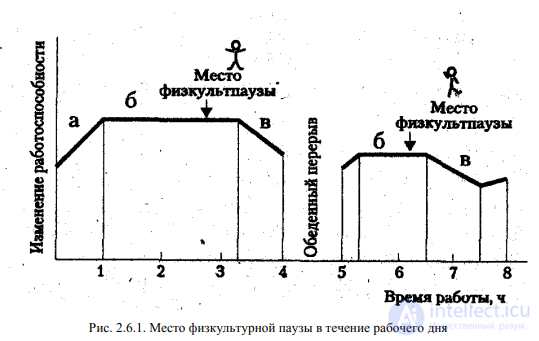
Fig. 2.6.1. Placement of the physical culture break during the working day
Studying the hourly changes in labor and psychophysical
indicators (amount of output, time spent on each work operation,
pulse rate, muscular strength, attention, speed of visual-auditory-motor reaction), occupational physiologists and psychologists determined the averaged
norms of the dynamics of human working capacity over the course of a working day
(Appendix 6, Fig. 11.3).
Despite the wide variety of specific characteristics of various
professional types of labor, there is a general two-stage plan of
change in working capacity: it rises at the beginning and declines at the end of
the working day. There are three phases in the dynamics of working capacity:
getting into the swing of work, high and stable working capacity, and its decline.
After the lunch break, the human body again passes through all the
phases of the dynamics of working capacity, although getting into the swing of work finishes earlier,
the phase of stable working capacity also occurs earlier and is more
pronounced, and the decline in working capacity is more noticeable.
Methodology for compiling and conducting a physical culture minute and
a micro-pause of active rest. In physical culture minutes of general
effect, the first exercise is most often associated with straightening the back and
drawing the shoulders back. The second - bends or turns of the torso in
114
combination with movements of the arms and legs, the third - swinging movements. Some
exercises arise involuntarily or out of habit. These are movements of
the head, shoulders, tense straightening of the legs while sitting, changing
posture (starting position).
Physical culture minutes of local effect allow those
muscle groups where fatigue is most felt to rest. In this case,
relaxation exercises are used, since it is they that
promote better blood supply to the muscles, and quick and complete
restoration of their working capacity. At the same time, certain elements of
massage may also be applied to enhance the
restorative effect.
Self-check questions:
1. Determine the place of PAPT of a pedagogue in the system of physical
education of students, list the main and additional factors
determining the content of PAPT: forms (types) of labor of specialists
in this field; conditions and nature of the labor; regime of work and rest;
features of the dynamics of working capacity of specialists during work and the
specifics of their professional fatigue and morbidity.
2. Name the means and forms of professionally applied
physical training (PAPT) of a pedagogue, and the means of PAPT selected in
accordance with the objectives of PAPT for future bachelors.

Comments