
Lecture
The degree of fatigue during physical exertion is determined by a combination of external and internal signs: from mild tiredness (rapid breathing, slight reddening of the skin) to severe overexertion (heavy sweating, paleness or cyanosis, a sharp decline in working capacity). It is important to recognize these signs in time in order to avoid progressing into chronic overexertion.
Skin:
Mild fatigue → slight reddening.
Significant fatigue → bright reddening.
Sharp overexertion → paleness or cyanosis.
Sweating:
Minor with mild tiredness.
Increased at a moderate degree (especially above the waist).
Excessive with severe fatigue — over the whole body, with salt crystallization.
Breathing:
Slight increase in rate (up to 22–26 breaths/min).
With significant fatigue — sharp increase in rate, difficulty breathing.
Movements: slowing down, reduced precision and coordination.
Decreased working capacity: inability to maintain the required pace or technique.
Changes in the cardiovascular system: rapid pulse, unstable blood pressure.
Nervous system: reduced concentration, slowed reactions, irritability.
Biochemical changes: accumulation of lactic acid, depletion of energy reserves.
A feeling of tiredness, heaviness in the muscles.
Decreased motivation and desire to continue the exertion.
Impaired attention and perception.
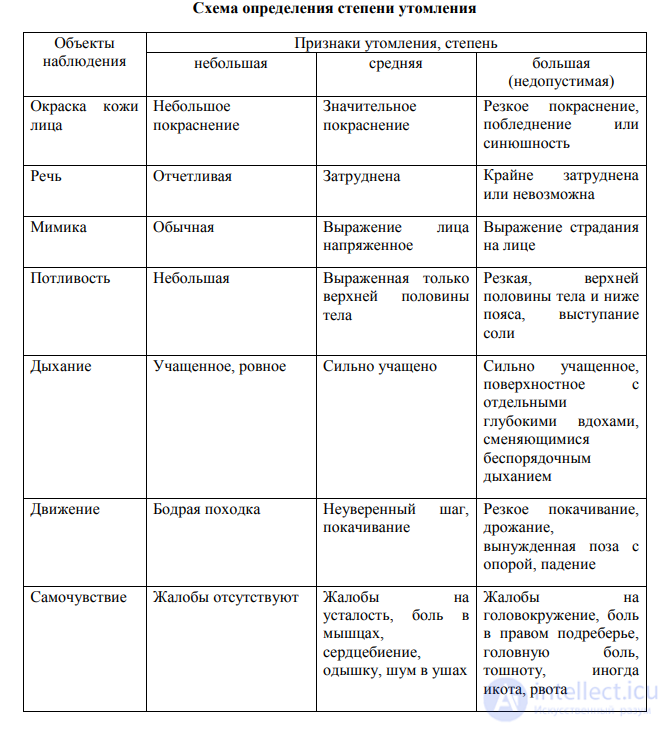
| Degree | External signs | Internal signs | Subjective sensations |
|---|---|---|---|
| Mild | Slight reddening of the skin, mild sweating, rapid breathing | Minor increase in pulse | Mild tiredness, desire to continue |
| Moderate | Bright reddening, heavy sweating, sharp increase in breathing rate | Reduced precision of movements, unstable blood pressure | Heaviness in the muscles, reduced concentration |
| Severe | Paleness/cyanosis of the skin, excessive sweating | Sharp drop in working capacity, depletion of energy reserves | Severe tiredness, refusal to continue exertion |
Danger of overexertion: progression into a chronic state lowers immunity and increases the risk of injury and illness.
Recommendations:
Maintain a balance between exertion and rest.
Monitor pulse and breathing during training.
At the first signs of significant fatigue, reduce intensity or stop the session.
Use recovery methods: sleep, nutrition, hydration, active recovery.

Comments