
Lecture
Training requires a set of dumbbells of different weights (from 5 to 20 kg and above); otherwise, at a certain point, once the body has adapted to the loads, progress may stall, and if you train at insufficient intensity your results may even decline. The following method is recommended for developing strength and endurance. The starting weight of the dumbbells should allow 10-12 repetitions, after which – rest until your breathing returns to normal, and then – perform the next set of the same exercise. The rest period can gradually be shortened from 2 minutes to 30 seconds, thereby raising the intensity of your training.
Once you reach 15 repetitions in every set of an exercise for the large muscles, add 2-3 kg to the dumbbells; for the small muscle groups – 1 kg, and you should again start working in sets of 8-10 repetitions. Every session must begin with a thorough warm-up (until you break a light sweat). Any 10-15 minute morning exercise routine without weights will do for this. Train 3 to 5 times a week. You should start a workout no later than 2 hours after a meal; heavy loads in the morning are not recommended.
A routine includes up to 12-15 exercises, while the number of sets depends on your physical fitness and the load of the previous session. For the first 1-2 weeks beginners perform a single set, then, depending on how they feel, add 1 or 2 more sets. Later on you can do 4 – 6 sets for the weaker muscle groups and 2-4 sets for the rest. The repetitions in each set are performed smoothly, without jerking, through the full range of motion. At the end of the session, calming and relaxing exercises are needed: slow running, walking, arm swings, stretching upward, hanging, and stretches for particular muscle groups.
A set of dumbbell exercises:
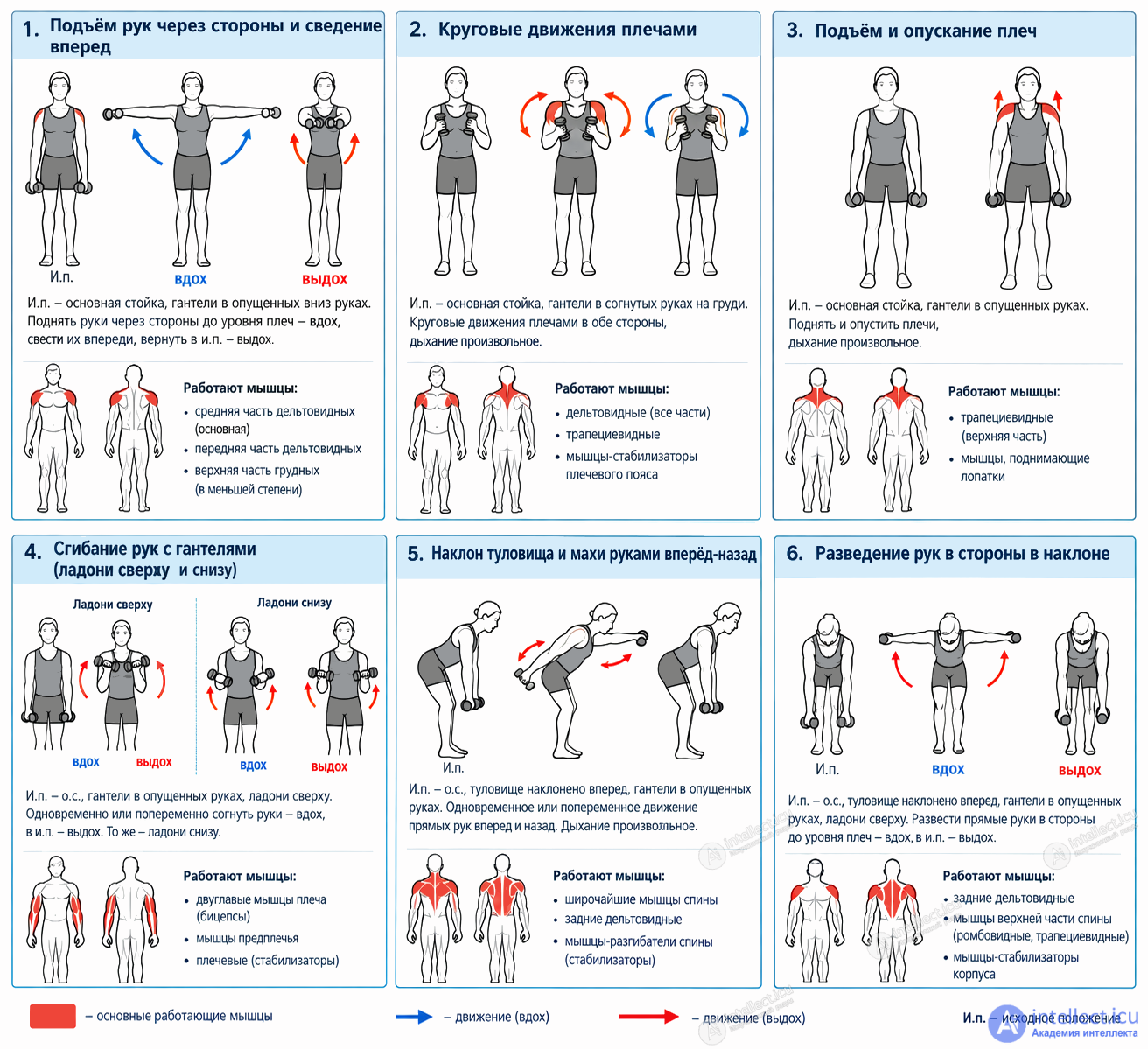
1. SP – basic stance, dumbbells in the arms lowered down. Raise
the arms out to the sides to shoulder level – inhale, bring them together in front,
return to the SP – exhale.
2. SP – basic stance, dumbbells held at the chest with the arms bent.
Circle the shoulders in both directions, breathing freely.
3. SP – basic stance, dumbbells in the lowered arms. Raise and
lower the shoulders, breathing freely.
4. SP – basic stance, dumbbells in the lowered arms, palms facing down.
Bend the arms simultaneously or alternately - inhale, return to the SP – exhale.
The same - with the palms facing up.
5. SP – basic stance, dumbbells in the lowered arms, torso bent forward.
Move the straight arms forward and
back, simultaneously or alternately. Breathe freely.
6. SP – basic stance, torso bent forward, dumbbells in the lowered arms,
palms facing down. Raise the straight arms out to the sides to shoulder level –
inhale, return to the SP – exhale.
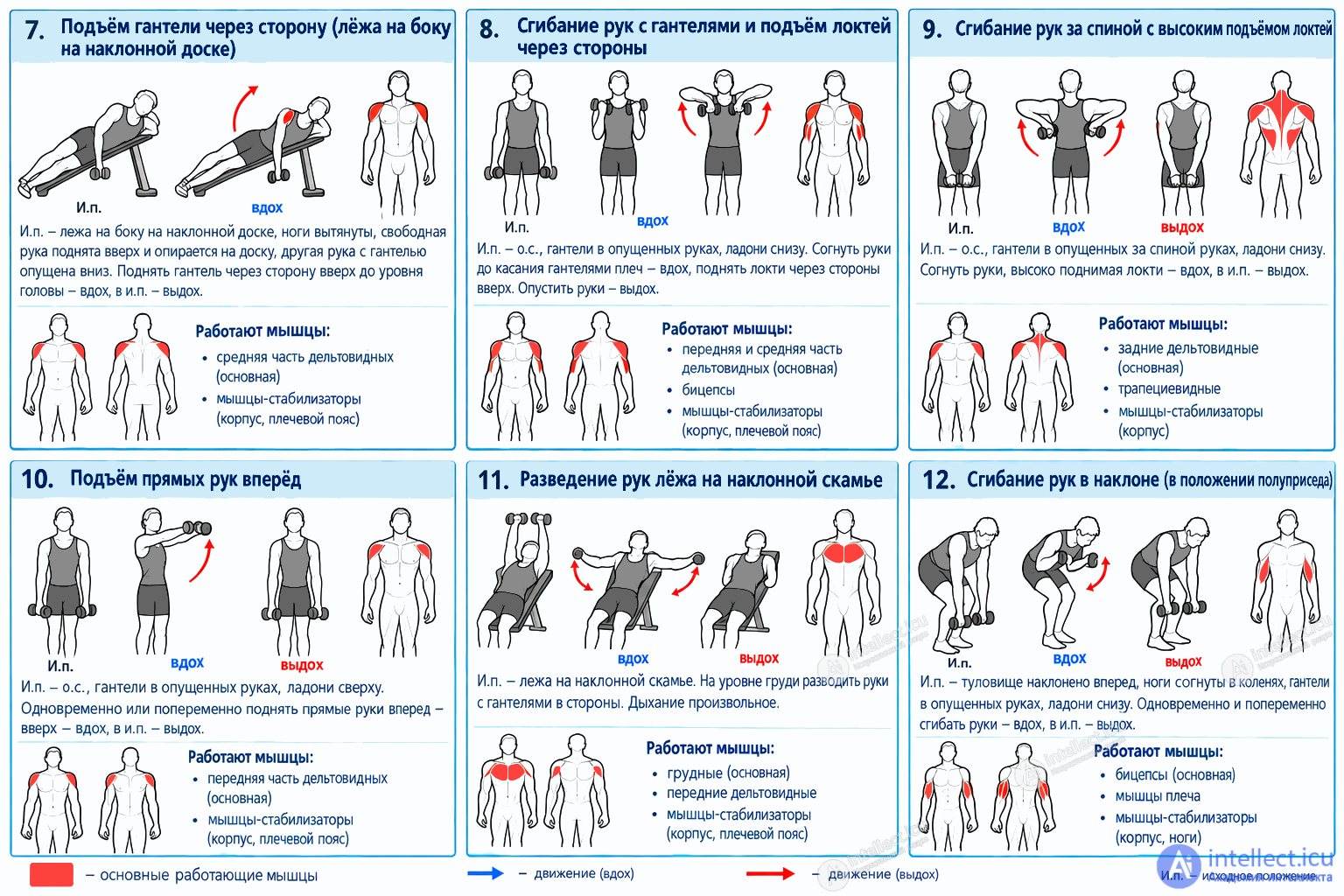
7. SP – lying on your side on an incline board, legs extended, the free
arm raised and resting on the board, the other arm holding a dumbbell
lowered down. Raise the dumbbell out to the side up to the level of
your head – inhale, return to the SP – exhale.
8. SP – basic stance, dumbbells in the lowered arms, palms facing up. Bend the arms
until the dumbbells touch the shoulders – inhale, then raise the elbows out to the sides
and up. Lower the arms – exhale.
9. SP – basic stance, dumbbells in the arms lowered behind the back, palms facing up.
Bend the arms, raising the elbows high – inhale, return to the SP – exhale.
10. SP – basic stance, dumbbells in the lowered arms, palms facing down.
Simultaneously or alternately raise the straight arms forward –
and up - inhale, return to the SP – exhale.
11. SP – lying on an incline bench. At chest level, open the arms holding the
dumbbells out to the sides. Breathe freely.
12. SP – torso bent forward, knees bent, dumbbells
in the lowered arms, palms facing up. Simultaneously and alternately
curl the arms – inhale, return to the SP – exhale.
Sign in and the lectures you have studied will be marked in this list.
Choose a course
Comments