
Lecture
A professional orientation places specific demands on a specialist
regarding physical and psychological qualities and applied
skills. For this reason, physical education and sport classes at universities
include instruction in the means of professional training and
professional prevention of life-safety hazards.
115
Professionally applied physical training (PAPT) as a
special branch of physical culture studies the physical
exercises (means) that prepare a person for professional
activity and prevent occupational illnesses
(prevention). In order to decide on the choice of means,
one needs to know:
- the type of work (mental, physical);
- working conditions (air temperature, humidity, lighting);
- the work and rest schedule;
- the dynamics of working capacity and occupational fatigue;
- the level of physical fitness and functional
capacity of the novice teacher [21].
Once again we arrive at the level of physical fitness of the young
specialist, expressed through the development of motor abilities:
flexibility, coordination, speed, strength, and general endurance. What was
monitored and coordinated by tests for students in educational institutions
at school continues at the university. General physical
fitness is nothing other than the overall working capacity of the young
specialist and a manifestation of their social adaptation and character traits.
Let us determine which qualities a teacher needs over the course of the school day.
Coordination abilities are needed by any specialist in the
ability to stand for 4-6-8 hours (stability
coordination). Moving around the classroom with turns around one's own axis
(monitoring students while simultaneously teaching new material) is
spatial coordination. Coordinated motor actions,
as another type of coordination, appear in writing text on the board,
referring to the lesson plan, and observing the class. If these types of
coordination are insufficiently developed, fatigue sets in quickly, which
will be accompanied by strain on the vocal apparatus and disruption of
116
circulation to the extremities and brain, leading to hypertension and
cardiovascular disease.
Flexibility, as a bodily quality, is linked to flexibility in
communicative relations between teacher and student,
teacher and parent, and in the pedagogical environment as a whole. A lack of
communicative flexibility and softness does not contribute to a favorable
climate in the educational environment, leading to psychological
instability and stressful moments that lower the immunity of all
participants in the educational process.
Strength, as a physical quality, influences the formation of character and
the expression “strong, courageous” - it manifests as the ability to defend oneself,
one's interests, and one's convictions. A lack of muscular strength, as a reflection,
prevents a person from expressing abilities they possess: musical,
artistic, creative (what will people say, what will they think, better if I do
nothing at all, in case I do it wrong). A lack of strength
abilities gives rise to a fear of self-expression in academic and social
life. This too leads to mental illness or negative,
deviant behavior (behavior of an individual that deviates from
generally accepted, most widespread, and established social
norms).
Speed is a motor ability that depends on the type of nervous
activity but is trainable through physical education and sport activities.
The speed of thinking depends on the number of neural connections in the brain.
It is trained by a large number of tasks facing the individual.
The speed of completing set tasks depends, among other things, on muscular
speed and developed coordination abilities, which increase
the neural synaptic connections of brain activity. A lack of sufficient
speed abilities quickly leads to fatigue.
General endurance is the combination of all physical (motor)
qualities. The absence of one leads to a decrease in the overall working capacity
117
of the person as a whole. Thus, the general physical
fitness of a young specialist is the preparation of the human body for professional and
life activity [19].
Methodology for selecting PAPT means
A methodology is a combination of means (physical exercises +
sun, air, and water), forms (morning exercises, a lesson or training
session, competition, sports festival), and methods (group,
individual, flow, frontal, circuit training, etc.).
To select PAPT means, one must:
1. determine the motivational goal for mastering elements of PAPT;
2. identify the weak link in one's physical fitness;
3. choose the form and methods of training;
4. determine the PAPT means;
5. draw up a plan for sports or health training.
As a practical example, one can present the author's health-improving
method of paradoxical breathing gymnastics by A.N.
Strelnikova.
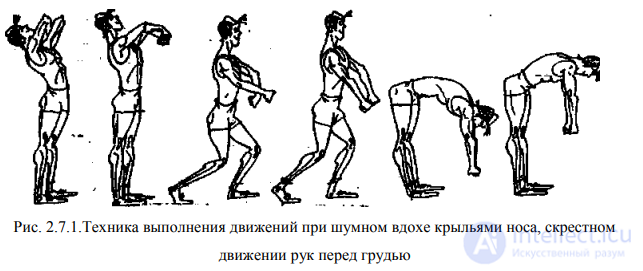
Fig. 2.7.1. Technique for performing movements during a noisy inhalation through the wings of the nose, with a crossing
movement of the arms in front of the chest
Breathing gymnastics is suitable for children and adults, the sick and the
healthy. It is a natural health-improving procedure accessible to everyone. A.N. Strelnikova's
gymnastics helps with many
illnesses; it is easy to perform: it does not require special
118
conditions or special clothing. It is recommended for: frequent respiratory
illnesses; chronic bronchitis; bronchial asthma.
Functions: special breathing exercises develop the
respiratory muscles and strengthen the respiratory apparatus; regular practice
improves lung ventilation and blood composition.
Result: vital lung capacity (VLC) increases by 0.2 - 0.4 liters
after one month of sessions of A.N. Strelnikova's gymnastics.
This was confirmed by researchers at the Central Research Institute of Tuberculosis of the Russian
Academy of Medical Sciences [32].
A.N. Strelnikova's breathing gymnastics, developed by a voice-training
teacher, runs contrary to conventional approaches and arose as a result of treating and
restoring the singing voice. The essence of the method lies in an active, forceful,
short inhalation, which trains all the muscles of the respiratory system.
The main point: the emphasis is on the inhalation; the exhalation is a result of the inhalation. The exhalation is performed after
an active “emotional” inhalation and happens by itself. The most
notable feature is the combination of breathing cycles with body
movements: squats, turns, bends, aerobic dance steps. One
cycle of movements is 8 repetitions (the dosage). (See Appendix 7).
Exercise 1. Turn the head right and left. At each
turn (at the endpoint), take a short, noisy, quick inhalation through the nose. The inhalation is
so sharp that the wings of the nose slightly draw in and contract (rather than flare
out). Methodological recommendations: pace - 1 inhalation per second or
a little faster. Do not think about the exhalation at all. It is performed
automatically through a slightly open mouth. This rule applies to
all of A.N. Strelnikova's exercises. The first three exercises serve as a
warm-up.
Exercise 2. Tilt the head right and left. A sharp inhalation at the
endpoint of each movement.
Exercise 3. Tilt the head forward and back. A short inhalation at the end of
each movement.
119
Exercise 4. Bring the arms together in front of the chest. As the arms move toward each other,
the upper part of the lungs compresses at the moment of a quick, noisy inhalation.
The right arm is alternately on top and on the bottom.
Training schedule: first course (3 days, twice a day - morning and evening).
Exercise 1. 2 sets of 8 inhalations. Repeat 3 times. Pause between sets
5-6 sec., and between exercises up to 12 sec.
Exercise 4. 2 x 8. 3 sets.
Exercise 5. 2 x 8. 6 sets.
Exercise 7. 2 x 8. 6 sets.
One session involves 288 movements - inhalations. Per day - 600 inhalations.
Training schedule: second course (3 days, twice a day - morning and evening).
Exercise 1. 4 x 8. 1 set.
Exercise 2. 4 x 8. 2 sets.
Exercise 4. 4 x 8. 1 set.
Exercise 5. 4 x 8. 3 sets.
Exercise 6. 4 x 8. 1 set.
Exercise 7. 6 x 8. 2 sets.
Total 576 inhalations per session. Per day - 1200 inhalations.
Training schedule: third course (3 days, twice a day - morning and evening).
Exercise 1. 4 x 8. 3 sets.
Exercise 2. 4 x 8. 2 sets.
Exercise 3. 4 x 8. 1 set.
Exercise 4. 6 x 8. 2 sets.
Exercise 5. 6 x 8. 4 sets.
Exercise 6. 4 x 8. 3 sets.
Exercise 7. 4 x 8. 2 sets.
Total 671 inhalations per session, per day - 1400 inhalations.
Training schedule: fourth course (3 days, twice a day - morning and
evening).
Exercise 1. 4 x 8. 3 sets.
120
Exercise 2. 4 x 8. 3 sets.
Exercise 3. 4 x 8. 2 sets.
Exercise 4. 8 x 8. 2 sets.
Exercise 5. 8 x 8. 3 sets.
Exercise 6. 6 x 8. 2 sets.
Exercise 7. 4 x 8. 2 sets.
Exercise 8. 4 x 8. 1 set.
Total - 704 inhalations per session, per day - 1600 inhalations.
Training schedule: fifth course (3 days, twice a day - morning and evening).
Exercise 1. 6 x 8. 2 sets.
Exercise 2. 6 x 8. 2 sets.
Exercise 3. 6 x 8. 2 sets.
Exercise 4. 10 x 8. 1 set.
Exercise 5. 10 x 8. 3 sets.
Exercise 6. 10 x 8. 3 sets.
Exercise 7. 10 x 8. 1 set.
Exercise 8. 6 x 8. 2 sets.
Total - 888 inhalations per session, per day 1800 inhalations.
Training schedule: sixth course (3 days, twice a day - morning and evening).
Exercise 1. 6 x 8. 2 sets.
Exercise 2. 6 x 8. 2 sets.
Exercise 3. 6 x 8. 2 sets.
Exercise 4. 12 x 8. 2 sets.
Exercise 5. 12 x 8. 1 set.
Exercise 6. 12 x 8. 3 sets.
Exercise 7. 6 x 8. 2 sets.
Exercise 8. 8 x 8. 2 sets.
In total - 992 inhalations per session, nearly 2000 per day.
Recommendations: this will be the dosage by the end of the first month
of training. The very first rhythm is 8 inhalations in six seconds. A load of fewer than
121
300 bends is ineffective. 300 - 400 bends can be considered the lower
limit of the load, and the upper limit up to 1200, even 2000 bends per day [22].
The great cardiac surgeon and advocate of a healthy lifestyle N.M.
Amosov proposed a set of exercises, and enthusiasts of his “1000
movements” method continue to use it and derive enormous enjoyment
and vital energy from it (see Appendix 6).
1. Describe the effect of PAPT exercises on students' bodies.
2. What must be done in order to correctly select the means for
independently mastering individual elements of PAPT?

Comments